PPP Model in Indian Railways (UPSC Economy)
Private train operations, haulage charges, regulatory gaps, Bibek Debroy's RRAI, and why PPP in railways has struggled.
Public-Private Partnerships (PPP) have transformed Indian highways, airports, and ports — but have struggled to take off in Indian Railways (IR). The 2019 decision to open up select passenger train operations to private operators was a landmark announcement, but the first bidding rounds drew thin response. Understanding why PPP in Indian Railways has stalled, and what needs to change, is essential UPSC GS III content — it sits at the intersection of infrastructure, regulation, and reform economics.
Why PPP is needed in Indian Railways
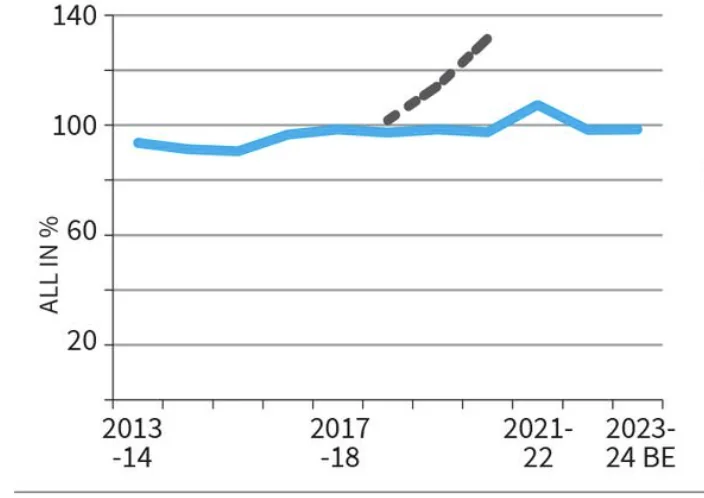
- Demand exceeds capacity. Around 5 crore passengers (about 15%) could not get confirmed tickets in pre-pandemic 2019-20. On some routes demand outstripped train capacity by 30%.
- Capacity unlocked by DFCs. With the Eastern and Western Dedicated Freight Corridors now operational, freight is moving off the passenger trunk routes, freeing slots for more passenger services on the Indian Railway Network.
- Investment needs. IR requires roughly Rs 50 lakh crore of investment between 2018 and 2030 to modernise infrastructure, rolling stock, stations and safety.
- High multiplier. IR has forward-backward linkages that deliver a multiplier of around 5 — every rupee invested generates Rs 5 of output (Economic Survey 2014-15).
- Passenger benefits. Private operators promise modern coaches, reduced travel times, and differentiated services — expanding choice in a segment that IR alone has not been able to meet.
How the private train model works
- Sharing of resources. IR retains ownership of the physical infrastructure — tracks, signalling, stations, electrification. Private operators bring their own modern coaches.
- Operating autonomy. Private operators have flexibility in fares, catering, housekeeping and branding — subject to bid commitments.
- Payment mechanism. Private operators pay a haulage charge to IR for use of tracks, signalling, stations, and electricity, plus a revenue share with IR.
- Safety and driving crew typically provided by IR.
Benefits for stakeholders
For Indian Railways
- No political interference in fare-setting for private trains.
- Steady income from haulage charges and revenue share.
- Lower operating cost through private efficiency gains.
- Reduced reliance on borrowed funds for network expansion.
For the private sector
- Complete autonomy over fares, service levels and branding.
- Scope for higher profits from premium service offerings.
- Access to routes previously closed to private operators (only ~5% of routes in the original pilot).
For passengers
- Greater choice of service levels.
- World-class amenities and service quality, forced by competition for passenger loyalty.
- More confirmed tickets — expanded capacity addresses the 5 crore waitlisted ticket gap.
Why the first bids fell flat
- High entry costs. Private entities must procure their own fully air-conditioned modern coaches — a significant capex commitment.
- Multiple IR charges. Haulage, station-use, energy, revenue share — together these narrow operator margins.
- No level-playing field. Private trains operate on the same routes as IR trains. There is no regulatory clarity on platform allocation, departure/arrival timing priority, and slot allocation — all of which IR controls.
- Unfair competition from cross-subsidised IR fares. IR passenger fares are subsidised by freight; UDAN air routes are subsidised for affordability; private operators must set cost-recovering fares that look expensive by comparison.
- Contract rigidity. Private operators have limited flexibility to change departure/arrival timings, introduce new halts, or alter train length.
- Penalty asymmetry. PPP contracts penalise private operators for punctuality failures — but punctuality depends on IR-owned signalling and track availability. The private operator is exposed to risks it doesn't control.
The way forward: Bibek Debroy's RRAI
The Bibek Debroy Committee on Railway Modernisation strongly recommended a Railway Regulatory Authority of India (RRAI) — an independent regulator — as the precondition for successful PPP.
Why a regulator matters
Currently, both policy-making and regulation sit with the Ministry of Railways, which also operates IR trains. This is a clear conflict of interest: the regulator is also the competitor. Private entities have no confidence that rules will be applied neutrally. An independent regulator would build the atmosphere of trust and fairness required for private capital to come in.
RRAI's role
- Determine whether IR's fares and charges are market-determined and competitive.
- Create a level-playing field between IR and private operators (slot allocation, platform use, scheduling).
- Ensure equal access to rail infrastructure for private entities.
- Adjudicate disputes between IR and private operators.
- Publish performance data and benchmarks.
Other reforms
- Rationalise haulage and station-use charges to make PPP economics viable.
- Remove penalty asymmetry — hold IR accountable for infrastructure failures that affect private trains.
- Expand the PPP envelope beyond the initial ~5% of routes to create a proper market.
- Standardise contracts and offer longer concession periods (25 years plus) for capital recovery.
- Streamline coach financing through NaBFID and InvIT-style structures.
Latest developments (2024-26)
- The original 2019 private passenger train tender was effectively withdrawn after poor response. The government is reportedly redesigning the framework.
- Station redevelopment PPP — over 1,300 stations are being redeveloped under Amrit Bharat Station Scheme, several via PPP concession models with air-rights monetisation.
- PPP in logistics. Multi-modal logistics parks at rail terminals are being developed through PPP.
- Private freight operators. The General Purpose Wagon Investment Scheme (GPWIS) and Liberalised Wagon Investment Scheme have drawn private wagon investment, even if private passenger operations remain stalled.
- Vande Bharat manufacturing itself is a form of modified PPP, with consortia bidding to manufacture trainsets.
UPSC Relevance
PPP in Railways is a nuanced UPSC GS III topic, good for mains answers on infrastructure, regulation and PPP design. Strong answers should explain why PPP has succeeded in highways and airports but stumbled in railways, analyse the role of an independent regulator, and offer concrete reforms (fee rationalisation, risk allocation, standardisation). Mention the haulage charge, Bibek Debroy Committee, and RRAI. Prelims may test specific schemes (GPWIS, Amrit Bharat Station Scheme) or the broad architecture of railway PPP. Integrate with themes of logistics cost, manufacturing competitiveness, and the $5 trillion economy vision.