PRASHAD Scheme: Pilgrimage Rejuvenation, Spiritual Heritage, and 41 Funded Sites
Complete guide to the PRASHAD Scheme: full form Pilgrimage Rejuvenation and Spiritual Heritage Augmentation Drive, the 100 percent central funding pattern, the 41 funded sites across 25 States, the comparison with Swadesh Darshan, and the key infrastructure components.
The PRASHAD Scheme is the Ministry of Tourism’s flagship instrument for upgrading pilgrimage and heritage destinations in India. The acronym expands into Pilgrimage Rejuvenation and Spiritual Heritage Augmentation Drive, a name that signals the scheme’s twin focus on the spiritual and the tangible. The scheme funds last-mile infrastructure at named pilgrimage cities and at heritage temples, with the explicit intention of making religious tourism more accessible, more comfortable, and more sustainable.
For policy aspirants, the scheme is a clean illustration of how a Central Sector scheme works in a domain that touches both Concurrent List subjects and the cultural identity of States. For students of public finance, it is an example of full central funding combined with State implementation. For students of tourism economics, it is the chief vehicle through which the Government of India has tried to translate the country’s deep stock of pilgrimage destinations into a structured tourism product.
This guide walks through the scheme’s launch and rationale, the 100 percent central funding pattern, the spread of 41 funded sites across 25 States, the recent expansion to projects such as Ramappa Temple and the Bhadrachalam Group of Temples, the comparison with the parallel Swadesh Darshan scheme, and the connection to broader heritage frameworks including the UNESCO World Heritage Sites in India network.
Launch, Rationale, and Nodal Ministry
The PRASHAD Scheme was launched in 2014-15 by the Ministry of Tourism. The rationale was straightforward. India has a dense network of pilgrimage destinations that draw millions of domestic tourists every year, but the supporting infrastructure at most of these destinations had not kept pace. Roads were congested, sanitation was poor, drinking water was unreliable, and basic amenities such as waiting rooms and first aid centres were missing or inadequate.
The Ministry of Tourism is the nodal ministry. Within the ministry, the scheme is administered by a dedicated division that issues guidelines, evaluates project proposals from States, releases funds, and monitors implementation. The objective set out in the scheme guidelines is the holistic development of identified pilgrimage destinations, covering infrastructure, connectivity, and amenities.
The scheme was an explicit response to the fact that several of India’s most visited pilgrimage cities had infrastructure that did not match their visitor footfall. Varanasi, Amritsar, and Ajmer were among the early names. The intention was to bring the experience of arriving at and moving through these cities closer to international tourist standards while preserving the spiritual and cultural integrity of the sites.
The 100 Percent Central Funding Pattern
PRASHAD is a Central Sector scheme. This means that the Government of India funds 100 percent of the project cost. There is no State matching contribution required. The scheme guidelines specify that the Centre will release funds in tranches against approved project milestones and that State implementing agencies will execute the works.
The 100 percent funding model has practical implications. It allows States with limited budgetary headroom to undertake significant pilgrimage infrastructure works without committing their own resources. It also gives the Centre tighter control over project specifications, design standards, and timelines. The trade-off is that the scheme can only fund as many sites as the central tourism budget permits, and States have to compete for project approvals.
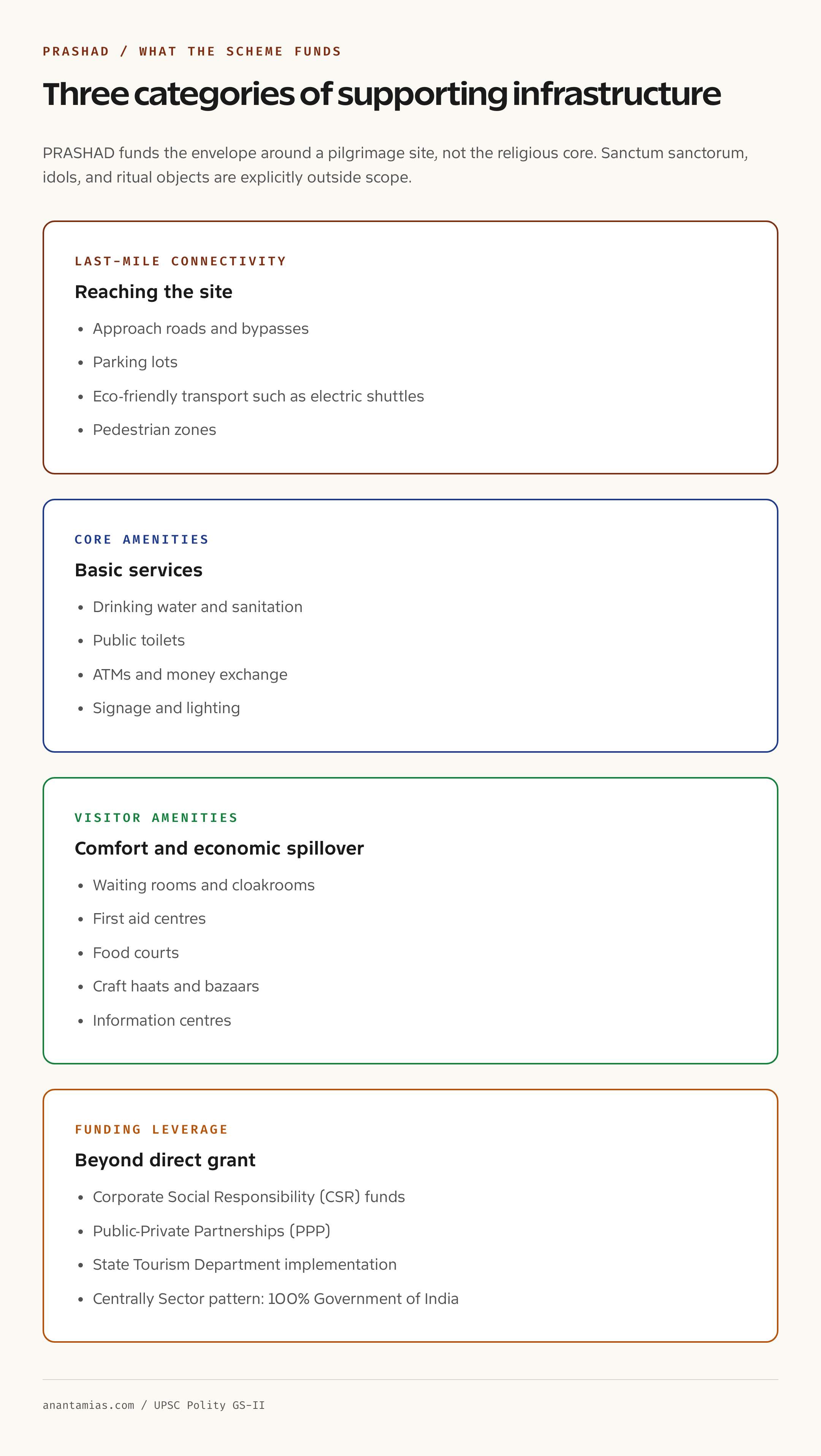
The scheme also allows leveraging of additional resources. Project proposals can build in Corporate Social Responsibility funds and Public-Private Partnership components for elements such as visitor amenity centres, food courts, and revenue-generating facilities. The CSR and PPP integration is intended to make the assets self-sustaining once the construction phase is complete.
Coverage: 41 Sites in 25 States
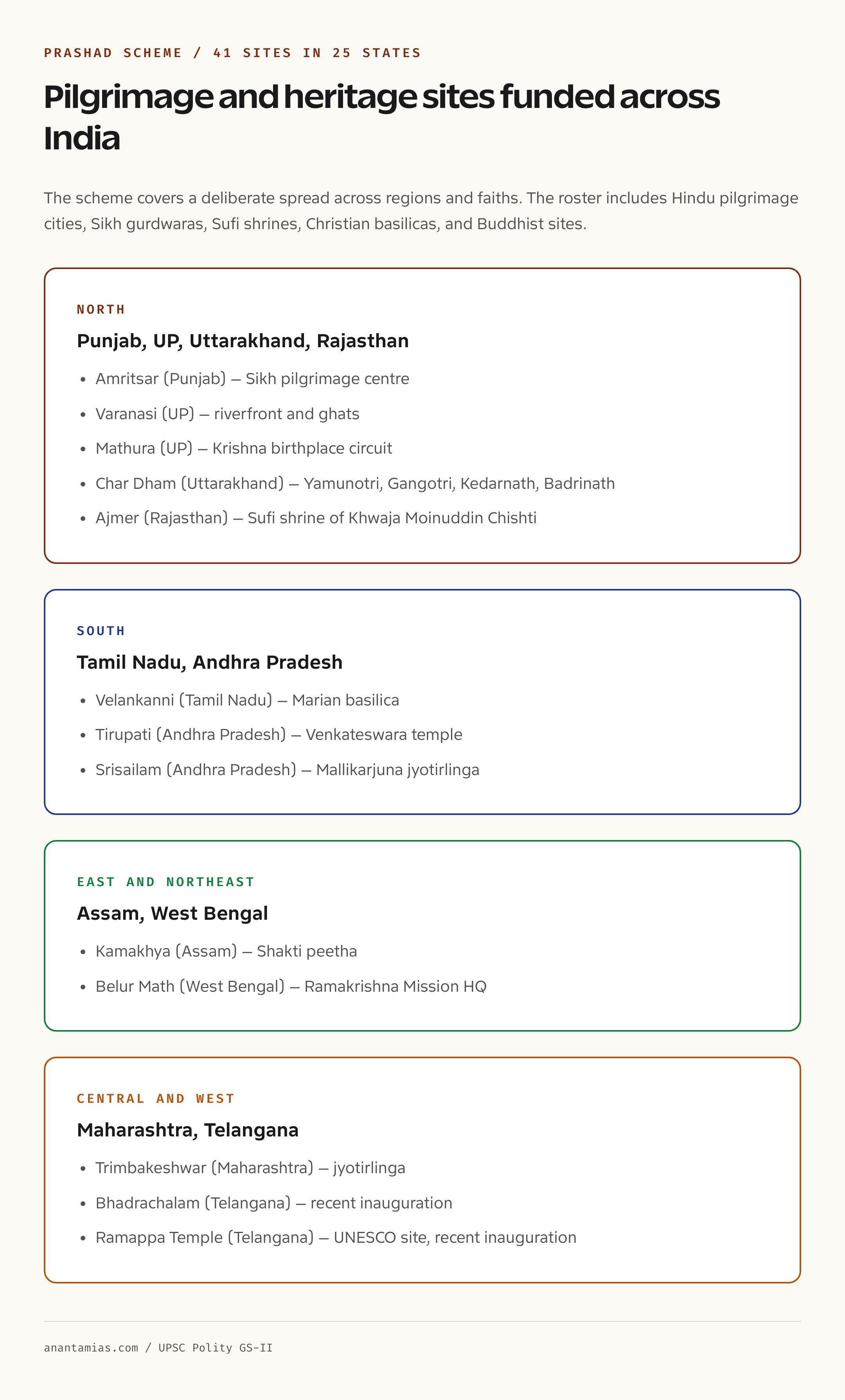
As of 2025, PRASHAD covers 41 sites spread across 25 States. The geographical spread was deliberate. The scheme was designed to ensure that no major region was left out and that the cultural diversity of India’s pilgrimage map was reflected in the funding pattern. The roster includes Hindu pilgrimage cities, Sikh gurdwaras, Sufi shrines, Christian basilicas, Buddhist sites, and major heritage temples.
The Hindu sites include Varanasi in Uttar Pradesh, Mathura, the Char Dham circuit in Uttarakhand, the Trimbakeshwar temple in Maharashtra, the Kamakhya temple in Assam, and the Tirupati and Srisailam temples in Andhra Pradesh. The Sikh sites include Amritsar in Punjab. The Sufi sites include the Ajmer Sharif Dargah in Rajasthan. The Christian sites include the Velankanni Basilica in Tamil Nadu. The Buddhist sites include sites in Bihar and Maharashtra.
Recent additions and inaugurations have expanded the list. The Bhadrachalam Group of Temples and Ramappa Temple, both in Telangana, were recently funded and inaugurated. Ramappa Temple is also a UNESCO World Heritage Site, and the PRASHAD funding sits alongside conservation funding from the Archaeological Survey of India for that site. The expansion to UNESCO sites signals a closer alignment between PRASHAD and India’s heritage conservation framework.
Implementation Agency and Project Cycle
The State or Union Territory government is the implementation agency. Project proposals are prepared by the State Tourism Department, vetted by the State Implementation Agency, and submitted to the Ministry of Tourism for approval. Once approved, the project is sanctioned with a defined cost ceiling, a list of components, and a timeline. The State agency then executes the works, draws funds in tranches, and reports progress to the central ministry.
This delegation model has both strengths and weaknesses. The strength is that States bring local knowledge, local contractors, and political ownership to the projects. The weakness is that delays in State execution have been a recurring problem, and audit reports of completed projects have raised concerns about utilisation. The Ministry of Tourism has tightened monitoring by requiring photographic and milestone-based reporting, but the gap between sanction and completion remains a watch point.
Key Infrastructure Components
The scheme funds a defined list of infrastructure components. The components fall into three broad categories. The first is last-mile connectivity, which covers approach roads, bypasses, parking lots, eco-friendly modes of transport such as electric shuttles, and pedestrian zones. The second is core amenities, which covers drinking water, sanitation, public toilets, ATMs, money exchange facilities, signage, and lighting. The third is visitor amenities, which covers waiting rooms, first aid centres, cloakrooms, food courts, craft haats and bazaars, and information centres.
The scheme deliberately stays away from religious or ritual works. Funds cannot be used to build or restore sanctum sanctorum, idols, religious paraphernalia, or ritual objects. The scheme is about the supporting envelope, not the religious core. This separation is consistent with the constitutional framework on State support to religious institutions and respects the secular character of central funding.
PRASHAD Versus Swadesh Darshan
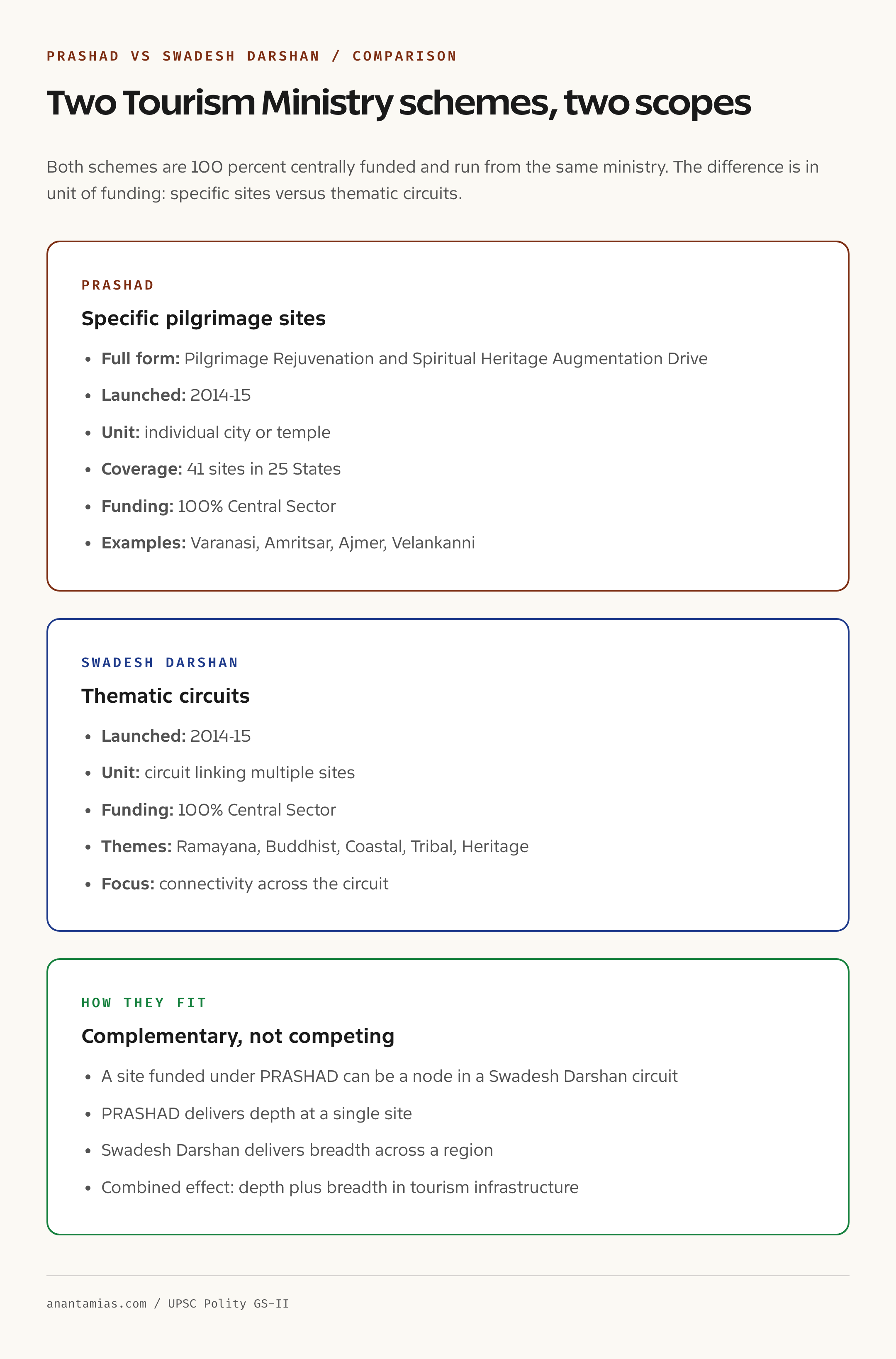
PRASHAD is often compared with Swadesh Darshan, the Ministry of Tourism’s other major tourism infrastructure scheme. Both are Central Sector schemes with 100 percent central funding and both are administered by the same ministry. The difference is in scope.
PRASHAD focuses on specific pilgrimage and heritage sites, treating each city or temple as the unit of funding. The intervention is concentrated and deep within a single site. Swadesh Darshan, by contrast, focuses on thematic circuits. It groups multiple sites under a single theme and funds connectivity and infrastructure across the circuit. The themes have included the Ramayana Circuit, the Buddhist Circuit, the Coastal Circuit, the Tribal Circuit, and the Heritage Circuit.
The two schemes are complementary. A site funded under PRASHAD may also be a node within a Swadesh Darshan circuit. The Buddhist sites in Bihar, for example, can be part of a Buddhist Circuit under Swadesh Darshan while individual sites such as Bodh Gaya can receive deep PRASHAD funding for site-specific upgrades. The combination is meant to deliver both depth and breadth.
| Feature | PRASHAD | Swadesh Darshan |
|---|---|---|
| Focus | Specific pilgrimage and heritage sites | Thematic circuits across multiple sites |
| Unit | Individual city or temple | Circuit linking several sites |
| Ministry | Tourism | Tourism |
| Funding | 100 percent central | 100 percent central |
| Examples | Varanasi, Amritsar, Ajmer, Velankanni | Ramayana Circuit, Buddhist Circuit, Coastal Circuit |
Constitutional and Federal Context
Tourism is not a separate entry in the Seventh Schedule but draws on multiple List entries including land, public works, and culture. The 100 percent central funding model lets the Centre operate in this space without provoking federal friction. States retain implementation authority and can shape the projects to local needs. The Centre retains the power to define standards and to allocate funds across States.
The scheme also fits within the broader cultural-policy framework set out in the Directive Principles of State Policy and various central cultural institutions. Article 49 of the Constitution requires the State to protect monuments, places, and objects of artistic or historic interest. PRASHAD operationalises Article 49 in the specific domain of pilgrimage cities, while leaving conservation work to ASI under the Ancient Monuments and Archaeological Sites and Remains Act, 1958.
Economic and Tourism Impact
Pilgrimage tourism is one of the largest segments of Indian domestic tourism by volume. Estimates from the Ministry of Tourism’s annual reports place pilgrimage and religious tourism at over 60 percent of domestic tourism trips. The PRASHAD intervention is therefore aimed at the busiest segment of the country’s tourism stack. By improving infrastructure at the most visited destinations, the scheme aims to lengthen the average duration of stay, increase visitor satisfaction, and create local employment in hospitality, transport, and crafts.
Local economic impacts have been documented in various scheme evaluations. Improved connectivity and amenities have been associated with increases in visitor numbers, longer dwell times, and growth of associated micro-enterprises such as homestays, eateries, and handicraft outlets. The scheme is not a magic bullet but is a meaningful piece of the broader rural and small-town economy at sites where pilgrimage is the dominant economic activity.
Challenges and Watch Points
PRASHAD has faced familiar implementation challenges. Project delays at the State end have been a recurring concern. Quality of construction has varied, and post-construction maintenance has not always been budgeted for. Crowd management remains a separate problem at very high-volume sites such as Varanasi during festival days, where infrastructure upgrades alone cannot solve congestion.
The scheme has also been criticised for uneven coverage. Not every faith tradition or region has received proportionate funding, and the political economy of site selection has at times generated friction. The Ministry has responded by widening the roster, including UNESCO sites and lesser-known temples, but the question of what is and is not included will remain politically charged.
UPSC Relevance and Question Patterns
PRASHAD is a likely topic for GS Paper II (governance and government schemes) and GS Paper I (Indian heritage and culture). Prelims questions typically test the full form, the launch year, the nodal ministry, the funding pattern, and the comparison with Swadesh Darshan. Mains questions can ask candidates to evaluate the scheme’s effectiveness, to discuss the federal architecture of central tourism schemes, or to link the scheme to heritage protection under Article 49.
A strong answer should mention the full form, the 2014-15 launch, the 100 percent central funding model, the 41 sites across 25 States, recent additions such as Ramappa and Bhadrachalam, and the contrast with Swadesh Darshan. Mentioning the CSR and PPP leverage and the link to Article 49 adds depth. Reference to the ASI’s parallel role at heritage sites distinguishes a top answer.
Frequently Asked Questions
What is the full form of PRASHAD?
PRASHAD stands for Pilgrimage Rejuvenation and Spiritual Heritage Augmentation Drive. It is a Central Sector scheme of the Ministry of Tourism for the holistic development of identified pilgrimage and heritage destinations.
When was the PRASHAD Scheme launched?
The PRASHAD Scheme was launched in 2014-15 under the Ministry of Tourism, Government of India.
How many sites are funded under PRASHAD?
As of 2025, PRASHAD covers 41 pilgrimage and heritage sites spread across 25 States. The roster includes Varanasi, Amritsar, Ajmer, Mathura, Velankanni, Kamakhya, Ramappa Temple, and the Bhadrachalam Group of Temples among others.
What is the funding pattern under PRASHAD?
PRASHAD is a Central Sector Scheme with 100 percent funding from the Government of India. There is no State matching contribution. The scheme also encourages leveraging of Corporate Social Responsibility funds and Public-Private Partnerships for sustainability.
What is the difference between PRASHAD and Swadesh Darshan?
PRASHAD focuses on specific pilgrimage and heritage sites such as individual cities or temples. Swadesh Darshan focuses on thematic circuits such as the Ramayana Circuit, Buddhist Circuit, or Coastal Circuit. Both are Central Sector schemes with 100 percent central funding under the Ministry of Tourism.
Which agency implements PRASHAD projects?
State and Union Territory governments are the implementation agencies. Project proposals are prepared by State Tourism Departments, approved by the Ministry of Tourism, and executed by State agencies under central monitoring.