Procedure Established by Law vs Due Process of Law (UPSC Polity)
Article 21 says 'procedure established by law', not 'due process'. Here is why the framers chose those words, how A.K. Gopalan read them narrowly, how Maneka Gandhi (1978) quietly imported due process anyway, and how it all set up the right to privacy — explained for UPSC GS2 Polity.
Article 21 of the Constitution is just one sentence long, and almost every word in it was argued over before it was written down. It reads: “No person shall be deprived of his life or personal liberty except according to procedure established by law.” Read it again and notice what is missing. It does not say “due process of law” — the famous American phrase that lets courts strike down a law for being unfair, not merely for being passed in the wrong way. The framers had that phrase on the table, looked at it hard, and deliberately put it down. Those five words, “procedure established by law”, are one of the most consequential drafting choices in the whole document, and the story of how Indian courts spent three decades reading them back into something close to “due process” is the story of how personal liberty actually came to be protected in India.
For a UPSC aspirant, this is not a dry textual quarrel. It sits at the heart of fundamental rights, it explains the single most cited case in Indian constitutional law, and it is the spine on which later rights — the right to privacy, the right to a fair trial, the right to live with dignity — were eventually built. Get the difference between “procedure established by law” and “due process of law” clear in your head, learn the two or three cases that turned one into the other, and you hold a key that unlocks a large slice of the Polity syllabus and a steady supply of GS2 and Essay material.
What the Two Phrases Actually Mean
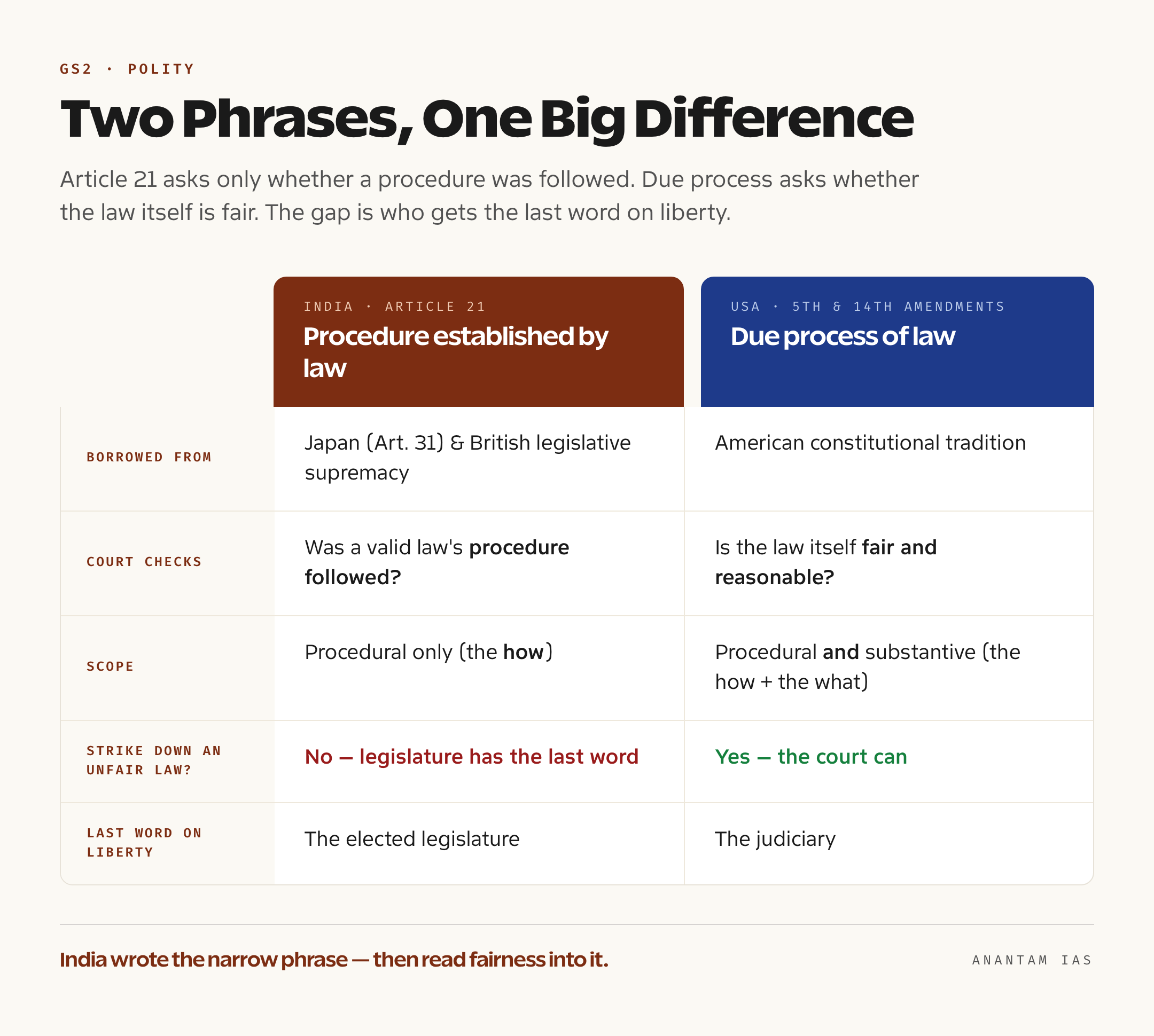
Start with the plain meaning, because the whole debate rides on a narrow distinction. “Procedure established by law” asks one question: was there a law, made by a competent legislature, laying down a procedure, and was that procedure followed? If yes, the deprivation of life or liberty is valid. The court checks the how — was the right authority used, was the prescribed process followed — but it does not sit in judgment on whether the law itself is fair, reasonable or just. The legislature’s word, so long as it is properly enacted, is final. It is a procedural test, and a thin one.
“Due process of law” asks a second, deeper question on top of the first. It accepts that there must be a valid law and a followed procedure, but it goes further and asks whether the law and the procedure are fair, just and reasonable. Under this standard a court can strike down a law not because it was badly passed but because it is arbitrary or oppressive in substance. Lawyers split this into two strands. Procedural due process polices how the state acts — fair hearing, notice, an unbiased judge. Substantive due process polices what the state does — whether the content of the law itself is reasonable, whatever procedure produced it. Due process, in short, hands the judiciary a roving power to test the quality of laws; procedure established by law withholds it.
The phrasing matters because India borrowed the narrower formula on purpose. The words “procedure established by law” were lifted almost verbatim from Article 31 of Japan’s 1947 Constitution, which itself drew on an older British instinct that Parliament, not the courts, is supreme. “Due process of law” is the American formula, written into the Fifth and Fourteenth Amendments of the US Constitution, where it became the engine American judges used to test the fairness of legislation. So the choice between the two phrases was really a choice about who should have the last word on liberty — the elected legislature or the unelected judge. India, at the moment of drafting, sided with the legislature.
Why the Framers Chose “Procedure”, Not “Due Process”
The choice was made knowingly, and the decisive moment happened in a meeting room in the United States. Sir B.N. Rau, the Constitutional Adviser who prepared the early drafts, toured the US in 1947 and called on Justice Felix Frankfurter of the US Supreme Court. Rau was inclined toward the American “due process” clause. Frankfurter talked him out of it. The warning was blunt: the due process clause had given American judges enormous, undemocratic power to strike down social and economic legislation they personally disliked — minimum-wage laws, labour protections, welfare measures — under the banner of “substantive due process”. For a new nation that desperately needed land reform, social legislation and economic restructuring, Frankfurter argued, handing the courts that veto would be dangerous. Rau carried the message home, and by the time the Drafting Committee finalised its work in early 1948, “due process” had been dropped and the Japanese-British formula put in its place.
The Constituent Assembly debate that followed shows the framers fully understood the trade-off they were making. Members worried that “procedure established by law” left the citizen exposed: if Parliament could prescribe any procedure at all, however harsh, and the courts could not test it for fairness, then personal liberty rested entirely on the legislature’s restraint. B.R. Ambedkar, piloting the article, acknowledged the dilemma honestly. He admitted there was a genuine danger that a legislature could pass a bad law, but he set against it the opposite danger — that “due process” would let a handful of judges override the will of elected representatives on matters of social policy. The Assembly chose to trust the legislature over the judiciary, and the language of Article 21 was settled accordingly. It was a deliberate, eyes-open decision, not an accident of drafting — and that is exactly why what the courts did to it afterwards is so striking.
A.K. Gopalan (1950): The Narrow Reading
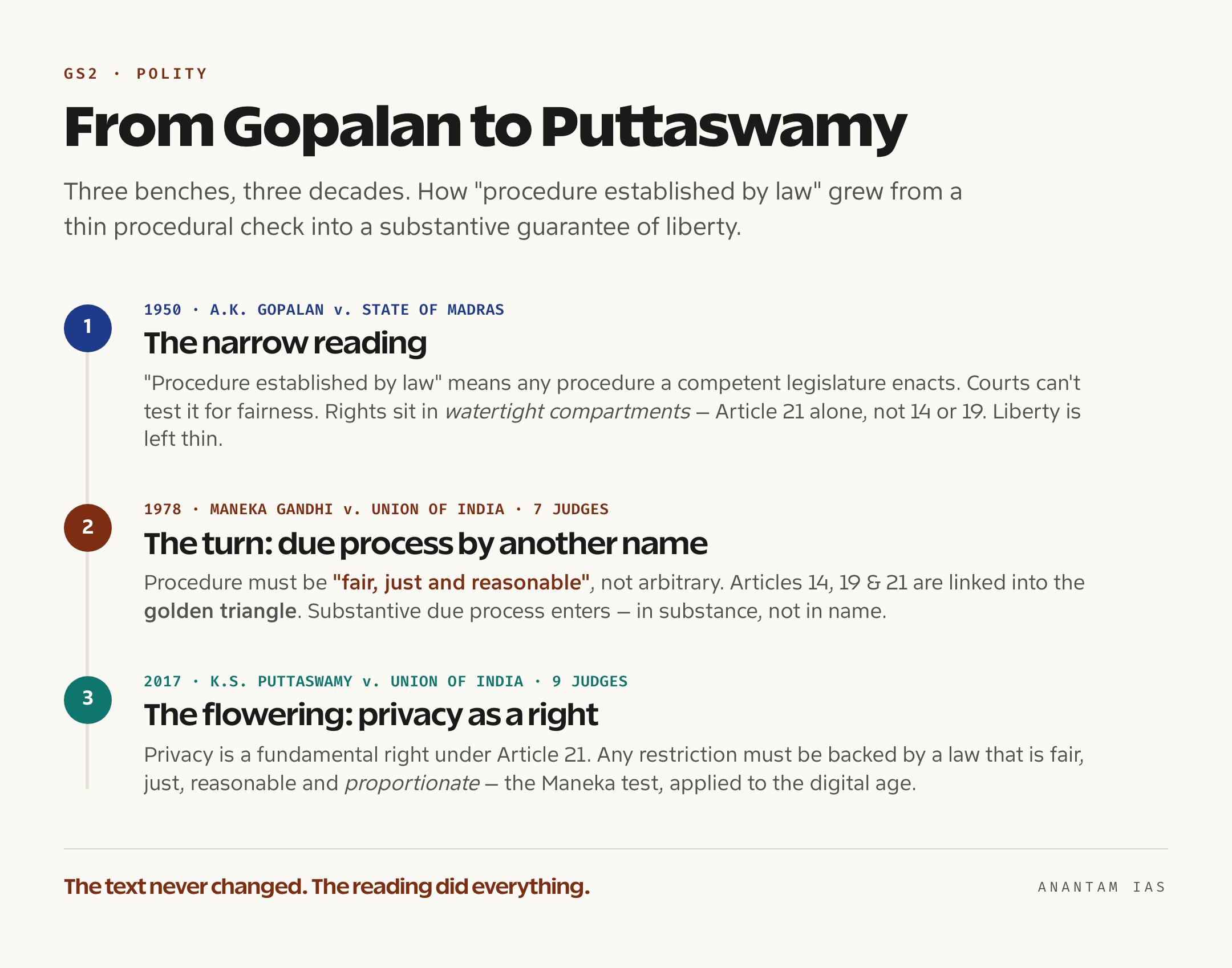
The first big test came almost immediately, and the Supreme Court read the words exactly as written. In A.K. Gopalan v. State of Madras, decided in 1950, a communist leader detained without trial under the Preventive Detention Act challenged his detention as a violation of Article 21. The Court, by a majority, took the literal view. “Procedure established by law”, it held, meant procedure laid down by a statute enacted by a competent legislature — nothing more. As long as Parliament had passed the detention law and the prescribed steps had been followed, the detention was valid, and it was not for the Court to ask whether that procedure was fair or the law reasonable. The judges expressly refused to import American “due process” into Article 21, pointing out that the framers had rejected exactly that phrase.
Gopalan did one more thing that shaped Indian law for a generation: it read the fundamental rights as separate, watertight compartments. The Court held that a law affecting personal liberty had to satisfy Article 21 alone; it did not also have to pass the test of Article 19 (freedoms like speech and movement) or Article 14 (equality). Each right lived in its own silo. The practical effect was a weak Article 21 — a citizen could be deprived of liberty by any law that named a procedure, and could not knock that law down by showing it was unreasonable or that it trampled some other freedom. For nearly thirty years this was the settled position. The Constitution’s promise of personal liberty was, in effect, only as strong as the legislature chose to make it.
Maneka Gandhi (1978): Due Process Comes In Through the Back Door
Then came the judgment that turned everything around. In Maneka Gandhi v. Union of India, decided in 1978, the government had impounded the passport of journalist Maneka Gandhi “in the public interest” and refused to give reasons. She challenged the order, and a seven-judge bench of the Supreme Court used the case to rewrite the meaning of Article 21. The Court held that the “procedure established by law” could not mean any procedure, however arbitrary — it had to be a procedure that was “fair, just and reasonable, not fanciful, oppressive or arbitrary”. A law that prescribed a procedure but the procedure was unfair would simply fail to be a “procedure” within the meaning of Article 21. In one move, the Court read the very fairness requirement the framers had left out back into the text.
Maneka Gandhi did this by demolishing the watertight-compartments theory of Gopalan. The Court held that Articles 14, 19 and 21 are not isolated silos but a connected whole — the “golden triangle” of fundamental rights. Any law that deprives a person of life or personal liberty must now run the gauntlet of all three: it must be non-arbitrary (Article 14), it must not unreasonably restrict the listed freedoms (Article 19), and it must lay down a fair, just and reasonable procedure (Article 21). Because Article 14 forbids arbitrariness and Article 19 demands reasonableness, folding them into Article 21 meant the Court could now test the substance of a liberty-depriving law, not just its form. That is substantive due process in everything but name. The Court never formally adopted the American phrase — it didn’t have to. It achieved the same result by reading “fair, just and reasonable” into the Indian words. As the judgment itself made plain, the difference between “procedure established by law” and “due process” had been narrowed almost to vanishing point.
What Changed Afterwards — From Fair Trials to Privacy
Once Article 21 became a substantive guarantee, it grew into the most fertile provision in the Constitution. With fairness and reasonableness now baked into “procedure established by law”, the Supreme Court began reading an expanding list of unstated rights into the single word “life”, insisting that “life” means more than mere animal existence — it means living with human dignity. From the Maneka foundation flowed the right to a speedy trial, the right to legal aid, the right against custodial torture, the right to a clean environment, the right to livelihood, the right to shelter, the right to health and the right to education, each justified as part of the right to live with dignity and each protected by the requirement that any law curtailing it be fair, just and reasonable. A provision the framers had written as a thin procedural safeguard had become the charter of substantive liberty.
The clearest modern proof of how far the journey went is the right to privacy. In Justice K.S. Puttaswamy v. Union of India, decided in 2017, a nine-judge bench unanimously held that the right to privacy is a fundamental right protected under Article 21, read with Articles 14 and 19 — the same golden triangle. And the test the Court applied to decide when the state may invade privacy was the direct descendant of Maneka Gandhi: any law that restricts privacy must rest on a valid statute, must serve a legitimate state aim, and must be fair, just, reasonable and proportionate. In other words, the Court applied substantive due process by another name to one of the most important rights of the digital age. The Aadhaar debate, the decriminalisation of consensual same-sex relations, the questions around surveillance and data protection — all of them now run through a test that exists only because the Court, decades earlier, decided “procedure established by law” had to mean fair procedure. The framers’ narrow words, in the end, carry an expansive promise the framers themselves chose not to write.
For Your Mains Answer
This is a core GS Paper 2 topic, sitting in the part of the syllabus that deals with the Indian Constitution, fundamental rights, and the separation of powers between the legislature and the judiciary. Questions on Article 21, on the evolution of the right to life and personal liberty, on judicial activism, or on the relationship between Parliament and the courts can all draw on this material. It is also a clean, high-quality example for the Essay paper whenever the theme touches liberty, the rule of law, or the limits of legislative power. The examiner rewards a candidate who can state the textual distinction precisely and then narrate the case-law arc that bridged it.
How to Build the Answer
Open with the text, not the cases — quote that Article 21 says “procedure established by law”, flag that this is not “due process”, and define both phrases in one crisp line each. Then walk the chain: why the framers chose the narrower phrase (Rau, Frankfurter, the fear of judicial overreach on social legislation), how A.K. Gopalan (1950) read it literally and weakly, how Maneka Gandhi (1978) read “fair, just and reasonable” into it and linked Articles 14-19-21 into the golden triangle, and how that opened the door to a long list of substantive rights culminating in Puttaswamy (2017). Close by judging the shift — was it legitimate creativity or judicial overreach? That arc — text, original choice, narrow reading, transformative reading, consequences, evaluation — fits almost any question on Article 21 or due process.
Common Mistakes to Avoid
Don’t say India “follows due process of law” — India’s text follows procedure established by law; the courts have read due process into it without amending the words. Don’t confuse procedural with substantive due process: procedural is about a fair process, substantive is about a fair law. Don’t credit Maneka Gandhi with “inventing” the right to privacy or environment — it laid the foundation; the specific rights came later. And don’t forget the framers’ reasoning was deliberate, citing Frankfurter — treating the original choice as careless misreads the whole story.
A Compact Answer Spine
Article 21 = “procedure established by law” (from Japan’s Article 31 / British tradition), NOT US “due process” → framers dropped due process deliberately after Rau met Frankfurter, fearing judicial veto over social legislation → A.K. Gopalan (1950): literal, narrow reading, rights in watertight compartments, weak Article 21 → Maneka Gandhi (1978, 7 judges): procedure must be “fair, just and reasonable”, Articles 14-19-21 = golden triangle → substantive due process imported in substance, not in name → flowering of rights (speedy trial, dignity, livelihood) → Puttaswamy (2017, 9 judges): privacy a fundamental right under the same test → verdict: judicial creativity that filled a deliberate textual gap.
Diagram or Flowchart Idea
Draw a simple horizontal timeline with three nodes — Gopalan 1950 (narrow), Maneka 1978 (the turn), Puttaswamy 2017 (privacy) — with a rising arrow above it labelled “scope of Article 21”. Beside it, sketch the golden triangle as three linked circles marked Articles 14, 19 and 21. The two visuals together capture the whole evolution and the doctrinal device that drove it.
A Balanced-Conclusion Line
A line that lands the marks: “Through Maneka Gandhi, the Supreme Court achieved by interpretation what the framers had withheld by text — reading fairness into ‘procedure established by law’ so that personal liberty in India is now guarded not merely by how a law is passed, but by whether it is just.”
How to Use Data Without Cramming
You need only three anchors, used as dates not decoration: Gopalan 1950 (the narrow start), Maneka Gandhi 1978 (the seven-judge turn to “fair, just and reasonable”), and Puttaswamy 2017 (the nine-judge privacy verdict). Attach one phrase to each — “watertight compartments”, “golden triangle”, “privacy under Article 21” — and the answer reads as authoritative without a single extra figure.
FAQ
What is the difference between “procedure established by law” and “due process of law”? “Procedure established by law” only requires that a deprivation of life or liberty follow a procedure laid down by a validly enacted law — the court checks that the right authority acted and the prescribed steps were followed, but not whether the law itself is fair. “Due process of law”, the American standard, lets a court go further and strike down a law for being arbitrary or unreasonable in substance, not just for being wrongly applied. India’s Article 21 uses the former phrase; over time the courts read much of the latter’s fairness requirement into it.
Why did the framers of the Indian Constitution avoid “due process”? They feared it would hand the judiciary too much power to block social and economic legislation. Constitutional Adviser B.N. Rau met US Supreme Court Justice Felix Frankfurter in 1947, who warned that “due process” had let American judges strike down welfare and labour laws under “substantive due process”. To protect land reform and social legislation in a new nation, the Drafting Committee dropped “due process” and adopted “procedure established by law”, borrowed from Article 31 of Japan’s 1947 Constitution.
How did the Maneka Gandhi case change Article 21? In Maneka Gandhi v. Union of India (1978), a seven-judge bench held that the “procedure established by law” must be “fair, just and reasonable, not fanciful, oppressive or arbitrary”. It also linked Articles 14, 19 and 21 into the “golden triangle”, so any law depriving a person of liberty must be non-arbitrary, reasonable and procedurally fair. This effectively imported substantive due process into Article 21 without formally adopting the American phrase, transforming a thin procedural safeguard into a substantive guarantee of liberty.
Does India now follow due process of law? Not in name. India’s Constitution still reads “procedure established by law”, and no amendment has changed it. But since Maneka Gandhi (1978), the courts have applied a fairness, reasonableness and proportionality test that delivers, in substance, much of what American due process delivers. The right to privacy verdict in Puttaswamy (2017) is the clearest example — privacy can be restricted only by a law that is fair, just, reasonable and proportionate.
Practice Questions
Prelims MCQs
- The phrase “procedure established by law” in Article 21 of the Indian Constitution was primarily borrowed from the Constitution of which country?
(a) United States of America
(b) Japan
(c) Australia
(d) Ireland
Answer: (b) The phrase was taken from Article 31 of the 1947 Constitution of Japan, reflecting a British-style emphasis on legislative supremacy rather than the American “due process” model. - In which case did the Supreme Court hold that the “procedure established by law” under Article 21 must be “fair, just and reasonable”?
(a) A.K. Gopalan v. State of Madras
(b) Kesavananda Bharati v. State of Kerala
(c) Maneka Gandhi v. Union of India
(d) Minerva Mills v. Union of India
Answer: (c) The seven-judge bench in Maneka Gandhi v. Union of India (1978) read the fairness requirement into Article 21 and rejected the narrow reading of A.K. Gopalan. - The “golden triangle” of the Indian Constitution, affirmed in the Maneka Gandhi case, refers to which combination of Articles?
(a) Articles 14, 19 and 21
(b) Articles 19, 21 and 22
(c) Articles 14, 21 and 32
(d) Articles 15, 16 and 19
Answer: (a) The golden triangle links the right to equality (Article 14), the freedoms (Article 19) and the protection of life and personal liberty (Article 21), which a liberty-depriving law must all satisfy. - With reference to the A.K. Gopalan case (1950), which statement is correct?
(a) It held that Article 21 includes substantive due process
(b) It read fundamental rights as separate, watertight compartments
(c) It struck down preventive detention as unconstitutional
(d) It linked Articles 14, 19 and 21 together
Answer: (b) A.K. Gopalan took a literal, narrow view, holding that a law affecting personal liberty had to satisfy only Article 21 and not also Articles 19 or 14 — a position later overruled in Maneka Gandhi. - The right to privacy was declared a fundamental right under Article 21 in which case, applying a fairness-and-proportionality test descended from Maneka Gandhi?
(a) Kharak Singh v. State of UP
(b) M.P. Sharma v. Satish Chandra
(c) Justice K.S. Puttaswamy v. Union of India
(d) Selvi v. State of Karnataka
Answer: (c) A nine-judge bench in Justice K.S. Puttaswamy v. Union of India (2017) held privacy to be a fundamental right and ruled that any restriction must be backed by a fair, just, reasonable and proportionate law.
Mains Practice Questions
- Distinguish between “procedure established by law” and “due process of law”, and examine why the framers of the Indian Constitution preferred the former in Article 21. (10 marks, 150 words)
- “The Maneka Gandhi case achieved by interpretation what the framers had withheld by text.” Critically analyse this statement with reference to the evolution of Article 21. (15 marks, 250 words)
- Trace the journey of Article 21 from A.K. Gopalan (1950) to Justice K.S. Puttaswamy (2017), and discuss how it transformed the protection of personal liberty in India. (15 marks, 250 words)
- Discuss the concept of substantive due process and assess the extent to which Indian courts have read it into “procedure established by law”. Is this judicial creativity or judicial overreach? (15 marks, 250 words)
- Explain the significance of the “golden triangle” of Articles 14, 19 and 21 in protecting fundamental rights, with suitable examples. (10 marks, 150 words)