Product-as-a-Service: From Owning Things to Paying for Use (UPSC Economy)
Rolls-Royce sells flying hours, not jet engines. Philips sells light, not bulbs. Product-as-a-Service flips the oldest deal in commerce — you pay for use, not ownership. Here is how servitisation works, why digital monitoring and the circular economy are driving it, and what it means for India, explained for UPSC GS3.
Think about the last big thing you bought and barely used. A power drill that runs, on average, for about thirteen minutes in its entire lifetime. A car that sits parked for roughly 95 per cent of the day. A printer you bought for the machine but really wanted for the pages. For most of economic history the deal was simple: a company made a thing, you paid for it, you owned it, and what happened next — whether it ran well, broke, gathered dust or went to landfill — was your problem. Product-as-a-Service quietly rewrites that deal. Under it, you stop buying the thing and start paying for what the thing does: the hours flown, the kilometres driven, the light in the room, the cold air, the clean clothes. The maker keeps ownership and sells you the use.
It sounds like a marketing gimmick, but it is one of the more consequential shifts in how modern industry earns money, and it sits at the centre of three big stories an aspirant has to track at once — the rise of the subscription and “as-a-service” economy, the spread of cheap digital monitoring through the Internet of Things, and the push for a circular economy that keeps materials in use instead of throwing them away. The word economists use for a manufacturer moving from selling products to selling the service those products deliver is servitisation, and it turns out to reorganise incentives, balance sheets and resource use all at the same time. For UPSC, it is a clean, modern lens on GS Paper 3 — on industry, growth, resource mobilisation and sustainable development — and the kind of concept that lets you sound genuinely current rather than textbook-stale.
What Product-as-a-Service Actually Means
Strip away the jargon and Product-as-a-Service, often shortened to PaaS, is a business model where a company sells the use or the outcome of a product instead of selling the product itself. The customer never takes ownership; the manufacturer or provider does, and charges over time. That charge can take several shapes, and naming them is half the battle in an answer. It can be pay-per-use, where you are billed by the unit of output — per kilometre, per flying hour, per page printed, per litre of compressed air. It can be a subscription or lease, a flat recurring fee for continuing access to the product and its upkeep. Or it can be a performance or outcome contract, the most ambitious form, where the provider is paid not for the product or even its use but for a guaranteed result — a certain level of light, a machine that is “always available,” a fixed temperature in a building.
The cleanest way to grasp it is through the classic cases, because PaaS was invented in heavy industry long before any app store existed. The grandparent of them all is Rolls-Royce’s “Power by the Hour”, a model the company first trademarked back in 1962 and later scaled into its TotalCare programme for jet engines. An airline no longer simply buys an engine; it pays Rolls-Royce a fixed sum for every hour that engine flies, and Rolls-Royce keeps the engine maintained, monitored and overhauled for the life of the contract. The airline buys thrust by the hour; the engine stays the maker’s responsibility. The same idea runs through the most-quoted examples in the field — Michelin selling tyres priced per kilometre driven and bundled with fleet-monitoring services rather than selling tyres outright, and Philips, through its Signify business, selling “light as a service” to clients like Amsterdam’s Schiphol airport, where the airport pays for illumination and Philips owns, maintains, upgrades and eventually recovers the fixtures.
You meet the consumer-facing version every day without calling it that. The streaming subscription that replaced the DVD shelf, the cloud-software seat that replaced the boxed CD, the furniture and appliances Indians increasingly rent by the month from the likes of Furlenco and RentoMojo, the car you take on a subscription instead of a loan. The thread tying a jet engine to a sofa is identical: in each case ownership stays upstream with the provider, and the customer pays a flow of money for a flow of use. That single structural change — ownership decoupled from use — is the whole concept, and everything interesting about PaaS follows from it.
Why Product-as-a-Service Is Rising Now
The model is old, so the real question is why it is suddenly everywhere, and the honest answer is that two enabling forces matured at the same time. The first is technology, specifically the Internet of Things — the web of cheap sensors and connected devices that lets a maker watch its product perform in the field in real time. You cannot bill someone fairly for use unless you can measure that use precisely, and you cannot promise “always available” unless you can see a failure coming. IoT made both possible. A sensor-laden Rolls-Royce engine streams thousands of data points per flight; a connected Michelin tyre reports pressure and wear; a smart meter logs every unit consumed. Once measuring usage and predicting breakdowns became cheap and continuous, pay-per-use and outcome contracts stopped being a gamble and became ordinary commerce. This is why analysts now treat servitisation as inseparable from digitalisation — the business model and the technology arrived together.
The second force is money, and here the appeal is mutual. For the provider, PaaS converts a one-off sale into recurring revenue — a predictable stream that markets value far more highly than lumpy product sales, the same reason software companies rushed from selling licences to selling subscriptions. It also deepens the customer relationship: a firm that maintains your machine for a decade learns your operation and is hard to dislodge. For the customer, the draw is access without the burden of ownership. There is no large upfront capital outlay, no money locked in a depreciating asset, no maintenance headache, no worry about the thing becoming obsolete — you simply pay as you go and hand the risk of breakdown and upgrade back to the maker. In a high-interest, capital-tight world, turning a big purchase into a manageable monthly cost is a powerful pitch, and it explains why the numbers are climbing. By one widely cited estimate the equipment-as-a-service market alone is on track to roughly double from around 95 billion dollars in 2025 to over 235 billion by 2035, and product-as-a-service has become the single largest business-model segment of the fast-growing digital circular economy.
How It Reshapes Incentives and the Circular Economy
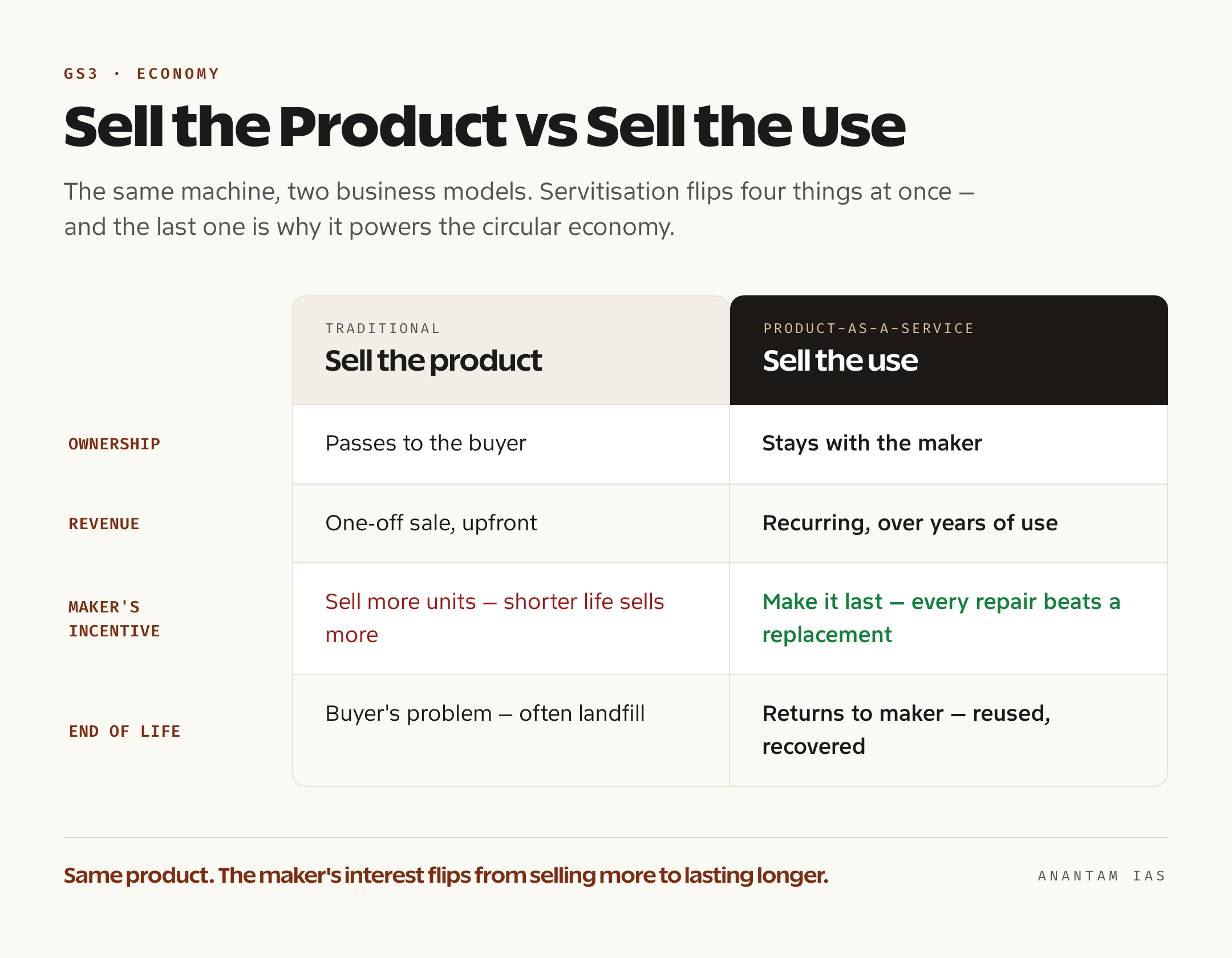
Here is where the model stops being a billing trick and becomes genuinely interesting for policy, because it flips the incentive that has governed manufacturing for two centuries. When a company makes money by selling units, its quiet interest is in selling more units — and a product that wears out, goes out of fashion or cannot be repaired sells more units. Planned obsolescence, the short-lived gadget, the appliance that is cheaper to replace than to fix: all of it makes commercial sense when revenue comes from the next sale. PaaS inverts that logic. When the maker keeps ownership and earns from continued use, a product that lasts longer, breaks less and can be refurbished is now in the maker’s own financial interest, because every repair is cheaper than a replacement it has to fund itself. Durability stops being a cost the seller avoids and becomes an asset the provider protects.
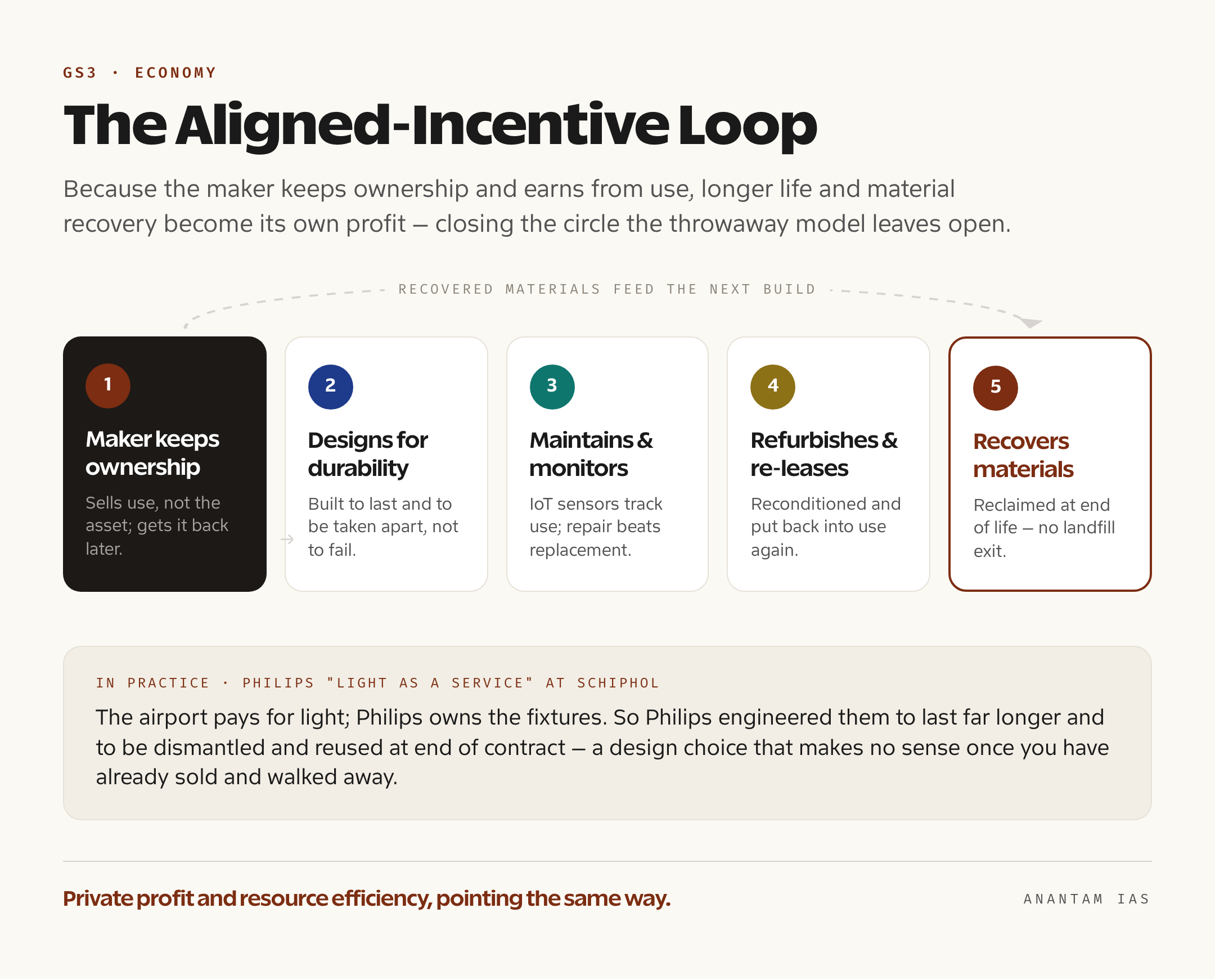
That single inversion is why Product-as-a-Service is treated as a foundational business model of the circular economy — the idea of designing out waste and keeping products and materials in use for as long as possible rather than running a straight line from raw material to landfill. Hold the two ideas together and a loop appears. Because the provider gets the product back at the end of the contract, it has every reason to design it to be repaired, upgraded, taken apart and have its materials recovered. The Schiphol lighting deal is the textbook illustration: because Philips knew it would own and reclaim the fixtures, it had them engineered to last far longer and to be dismantled for reuse at end of life — a design choice that makes no sense if you have already sold the product and walked away. Servitisation aligns the commercial interest of the maker with resource efficiency, which is exactly the alignment a circular economy needs and the market, left to a sell-and-forget model, rarely delivers on its own.
The customer gains in this loop too, and not only on price. You get access to better, better-maintained equipment than you might afford to buy; you offload the risk of obsolescence; and you can scale up or down as your needs change instead of being stuck with a depreciating asset. The aspirant’s takeaway is that PaaS is one of those rare arrangements where the private incentive and the public good can point the same way — a manufacturer chasing recurring profit and a planet needing fewer discarded products can, under the right contract, want the very same thing: a product that lasts.
The India Story: From Tractors to Batteries
For India this is not an imported abstraction — it is already running across the economy, often under names that hide the underlying model. Start with agriculture, where Product-as-a-Service may matter most. The average Indian holding is tiny and the average farmer cannot justify buying a tractor, a combine harvester or a drone that sits idle for most of the year. The answer, scaled up through government and private effort, is the Custom Hiring Centre — a depot that rents farm machinery to farmers on a pay-per-use basis, by the hour, the day or the acre. There are now well over 75,000 such centres operating across the country, backed by NABARD financing and state apps that let a farmer book a machine the way you book a cab. This is equipment-as-a-service in its most developmental form: it puts modern mechanisation within reach of a smallholder who could never own it, and a wave of private “Uber-for-tractors” rental startups is pushing the same idea further.
Energy and mobility tell a similar story. India’s rooftop and rural solar push increasingly runs on a solar-as-a-service or RESCO model, where a developer installs and owns the panels and the household or business simply pays for the power generated — removing the upfront cost that stalls adoption. In electric mobility, the country has effectively turned the battery, the single most expensive part of an electric two- or three-wheeler, into a service: under battery-swapping and Battery-as-a-Service models, a driver buys the vehicle without the battery and then leases energy by swapping depleted packs for charged ones at a station, paying per swap or by subscription. Players like Sun Mobility and Battery Smart have built thousands of swap points on exactly this logic, and it cuts the purchase price of an EV by a third or more — a textbook case of decoupling ownership from use to make a product affordable.
The pattern repeats up the income ladder and into the home. India’s young, mobile urban professionals increasingly rent furniture and appliances by the month rather than buying them, a furniture-rental market growing at double-digit rates and led by subscription brands; software, long sold as a service, needs no introduction; and even office space and printers move on per-use contracts. The common engine across farm, energy, mobility and home is the same one driving the model worldwide: a large, lumpy purchase converted into an affordable, flexible, pay-as-you-go service. In a country where capital is scarce and the priority is access for the many rather than ownership by the few, that conversion is not a luxury feature of the model — it is the whole point.
The Catch: Where Product-as-a-Service Struggles
None of this means the model is a free lunch, and a balanced answer has to say where it strains. The first problem is financial, and it lands on the provider. Selling a product gets you paid today; servitising it means you keep the asset on your own books and recover the cash slowly over years of use, so the company has to finance that gap and carry the risk that the customer leaves or the asset underperforms. Rolls-Royce’s celebrated TotalCare model is also a cautionary tale here: the long contracts complicated its accounts and, under newer accounting rules, exposed how unprofitable such deals can be in their early years before the usage revenue catches up. Servitisation can be a balance-sheet trap as easily as a goldmine, and it demands deep pockets and patient capital that many smaller firms simply do not have.
The second problem is cultural and structural. Ownership runs deep — in India especially, owning a home, a car, a tractor or gold still carries status and security that renting does not, and persuading customers to pay forever for something they will never own is a genuine behavioural hurdle. There is a lock-in worry too: a customer who depends on one provider for a machine, its maintenance and its data can find switching costly, and a tension exists at the heart of the model between locking customers in and the open, competitive markets a circular economy ideally wants. Data is its own minefield — the IoT sensors that make pay-per-use possible also stream detailed operational information back to the provider, raising real questions about who owns that data and how it is used. And there is an equity edge a public-policy answer should not miss: a permanent rental can, over a long enough horizon, cost more than outright ownership would have, so a model that widens access can also quietly trap lower-income users in perpetual payments. The way forward is not to abandon servitisation but to govern it — clear contract and consumer-protection norms, data-ownership rules, financing support for providers, and circular-economy regulation that rewards genuine reuse rather than mere lock-in. Done well, Product-as-a-Service is a powerful tool for an affordable, less wasteful economy; done carelessly, it is just a subscription on everything.
For Your Mains Answer
This is a high-value, modern concept for GS Paper 3, which covers the Indian economy, industrial growth and development, mobilisation of resources, and the environment and sustainable development. It plugs directly into questions on new business models, the circular economy, sustainable industrialisation, the subscription and gig economy, and emerging technologies like IoT — and it gives you a sophisticated, contemporary example that most candidates will not have. It also works for the Essay paper on themes of consumption, sustainability and access versus ownership. The skill examiners reward is the same one this article uses: define the model crisply, show the incentive inversion at its core, and ground it in concrete Indian examples rather than abstract theory.
How to Build the Answer
Lead with the one-line definition — selling the use or outcome of a product rather than the product itself — then name the three pricing forms (pay-per-use, subscription, outcome contract). Anchor it with one global example (Rolls-Royce “Power by the Hour” or Philips “light as a service”) and immediately bring it home with Indian ones (Custom Hiring Centres, battery swapping, solar-as-a-service). Then make the conceptual move that earns marks: explain how keeping ownership with the maker aligns its incentive with durability and so links PaaS to the circular economy. Close with a balanced ledger of benefits and challenges. That arc — define, pricing forms, examples, the incentive-and-circularity link, evaluation — fits almost any question that touches the topic.
Common Mistakes to Avoid
Don’t reduce PaaS to “just renting” — the heart of it is the inversion of the maker’s incentive toward durability, which simple renting need not involve. Don’t forget the enabling role of IoT; without cheap usage-measurement the model can’t scale, and saying so signals you understand why it is rising now and not decades ago. Don’t present it as an unmixed good — flag the financing burden on providers, the lock-in and data concerns, and the risk that perpetual rental costs the poor more than ownership. And don’t leave it global — an answer with Custom Hiring Centres and battery swapping reads as far stronger than one stuck on jet engines.
A Compact Answer Spine
PaaS / servitisation = sell the use or outcome, not the product; ownership stays with the maker → three forms: pay-per-use, subscription/lease, outcome contract → classics: Rolls-Royce “Power by the Hour”, Michelin per-km, Philips “light as a service” → rising now because IoT makes usage-billing and prediction cheap + recurring revenue for firms + access without capital for customers → core idea: maker keeps ownership ⇒ durability and reuse become its own interest ⇒ foundation of the circular economy → India: Custom Hiring Centres (75,000+), battery swapping / BaaS, solar-as-a-service / RESCO, furniture-and-appliance rental → challenges: provider’s balance-sheet and financing risk, ownership culture, lock-in, data, possible higher lifetime cost for the poor → way forward: contract, data and consumer-protection norms + circular-economy regulation.
Diagram or Flowchart Idea
Draw a simple two-column “sell the product vs sell the use” comparison — ownership, revenue, incentive, end-of-life — beside a small closed loop: maker owns ⇒ designs for durability ⇒ maintains ⇒ refurbishes ⇒ recovers materials ⇒ back to use. The contrast plus the loop captures the whole argument at a glance and is quick to sketch.
A Balanced-Conclusion Line
A line that lands the marks: “Product-as-a-Service matters less as a billing trick than as an alignment — when the maker keeps the asset, longer life and less waste become its own profit, turning private incentive toward the circular economy, provided regulation keeps the model from hardening into lock-in and perpetual rent on the poor.”
How to Use Data Without Cramming
You need only a few anchors, not a spreadsheet: Rolls-Royce trademarked “Power by the Hour” in 1962; over 75,000 Custom Hiring Centres operate in India; battery-swapping models cut an EV’s purchase price by roughly a third; and equipment-as-a-service is projected to roughly double from about 95 billion to over 235 billion dollars between 2025 and 2035. Drop those into the right sentences and attribute them plainly rather than scattering numbers loose.
Frequently Asked Questions
What is Product-as-a-Service in simple terms?
It is a business model where you pay for the use or outcome of a product instead of buying and owning the product itself. The maker or provider keeps ownership and charges you over time — by usage (per kilometre, per flying hour), by subscription, or for a guaranteed result. Rolls-Royce selling flying hours instead of jet engines, and Philips selling light instead of bulbs, are the classic examples; renting furniture by the month or leasing an EV battery are everyday Indian ones.
How is Product-as-a-Service different from ordinary renting?
Renting and PaaS both let you use something without owning it, but PaaS goes further by changing the maker’s incentive. Because the manufacturer keeps ownership and earns from continued use, it now profits from a product that lasts longer, breaks less and can be repaired or refurbished — the opposite of the sell-more-units logic of traditional manufacturing. It is usually also bundled with maintenance, monitoring and upgrades, and made possible by IoT sensors that measure usage precisely. That incentive shift toward durability is what links it to the circular economy.
Why is Product-as-a-Service growing so fast now?
Two forces matured together. The Internet of Things made it cheap to measure exactly how much a product is used and to predict failures, so pay-per-use and “always available” contracts became practical rather than risky. And the economics suit both sides: providers get predictable recurring revenue and a sticky customer relationship, while customers get access without a large upfront purchase, no maintenance burden and no obsolescence risk — attractive when capital is tight.
How does Product-as-a-Service apply to India?
Widely, often under other names. Custom Hiring Centres rent farm machinery to smallholders on a pay-per-use basis, with over 75,000 now operating; solar-as-a-service (the RESCO model) lets users pay for power while a developer owns the panels; battery swapping and Battery-as-a-Service let EV users lease energy instead of buying a costly battery; and urban professionals increasingly rent furniture and appliances by subscription. In each case a large, lumpy purchase becomes an affordable pay-as-you-go service — extending access in a capital-scarce economy.
Practice Questions
Prelims MCQs
- With reference to “Product-as-a-Service” (servitisation), which of the following best describes the model?
(a) A company sells products at a discount to bulk buyers
(b) A company sells the use or outcome of a product while retaining ownership of the product itself
(c) A government scheme to subsidise consumer goods
(d) The outsourcing of after-sales repair to third parties
Answer: (b) In PaaS the provider keeps ownership and charges for use, subscription or a guaranteed outcome rather than transferring the product to the customer. - Rolls-Royce’s “Power by the Hour” model is an early example of Product-as-a-Service because it involves which of the following?
(a) Selling jet engines at a fixed list price
(b) Charging airlines for every hour an engine flies while Rolls-Royce maintains it
(c) Leasing aircraft to airlines
(d) Manufacturing engines under licence abroad
Answer: (b) Airlines pay per flying hour and Rolls-Royce retains responsibility for maintaining and overhauling the engine, selling use rather than the engine. - Which technology has been most central to making pay-per-use and outcome-based servitisation models practical at scale?
(a) Blockchain alone
(b) The Internet of Things (IoT), through cheap sensors that measure usage and predict failures
(c) 3D printing
(d) Quantum computing
Answer: (b) IoT enables continuous, accurate measurement of usage and predictive maintenance, which fair pay-per-use and “always available” contracts require. - How does Product-as-a-Service support the circular economy?
(a) By encouraging customers to replace products frequently
(b) By keeping ownership with the maker, which gains a financial interest in durability, repair, refurbishment and material recovery
(c) By banning the sale of physical products
(d) By exporting waste to other countries
Answer: (b) Because the maker retains and reclaims the asset, longer life and reuse become its own commercial interest, aligning the model with circular-economy goals. - In the Indian context, which of the following are examples of Product-as-a-Service / pay-per-use models? 1. Custom Hiring Centres for farm machinery 2. Battery-as-a-Service / battery swapping for electric vehicles 3. Solar-as-a-Service (RESCO) for rooftop solar. Select the correct answer:
(a) 1 and 2 only
(b) 2 and 3 only
(c) 1 and 3 only
(d) 1, 2 and 3
Answer: (d) All three let users pay for use or output while a provider owns the underlying asset — machinery, battery or solar panels.
Mains Practice Questions
- What is Product-as-a-Service (servitisation)? Explain how it differs from traditional product sales and why digital technologies have accelerated its adoption. (10 marks, 150 words)
- “Product-as-a-Service aligns the commercial interest of the manufacturer with resource efficiency.” In light of this statement, examine the relationship between servitisation and the circular economy. (15 marks, 250 words)
- Discuss the potential of pay-per-use and “as-a-service” models — such as Custom Hiring Centres, battery swapping and solar-as-a-service — to widen access in a capital-scarce economy like India. (15 marks, 250 words)
- Product-as-a-Service is often presented as a win-win, yet it carries significant risks. Critically analyse the financial, behavioural, data and equity challenges of servitisation and suggest a regulatory way forward. (15 marks, 250 words)
- “The shift from owning things to paying for use is reshaping both business models and sustainability.” Examine this statement with reference to global and Indian examples. (15 marks, 250 words)