Public Distribution System (PDS): Issues and Reforms (UPSC Economy)
PDS covers 80 crore under NFSA via 5.4 lakh ration shops. Learn Shanta Kumar committee reforms, ONORC, leakages, FCI reforms, and 2024-26 updates for UPSC.
The Public Distribution System (PDS) is India's largest food-security programme and one of the biggest in the world. Through a network of about 5.4 lakh Fair Price Shops (FPS), the Centre and states distribute subsidised rice, wheat, coarse grains, sugar, and kerosene to roughly 80 crore people under the National Food Security Act (NFSA), 2013. UPSC tests PDS across GS-II (welfare schemes, vulnerable sections) and GS-III (food security, buffer stocks, issues of farm subsidies, direct and indirect subsidies).
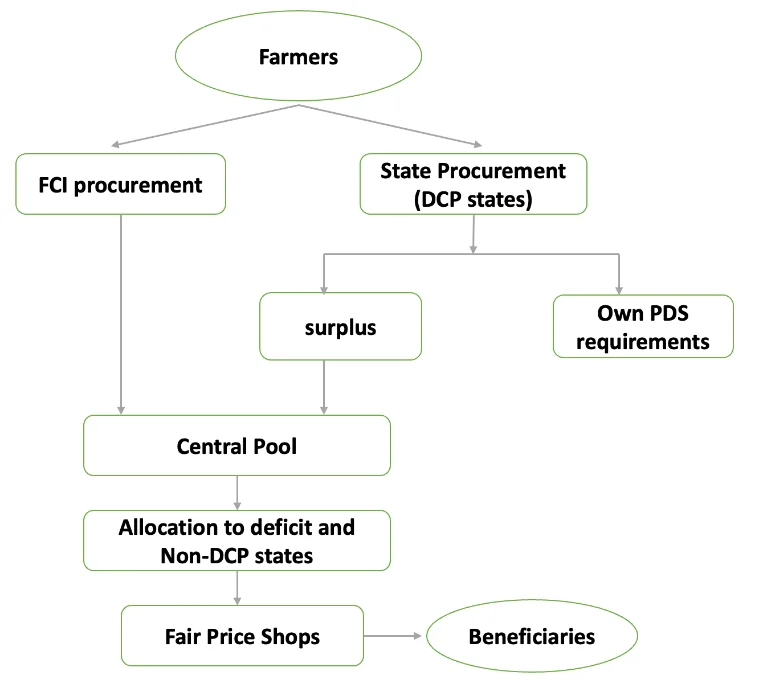
Structure of PDS
The Targeted PDS (TPDS) classifies beneficiaries into two categories under NFSA:
- Antyodaya Anna Yojana (AAY) — poorest of the poor families; 35 kg foodgrains per family per month.
- Priority Households (PHH) — 5 kg per person per month.
The Centre, through the Food Corporation of India (FCI), procures foodgrains at Minimum Support Price (MSP) and distributes them to states at central issue prices well below cost. States pay transport, handling, and FPS dealer margins.
How PDS Functions
- Procurement: FCI and state agencies buy paddy, wheat, and coarse cereals at MSP from farmers, mostly in surplus states like Punjab, Haryana, Madhya Pradesh, Chhattisgarh, and Telangana.
- Storage: In FCI warehouses, Central Warehousing Corporation (CWC), and State Warehousing Corporations (SWC).
- Allocation: Centre allocates to states based on NFSA population.
- Distribution: Through Fair Price Shops using ePoS machines and Aadhaar authentication.
Key Issues in PDS
Leakages and Diversion
Historically, leakage rates have been high. The Shanta Kumar Committee (2015) estimated leakage at 40-50% in some states. ePoS digitisation has reduced this significantly but regional diversion and ghost beneficiaries persist.
Exclusion Errors
Many genuinely poor families are missed due to outdated SECC-2011 data, informal tenancy, inter-state migration, and lack of documents. Homeless and migrant populations face the biggest exclusion.
Quality of Grains
Broken grains, low-quality rice, and storage losses damage the programme's credibility.
Burden on FCI and MSP Distortion
Open-ended MSP procurement creates overflowing buffer stocks — FCI stocks have often been more than double the buffer-stocking norms, raising storage and carrying costs.
Nutritional Narrowness
PDS focuses on rice-wheat calories and ignores pulses, oils, and millets — contributing to hidden hunger. Recent millets push is trying to correct this.
FPS Viability
Dealer margins are thin, pushing dealers toward malpractices. Consolidation of FPS with additional services (banking, PM-Kisan enrolment) is a gradual fix.
Shanta Kumar Committee (HLC) Recommendations, 2015
The High-Level Committee on FCI chaired by Shanta Kumar set out a radical reform blueprint:
On Coverage
- Reduce current NFSA coverage from 67% to 40% of population — enough to cover BPL families and some above.
On Procurement
- FCI should hand over procurement to states that have gained expertise (Chhattisgarh, MP, Odisha).
- FCI should focus on eastern India where MSP procurement is weak.
On Quantity and Price
- Increase PDS grain entitlement to 7 kg per person (from 5 kg earlier under TPDS).
- AAY households: continue Rs 3/2/1 per kg for rice/wheat/coarse grains.
- PHH households: price should be linked to MSP — around 50% of MSP.
On End-to-End Computerisation
- Defer NFSA implementation in states that have not digitised beneficiary lists, published FPS-level data, or set up vigilance committees.
On Cash Transfers
- Start cash transfers in cities with over 1 million population, extend to grain-surplus states, then let deficit states opt in. Expected saving: Rs 30,000 crore.
On Storage and Movement
- Outsource stocking to CWC, SWC, and private agencies to cut costs.
- Phase out Covered And Plinth (CAP) open-air storage.
- Containerise grain movement to cut transit losses.
On Buffer Stocks
- Adopt a comprehensive liquidation policy — sell or export surplus when stocks exceed norms.
- End open-ended procurement which causes structural overstocking.
On Direct Benefit Transfer
- Move to DBT for food subsidy in urban and surplus-grain states to cut intermediation costs.
Recent Reforms and Modernisation
End-to-End Computerisation
- Integrated Management of PDS (IM-PDS) portal.
- ePoS machines at nearly all FPS, with biometric and Aadhaar authentication.
One Nation One Ration Card (ONORC)
Launched August 2019, ONORC lets NFSA beneficiaries draw rations from any FPS across India using their existing ration card. Especially critical for migrant workers. As of 2024, all 36 states and UTs are on ONORC.
Fortification
Rice fortification — with iron, folic acid, and Vitamin B12 — is now universal under PDS, PM Poshan (mid-day meal), and ICDS from FY 2023-24.
Millets in PDS
Some states distribute ragi, bajra, and jowar through PDS. Budget 2023-24 emphasised Shree Anna (millets) and more states are piloting millets in NFSA.
Pradhan Mantri Garib Kalyan Anna Yojana (PMGKAY)
Launched during COVID-19 in April 2020, PMGKAY provided 5 kg additional free grain per person per month over NFSA entitlement. It was extended multiple times and in January 2023 merged with NFSA as free grains for 81 crore people for five years, extended in 2024 to cover the period up to December 2028.
Latest developments (2024-26)
- PMGKAY extended from 1 January 2024 for five more years (till December 2028), making NFSA foodgrains free for ~81 crore people.
- Rice fortification fully rolled out nationally across all NFSA, PM Poshan, and ICDS programmes from FY 2023-24 onwards.
- One Nation One Ration Card (ONORC) — over 170 crore portability transactions recorded by 2024 covering migrant workers.
- Smart PDS rolled out with improved digital ledger, beneficiary deduplication, and real-time allocation.
- FCI reform — Budget 2024-25 allocated Rs 2.05 lakh crore for food subsidy; Budget 2025-26 retained similar allocation while pushing FCI to improve buffer operations and liquidation timelines.
- NFSA database revision: The Centre asked states to update NFSA beneficiary lists using newer data, though the decadal population census remains pending.
- Millets in PDS: Karnataka, Odisha, Telangana, and Andhra Pradesh distributed ragi/jowar under PDS in 2024; Budget 2024-25 included enhanced millets procurement.
- Updated context: Debate continues on whether to shift urban PDS to DBT while retaining grain distribution in rural, remote, and tribal areas — no national rollout yet as of early 2026.
Way Forward
- Accurate beneficiary data — update NFSA lists using recent surveys and AgriStack-linked farmer registry.
- Nutrition-sensitive PDS — add pulses, edible oils, and millets to the basket.
- Selective DBT pilots in urban areas and surplus-grain states.
- Rationalise MSP-PDS link — cap open-ended procurement; move to a decentralised MSP-linked procurement-and-consumption model.
- Cold chain for perishables — Operation Greens integration with PDS for nutritional diversity.
- FCI restructuring — FCI's role as procurement agency should be supplemented by state agencies in grain-deficit eastern India.
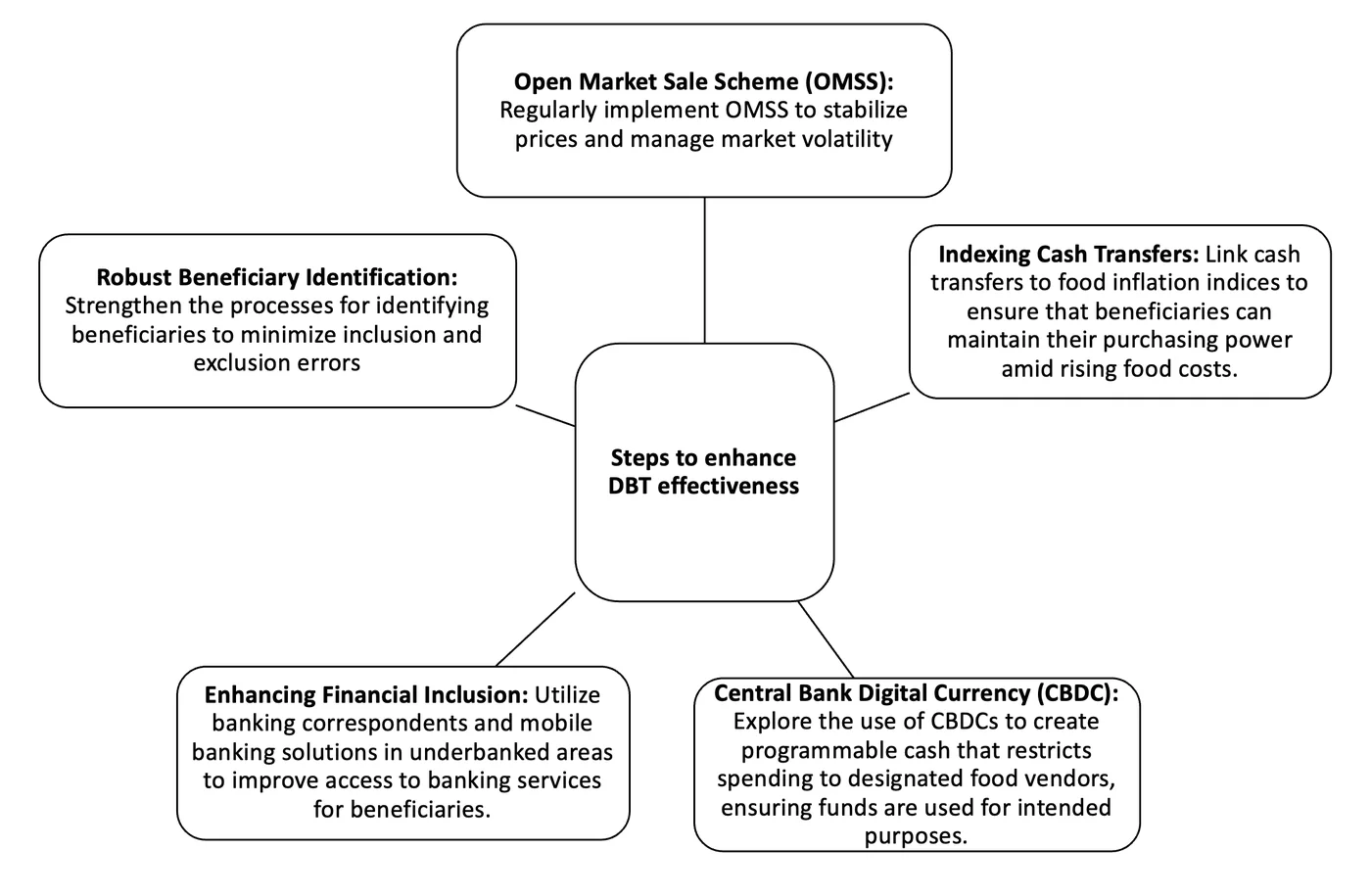
| Advantages of DBT cash transfer in PDS | Limitations of DBT cash transfer in PDS |
|---|---|
| Reduced Subsidy Costs: DBT can lower logistics costs associated with the procurement, storage, and distribution of food grains, thereby alleviating the financial burden on the government. Wider Choice to consumer: By providing cash instead of food grains, beneficiaries can purchase food items according to their preferences, addressing nutritional deficiencies more effectively. Crop Diversification: DBT may encourage farmers to grow a variety of crops based on market demand, promoting agricultural diversity and improving food security. Minimized Leakages: Cash transfers can significantly reduce leakages in the current system, such as ghost cards and shadow ownership, by ensuring that funds are directly transferred to verified beneficiaries. Implementation of One Nation One Ration Card: DBT facilitates the easier implementation of the One Nation One Ration Card scheme, ensuring portability and access for beneficiaries across states. Improves market efficiency: Encourages private trade and competition by reducing the government's dominant role in grain procurement and distribution. | Price Volatility: Beneficiaries may be exposed to fluctuating market prices, which could impact their purchasing power and food security. Misuse of Cash: There is a risk that cash may be spent on non-food items, undermining the primary goal of ensuring food security. Inclusion/Exclusion Errors: Errors in identifying beneficiaries could exclude deserving individuals or include ineligible ones, leading to inequities. Financial Inclusion Barriers: Inadequate access to banking facilities, especially in rural areas, may hinder effective implementation of DBT. Weak market access: In remote and tribal areas where food markets are thin or absent, availability of cash does not guarantee access to food. |
UPSC Relevance
GS-III Mapping
- Public Distribution System — objectives, functioning, limitations, revamping.
- Issues of buffer stocks and food security.
- Issues related to direct and indirect farm subsidies.
- Technology missions — ePoS, ONORC, AgriStack.
Prelims Pointers
- NFSA, 2013 — 75% rural + 50% urban coverage = ~67% of population.
- AAY = 35 kg/family/month; PHH = 5 kg/person/month.
- Shanta Kumar Committee — 2015 HLC on FCI restructuring.
- PMGKAY — launched April 2020; merged with NFSA from January 2023; extended to December 2028 in 2024.
- ONORC — launched August 2019; all states and UTs on board.
Mains Angles
- "Critically examine the recommendations of the Shanta Kumar Committee on restructuring FCI and reforming PDS." (GS-III)
- "Evaluate the impact of One Nation One Ration Card on migrant welfare and food security."
- "Is cash transfer a better alternative to in-kind PDS? Discuss with examples."
- "Discuss the role of fortification and millets in making PDS nutrition-sensitive."
A reformed PDS — accurate in targeting, nutrition-sensitive in basket, and digital in delivery — remains central to India's food-security architecture. For aspirants, combine the NFSA 2013 framework with Shanta Kumar reforms and the 2024 PMGKAY extension to build a complete answer.