The Quantum Internet: Unhackable Networks and the Next Leap in Communication (UPSC Science & Tech)
The quantum internet moves quantum information — qubits — using entanglement and quantum key distribution instead of ordinary bits, promising communication that is secure by the laws of physics. Here is the full picture: how it works, how it differs from quantum computing, the global race led by China and the EU, and India's National Quantum Mission — explained for UPSC GS3.
For most of the past decade, “quantum” reached the headlines through quantum computing — the race to build machines that could one day crack the codes protecting your bank, your hospital records and a nation’s secrets. But a quieter, equally radical project has been gathering pace alongside it, and in 2025 it began moving from the lab into the real world. Researchers in Europe linked two solid-state quantum memories with shared entanglement, a building block of long-distance quantum networking; New York earmarked $300 million to turn Long Island’s telecom fibre into a quantum testbed; and a Chinese microsatellite beamed quantum-secured keys to ground stations as far away as South Africa. The common thread is a single idea: a quantum internet, a network that carries not ordinary bits but quantum information itself.
This matters because it inverts the logic of computer security. Today’s encryption is a race between codemakers and codebreakers, and a powerful enough quantum computer would win that race. A quantum internet promises the opposite — communication whose secrecy rests not on a hard maths problem but on the laws of physics, so that any attempt to listen in physically disturbs the message and gives the eavesdropper away. For India, this sits at the centre of national security, the ₹6,003-crore National Quantum Mission, and the looming need to make every government and banking network quantum-safe. For a UPSC aspirant, it is one of the highest-value science-and-technology themes of the decade, and it rewards anyone who can explain it clearly without drowning in physics.
What the Quantum Internet Actually Is
Start with the difference between a bit and a qubit, because everything else follows from it. The internet you use today moves classical bits — switches that are either 0 or 1, encoded as pulses of light in a fibre or radio waves in the air. A quantum internet moves quantum bits, or qubits, carried by single particles of light called photons. A qubit obeys two strange rules. First, superposition: until it is measured, a qubit is not simply 0 or 1 but a blend of both at once, collapsing to a definite value only when you look. Second, entanglement: two qubits can be linked so that measuring one instantly fixes the state of the other, however far apart they sit — what Einstein uneasily called “spooky action at a distance.” The quantum internet is, at heart, a network built to create, store and ship these fragile quantum states between distant machines.
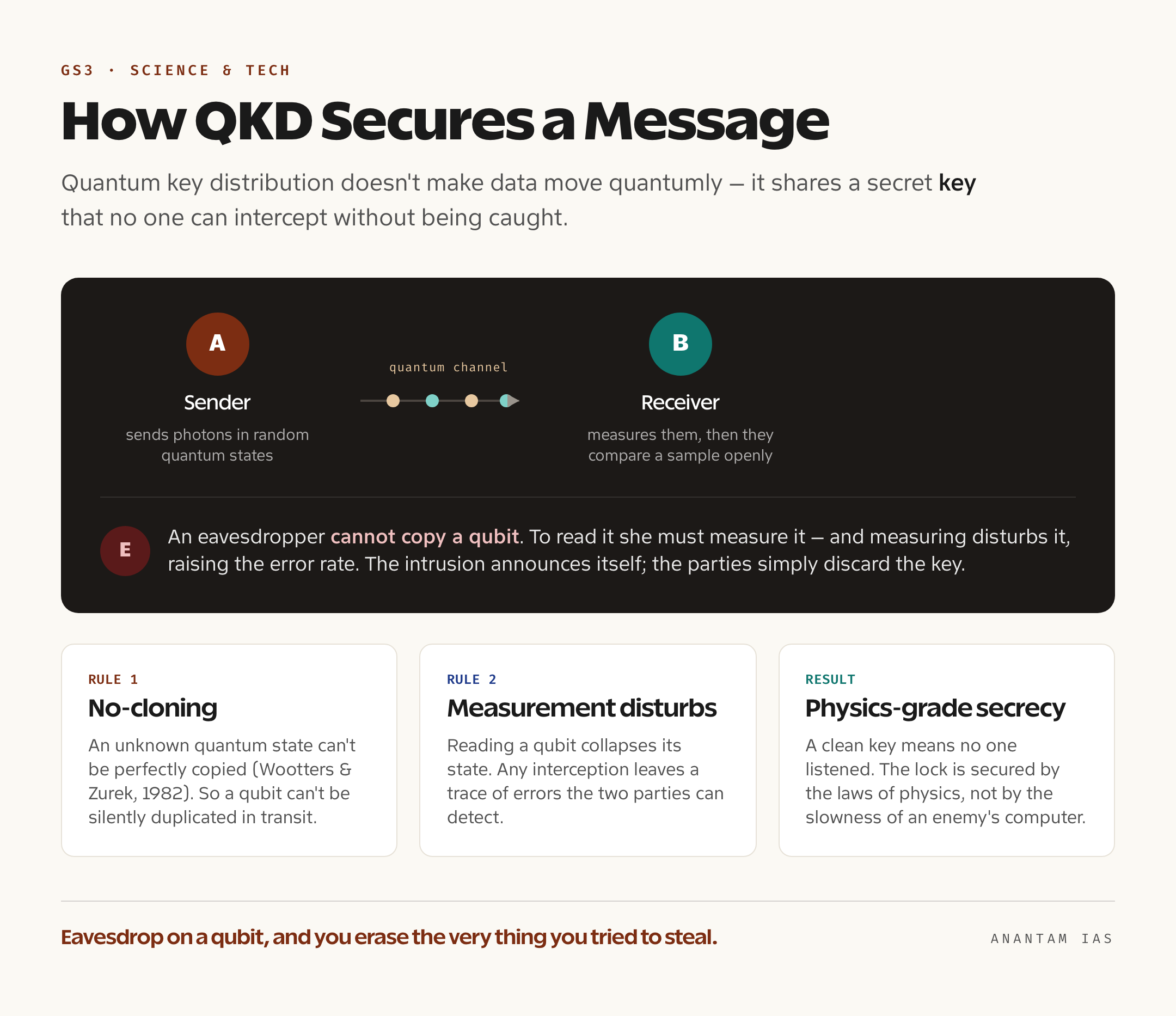
A third rule turns this from a curiosity into a security tool: the no-cloning theorem, proved by Wootters and Zurek in 1982. It says you cannot make a perfect copy of an unknown quantum state. This is not an engineering limit that better technology will overcome; it is a consequence of quantum mechanics itself. The implication for communication is profound. A classical message can be silently copied in transit — that is exactly how wiretaps and data interception work. A quantum message cannot. Any eavesdropper who tries to read a qubit must measure it, measuring disturbs it, and the disturbance shows up as errors the legitimate parties can detect. So the very act of spying announces itself. That single property is what people mean when they call the quantum internet “unhackable” — a slight overstatement, but a useful one: the channel is secured by physics, not by the assumption that an enemy’s computer is too slow.
It helps to be clear about what such a network is for, because it is not a faster version of the web. A quantum internet will not stream films or load pages better. Its purposes are narrower and deeper: to distribute encryption keys that no one can intercept, to link separate quantum computers into a larger distributed machine, and to connect ultra-precise quantum sensors and clocks so they can compare measurements with a precision impossible today. Think of it less as a replacement for the classical internet and more as a specialised secure layer running alongside it, handling the handful of jobs where physics-grade security or quantum coordination is worth the enormous effort.
How It Works: Keys, Teleportation and Repeaters
The most mature application, and the one already being deployed, is quantum key distribution, or QKD. The goal is modest but powerful: let two parties share a secret string of random numbers — a key — that absolutely no one else can know. In a typical scheme, a sender transmits photons encoded in random quantum states; the receiver measures them; the two then compare a sample of their results over an ordinary public channel. Because of the no-cloning rule, any interception raises the error rate above a known threshold, so if the numbers match cleanly, the parties know the key is private and can use it to encrypt their actual message with unbreakable one-time-pad secrecy. The message still travels over the normal internet — only the key rides the quantum channel. QKD does not make data move quantumly; it makes the lock physically uncrackable.
Moving the qubits themselves is harder, and this is where two more ideas come in. The first is quantum teleportation — a real, demonstrated technique with a misleading name. It does not transport matter; it transfers an unknown quantum state from one place to another using a pre-shared pair of entangled qubits plus a short classical message. Crucially, the original state is destroyed in the process, which is why teleportation does not violate the no-cloning theorem — there is only ever one copy, transferred, never duplicated. Teleportation is the basic move by which a future quantum internet would hand a qubit from one node to the next and stitch separate quantum computers into one.
The second is the hardest engineering problem in the field: distance. Photons get absorbed and scattered as they travel down a fibre, and because you cannot copy a qubit, you cannot simply amplify the signal the way classical repeaters boost a phone call. Beyond roughly a hundred kilometres, the loss is fatal. The answer is the quantum repeater — a device that uses entanglement swapping and quantum memory to extend a link in short, low-loss hops, building up entanglement across each segment and then joining them. Quantum repeaters depend on quantum memory, the ability to hold a fragile quantum state intact long enough to coordinate the next hop, and in 2025 European teams reached a milestone by entangling two such solid-state memories. Get repeaters working at scale and the continental quantum internet becomes possible; without them, quantum links stay stuck at city distances or rely on satellites firing photons through the thin upper atmosphere, where loss is far lower than in glass.
Quantum Internet Versus Quantum Computing
These two are constantly confused, and getting the distinction crisp is worth easy marks. A quantum computer is a machine that processes quantum information — it uses superposition and entanglement among many qubits to run certain calculations far faster than any classical computer, from simulating molecules to, eventually, breaking today’s public-key encryption. The quantum internet, by contrast, transmits quantum information between machines and people. One computes; the other communicates. You can read more in our explainer on quantum computing, which sets out how the machines themselves work.
The two are deeply linked, and the link runs in both directions. A quantum computer threatens classical communication, because algorithms like Shor’s would let a large enough machine crack the RSA and elliptic-curve encryption that secures most of the internet — the so-called “harvest now, decrypt later” danger, where adversaries hoover up encrypted data today to unlock once quantum machines mature. The quantum internet is one of the two answers to that threat: where QKD is available, it offers keys that no future computer can compute its way past. The other answer is software-based — new classical algorithms designed to resist quantum attack, the subject of our piece on post-quantum cryptography. Most experts expect both to be used together: post-quantum cryptography everywhere as the practical default, and quantum key distribution on the highest-value links where physics-grade security justifies the cost.
There is a second connection that points to the future. Because no one can copy a qubit, and because individual quantum computers are hard to scale past a certain size, one path to more powerful machines is to network several smaller quantum processors into a single distributed computer — and that network is, by definition, a quantum internet. So the quantum internet is not only a defence against quantum computers; it may turn out to be the way we build the biggest quantum computers of all. Communication and computation, in the quantum world, fold back into each other.
The Global Race and Where India Stands
No country wants to be the one whose secrets are readable while everyone else’s are not, so quantum communication has become a strategic contest. China is the clear front-runner. In 2016 it launched Micius, the world’s first quantum-communication satellite, and used it to demonstrate space-to-ground quantum key distribution and an intercontinental quantum-secured video call. It then wove that satellite link into a fibre backbone of more than 2,000 kilometres connecting Beijing and Shanghai, creating the first integrated space-and-ground quantum network. In March 2025 China went further, using a small, cheaper quantum microsatellite to distribute keys to multiple compact ground stations — including one in South Africa, its first intercontinental quantum link in the Southern Hemisphere — a sign the technology is moving from one giant flagship toward an affordable constellation.
Europe and the United States are pushing hard too, along different lines. The European Union is building EuroQCI, the European Quantum Communication Infrastructure, a planned network knitting together national fibre links with satellite QKD; all 27 member states have signed up, a dedicated secure-communication satellite is slated to fly, and the Quantum Internet Alliance, a consortium of more than 40 European partners, is racing to demonstrate a working multi-node quantum-internet prototype. The United States has poured money into testbeds and national-laboratory networks — the Long Island fibre testbed is one — but has not yet stood up a single federated continental network the way Europe and China have. The pattern is a familiar one: a few well-funded states sprinting to set the standards everyone else will have to adopt.
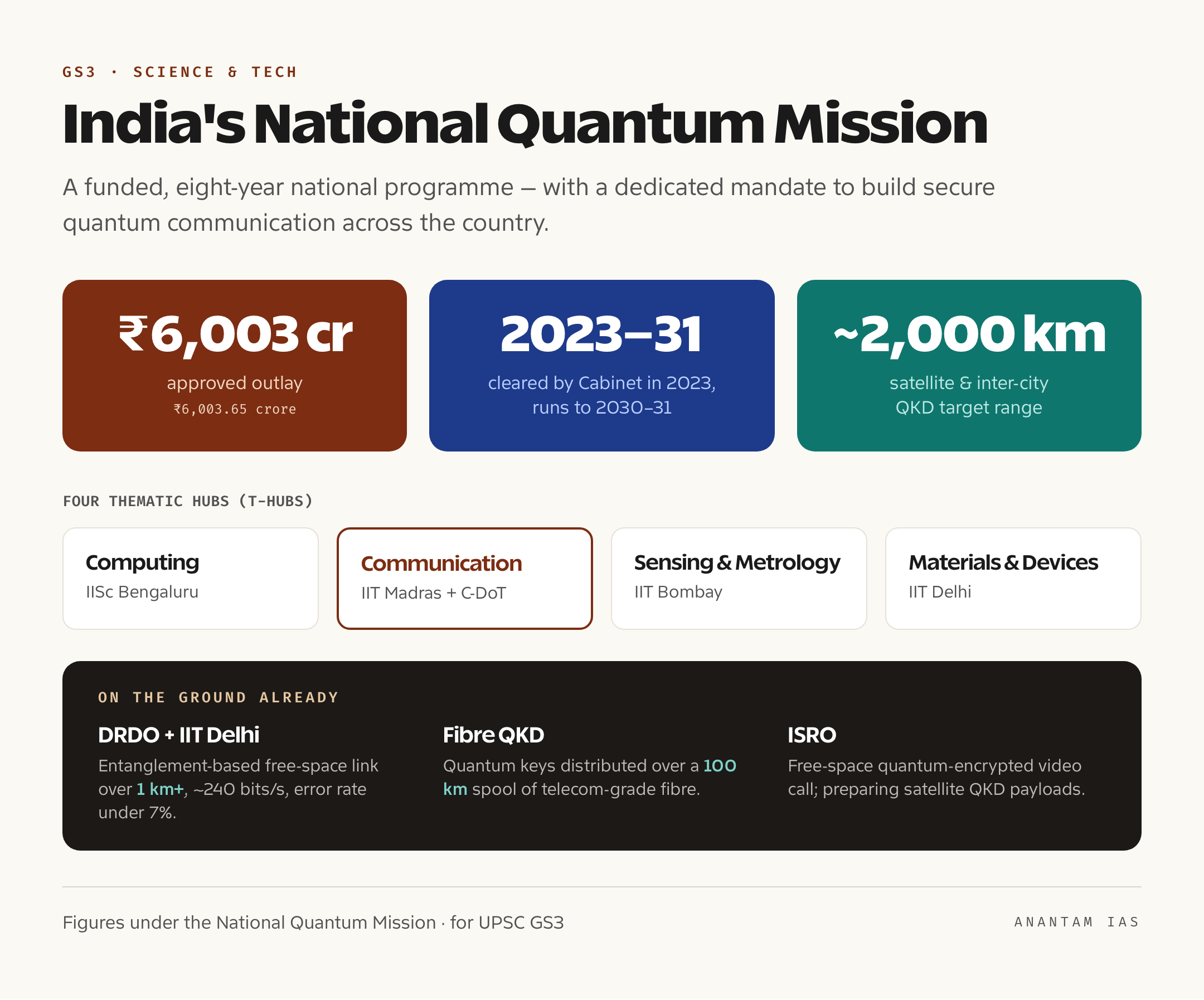
India has read the signal and acted. The centrepiece is the National Quantum Mission, approved by the Union Cabinet in April 2023 with an outlay of ₹6,003.65 crore running to 2030-31, making India one of only a handful of countries with a dedicated, fully funded national quantum programme. The mission runs through four Thematic Hubs, each a consortium of institutions: quantum computing at IISc Bengaluru, quantum communication jointly at IIT Madras and the government’s Centre for Development of Telematics (C-DoT), quantum sensing and metrology at IIT Bombay, and quantum materials and devices at IIT Delhi. The communication hub’s mandate is explicit and ambitious — satellite-based quantum key distribution and inter-city QKD over existing optical fibre across roughly 2,000 kilometres, plus multi-node networks with quantum memories and secure links with friendly nations.
The demonstrations are already arriving, which is what lifts this from policy to capability. DRDO, working with IIT Delhi, has shown entanglement-based free-space quantum secure communication over more than a kilometre on the IIT Delhi campus, achieving a secure key rate of about 240 bits per second with a quantum bit error rate under 7 per cent — modest numbers, but a genuine working entangled link. The same effort distributed quantum keys over a 100-kilometre spool of telecom-grade fibre. ISRO, for its part, has demonstrated free-space quantum communication over a few hundred metres — encrypting a live video conference with quantum-generated keys — and is preparing QKD payloads to fly on future satellites, the step that would carry India’s quantum-safe links beyond the ground. The hard truth is that India trails China by years on deployment. But it has the rare combination of a funded mission, working demonstrations across DRDO, ISRO and the IITs, and a clear strategic reason to keep going.
The Hurdles That Still Stand in the Way
It is worth being honest about how early this all is, because hype runs well ahead of hardware. The deepest enemy is decoherence — the tendency of fragile quantum states to leak their information into the surrounding environment and collapse, scrambled, in a fraction of a second. Heat, stray light, vibration, the faintest electromagnetic noise: any of it can destroy a qubit before it is used. Building systems isolated enough to preserve quantum states, often at temperatures near absolute zero, is extraordinarily hard and expensive, and decoherence is the wall that every quantum technology, communication and computing alike, keeps running into.
From that root grow the practical problems. Quantum memory — storing a qubit faithfully for long enough to coordinate a network — remains immature, yet repeaters cannot work without it. Quantum repeaters themselves are still largely experimental, which is precisely why long-distance quantum links today lean on line-of-sight satellites rather than continental fibre. Photon loss limits ground links to city-scale distances; key rates are slow, often thousands or millions of times below classical data rates; and the equipment is bulky, costly and demanding to run. There are softer challenges too — too few trained quantum engineers, supply chains for specialised components concentrated in a few countries, and the absence of agreed international standards for how quantum networks should interconnect.
And there is the policy paradox worth carrying into an answer. The same quantum revolution that promises unbreakable communication also threatens to break all the encryption protecting the world right now. That is why “quantum-safe” is suddenly urgent for governments, banks and militaries, and why the response is twofold — deploy quantum key distribution on the most sensitive links, and migrate everything else to post-quantum cryptography before adversaries’ machines mature. India’s mission is racing on both tracks, against a clock no one can see. The realistic timeline is sobering: useful city-scale and satellite quantum links exist now, but a true global quantum internet, with working repeaters knitting continents together, is most likely a development of the 2030s and beyond.
For Your Mains Answer
This is a high-value topic for GS Paper 3, which covers developments in science and technology, their applications and effects in everyday life, awareness in the fields of IT and computers, and indigenisation of technology. It connects directly to internal-security questions on cyber security and to defence-technology themes — quantum communication is, after all, a strategic capability. It also offers a sharp, current example for the Essay paper on technology, security and self-reliance. The skill examiners reward is the same one this article uses: explain a hard idea in plain language, anchor it with two or three exact figures, and always land the India connection.
How to Build the Answer
Move in a clean chain. Open by distinguishing a qubit from a bit (superposition and entanglement), then introduce the no-cloning theorem as the source of provable security. Explain QKD as the mature, deployed application — keys secured by physics — and name teleportation and quantum repeaters as the steps needed to move qubits and beat distance. Separate the quantum internet (communication) from quantum computing (computation), and show how the two connect through the encryption threat. Then place India in the global race — China’s Micius and Beijing-Shanghai backbone, the EU’s EuroQCI — and bring it home with the National Quantum Mission and the DRDO, IIT Delhi and ISRO demonstrations. Close with the honest hurdles and a balanced verdict. That arc — concept, security, application, distinction, global race, India, challenges — fits almost any question on the theme.
Common Mistakes to Avoid
Don’t say the quantum internet is just a faster internet; it is a specialised secure layer, not a replacement. Don’t claim quantum teleportation moves matter or sends information faster than light — it transfers a state and still needs a classical message. Don’t conflate the quantum internet with quantum computing; one transmits, the other computes. And don’t present QKD as the only defence against quantum attacks — pair it with post-quantum cryptography, the software answer, to show command of the full picture.
A Compact Answer Spine
Classical internet moves bits; quantum internet moves qubits using superposition + entanglement → no-cloning theorem (1982) means a qubit can’t be copied, so eavesdropping disturbs it and is detected → QKD shares a provably secret key (mature, deployed) → teleportation + quantum repeaters + quantum memory needed to move qubits and beat distance → quantum internet (communicates) ≠ quantum computing (computes), but linked via the encryption threat (“harvest now, decrypt later”) → global race: China’s Micius + 2,000 km Beijing-Shanghai backbone, EU’s EuroQCI, US testbeds → India: National Quantum Mission, ₹6,003.65 cr, 2023-2031, four T-Hubs, 2,000 km target; DRDO-IIT Delhi entangled free-space link, ISRO satellite QKD plans → hurdles: decoherence, quantum memory, repeaters, scaling → verdict: city-scale now, global quantum internet by the 2030s.
Diagram or Flowchart Idea
Draw a simple two-node sketch: a sender and receiver linked by a “quantum channel” carrying entangled photons, with a little eavesdropper figure between them labelled “any measurement → disturbance → detected.” Beside it, a short ladder of three rungs — QKD (now) → quantum repeaters and memory (next) → networked quantum computers (future). A clean concept-plus-roadmap visual like this communicates the whole story and is quick to draw.
A Balanced-Conclusion Line
A line that lands the marks: “The quantum internet promises communication secured by the laws of physics rather than the limits of computers — and for India, the National Quantum Mission is less about winning a sprint it is already behind in than about not being left dependent on others for the security of its own networks.”
How to Use Data Without Cramming
You need only a handful of anchors: the no-cloning theorem (1982), China’s Micius (2016) and its 2,000-km Beijing-Shanghai backbone, India’s National Quantum Mission (₹6,003.65 crore, 2023-2031, four hubs, 2,000-km target), and one homegrown demonstration — DRDO and IIT Delhi’s entangled free-space link of more than a kilometre. Attribute them plainly — “under the National Quantum Mission” — rather than scattering numbers without a source.
Frequently Asked Questions
What is the quantum internet, in one line?
It is a network that transmits quantum information — qubits carried by single photons — using entanglement and quantum key distribution, rather than the classical 0s and 1s of today’s internet. Its purpose is not speed but security and quantum coordination: distributing encryption keys that physically cannot be intercepted, linking quantum computers, and connecting ultra-precise quantum sensors. Because the no-cloning theorem forbids copying an unknown quantum state, any eavesdropper disturbs the message and is detected, which is why its security rests on physics rather than on the difficulty of a maths problem.
How is the quantum internet different from quantum computing?
A quantum computer processes quantum information to run certain calculations far faster than classical machines; the quantum internet transmits quantum information between machines and people. One computes, the other communicates. They are linked: a powerful quantum computer threatens today’s encryption, and the quantum internet (through quantum key distribution) is one defence against that threat — while networking several quantum computers over a quantum internet is also a route to building bigger quantum machines.
Is the quantum internet really unhackable?
Almost, and the qualifier matters. Quantum key distribution makes the key provably secure — any interception disturbs the qubits and is caught — so the encryption it protects cannot be broken by computing power, present or future. But real devices can still have flaws, side channels and implementation bugs, and the actual data usually still travels over the classical internet. So it is better to say the quantum internet offers communication whose secrecy is secured by the laws of physics, which is far stronger than today’s maths-based encryption, rather than literally unhackable in every respect.
What is India doing about the quantum internet?
India runs the National Quantum Mission, approved in 2023 with an outlay of about ₹6,003 crore through 2031, with a dedicated quantum-communication hub led by IIT Madras and C-DoT targeting satellite and inter-city quantum key distribution over roughly 2,000 kilometres. DRDO and IIT Delhi have demonstrated an entanglement-based free-space quantum link over more than a kilometre, the programme has distributed keys over 100 km of fibre, and ISRO has shown short-range free-space quantum communication and is preparing satellite QKD payloads.
Practice Questions
Prelims MCQs
- The “no-cloning theorem,” central to quantum communication, states which of the following?
(a) Two entangled particles can never be separated
(b) An unknown quantum state cannot be perfectly copied
(c) A qubit can store only one bit of information
(d) Quantum information always travels faster than light
Answer: (b) Proved in 1982, the no-cloning theorem says an arbitrary unknown quantum state cannot be duplicated; this is what makes eavesdropping detectable and quantum key distribution secure. - Quantum Key Distribution (QKD) provides security primarily because:
(a) It uses faster computers than an attacker
(b) The encryption key is too long to guess
(c) Any attempt to intercept the qubits disturbs them and is detected
(d) The message travels faster than light
Answer: (c) An eavesdropper must measure the qubits to read them, and measurement disturbs their state, raising the error rate and revealing the intrusion — so the key’s secrecy rests on physics, not on computational difficulty. - With reference to quantum teleportation, which statement is correct?
(a) It transports physical particles instantly across space
(b) It transfers an unknown quantum state using shared entanglement and a classical message, destroying the original
(c) It allows faster-than-light communication
(d) It copies a qubit so both sender and receiver hold it
Answer: (b) Teleportation transfers a quantum state, not matter; it relies on pre-shared entanglement plus a classical channel, and the original state is destroyed — consistent with the no-cloning theorem. - Which of the following best describes the role of a quantum repeater?
(a) It amplifies a qubit’s signal like a classical amplifier
(b) It copies qubits to broadcast them widely
(c) It extends quantum communication over long distances using entanglement swapping and quantum memory
(d) It converts qubits into classical bits for storage
Answer: (c) Because qubits cannot be copied or amplified, repeaters use entanglement swapping and quantum memory to build links in short, low-loss hops, overcoming photon loss over distance. - India’s National Quantum Mission, approved in 2023, is correctly described by which statement?
(a) It has an outlay of about ₹6,003 crore and runs to 2030-31 with four Thematic Hubs
(b) It is funded entirely by private industry
(c) It focuses only on quantum computing, not communication
(d) It is implemented solely by ISRO
Answer: (a) The mission has an outlay of ₹6,003.65 crore through 2030-31 and runs via four Thematic Hubs — computing, communication, sensing and metrology, and materials and devices.
Mains Practice Questions
- Explain the concept of the quantum internet and how it differs from quantum computing. Why is its security described as resting on the laws of physics rather than on computational difficulty? (15 marks, 250 words)
- Discuss the working principles of quantum key distribution and quantum repeaters. What are the major technical challenges in building a long-distance quantum communication network? (15 marks, 250 words)
- “The same quantum revolution that promises unbreakable communication also threatens to break the encryption that secures the world today.” Examine this paradox and the twin response of quantum key distribution and post-quantum cryptography. (15 marks, 250 words)
- Evaluate India’s preparedness in quantum communication with reference to the National Quantum Mission and recent DRDO, IIT and ISRO demonstrations. How does India compare with the global leaders? (15 marks, 250 words)
- Quantum communication is increasingly seen as a strategic capability. Analyse its implications for India’s national security and the steps needed to build sovereign quantum-safe networks. (10 marks, 150 words)