Raimona National Park: Assam’s Sixth National Park Explained
Notified on World Environment Day 2021, Raimona is Assam's sixth national park and the Indian stronghold of the golden langur. Here is what it protects, why it sits at the heart of an India-Bhutan landscape, and how to write about it for the Mains.
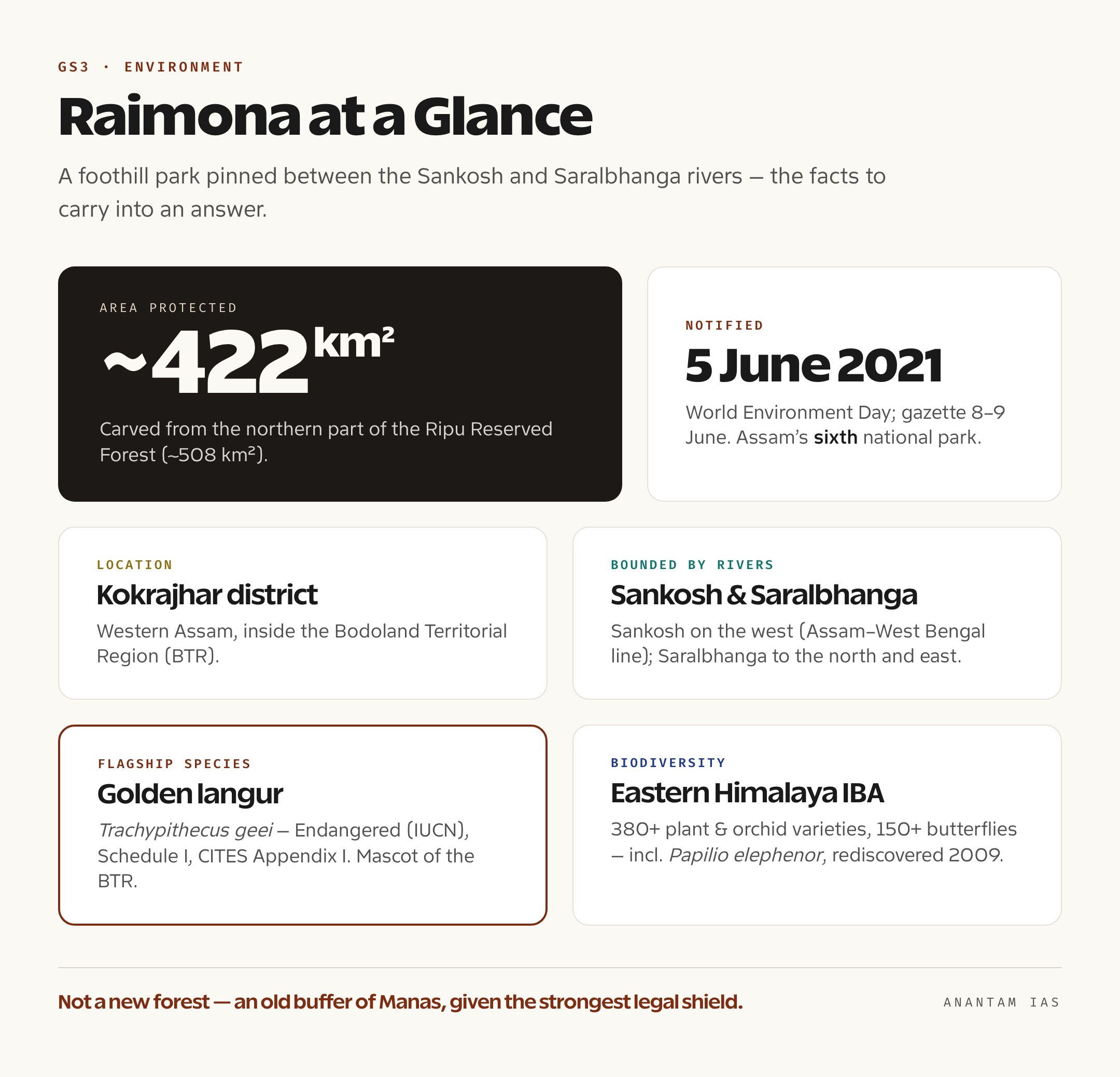
Raimona National Park is Assam’s sixth national park, notified on 5 June 2021 (World Environment Day) and covering about 422 square kilometres in the Kokrajhar district of western Assam, within the Bodoland Territorial Region. Carved from the northern part of the Ripu Reserved Forest, it is the flagship stronghold of the endangered golden langur (Trachypithecus geei) and forms the western arm of the transboundary India–Bhutan Manas conservation landscape. It was the first national park notified in the Bodoland Territorial Region after the 2020 Bodo Peace Accord.
On 5 June 2021 — World Environment Day — Assam quietly added its sixth national park, and almost no one outside the state’s forest circles noticed at first. Raimona was not a new forest. It was a stretch of the old Ripu Reserved Forest in Kokrajhar district that had been guarding the western flank of Manas for decades, suddenly handed the strongest legal shield Indian law offers. The upgrade mattered because of what lives there: the golden langur, a primate so localised that the entire global population fits inside a thumbnail of forest straddling Assam and southern Bhutan.
And the timing was no accident. Raimona was the first national park notified inside the Bodoland Territorial Region after the 2020 Bodo Peace Accord, which means a community that had spent decades in armed struggle chose, almost immediately, to put its forests under protection. That is the real story of Raimona — a conservation map and a peace map drawn over the same ground.
What Raimona Protects and Where It Sits
Raimona National Park covers about 422 square kilometres in the Kokrajhar district of western Assam, inside the Bodoland Territorial Region. The Government of Assam announced it on World Environment Day, 5 June 2021, with the gazette notification following on 8-9 June, making it the state’s sixth national park. The name comes from Raimona, a historical capital linked to the old Bijni estate, so the park carries a local memory, not an administrative coinage.
It was not built from scratch. Raimona was carved out of the northern portion of the Ripu Reserved Forest — a reserve of about 508 square kilometres — sitting next to the Chirang Reserved Forest and the Ultapani belt. For years this tract was the western-most buffer of the Manas Tiger Reserve, and conservationists had long pushed to turn the Ripu-Chirang forests into a wildlife sanctuary. The 2021 notification went further than that older proposal, giving the area full national-park status in one move.
The geography is easy to fix in the mind once you anchor it to rivers. The Sankosh River runs along the western edge, marking the boundary between Assam and West Bengal as it descends from Bhutan; the Saralbhanga River frames the north and east. The Ripu Reserved Forest sits to the south. So Raimona is a wedge of foothill forest pinned between two rivers in the Eastern Himalaya, one of the world’s recognised biodiversity hotspots, and BirdLife International treats it as an Important Bird and Biodiversity Area. The terrain shifts from moist deciduous and semi-evergreen forest to riverine grassland, holding by various counts more than 380 plant and orchid varieties and over 150 species of butterfly — including the yellow-crested spangle, Papilio elephenor, rediscovered here in 2009 after roughly a century with no confirmed sighting.
The India-Bhutan Manas Landscape
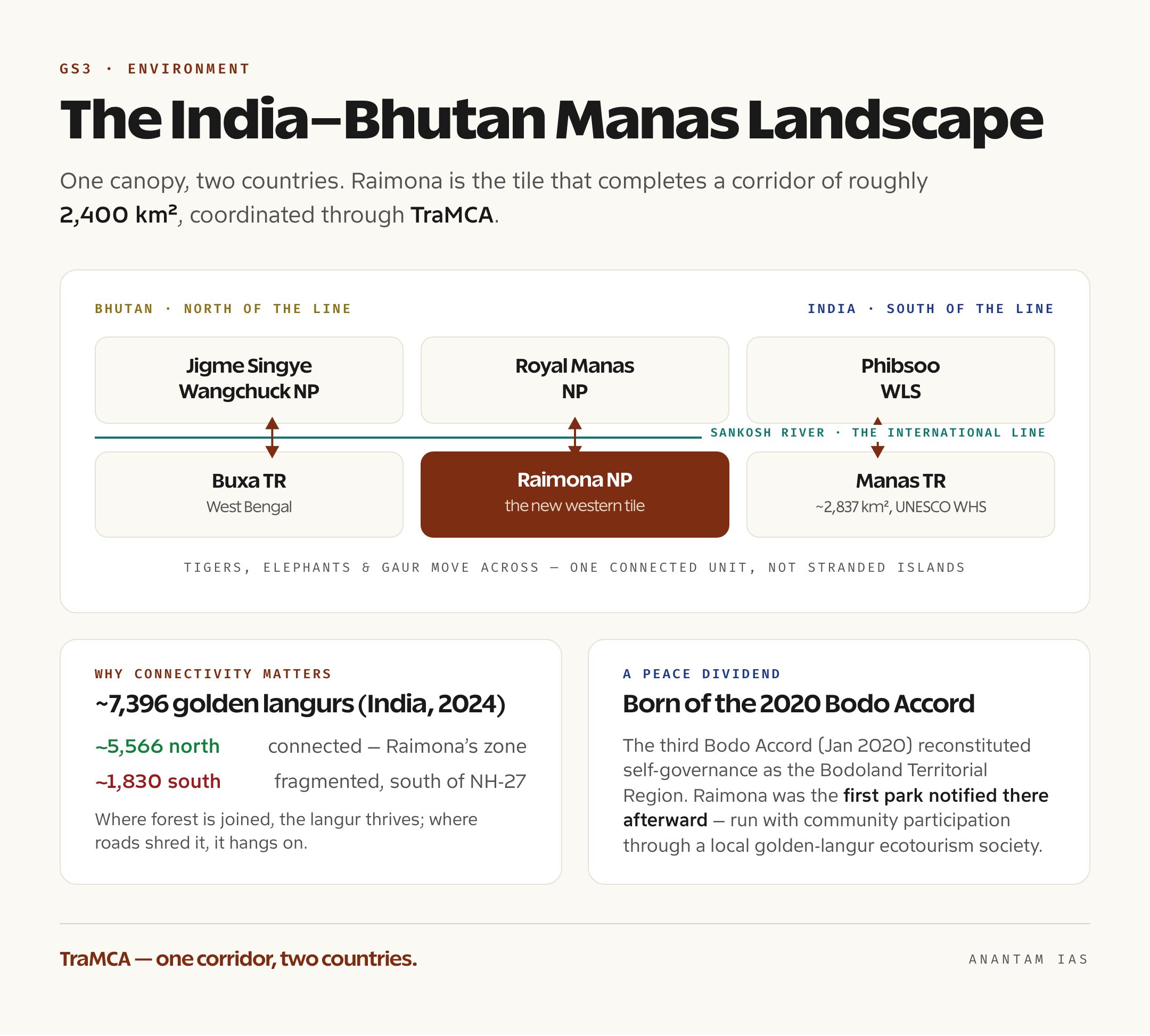
The single most important fact about Raimona is that it does not stand alone. It is one tile in a contiguous forest landscape of roughly 2,400 square kilometres that ignores the international border. To its east lies the Manas Tiger Reserve, itself about 2,837 square kilometres and a UNESCO World Heritage Site. To the south-west the forest continues toward the Buxa Tiger Reserve in West Bengal. And across the Sankosh, in Bhutan, the same canopy carries on into the Phibsoo Wildlife Sanctuary, the Royal Manas National Park and the larger Jigme Singye Wangchuck National Park.
This stitched-together expanse is managed, in principle, through the Transboundary Manas Conservation Area, usually shortened to TraMCA — a cooperative arrangement under which the Assam and Bhutan forest departments coordinate patrolling, monitoring and habitat work across the line. The reason it matters is biological. Tigers, Asian elephants, gaur and other wide-ranging animals do not recognise the Sankosh as a boundary; they need room to move between seasons and across generations, and a single isolated park, however well guarded, cannot give them that. Raimona’s value is that it closes the western gap in this corridor, letting the Indo-Bhutan population behave as one connected unit rather than a string of stranded islands. The Wildlife Trust of India’s Vivek Menon has floated the idea of formalising it further as a transboundary “Peace Park” with Bhutan — a label that would fit a landscape born out of an actual peace accord.
Why the Golden Langur Makes Raimona Special
If Raimona has a face, it is the golden langur, Trachypithecus geei — a monkey with a cream-to-burnished-gold coat, a black face and a long tail, named after the naturalist E.P. Gee who brought it to scientific attention in 1953. It is one of the most range-restricted primates on Earth. The entire wild population lives in a single triangle of forest bounded by the Manas and Sankosh rivers in Assam and a sliver of south-central Bhutan, and nowhere else. The IUCN Red List rates it Endangered, it sits in Schedule I of the Wild Life (Protection) Act, 1972, and it is listed in CITES Appendix I — the strongest tiers of protection available.
The numbers are cautiously encouraging but fragile. A survey reported in the journal Global Ecology and Conservation in 2024 estimated about 7,396 golden langurs in India, up from roughly 6,000 in 2008-09. That total splits into a healthier northern population of around 5,566 animals in the western Manas landscape — the zone Raimona anchors — and a badly fragmented southern population of about 1,830 langurs scattered in forest patches south of National Highway 27. The split is the whole problem in one statistic: where the forest is connected, the langur thrives; where roads and fields have shredded it, the animal hangs on in isolated pockets that slowly lose genetic diversity. Over the longer view, researchers note the species has still declined by more than 30 percent across three decades.
That is why national-park status for Raimona is more than a paperwork upgrade. By locking in the connected northern habitat, it protects the half of the population that has the best chance. The langur has also become a regional emblem — it is the official mascot of the Bodoland Territorial Region — which ties the animal’s fate to local pride rather than to distant directives from outside.
A Park Born of the Bodo Peace Accord
You cannot explain Raimona honestly without the politics, because the politics is the reason it exists at all. For decades, Bodoland in western Assam was a theatre of insurgency, with armed groups demanding a separate state and waves of violence that made systematic conservation almost impossible. The breakthrough came in January 2020, when the Centre, the Assam government and Bodo organisations signed the third Bodo Accord, dissolving the largest insurgent faction and reconstituting the area’s self-governance as the Bodoland Territorial Region under the Bodoland Territorial Council.
Raimona was notified barely a year and a half later, and that sequence is the point. A region that had been fighting now had the autonomy, and the incentive, to manage its own forests — and one of its first big decisions was to give its best wildlife habitat the highest legal protection. The golden langur becoming the BTR’s mascot is part of the same gesture: conservation reframed as a marker of Bodo identity and a peace dividend, not a restriction imposed from above.
The community has stayed in the picture. Soon after the park was declared, residents formed the Raimona Golden Langur Eco Tourism Society, registered in late June 2021, to run low-impact tourism and give fringe villages a stake in keeping the forest intact. That model — local people earning from a living forest rather than from clearing it — is exactly what the post-Accord settlement was meant to enable, and it is why Raimona is cited in UPSC discussions as a working example of indigenous and community-led conservation under the Sixth Schedule framework.
Threats and the Road Ahead
A young park inherits old problems, and Raimona’s are familiar across the Brahmaputra foothills. Habitat fragmentation is the deepest one: decades of encroachment into the Ripu and Chirang reserve forests, plus roads and power lines slicing through, have broken the once-continuous canopy that wide-ranging animals depend on. For the golden langur, fragmentation turns lethal in a specific, modern way — in late 2024, several langurs were electrocuted on power lines in the Kokrajhar and Bongaigaon belt as they tried to leap across gaps in the broken forest, a reminder that infrastructure built without insulation or canopy bridges quietly kills the very species the park exists to save.
The other pressures stack up alongside it. There is poaching, both of hardwood and of animals spilling over from the adjoining Manas landscape, including its rhinos. Human-elephant conflict flares along the fringe villages where crops meet forest. Invasive plants such as Mikania micrantha, a smothering vine, degrade the understorey that grazers rely on. And transboundary coordination with Bhutan, though genuine, is logistically hard across an international line with separate budgets, laws and command chains.
The way forward writes itself from the diagnosis. Restoring connectivity — through canopy bridges, insulated or buried power lines, and reclaiming encroached corridors — would do more for the langur than any single measure. Deepening TraMCA into joint patrolling and shared monitoring protocols, rather than goodwill alone, would make the India-Bhutan corridor function as one. And channelling tourism revenue back to the community societies keeps the local stake alive, so that the people living beside Raimona stay its guardians rather than its competitors. Get those three right and Raimona becomes the textbook case for how a peace accord, indigenous governance and biodiversity protection can pull in the same direction.
For Your Mains Answer
Raimona is a high-value example because it sits at the intersection of three GS papers. In GS Paper 3, it slots into conservation, biodiversity, protected-area networks and the idea of transboundary or landscape-level management. In GS Paper 2, it illustrates federalism and autonomous self-governance — the Sixth Schedule, the Bodoland Territorial Council, and community participation in environmental governance. And in GS Paper 1, it touches the geography of the Eastern Himalaya and the human geography of the Bodo region. The skill is to use Raimona as a case study that proves a larger argument, rather than reciting it as a standalone fact.
How to Build the Answer
Open with the species or the landscape, not the date. Lead with the golden langur’s range-restriction or with the India-Bhutan corridor, then bring in Raimona as the institutional response. Move outward in widening circles: the park, the TraMCA landscape, the Bodo Accord context, the threats, and finally the way forward. If the question is about conservation, anchor on connectivity and the langur numbers; if it is about governance, anchor on the post-2020 Accord and community-led tourism. That arc — flagship, landscape, politics, threats, solutions — fits almost any framing of the question.
Common Mistakes to Avoid
Don’t confuse Raimona with Dehing Patkai, which was notified weeks later in 2021 as a separate park. Don’t call the golden langur a “monkey of the Western Ghats” — it is strictly Indo-Bhutan foothills. Don’t overstate Bhutan cooperation as seamless; it is real but limited. And don’t drown the answer in a list of species with no argument; one or two anchors — the 422 sq km area, the roughly 7,396 langurs — are plenty.
A Compact Answer Spine
Golden langur is range-restricted to the Manas-Sankosh triangle → Raimona (422 sq km, notified 5 June 2021) protects the connected northern population → it completes the western arm of the 2,400 sq km India-Bhutan Manas landscape managed through TraMCA → born of the 2020 Bodo Accord and run with community participation → threats are fragmentation, electrocution, poaching, invasives → way forward is connectivity, joint transboundary patrolling and community tourism.
Diagram or Flowchart Idea
Draw a simple landscape map: a horizontal band with the Sankosh river as a vertical line down the middle. Put Manas and Raimona on the Indian side, Royal Manas and Phibsoo on the Bhutan side, and draw arrows of animal movement crossing the river. Label the whole band “TraMCA — one corridor, two countries.” A clean transboundary sketch like this earns marks fast and is quick to draw.
A Balanced-Conclusion Line
Raimona shows that the strongest conservation is the kind a community chooses for itself — and that protecting a forest and protecting a peace can be the same act.
How to Use Data Without Cramming
Carry three numbers and no more: 422 square kilometres, sixth national park of Assam, and roughly 7,396 golden langurs in India. Attribute the langur figure to a 2024 survey rather than quoting it as eternal truth, and you sound like someone who has read the science rather than memorised a fact sheet.
FAQ
When was Raimona National Park created, and where is it? Raimona was announced on 5 June 2021 — World Environment Day — with the gazette notification following on 8-9 June 2021, making it Assam’s sixth national park. It covers about 422 square kilometres in the Kokrajhar district of western Assam, within the Bodoland Territorial Region, carved largely from the northern part of the Ripu Reserved Forest.
Why is the golden langur so closely linked to Raimona? The golden langur, Trachypithecus geei, lives only in a triangle of forest between the Manas and Sankosh rivers in Assam and southern Bhutan. Raimona protects a large slice of the healthier northern population, and the animal is the official mascot of the Bodoland Territorial Region, so the park has become the species’ best-protected Indian stronghold.
What is the Transboundary Manas Conservation Area? TraMCA is a cooperative arrangement under which Assam and Bhutan coordinate conservation across a contiguous forest landscape of roughly 2,400 square kilometres. Raimona links to the Manas Tiger Reserve and Buxa in India and to Bhutan’s Phibsoo, Royal Manas and Jigme Singye Wangchuck parks, allowing tigers, elephants and gaur to move across the international border.
How is Raimona connected to the Bodo Peace Accord? The 2020 Bodo Accord ended a long insurgency and reconstituted the area’s self-governance as the Bodoland Territorial Region. Raimona was the first national park notified there afterward, making it a visible peace dividend — a region that had been at war choosing to give its best forest the highest legal protection and running it with community participation.
Practice Questions
Prelims MCQs
- With reference to Raimona National Park, consider the following: it was notified as Assam’s sixth national park, lies in the Kokrajhar district, and is bounded on the west by the Sankosh River. Which statement is correct?
(a) It is Assam’s seventh national park
(b) It lies in the Dibrugarh district
(c) It is bounded on the west by the Sankosh River, which separates Assam and West Bengal
(d) It was notified in 2011.
Answer: (c) The Sankosh forms Raimona’s western boundary between Assam and West Bengal; the park is Assam’s sixth, in Kokrajhar, notified in June 2021. - The golden langur (Trachypithecus geei) is naturally found in:
(a) the Western Ghats
(b) the Sundarbans
(c) a triangle of forest between the Manas and Sankosh rivers in Assam and southern Bhutan
(d) the Andaman Islands.
Answer: (c) The golden langur is a range-restricted primate of the Indo-Bhutan foothills, found nowhere outside the Manas-Sankosh triangle. - Raimona National Park is contiguous with which of the following protected areas? 1. Manas Tiger Reserve (Assam) 2. Buxa Tiger Reserve (West Bengal) 3. Royal Manas National Park (Bhutan). Select the correct answer:
(a) 1 only
(b) 1 and 3 only
(c) 2 and 3 only
(d) 1, 2 and 3.
Answer: (d) All three lie within the connected India-Bhutan Manas landscape managed through TraMCA. - The golden langur is the official mascot of which administrative region?
(a) North Cachar Hills Autonomous Council
(b) Bodoland Territorial Region
(c) Karbi Anglong Autonomous Council
(d) Tripura Tribal Areas Autonomous District Council.
Answer: (b) The golden langur is the mascot of the Bodoland Territorial Region, where Raimona is located. - Under which law and schedule is the golden langur given the highest domestic protection in India?
(a) Schedule II of the Forest (Conservation) Act, 1980
(b) Schedule I of the Wild Life (Protection) Act, 1972
(c) Schedule III of the Biological Diversity Act, 2002
(d) Schedule IV of the Environment (Protection) Act, 1986.
Answer: (b) The golden langur is listed in Schedule I of the Wild Life (Protection) Act, 1972, and is rated Endangered by the IUCN.
Mains Practice Questions
- “Transboundary protected areas are central to large-mammal conservation in South Asia.” Examine this statement with reference to the India-Bhutan Manas landscape and the role of Raimona National Park. (15 marks, 250 words)
- Discuss how the 2020 Bodo Peace Accord shaped conservation outcomes in western Assam, using Raimona National Park as a case study of indigenous and community-led forest governance. (15 marks, 250 words)
- Habitat fragmentation, not poaching alone, is the principal threat to range-restricted primates such as the golden langur. Critically analyse this claim and suggest measures to restore ecological connectivity. (15 marks, 250 words)
- Evaluate the effectiveness of cooperative arrangements like the Transboundary Manas Conservation Area in managing shared biodiversity across international borders. (10 marks, 150 words)
- Community-based ecotourism can align local livelihoods with biodiversity protection, but only under specific conditions. Discuss with reference to the conservation model around Raimona National Park. (10 marks, 150 words)