Rene Descartes: Reason, Virtue and Cartesian Ethics (UPSC GS IV)
Rene Descartes for UPSC GS IV — life, cogito ergo sum, rationalist ethics, virtue as right reason, Sartrean existentialist contrast, and civil service relevance.
Modern philosophy is conventionally said to begin with Rene Descartes. His decision, in the 1630s, to doubt everything he could possibly doubt and to rebuild knowledge from indubitable foundations — that famous methodological scepticism — set the agenda for European philosophy for the next four centuries. For the UPSC GS IV aspirant, Descartes matters less as a metaphysician than as the figure who established reason as the primary instrument of moral life and right reasoning as the core of virtue.
This article works through Descartes's life, his philosophical contributions, his key works, his influence on subsequent ethical thinking, and the lessons that the contemporary civil servant can draw from a seventeenth-century French philosopher.
Life and times
Rene Descartes was born in 1596 in La Haye en Touraine, France (the town has since been renamed Descartes in his honour). The son of a lawyer-magistrate, he was educated at the Jesuit Royal College of La Flèche, one of the finest schools in Europe at the time, where he received a thorough grounding in classical languages, philosophy and mathematics.
His youth coincided with the Scientific Revolution. Galileo, Kepler and Bacon were rewriting natural philosophy. The wars of religion were tearing Europe apart. The medieval scholastic synthesis of Aquinas was visibly cracking. Descartes lived through this turbulence as a quiet, private figure — serving briefly in the army of Maurice of Nassau, travelling widely, settling for two decades in the Netherlands where intellectual freedom was greater than in France.
The pivotal moment in Descartes's intellectual life occurred on a winter's night in 1619, in a heated room ("poêle") in Bavaria, where he had a series of dreams that he interpreted as a call to a new method of inquiry. Out of that experience came the project that would occupy the rest of his life — the construction of a unified philosophy on rational foundations.
He died in 1650 in Stockholm, where he had been summoned by Queen Christina of Sweden to teach her philosophy. The early-morning lessons in the Swedish winter ruined his health.
Philosophical contributions
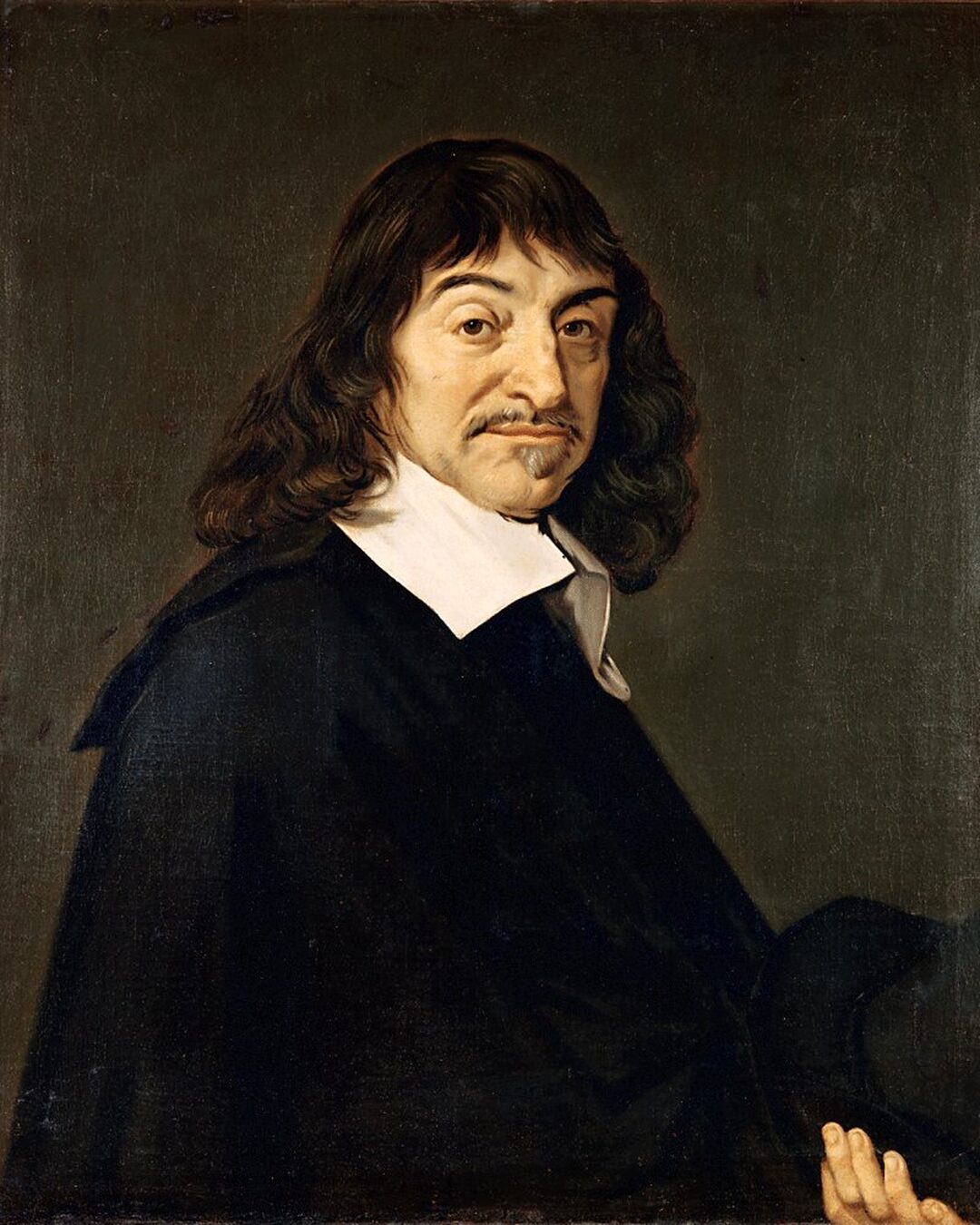
Descartes's contributions can be grouped under five heads.
1. Methodological scepticism and the cogito
In the Meditations on First Philosophy (1641), Descartes undertook a systematic doubt — could anything resist being doubted? Sense perception could deceive (illusions, dreams). Mathematical truths could be doubted (perhaps a deceiving demon arranges things to seem mathematical). What remained was the very fact of doubting — and doubting requires a doubter.
"Cogito, ergo sum" — I think, therefore I am.
The cogito is the indubitable starting point of Cartesian philosophy. Whatever else can be doubted, the existence of the thinking self cannot. From this foundation, Descartes attempted to rebuild knowledge of the external world, of God, and of moral truth.
2. Mind-body dualism
Descartes argued that mind (res cogitans, thinking substance) and body (res extensa, extended substance) are radically distinct. The mind is non-extended, indivisible, knowing; the body is extended, divisible, mechanical. This dualism shaped subsequent philosophy of mind — both as foundation and as target. Modern philosophy of mind largely consists of attempts to repair, replace or refine the Cartesian split.
3. Reason as the primary instrument
For Descartes, reason is sufficient in searching for the goods we should seek, and virtue consists of the correct reasoning that should guide our actions. This is the rationalist core of Cartesian ethics. Where Aristotle grounded virtue in habituation and Aquinas combined reason with revelation, Descartes located virtue in the right use of the mind.
This makes Cartesian ethics an ethics of method. To be virtuous is to reason carefully — to attend to clear and distinct ideas, to suspend judgement when evidence is insufficient, to follow logic where it leads.
4. The provisional moral code
In Discourse on the Method (1637), Descartes laid out a "provisional morality" to guide his life while he reconstructed his philosophical foundations. Three maxims stand out.
- Obey the laws and customs of your country and stick with the religion you were raised in until you have rebuilt your foundations.
- Be firm and resolute in action once you have decided, even on imperfect evidence — indecisiveness is worse than imperfect decision.
- Master yourself rather than fortune — change your desires rather than the order of the world, since one is in your power and the other is not.
This provisional morality is striking. It is conservative in social orientation, decisive in personal action, and Stoic in its inner discipline.
5. Foundationalism in epistemology
Descartes is the paradigmatic foundationalist: he held that knowledge must be built on indubitable foundations from which all other beliefs can be derived. This methodological commitment shaped not just philosophy but science and policy reasoning. The modern preference for evidence-based policy traces partly to this Cartesian intuition that good thinking must start from secure foundations.
Key works
- Discourse on the Method (1637) — the popular introduction; introduced the cogito and the four rules of method.
- Meditations on First Philosophy (1641) — the systematic exposition of methodological doubt and the rebuilding of knowledge.
- Principles of Philosophy (1644) — the textbook treatment, intended for use in universities.
- The Passions of the Soul (1649) — Descartes's closest approach to a sustained ethics; a treatment of the emotions and their regulation by reason.
Influence on ethical theory

Descartes's influence runs in several directions.
- Rationalism — Spinoza, Leibniz and Kant all built rationalist ethical systems whose ancestor is Cartesian.
- Modern philosophy of mind — every theory of consciousness either accepts or refutes mind-body dualism.
- Scientific method — the Cartesian commitment to clear and distinct ideas, methodical doubt and systematic reconstruction shaped modern scientific reasoning.
- Existentialism — figures like Sartre wrote partly against Cartesian assumptions while inheriting the Cartesian focus on the conscious self. Sartre's view, that individuals must be concerned with ethics rather than society because individuals impact society, accepts the Cartesian centring of consciousness while rejecting Cartesian rationalism. His ethical views are deeply intertwined with his existentialist philosophy, focusing on individual freedom, responsibility, and the creation of one's own values.
Descartes and Sartre — a useful contrast
The contrast clarifies what is distinctive in each.
| Descartes | Sartre |
|---|---|
| Reason is sufficient for ethics | Reason cannot supply values; humans must create them |
| Virtue is correct reasoning | Authentic existence is the assumption of freedom and responsibility |
| Dualist (mind / body) | Phenomenological — consciousness is intentional, directed at the world |
| Foundationalist | Anti-foundationalist — existence precedes essence |
| Conservative provisional morality | Radical individual ethical responsibility |
Both centre the conscious self. Descartes treats the self as the rational thinker; Sartre treats it as the responsible chooser. Both views can speak to civil servants — one emphasising disciplined reasoning, the other emphasising responsibility for one's choices.
Relevance to civil services and Indian governance
Descartes's contributions translate into administrative practice in several ways.
Methodological doubt as anti-corruption discipline
The Cartesian habit of subjecting received opinion to deliberate doubt has direct application. The officer who automatically distrusts the convenient narrative — "this contractor is reliable, this beneficiary is genuine, this file requires no further inquiry" — is more likely to catch the irregularity that less suspicious colleagues miss.
Clear and distinct ideas as a writing standard
Descartes's criterion for good thinking — that ideas be clear (distinguishable from confusion) and distinct (not blurred with other ideas) — is a workable standard for office notes, public communications and policy briefs. The Cartesian sentence is one whose meaning is unambiguous and whose reasoning is traceable.
Provisional morality as decision-making heuristic
Descartes's three maxims map onto good administrative practice.
- Obey the laws and customs of the country until reasoned grounds for change emerge.
- Decide and act firmly even under imperfect information; indecision is itself a decision, usually a worse one.
- Master desires rather than circumstances — accept what cannot be changed, focus on what can.
Reason and emotion in The Passions of the Soul
Descartes's late work argues that reason can and should regulate emotion — not by suppression but by understanding the source and re-evaluating the cause. This is the seventeenth-century anticipation of modern cognitive-behavioural therapy and is broadly applicable to administrative self-management.
Two Indian case studies
Case study 1 — Vinod Rai's CAG audits as Cartesian inquiry
Rai's audits proceeded by methodical doubt — the conventional narrative was set aside, every assumption was tested against evidence, and conclusions were drawn only from what survived rigorous examination. The 2G and Coalgate audits exemplify Cartesian method applied to public-finance scrutiny.
Case study 2 — the Aadhaar privacy debate
The Supreme Court's Puttaswamy judgement (2017) and subsequent Aadhaar judgement (2018) reasoned partly on Cartesian-Sartrean lines about the nature of selfhood and individual autonomy. The framing of privacy as essential to the conscious, choosing self echoes the deeper European tradition that begins with the cogito.
UPSC past-year question references
- GS IV regularly tests rationalist versus emotive accounts of ethical reasoning.
- 2018 GS IV: discussion of moral reasoning in case studies that benefit from explicit Cartesian methodology.
- GS Paper IV case studies frequently reward candidates who structure analysis with Cartesian clarity.
Mains answer hook
Rene Descartes inaugurated modern philosophy with a single insight — that the existence of the thinking self resists all doubt — and built from that foundation an ethics in which reason is sufficient for the search for goods we should seek, and virtue consists of correct reasoning. His provisional morality — obey law, decide firmly, master desire rather than fortune — and his treatment of the passions remain practically useful three centuries later. For the contemporary civil servant, Descartes supplies the discipline of methodical doubt, the standard of clear and distinct ideas, and the conviction that reason rightly used is at the heart of moral and administrative life. Sartre's existentialist response, that the individual must take responsibility for ethics in a world that does not pre-supply values, completes the picture — reason is necessary, responsibility is unavoidable.
Prelims pointers
- Rene Descartes — 1596–1650; French; "father of modern philosophy."
- Discourse on the Method (1637); Meditations on First Philosophy (1641); The Passions of the Soul (1649).
- "Cogito, ergo sum" — I think, therefore I am.
- Mind-body dualism — res cogitans and res extensa.
- Provisional morality — three maxims from the Discourse.
- Sartre — existentialist response; existence precedes essence; individuals must create values.
FAQ
Did Descartes write a major work specifically on ethics?
Not in the systematic way he wrote on metaphysics. The Passions of the Soul and the Discourse contain his most sustained ethical reflection. He left ethics relatively underdeveloped.
What is the cogito?
The cogito (Latin: cogito, ergo sum — I think, therefore I am) is Descartes's irreducible starting point. The very act of doubting confirms the existence of the doubter.
Is mind-body dualism still defended?
Strict Cartesian dualism has few contemporary defenders, but the broader question — whether consciousness can be reduced to physical processes — remains open. Modern philosophers and neuroscientists continue to grapple with it.
How does Sartre depart from Descartes?
Both centre the conscious self, but Sartre rejects Cartesian rationalism in favour of existentialist responsibility. For Sartre, reason cannot supply values; the individual must create them through choice.
What is the practical takeaway from Descartes for a civil servant?
The discipline of methodical doubt, the standard of clear and distinct ideas, the firm provisional morality, and the regulation of emotion through reasoned understanding.
Descartes is the philosopher whose footprints are everywhere in modern thought — even where his name is rarely mentioned. For the UPSC aspirant, the value lies less in the metaphysics than in the practical methodological discipline: think clearly, doubt the easy narrative, decide firmly, regulate desire by reason. These are skills the civil service rewards.