Right to Freedom of Religion: Articles 25-28 (UPSC Polity)
Articles 25 to 28 are the constitutional heart of Indian secularism — the right to profess, practise and propagate faith, to manage religious affairs, to be free of taxes for any religion, and to study without forced religious instruction. Here is the full picture, the essential religious practices doctrine, and the cases from Shirur Mutt to Sabarimala, explained for UPSC GS2.
In April 2026, nine judges of the Supreme Court, led by Chief Justice Surya Kant, sat down to settle a question the Constitution left deliberately open: who decides what counts as religion, and how far can the state reach into a faith before it crosses a line? The case carries the name of a hill shrine in Kerala — Sabarimala — but the bench is really untangling the whole architecture of religious freedom. After sixteen days of argument, it reserved its verdict. Whatever it says will reshape how Articles 25 to 28 of the Constitution are read for a generation.
That makes this cluster of four articles one of the most alive parts of the fundamental-rights chapter. Articles 25 to 28 together form the Right to Freedom of Religion, the constitutional spine of Indian secularism. They promise something genuinely difficult — that a country with every major faith and a state that funds temples, runs religious endowment boards and teaches in minority schools can still keep the individual’s conscience free. For a UPSC aspirant, this is prime GS2 territory: it sits at the meeting point of fundamental rights, secularism, the basic structure and a live stream of Supreme Court litigation. Get the four articles, the reasonable restrictions and a handful of cases straight, and you can answer almost anything thrown at you here.
What Articles 25-28 Actually Guarantee
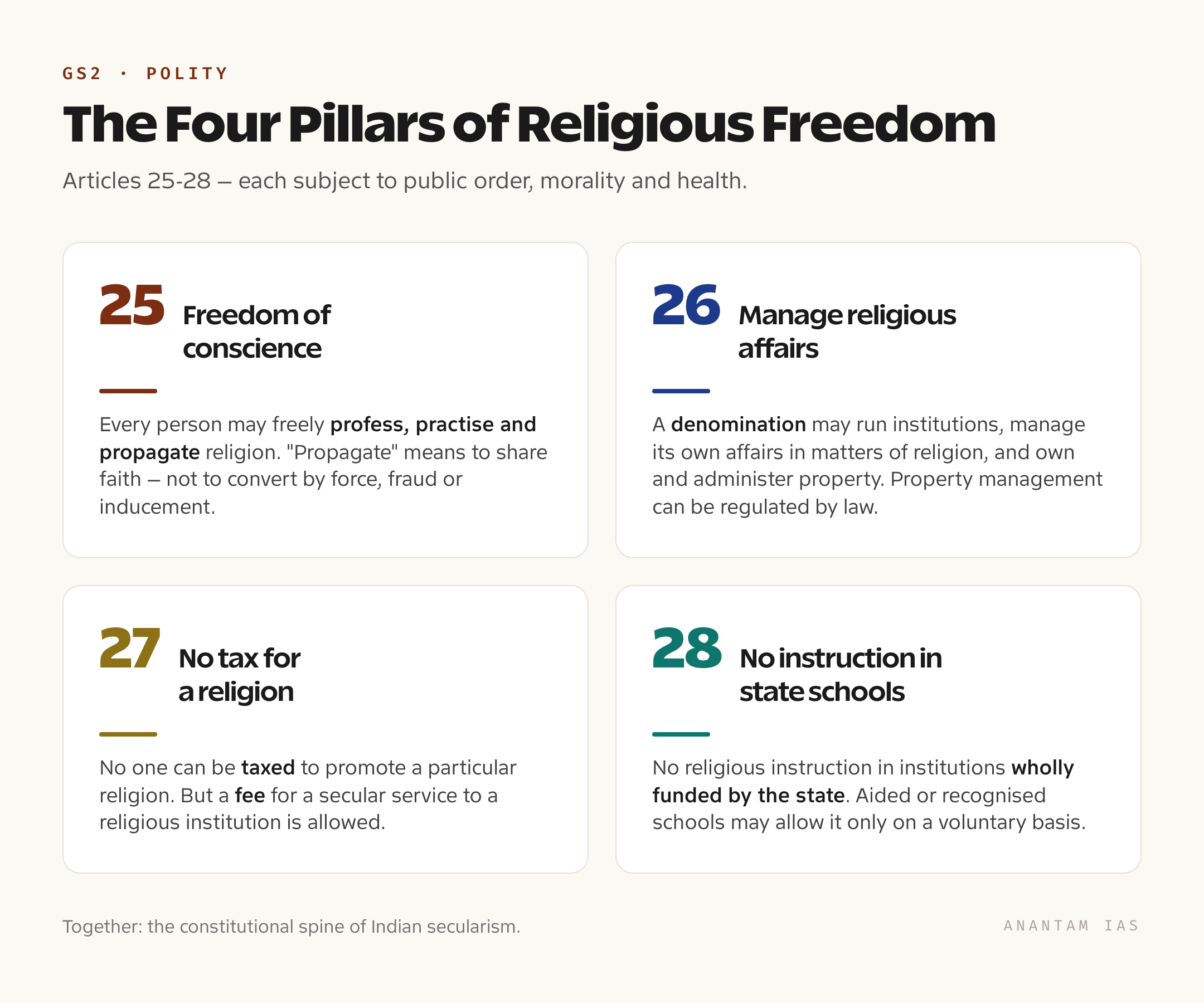
Start with the four articles laid out plainly, because most confusion here comes from blurring them. Article 25 is the individual’s right — freedom of conscience and the right to freely profess, practise and propagate religion. “Profess” means to declare your faith openly, “practise” means to perform its rituals and observances, and “propagate” means to spread or transmit it to others. That last word was hard-fought in the Constituent Assembly, and the courts have since clarified it carries no right to convert another person by force, fraud or inducement — only to share one’s beliefs. Article 25 belongs to every person, not just citizens, and to believers and non-believers alike, since freedom of conscience covers the right to hold no religion at all.
Article 26 is the collective right — it lets every religious denomination, or any section of one, do four things: establish and maintain institutions for religious and charitable purposes, manage its own affairs in matters of religion, own and acquire property, and administer that property in accordance with law. The crucial split inside Article 26 is between “matters of religion,” which the state may not touch, and the management of property, which the state can regulate by ordinary law. Article 27 bars the state from compelling anyone to pay a tax whose proceeds are earmarked for promoting or maintaining any particular religion — secularism on the fiscal side. And Article 28 keeps religion out of state classrooms: no religious instruction in any institution wholly maintained out of state funds, with carefully drawn exceptions for institutions run by endowments or trusts and for state-recognised or state-aided schools where attendance stays voluntary.
But none of these rights is absolute, and that qualifier is where the marks are. Every right under Article 25 is subject to public order, morality and health, and to the other fundamental rights — so a practice that disturbs public order or harms health gets no shelter. The state is also expressly allowed to do two more things under Article 25(2): to regulate or restrict any economic, financial, political or other secular activity associated with religious practice, and to provide for social welfare and reform, including throwing open Hindu religious institutions of a public character to all classes and sections of Hindus. That second clause is the constitutional engine behind temple-entry reform and the abolition of untouchability in worship. The drafters built freedom and reform into the same article on purpose, and that tension runs through every major case that follows.
The Essential Religious Practices Doctrine
Here is the single most important idea in this entire chapter, and the one examiners love. The Constitution protects “matters of religion,” but it never defines them — so somebody has to decide which practices are genuinely religious and which are merely social customs dressed up as faith. The Supreme Court took that job for itself in 1954, in the Shirur Mutt case, and the test it built is called the doctrine of essential religious practices. The idea is simple to state and hard to apply: the Constitution protects only those practices that are essential and integral to a religion, the ones without which the faith itself would change. Everything else — the secular, administrative or economic activity around worship — the state is free to regulate.
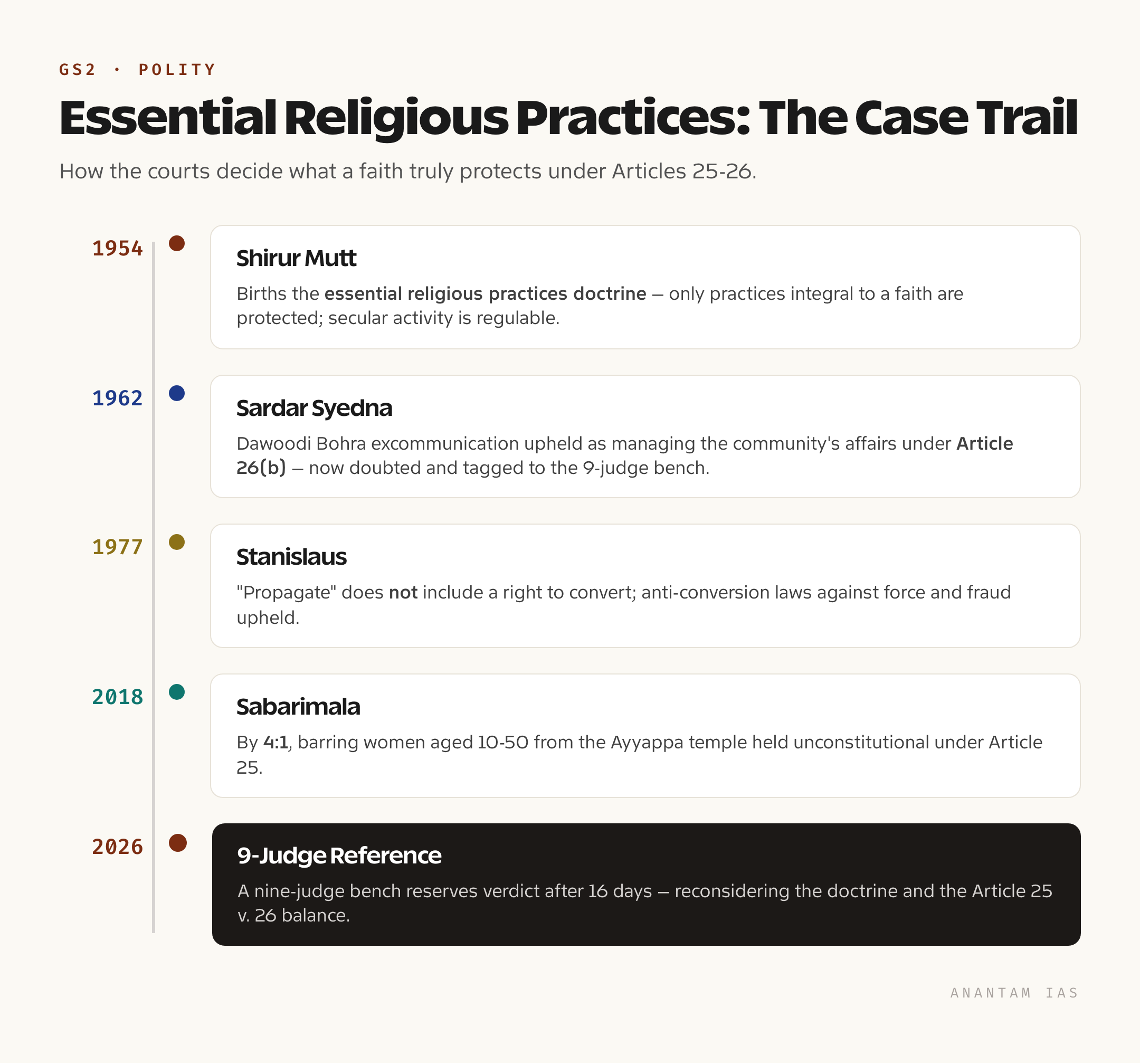
In Shirur Mutt, formally the Commissioner of Hindu Religious Endowments, Madras versus the head of the Shirur Mutt, the court drew the line between the religious core, which is protected, and the secular shell, which is not. A law could regulate how a temple’s property and money were managed without violating Article 26, but it could not interfere with the rituals, ceremonies and observances that the faith itself treated as essential. That single distinction — essential practice protected, secular activity regulable — has decided dozens of cases since. The court has used it to hold that the tandava dance was not essential to the Ananda Marga faith, that cow sacrifice was not essential to Islam on Bakr-Id, and, more controversially, to scrutinise practices from temple entry to triple talaq.
And that is exactly where the doctrine has drawn fire. Critics — including judges — argue that secular courts have ended up acting as theologians, deciding what is “truly” religious from the outside, a job the Constitution never clearly handed them. The worry is that the test lets the state pick which parts of a faith deserve protection, which can cut both ways: it has been a tool of progressive reform, but it also concentrates enormous interpretive power in judges. This is the heart of what the nine-judge bench is now reconsidering. The reference asks whether the courts should keep deciding essentiality at all, how Article 25 (the individual right) squares with Article 26 (the group right), and how far “constitutional morality” can override a community’s claimed practice. Whatever the bench decides will either reaffirm or rebuild the doctrine that has governed religious freedom for over seventy years.
Landmark Cases You Must Know
A short, well-chosen list of cases turns a vague answer into a sharp one, so carry these. Shirur Mutt (1954) is the anchor — it created the essential religious practices test and the religion-versus-secular-management distinction under Article 26. Then comes Sardar Syedna Taher Saifuddin versus State of Bombay (1962), where the Supreme Court struck down a Bombay law that had banned excommunication; the majority held that a religious head’s power to excommunicate members was part of managing the community’s affairs in matters of religion, protected by Article 26(b). That ruling has lately been doubted — a Constitution Bench has tagged the Dawoodi Bohra excommunication question to the same nine-judge Sabarimala reference, asking whether excommunication, which can amount to a “civil death,” survives the test of constitutional morality.
The Sabarimala case (Indian Young Lawyers Association versus State of Kerala, 2018) is the modern landmark. A five-judge bench ruled 4:1 that barring women between the ages of ten and fifty from the Ayyappa temple was unconstitutional — it violated their right to worship under Article 25 and could not be saved as an essential practice or as the right of a denomination under Article 26. The lone dissent argued courts should not test the rationality of religious belief at all. In 2019 the review petitions did something unusual: instead of simply re-deciding Sabarimala, the bench referred a set of larger questions to a nine-judge bench, bundling in disputes over the entry of Muslim women into mosques, Parsi women who marry outside the faith, and the Bohra excommunication practice. That is the reference whose verdict was reserved in 2026, which is why this whole area is examinable right now.
Two more deserve a line each. In Stanislaus versus State of Madhya Pradesh (1977), the court held that the right to “propagate” under Article 25 does not include a right to convert another person, upholding anti-conversion laws aimed at force, fraud or allurement. And the Bijoe Emmanuel case (1986) — the National Anthem case — protected three Jehovah’s Witnesses children who refused to sing the anthem on grounds of faith; the court held that standing respectfully without singing was protected by Article 25, a ringing defence of conscience as the core of the right. Together these cases map the full range of the freedom: belief, practice, propagation, denominational autonomy and the limits of all four.
How the State Stays Secular: Articles 27 and 28
Articles 27 and 28 get skipped in revision and then cost marks, so give them their due. Article 27 says no person can be compelled to pay any tax whose proceeds are specifically appropriated to promote or maintain a particular religion or denomination. The point is fiscal neutrality — public money raised through taxation cannot be funnelled into favouring one faith. But there is a sharp distinction every aspirant should be able to draw: Article 27 bars a tax, not a fee. A tax is a compulsory levy for general public purposes with no direct service in return; a fee is a charge for a specific service rendered. So the state may charge a fee on pilgrims or religious endowments to cover the cost of regulating or providing services to them, because that pays for a secular service rather than promoting the religion itself. The state can also spend public money even-handedly across all religions; what it cannot do is tax citizens to bankroll one.
Article 28 keeps religion out of state-funded education, and it works through four neat categories that examiners adore. No religious instruction may be provided in any educational institution wholly maintained out of state funds — that is the strict bar. But an institution administered by the state yet established under an endowment or trust that requires religious instruction may impart it. In a state-recognised or state-aided institution, religious instruction is permitted, but no student can be forced to attend it or to take part in religious worship without their consent — or, if a minor, their guardian’s consent. So the rule scales with the source of money: pure state funding means no religion in the classroom; partial aid or recognition allows it only on a voluntary basis. Read together, Articles 27 and 28 are the institutional plumbing of Indian secularism — the state neither taxes you for a faith nor teaches you one on its own dime, while still leaving room for genuinely religious institutions to function.
There is a bigger idea sitting under all four articles worth naming in a conclusion. India’s secularism is not the strict wall-of-separation model of the United States or France; it is a model of “principled distance,” where the state keeps an equal, calibrated relationship with every religion and may intervene — to reform, regulate or protect — but must do so even-handedly. Articles 25 to 28 are how that principle is written into law: freedom for the individual conscience, autonomy for the community, neutrality in money, and secularity in state education, all of it balanced against public order, morality, health and the constitutional promise of reform.
For Your Mains Answer
This is core GS Paper 2 material — the Constitution, fundamental rights, separation of powers, and the role of the judiciary all converge here, and the secularism angle feeds the Indian society portions of GS1 and even the Essay paper. Questions can come as direct fundamental-rights asks (“Discuss the scope of the right to freedom of religion”), as case-driven prompts (Sabarimala, the essential practices doctrine), or as debate questions on whether courts should adjudicate religious essentiality at all. The skill rewarded is always the same: state the articles precisely, name the limits, and anchor your argument in two or three cases.
How to Build the Answer
Move in a clean sequence: the four articles (25 individual, 26 collective, 27 fiscal, 28 educational) → the reasonable restrictions on Article 25 (public order, morality, health, other rights, plus the 25(2) reform power) → the essential religious practices doctrine and where it came from → two or three cases that show the doctrine in action → a balanced verdict on the doctrine’s strengths and the live nine-judge reconsideration. That arc — provisions, limits, doctrine, cases, evaluation — fits almost any question in this area.
Common Mistakes to Avoid
Don’t say “propagate” includes a right to convert — Stanislaus settled that it does not. Don’t forget the tax-versus-fee distinction under Article 27; it is the favourite trap. Don’t treat the rights as absolute — every Article 25 right bows to public order, morality and health. Don’t mix up Article 28’s four categories: wholly state-funded means no religious instruction, full stop, while aided or recognised institutions allow it only voluntarily. And don’t present the essential practices doctrine as settled law — flag that a nine-judge bench is reconsidering it.
A Compact Answer Spine
Right to Freedom of Religion = Articles 25-28 → Art 25: profess, practise, propagate (not convert), subject to public order, morality, health + state’s reform power [25(2)] → Art 26: denominations manage religious affairs (protected) vs property (regulable) → Art 27: no tax to promote a religion (but fees allowed) → Art 28: no religious instruction in wholly state-funded schools → essential religious practices doctrine from Shirur Mutt (1954) → Sardar Syedna (1962), Stanislaus (1977), Bijoe Emmanuel (1986), Sabarimala (2018) → nine-judge reference reserved 2026 → “principled distance” model of secularism.
Diagram or Flowchart Idea
Draw a 2×2 grid: Article 25 (individual) and 26 (collective) in the top row, 27 (fiscal) and 28 (educational) in the bottom, with the shared base bar reading “subject to public order, morality, health.” Beside it, a short horizontal timeline — Shirur Mutt 1954 → Sardar Syedna 1962 → Sabarimala 2018 → 9-judge reference 2026 — captures the doctrine’s evolution at a glance.
A Balanced-Conclusion Line
A line that lands the marks: “Articles 25 to 28 make Indian secularism a balancing act rather than a wall — protecting the conscience of the individual and the autonomy of the community, yet empowering the state to reform and regulate; the nine-judge Sabarimala reference now tests whether courts are the right umpires of what counts as essential to a faith.”
How to Use Data Without Cramming
You need anchors, not a casebook: the four article numbers and their one-word themes, the three limits (public order, morality, health), the Shirur Mutt 1954 origin of the doctrine, the Sabarimala 4:1 ruling of 2018, and the nine-judge reference reserved in 2026. Attribute them plainly — “as the Supreme Court held in Shirur Mutt” — rather than scattering case names loosely.
FAQ
What is the Right to Freedom of Religion under the Indian Constitution? It is the cluster of fundamental rights in Articles 25 to 28. Article 25 gives every person freedom of conscience and the right to profess, practise and propagate religion. Article 26 lets religious denominations manage their own affairs and property. Article 27 bars taxes meant to promote a particular religion. Article 28 keeps religious instruction out of wholly state-funded educational institutions. All of these are subject to public order, morality, health and the other fundamental rights.
What is the essential religious practices doctrine? It is a test the Supreme Court created in the 1954 Shirur Mutt case to decide which practices a faith genuinely protects under Articles 25 and 26. Only practices that are essential and integral to a religion — those the faith would lose its identity without — get constitutional protection; secular, economic or administrative activity around worship can be regulated by the state. The doctrine is now being reconsidered by a nine-judge bench because critics say it makes courts act as theologians.
Does the right to “propagate” religion include a right to convert others? No. In the 1977 Stanislaus case, the Supreme Court held that the word “propagate” in Article 25 means the right to transmit or spread one’s faith, not a right to convert another person, especially by force, fraud or allurement. On that basis the court upheld state anti-conversion laws targeting coerced or fraudulent conversions.
What is the difference between Articles 27 and 28? Article 27 is about money: the state cannot compel you to pay a tax whose proceeds are used to promote any particular religion, though it can charge fees for secular services to religious institutions. Article 28 is about education: no religious instruction in institutions wholly funded by the state, with religious instruction allowed only on a voluntary basis in state-recognised or state-aided institutions, and permitted in institutions run under a trust that requires it.
Practice Questions
Prelims MCQs
- Which of the following rights is guaranteed by Article 25 of the Constitution?
(a) The right of religious denominations to administer property
(b) Freedom of conscience and the right to profess, practise and propagate religion
(c) Freedom from taxes for promotion of a religion
(d) Freedom from compulsory religious instruction in state schools
Answer: (b) Article 25 guarantees the individual’s freedom of conscience and the right to freely profess, practise and propagate religion, subject to public order, morality and health. - The essential religious practices doctrine was first formulated by the Supreme Court in which case?
(a) Sardar Syedna Taher Saifuddin case
(b) Indian Young Lawyers Association case
(c) Commissioner, Hindu Religious Endowments, Madras v. Shirur Mutt
(d) Stanislaus v. State of Madhya Pradesh
Answer: (c) The 1954 Shirur Mutt case created the doctrine and the distinction between protected religious practice and regulable secular activity. - With reference to Article 27 of the Constitution, which statement is correct?
(a) It prohibits both taxes and fees on religious institutions
(b) It prohibits taxes whose proceeds promote a particular religion, but not fees for secular services
(c) It allows the state to tax citizens to maintain all religions equally
(d) It applies only to Hindu religious endowments
Answer: (b) Article 27 bars a tax earmarked to promote or maintain a particular religion; a fee for a specific secular service is permitted. - Under Article 28, religious instruction is absolutely prohibited in which type of institution?
(a) Institutions recognised by the state
(b) Institutions receiving aid out of state funds
(c) Institutions administered by the state but established under a trust requiring religious instruction
(d) Institutions wholly maintained out of state funds
Answer: (d) Article 28(1) bars religious instruction in any institution wholly maintained out of state funds; aided or recognised institutions may allow it only voluntarily. - Consider the following statements about the Sabarimala temple case:
1. The main issue was a dispute over the temple trust’s property.
2. The central question was the bar on entry of women aged 10 to 50.
3. A bench of the Supreme Court had held the exclusion of these women unconstitutional. Which are correct?
(a) 1 and 2 only
(b) 2 and 3 only
(c) 1 and 3 only
(d) 1, 2 and 3
Answer: (b) The case concerned the menstruating-age entry bar, not a property dispute, and the 2018 bench held the exclusion unconstitutional.
Mains Practice Questions
- Discuss the scope and limitations of the Right to Freedom of Religion under Articles 25 to 28 of the Constitution. How do these provisions reflect the Indian model of secularism? (15 marks, 250 words)
- Critically examine the essential religious practices doctrine. Should constitutional courts be deciding what is essential to a religion? (15 marks, 250 words)
- “Article 25(2) builds reform into the very article that guarantees religious freedom.” In light of the Sabarimala case, analyse the tension between religious autonomy and social reform. (15 marks, 250 words)
- Distinguish between the protections under Article 26 (matters of religion) and the regulable sphere of religious property and management, using relevant case law. (10 marks, 150 words)
- Explain how Articles 27 and 28 secure fiscal and educational secularism in India. How do the exceptions under Article 28 balance state neutrality with the autonomy of religious institutions? (15 marks, 250 words)