Road Sector in India: Status, Challenges, Reforms (UPSC Economy)
India's roads carry roughly two-thirds of its freight and almost all of its passengers — and national highways do 40% of that work on barely 2% of the network. Here is the scale, the reforms and the road ahead, for UPSC GS3.
Drive out of almost any Indian city and within minutes you are on a road that did not exist, or was half its width, a decade ago. India now runs the world’s second-largest road network — roughly 66 lakh kilometres of it, behind only the United States — and that web of tar and concrete carries close to two-thirds of the country’s freight and the overwhelming majority of its passenger trips. For a nation of India’s size and density, the road sector sits at the dead centre of the economy: it sets the cost of moving a tonne of cement, decides whether a farmer can reach a mandi, and shapes the daily commute of hundreds of millions of people.
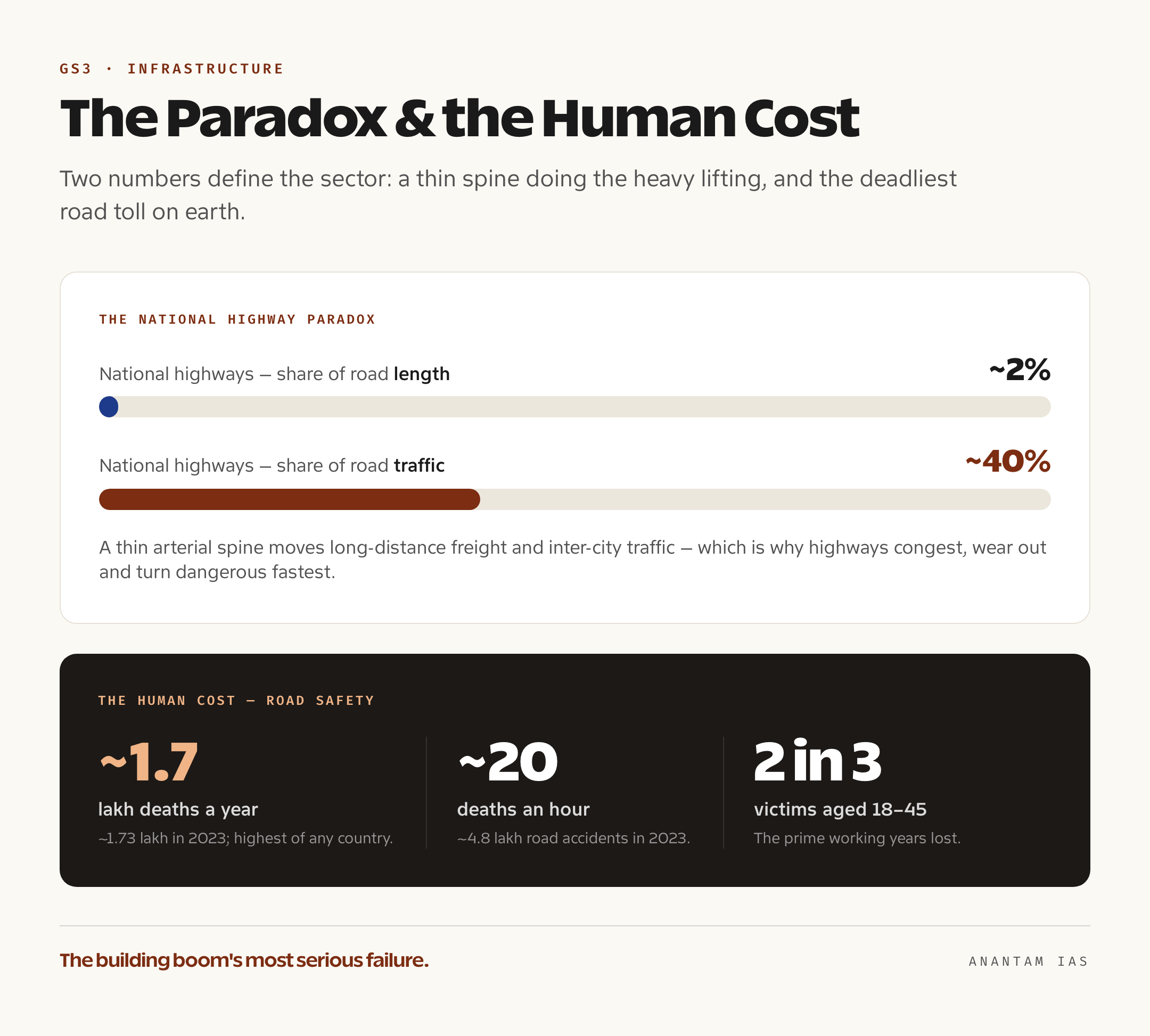
But the same network hides a hard paradox. National highways make up barely 2% of all road length, yet they shoulder about 40% of the traffic — a thin spine doing the heavy lifting for the whole body. And every year India’s roads kill roughly 1.7 lakh people, the highest road-death toll of any country. For UPSC General Studies Paper 3, the road sector is where infrastructure, public finance, logistics competitiveness and safety all collide, and the past decade has rewritten almost every figure in the story.
How Big the Road Network Actually Is
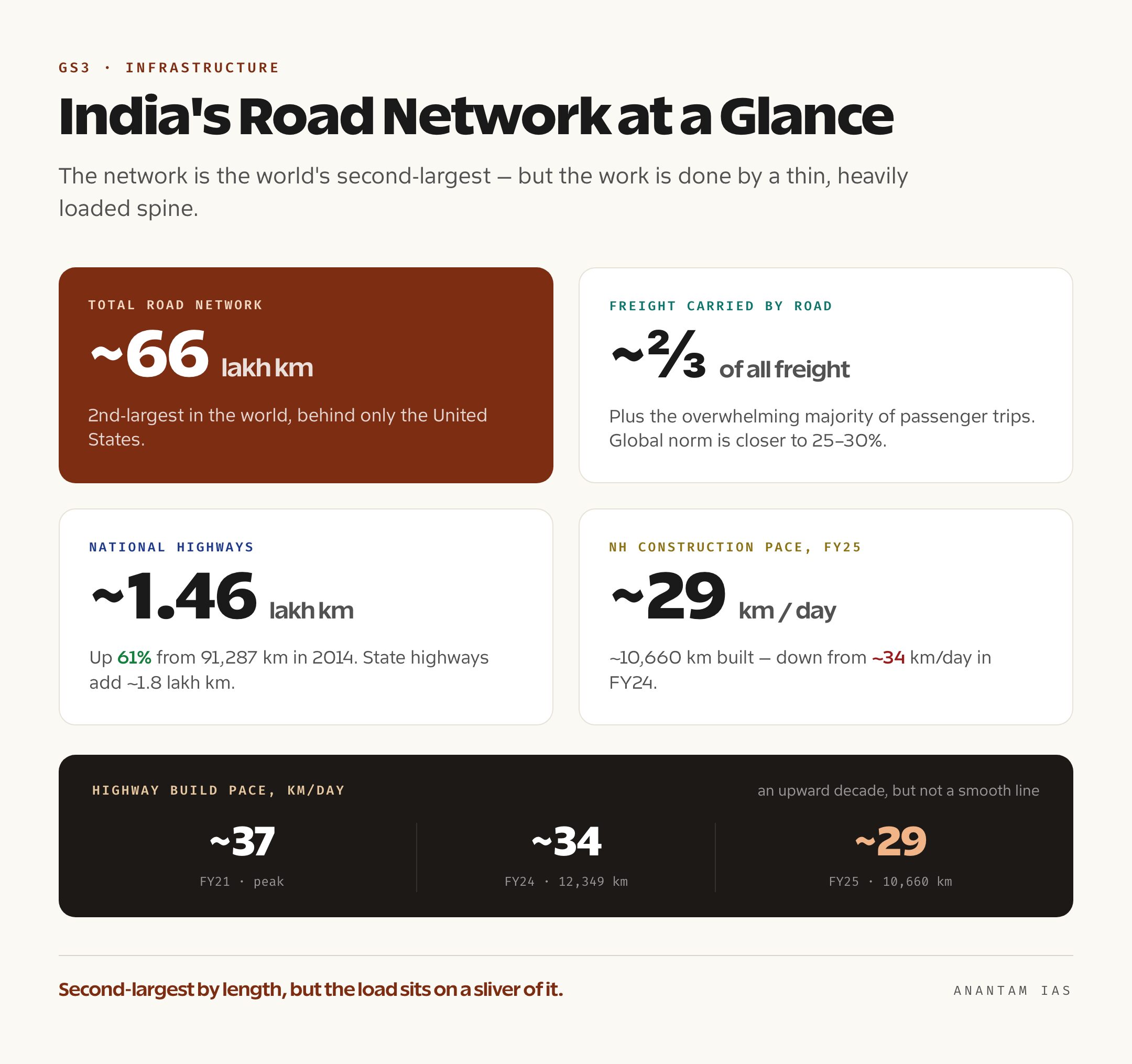
Start with the physical plant, because the scale is genuinely hard to picture. India’s total road network has crossed roughly 66 lakh kilometres, a figure the Ministry of Road Transport and Highways places second in the world. The bulk of that is the capillary network — rural roads, district roads and state highways that connect villages to towns and towns to markets. State highways run to around 1.8 lakh km and major district roads to several lakh more. Sitting on top of this is the arterial layer: national highways, which the Ministry now puts at about 1.46 lakh km, up 61% from 91,287 km in 2014.
Here is the number every aspirant should carry into the exam hall. National highways are barely 2% of the network by length, but they carry close to 40% of all road traffic. That single ratio explains why so much policy attention and money flow to the highways and why they wear out, congest and turn dangerous faster than any other road class. It also explains the relentless focus on building more of them, and on widening the busiest stretches to four and six lanes.
The pace of that building is the decade’s headline story, and it is more honest to tell it with its wobble intact. National highway construction peaked at about 37 km a day in FY21, eased to roughly 34 km a day in FY24 when about 12,349 km were built, and then slipped to around 29 km a day in FY25 — about 10,660 km — as land-acquisition delays and more complex projects, including tunnels and elevated corridors, slowed execution. So the trajectory is upward over the decade but far from a smooth line, and the recent dip is itself a useful exam point about the limits of headline targets.
Bharatmala, GatiShakti and the Logistics Push
The umbrella programme driving highway expansion is the Bharatmala Pariyojana, the government’s flagship for building economic corridors, inter-corridors and feeder routes, plus border, coastal and port-connectivity roads and a clutch of greenfield expressways like the Delhi-Mumbai and Bengaluru-Chennai routes. Under Phase I, projects covering about 26,425 km had been awarded by mid-2025 and roughly 20,770 km built, against an original target of around 34,800 km. The Comptroller and Auditor General has flagged real problems with the programme — a per-kilometre cost that rose from about Rs 14 crore to Rs 24 crore, and sanctioned funds running well above the originally approved outlay — which is exactly the kind of audit finding that strengthens a balanced answer.
Roads, though, are only half a logistics system; the other half is how well they connect to rail, ports and air. That is the job of PM GatiShakti, the National Master Plan launched in 2021 that puts every infrastructure ministry on a single GIS platform with over 1,500 data layers so that a new highway, a port and a freight line are planned together rather than in silos. Riding alongside it is the National Logistics Policy, whose central aim is to pull India’s logistics cost down toward the global single-digit benchmark. A first systematic government study in 2025 pegged that cost at about 7.97% of GDP — far below the 13-14% long quoted from older estimates — and India has set itself the goal of breaking into the World Bank’s top 25 on the Logistics Performance Index, up from 38th in 2023.
The freight mix is where roads cut both ways. Roads carry roughly two-thirds of India’s freight against a global norm closer to 25-30%, which is efficient for short hauls but expensive and carbon-heavy over long distances. So the policy logic is not to build fewer roads but to use them for what they do best — first- and last-mile connectivity and short-to-medium hauls — while shifting bulk long-distance cargo onto rail and waterways. Multi-modal logistics parks, with 35 sites approved and the first few targeted to open by 2027, are meant to be the stitching points where a truck hands its load to a train.
How Highways Are Financed: NHAI and Asset Monetisation
Building 30-odd kilometres of highway a day costs far more than any annual budget can carry on its own, so the harder question is where the money comes from. The Union Budget does the heavy lifting — the Ministry of Road Transport and Highways was allocated about Rs 2.87 lakh crore in 2025-26, of which roughly Rs 1.87 lakh crore went to the National Highways Authority of India (NHAI), the body that actually builds and operates most national highways. But budget money alone cannot keep pace, and NHAI had borrowed heavily over the years, so the government turned to a second, cleverer source: recycling assets it already owns.
The idea is asset monetisation, and it rests on a simple insight — a finished, toll-paying highway is a predictable income stream that investors will pay a large sum upfront to own for a fixed period. NHAI uses two main routes. Under Toll-Operate-Transfer (TOT), it auctions the right to collect tolls and maintain a bundle of completed highways for about 20 years to the bidder offering the highest upfront fee. Under the Infrastructure Investment Trust (InvIT) model, it pools highways into a trust and sells units to pension funds and other long-term investors. Through these two routes up to FY25, NHAI had monetised about 2,564 km via TOT to raise roughly Rs 48,995 crore and about 2,345 km via InvIT for around Rs 43,638 crore, and in FY26 it was pushing toward a further Rs 30,000 crore target. Crucially, the cash raised is recycled into building new highways, turning the road network into a self-funding machine rather than a permanent drain on the exchequer.
Tolling itself is being rebuilt around technology. FASTag electronic toll collection is now near-universal, which has stripped most of the cash queues out of toll plazas. The next step — a satellite-based GNSS system that would charge drivers for the exact distance they travel rather than a flat plaza fee — has been talked up heavily, but it is worth being precise here: as of 2025 the government had not switched to GNSS tolling. Instead it is rolling out a barrier-less system using Automatic Number Plate Recognition (ANPR) with FASTag at selected plazas, and a hybrid GNSS model is being trialled first on trucks and buses that already carry vehicle-tracking units, with wider integration pencilled in for 2026-27. So the direction is clear, but the timeline has slipped, and an answer that says GNSS is “already operational” would be wrong.
Road Safety: The Sector’s Deadliest Failure
No account of India’s roads survives contact with their human cost. The country recorded about 4.8 lakh road accidents and roughly 1.73 lakh deaths in 2023, and provisional figures for 2024 put fatalities near 1.7 lakh — meaning India loses around 20 people an hour, and roughly two in three of the dead are aged between 18 and 45, the prime working years. No other country loses as many people on its roads. This is not a side-issue to the building boom; it is the building boom’s most serious failure.
The legislative backbone of the response is the Motor Vehicles (Amendment) Act, 2019, which came into force that September. It sharply raised penalties — the fine for drunk driving rose from Rs 2,000 to Rs 10,000, for instance — lifted hit-and-run compensation, and, importantly for an answer, made road design accountable by allowing penalties on contractors and consultants who build or maintain unsafe roads. The Act also created a National Road Safety Board to advise governments on vehicle and road-safety standards. On the vehicle side, the Bharat New Car Assessment Programme (Bharat NCAP) became operational in 2023, giving Indian buyers star safety ratings for cars tested to Indian conditions.
But the fatality numbers have barely moved, which tells you the problem is less about laws on paper than about the things laws cannot fix overnight: weak on-ground enforcement, badly designed junctions and accident black spots, a road environment that mixes high-speed cars with pedestrians, two-wheelers and bullock carts, and a maintenance regime that lets surfaces decay. The expert consensus, echoed in court-monitored road-safety committees, is that India must move to a “Safe System” or Vision Zero approach — designing roads so that human error does not turn fatal, segregating vulnerable users, fixing black spots, and tightening enforcement — rather than leaning on penalties alone.
Challenges and the Way Forward
Pull the threads together and five structural challenges define the sector. First, financing and maintenance: India still spends far less on operations and maintenance than it needs, so new highways start decaying before they are paid for, and private capital remains shy because of unresolved risk-sharing in older public-private contracts. Second, land acquisition is the single biggest source of cost and time overruns, even with the BhoomiRashi portal digitising the paperwork. Third, road safety remains the deadliest gap, as the flat fatality curve shows. Fourth, last-mile rural connectivity is unfinished — the Pradhan Mantri Gram Sadak Yojana has built over 7.8 lakh km of rural roads, and its fourth phase, approved in 2024, aims to connect 25,000 more habitations through about 62,500 km by 2029, yet remote, tribal and hilly districts still wait. Fifth, the sector must green itself, both by planting and protecting along corridors and by preparing roads for electric mobility.
That last point is where the road ahead literally meets the road sector. India is building out an e-mobility layer on top of the asphalt: the National Highways for Electric Vehicles programme is creating a 5,500-km network of “e-highways” with fast chargers along corridors like Delhi to Kanyakumari, with the target advanced to 2027, and the PM E-DRIVE scheme is funding tens of thousands of public chargers on national-highway corridors. Public charging points have grown from around 5,000 in 2022 to over 29,000 by early 2026, though that is still thin against the EVs on the road. The first heavy-duty electric freight corridors and truck battery-swapping stations went live in 2025, hinting at where long-haul road freight is headed.
So the way forward is a list any examiner will recognise. Keep building, but fund life-cycle maintenance properly from the Central Road and Infrastructure Fund. Deepen asset monetisation and de-risk PPP contracts to crowd in private money. Treat safety as design, not just penalty — adopt the Safe System approach, fix black spots, and protect pedestrians and two-wheeler riders. Finish the rural last mile under PMGSY-IV. Integrate roads tightly with rail and ports through GatiShakti to drive logistics cost into single digits. And build the green and electric layer now, so the network India is laying today is fit for the vehicles of tomorrow. The decade rebuilt the country’s highways; the unfinished work is making them safe, maintained, financed and clean.
For Your Mains Answer
The road sector is a dependable, recurring theme in GS Paper 3 under infrastructure, investment models and the role of the public and private sectors in growth. It also feeds GS Paper 3 economy questions on logistics cost and competitiveness, and GS Paper 3 internal-security and disaster-adjacent angles on road safety, while supplying ready data for Essay answers on infrastructure and sustainable development. Treat roads as a case study in how a state builds, finances and now has to make safe a piece of national infrastructure — that framing beats a bare list of schemes.
How to Build the Answer
Open with scale and the core paradox, not a scheme list — the world’s second-largest network, two-thirds of freight, and national highways doing 40% of the traffic on 2% of the length. Then diagnose the structural problems (financing and maintenance, land acquisition, the deadly safety record, the rural last mile) before describing the response (Bharatmala, NHAI monetisation, GatiShakti, the Motor Vehicles Act). Close with a calibrated way forward. The arc — significance, paradox, problems, reforms, balanced outlook — fits almost any road-sector question.
Common Mistakes to Avoid
Don’t reduce the answer to a parade of scheme names. Bharatmala and Setu Bharatam are vehicles; the substance is financing, safety and logistics cost. Don’t claim GNSS tolling is “already operational” nationwide — as of 2025 it was still being trialled, with ANPR-FASTag barrier-less tolling rolling out instead. And don’t treat road safety as a footnote; with about 1.7 lakh deaths a year it deserves a full limb of the answer.
A Compact Answer Spine
World’s second-largest network (~66 lakh km), roads carry ~two-thirds of freight, NHs do ~40% of traffic on ~2% of length → building at ~29 km/day in FY25 (down from ~34 in FY24) → financed via record MoRTH budget plus NHAI asset monetisation (TOT and InvIT) → planned through Bharatmala and integrated via PM GatiShakti and the National Logistics Policy → core failures: ~1.7 lakh road deaths a year, land-acquisition delays, weak maintenance, unfinished rural last mile → way forward: Safe System safety, life-cycle maintenance, deeper monetisation, PMGSY-IV, GatiShakti integration and green/electric highways.
Diagram or Flowchart Idea
Draw a simple pyramid of the road network: a wide base labelled “rural and other roads (the bulk of ~66 lakh km),” a middle band of “state highways and district roads,” and a thin tip labelled “national highways — ~2% of length, ~40% of traffic.” An arrow off the tip can point to two boxes, “financing: budget + TOT/InvIT” and “the safety gap: ~1.7 lakh deaths a year.” It captures the paradox and the two big tensions in one glance.
A Balanced-Conclusion Line
“The past decade built the world’s second-largest road network at remarkable speed; the unfinished reform is to make it safe, maintained, financed and green — and that, not raw kilometres, is where India’s logistics competitiveness and the lives of 1.7 lakh people a year will actually be decided.”
How to Use Data Without Cramming
Pick three or four anchors and use them precisely: the 40%-of-traffic-on-2%-of-length paradox, the ~29 km/day FY25 construction pace, the roughly 1.7 lakh annual road deaths, and logistics cost at about 7.97% of GDP. Naming the source — the Ministry of Road Transport and Highways, the CAG’s Bharatmala audit, the National Logistics Policy — reads as scholarship, not memorisation.
FAQ
Why do national highways matter so much when they are such a small share of the network? Because of the central paradox of India’s road sector: national highways are barely 2% of total road length but carry close to 40% of all road traffic. They are the arterial spine moving long-distance freight and inter-city passengers, which is why most highway policy, budget and construction effort is concentrated on them — and why they congest, wear out and turn dangerous fastest.
What is Bharatmala Pariyojana? Bharatmala is the government’s flagship highway-development programme, building economic corridors, feeder and inter-corridor routes, border, coastal and port-connectivity roads, and greenfield expressways. Under Phase I, about 26,425 km had been awarded and roughly 20,770 km built by mid-2025. The CAG has flagged cost escalation and funding overruns, so a strong answer presents both the progress and the audit concerns.
How does NHAI raise money beyond the budget? Through asset monetisation. Under Toll-Operate-Transfer (TOT), NHAI auctions the right to toll and maintain completed highways for about 20 years for a large upfront payment; under the InvIT model, it pools highways into a trust and sells units to long-term investors. Up to FY25 this had raised roughly Rs 49,000 crore via TOT and Rs 44,000 crore via InvIT, and the proceeds are recycled into building new highways.
How serious is India’s road-safety problem? Very. India records around 1.7 lakh road deaths a year — the highest of any country — with roughly two in three victims aged 18 to 45. The Motor Vehicles (Amendment) Act, 2019 raised penalties, created a National Road Safety Board and made road design accountable, and Bharat NCAP now rates car safety. But fatalities have barely fallen, which is why experts urge a “Safe System” or Vision Zero approach that fixes road design and enforcement, not just penalties.
Practice Questions
Prelims MCQs
- With reference to India’s road network, consider the correct position: national highways constitute roughly what share of total road length, and carry roughly what share of road traffic?
(a) About 10% of length, 40% of traffic
(b) About 2% of length, 40% of traffic
(c) About 2% of length, 20% of traffic
(d) About 20% of length, 40% of traffic.
Answer: (b) National highways are barely 2% of total road length but carry close to 40% of road traffic — the sector’s defining paradox. - Under which model does the National Highways Authority of India auction the right to collect tolls and maintain a bundle of completed highways for a fixed period (around 20 years) in return for a large upfront payment?
(a) Hybrid Annuity Model
(b) Engineering, Procurement and Construction (EPC)
(c) Toll-Operate-Transfer (TOT)
(d) Build-Operate-Transfer (BOT) Annuity.
Answer: (c) TOT grants tolling-and-maintenance rights for an upfront fee, with proceeds recycled into new highway construction. - The Bharatmala Pariyojana focuses on which of the following? 1. Economic corridors and feeder routes.
2. Border and international connectivity roads.
3. Coastal and port-connectivity roads.
4. Greenfield expressways. Select the correct answer:
(a) 1 and 4 only
(b) 1, 2 and 3 only
(c) 2, 3 and 4 only
(d) 1, 2, 3 and 4.
Answer: (d) Bharatmala is an umbrella programme covering all four of these categories of highway development. - The Motor Vehicles (Amendment) Act, 2019 provided for which of the following? 1. Higher penalties for traffic offences.
2. A National Road Safety Board.
3. Penalties on contractors for faulty road design or maintenance. Select the correct answer:
(a) 1 only
(b) 1 and 2 only
(c) 1, 2 and 3
(d) 2 and 3 only.
Answer: (c) The Act raised penalties, created the National Road Safety Board, and made road designers and maintainers accountable for unsafe roads. - PM GatiShakti, launched to coordinate infrastructure, is best described as:
(a) A scheme to build only rural roads under MoRTH
(b) A GIS-based National Master Plan integrating multiple infrastructure ministries on one digital platform
(c) A toll-collection system replacing FASTag
(d) A credit-guarantee fund for highway contractors.
Answer: (b) PM GatiShakti is a National Master Plan that puts infrastructure ministries on a shared GIS platform with over 1,500 data layers for integrated multimodal planning.
Mains Practice Questions
- “India has built the world’s second-largest road network at remarkable speed, yet the deeper reform agenda remains unfinished.” Critically examine the achievements and structural challenges of India’s road sector. (15 marks, 250 words)
- National highways carry about 40% of India’s road traffic on roughly 2% of the network. Analyse the implications of this concentration for highway planning, financing and safety. (15 marks, 250 words)
- Discuss how asset monetisation through Toll-Operate-Transfer and Infrastructure Investment Trusts has changed the financing of national highways in India. What are its benefits and risks? (15 marks, 250 words)
- Despite a strong legislative framework, road accidents continue to claim around 1.7 lakh lives in India every year. Examine the causes and suggest a “Safe System” approach to reduce road fatalities. (15 marks, 250 words)
- Evaluate the role of PM GatiShakti and the National Logistics Policy in reducing India’s logistics cost and rebalancing its freight modal mix. (10 marks, 150 words)