Rogan Art of Gujarat: The Persian-Origin Cloth Painting of Kutch (UPSC Art and Culture)
Rogan art is a castor-oil cloth painting that once spanned Gujarat and now survives in a single Kutch village, Nirona, kept alive by the Khatri family and Padma Shri Abdul Gafur Khatri. Here is the full story — its Persian roots, the boiled-oil technique, the Tree of Life that travelled to the White House, and its GI tag — explained for UPSC GS1 Art and Culture.
In 2014, when an Indian Prime Minister wanted a gift fit for the President of the United States, he didn’t reach for gold or marble. He reached for a square of cloth painted in a single village in the Kutch desert. The painting Narendra Modi handed Barack Obama at the White House was a Rogan-art “Tree of Life” — a glowing, symmetrical tree of leaves and birds, drawn freehand in coloured oil-paste by a craftsman named Abdul Gafur Khatri. For a craft that, three decades earlier, had been all but dead — practised by a single family who could barely sell it — that journey from a mud-walled workshop to the Oval Office is one of the most remarkable revival stories in Indian handicrafts.
And it is exactly the kind of story UPSC rewards. Rogan art sits in the GS1 Art and Culture chapter on Indian handicrafts, the part of the syllabus where examiners test whether you can pair a craft with its place, name its technique, and explain why it nearly vanished and how it came back. Rogan gives you all three in one tight package: a distinctive method no other craft shares, a precise location you can fix on the map, a Padma Shri name to quote, and a live debate about how a dying tradition survives in a machine age. Learn it well and you have a ready example for handicrafts, intangible heritage, GI tags, artisan livelihoods, and even women’s empowerment — all from one painted cloth.
What Rogan Art Is and Where It Comes From
Rogan art is a form of cloth painting in which the colour is not woven, printed or brushed in the ordinary sense — it is drawn on in oil. The word “rogan” means oil or varnish in Persian, and that single word holds the secret of the craft: the paint is a thick, oil-based paste, and the artist lays it onto fabric in fine raised threads. The result is a design that sits slightly above the cloth, catching the light, glossy and almost three-dimensional, in a way a printed textile never can. Traditional pieces carry dense floral and geometric patterns — the Persian flower, the paisley, and above all the Tree of Life — usually on a dark ground so the bright paste glows against it.
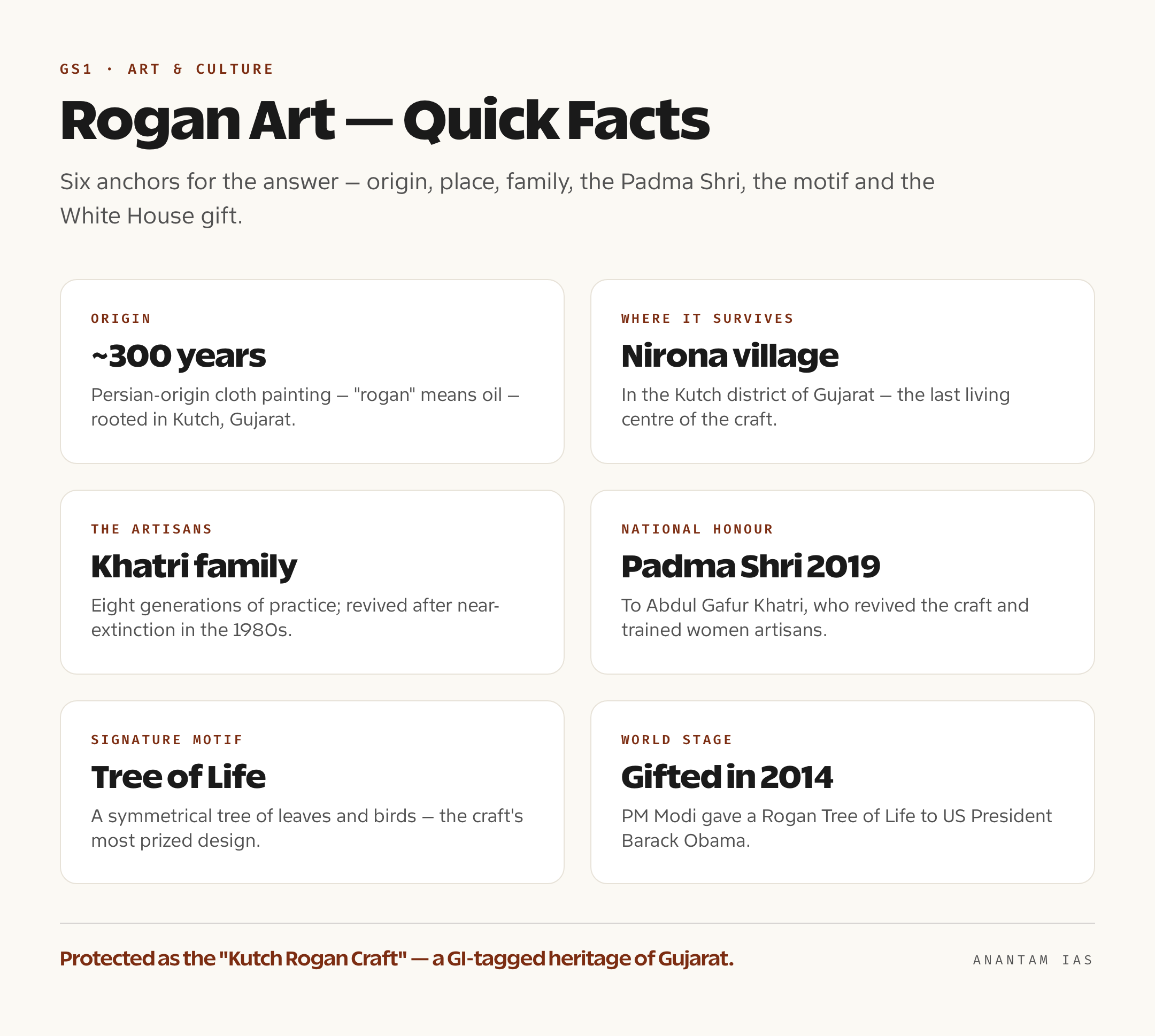
The most widely told account traces the craft to Persia, brought into India a little over three centuries ago, settling in the Kutch region of Gujarat where it took root among the Khatri community of artisans. (Some scholars trace an even older Indian lineage for oil-based painting, but the living Kutch tradition is the one the syllabus cares about, and its Persian-influenced motifs are unmistakable.) For an aspirant, the safe, examinable line is this: Rogan is a roughly 300-year-old Persian-origin cloth-painting tradition of Kutch, Gujarat, kept alive today by the Khatri family of artisans. That sentence alone will anchor most answers.
What makes Rogan special is also what made it fragile. It was never a mass craft. It was slow, done entirely by hand, with no machine and no shortcut, and for most of its history it decorated everyday textiles for local communities — bridal skirts, cushion covers, the cloths of ordinary village life. When cheap, machine-printed fabric flooded the market in the twentieth century, demand for laboriously hand-painted cloth collapsed. By the 1980s the craft that had once been practised in several towns across Gujarat had shrunk to almost nothing, surviving in the hands of a single struggling family in one village. That village is Nirona, in Kutch, and it is where the whole story now lives.
The Technique: Boiling Oil Into Paint
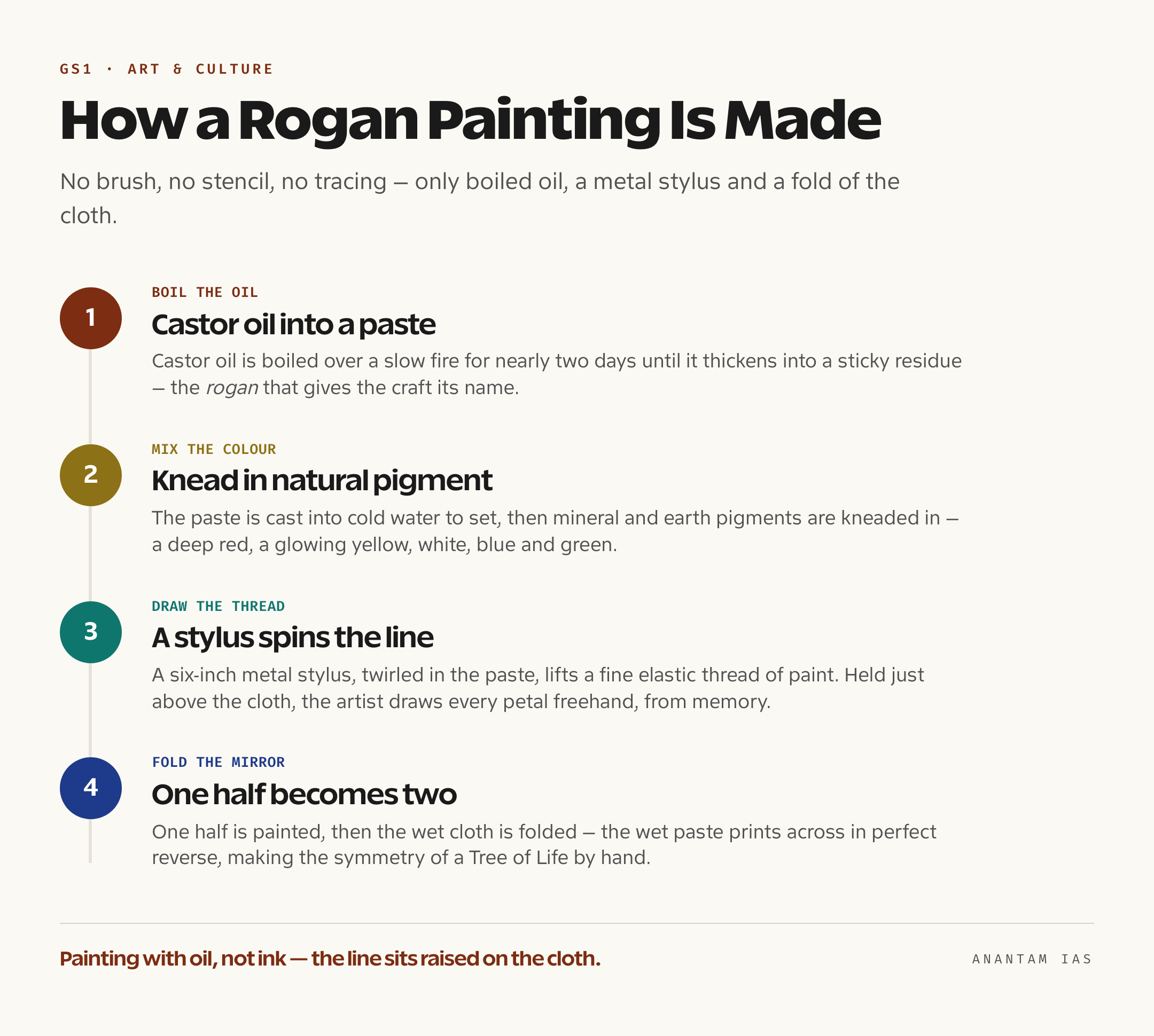
This is the part that earns marks, because the method is unlike anything else in Indian art. It begins not with a brush but with a pot. Castor oil — pressed from castor seeds, a crop the Kutch region grows — is boiled over a slow fire for the better part of two days, until it thickens and darkens into a sticky, gel-like residue. That residue is the “rogan.” It is then cast into cold water, where it congeals into a stretchy, glue-like mass, and natural pigments — colours drawn from minerals and earth — are kneaded into it to make the paints: a deep red, a brilliant yellow, a glowing white, a rich blue and green. The paint that results is heavy, elastic and luminous, nothing like watercolour or ink.
Now comes the drawing, and there is no brush in sight. The artist takes a small lump of the coloured paste on a flat palm and a six-inch metal stylus — a stick, blunt and plain — and twirls the rod in the paste until a fine thread of paint rises from it, almost like spinning sugar. Working with the stylus held just above the fabric, never quite touching it, the craftsman lets this elastic thread fall onto the cloth and guides it into curves, petals and stems. There is no pencil outline, no stencil, no tracing. The entire design is drawn freehand, from memory, by an artist who has the patterns in his hands the way a musician has a raga. A single detailed piece can take days.
Then comes the trick that gives Rogan its uncanny symmetry. To make a mirrored design — the two identical halves of a Tree of Life, say — the artist paints only one half of the cloth, then folds the fabric in two while the paste is still wet. The pattern presses across to the blank side and prints itself in perfect reverse, so that one painted half becomes two matching halves. It is a kind of hand-made symmetry, achieved with a fold rather than a measurement. Because the paint sits raised on the surface, a finished Rogan textile has a slight relief you can feel with a fingertip — the signature of a craft that is, quite literally, painting with oil.
The Khatri Family and Abdul Gafur Khatri’s Revival
By the 1980s Rogan art had narrowed to a single thread, and that thread ran through one household — the Khatri family of Nirona, who had practised the craft for some eight generations. The man at the centre of its rescue is Abdul Gafur Khatri, born in Nirona in 1965 into that artisan family. As a young man, seeing no future in a craft nobody was buying, he had left the village to find work in Ahmedabad and Mumbai, as many of his generation did. But the elders of his family called him back to learn the dying art from his father and grandfather before it was lost — and from the mid-1980s, with a small state-government push to revive the craft, he chose to stay in Nirona and rebuild it rather than let it disappear.
What he then did is the heart of the story, and it has two parts an aspirant should remember. First, he refused to dilute the craft for the market — he held it to its old standards, its natural pigments and its freehand discipline, while patiently finding new buyers through exhibitions, tourism and, later, the internet. Second, and more striking for a conservative artisan community, he broke an old rule: Rogan painting had been passed down only to the men of the family, but Abdul Gafur Khatri began teaching it to women, including those from outside the immediate family, turning a closed male craft into a wider source of livelihood. That single decision did as much to secure the craft’s future as any sale, because it multiplied the number of people who could carry it forward.
Recognition followed the work. He won a National Award for the craft in 1997, a string of state honours over the years, and in 2019 the Government of India conferred on him the Padma Shri — the country’s fourth-highest civilian award — for his role in saving Rogan art. The family’s reputation for sheer skill is just as quotable: the Khatris are credited with a record-setting feat, painting hundreds of Tree of Life designs across a hundred metres of cloth in a single sitting of around twenty-one hours. For an answer on craft revival or on intangible heritage, “Padma Shri Abdul Gafur Khatri of Nirona, Kutch” is a name worth carrying.
The Tree of Life, the Obama Gift and the GI Tag
The motif that made Rogan famous is the Tree of Life — an ancient, near-universal symbol of growth, fertility and the connectedness of all living things, here rendered as a single tree spreading symmetrical branches heavy with flowers, leaves and birds. In Rogan, it is the showpiece, the design that best displays the craft’s glossy raised line and its folded symmetry, and it is the piece artisans labour over most. It was a Tree of Life that carried Rogan art onto the world stage. During Prime Minister Narendra Modi’s 2014 visit to the White House, he presented President Barack Obama with Rogan paintings made by Abdul Gafur Khatri and his brother — a gift of soft diplomacy that put a near-forgotten Kutch craft into headlines around the world and onto the wish-lists of buyers who had never heard of Nirona.
That moment did for Rogan what years of effort had struggled to do alone: it made the craft visible. Visitors began routing through Nirona on the Kutch tourist trail, especially around the Rann Utsav desert festival, to watch the painting done by hand and to buy directly from the artisans. The post-2001 rebuilding of Kutch after the Bhuj earthquake, which brought roads, tourism and outside attention to the region, had already started this opening-up; the Obama gift accelerated it. A craft that had survived on the edge of extinction suddenly had a market that stretched well beyond the village.
The craft also carries formal protection. Rogan painting is recognised under India’s Geographical Indication system as “Kutch Rogan Craft,” a GI tag that ties the name to its place of origin and guards it against imitation — the same kind of protection that shields Kutch’s other famous handicrafts, from Ajrakh block-printing to Kutch embroidery and Bhujodi weaving. A GI tag does two useful things at once: it gives the genuine artisans of Kutch a legal claim to the name and a marketing edge, and it formally registers Rogan as part of India’s living craft heritage. For UPSC, that lets you connect Rogan to the wider themes of GI protection, the safeguarding of traditional knowledge, and the role of crafts in rural livelihoods and the cultural economy.
For Your Mains Answer
This is a clean, high-value topic for GS Paper 1, specifically the Indian Heritage and Culture section that covers art forms and handicrafts from ancient to modern times. Rogan art works as a ready example in answers on Indian handicrafts, on the safeguarding of intangible and traditional cultural heritage, on Geographical Indication tags, and on the link between crafts, tourism and rural livelihoods. It also doubles as a soft-diplomacy example (the Obama gift) and a women’s-empowerment example (training women artisans), which makes it unusually flexible across GS1 and even GS2/Essay themes. The skill examiners reward is the same one this article uses: fix the craft to its place, describe its unique technique precisely, and tie its survival to a larger argument about heritage and economy.
How to Build the Answer
Open by placing the craft: a roughly 300-year-old, Persian-origin cloth painting of Kutch, Gujarat, now surviving mainly in Nirona village. Then describe what makes it unique — the boiled castor-oil paste called rogan, the freehand metal-stylus drawing without any brush or tracing, and the folded mirror-image symmetry. Move to its near-death and revival: machine textiles killed the market, it shrank to one family, and Padma Shri Abdul Gafur Khatri of the Khatri family rebuilt it, notably by training women. Close with significance — the Tree of Life, the 2014 Obama gift, the GI tag, and tourism through the Rann of Kutch — and a line on what it tells us about saving a craft in a machine age. That arc — place, technique, decline, revival, significance — fits almost any handicraft question.
Common Mistakes to Avoid
Don’t call Rogan a printing or weaving craft — it is painting with an oil-based paste, drawn by hand, and that distinction is the whole point. Don’t say it is brushed on; there is no brush, only a metal stylus and a thread of paint. Don’t confuse the symmetry with stencilling — it comes from folding the wet cloth, not from a template. Don’t place it vaguely in “Gujarat”; name Kutch and, ideally, Nirona village. And don’t forget the human anchor — quoting Abdul Gafur Khatri and his Padma Shri turns a generic craft answer into a specific, credible one.
A Compact Answer Spine
Rogan = oil-based cloth painting, Persian origin, ~300 years in Kutch, Gujarat → technique: castor oil boiled ~2 days into a paste (“rogan”), mixed with natural pigments, drawn freehand in fine threads with a 6-inch metal stylus, mirror images made by folding wet cloth → motif: the Tree of Life → near-extinct by the 1980s as machine textiles killed demand → revived in Nirona by the Khatri family, especially Padma Shri (2019) Abdul Gafur Khatri, who also trained women → reached the world via PM Modi’s 2014 Tree of Life gift to Obama → protected as the “Kutch Rogan Craft” GI tag → significance: intangible heritage, GI protection, craft-based rural livelihood and Kutch tourism.
Diagram or Flowchart Idea
Draw a simple four-step horizontal flow of the technique: boil castor oil → form the paste & mix pigment → draw the thread with a stylus → fold for the mirror image. Beside it, sketch a small symmetrical Tree of Life to stand for the signature motif. A clean process strip like this shows the examiner you understand how the craft works, not just that it exists, and it takes seconds to draw.
A Balanced-Conclusion Line
A line that lands the marks: “Rogan art shows that India’s crafts survive not by freezing in the past but by finding new patrons — a single family in Nirona kept a 300-year-old tradition alive by holding its technique sacred while opening its doors to women, to tourists and, once, to a President.”
How to Use Data Without Cramming
You need only a handful of anchors, not a dossier: roughly 300 years old, Persian origin, Nirona village in Kutch, castor oil boiled for about two days, a six-inch metal stylus, the Tree of Life, Padma Shri 2019, the 2014 Obama gift, and the “Kutch Rogan Craft” GI tag. Drop those into the right sentences and the answer reads as authoritative. Attribute them plainly — “recognised under India’s GI system as the Kutch Rogan Craft” — rather than scattering claims without a frame.
FAQ
What is Rogan art and where is it practised? Rogan art is a traditional cloth-painting craft in which designs are drawn onto fabric with a thick, oil-based paste rather than woven, printed or brushed. The word “rogan” means oil in Persian, and the craft is widely traced to a Persian origin some three centuries ago. It is practised in the Kutch district of Gujarat and today survives mainly in the village of Nirona, kept alive by the Khatri family of artisans.
How is a Rogan painting actually made? Castor oil is boiled over a slow fire for nearly two days until it thickens into a sticky residue called rogan, which is then mixed with natural mineral and earth pigments to make the paints. The artist takes the paste on a palm and a six-inch metal stylus, draws out a fine elastic thread of paint, and guides it onto the cloth freehand — with no brush, pencil or tracing. Symmetrical designs are made by painting one half and folding the wet cloth so the image mirrors itself.
Who is Abdul Gafur Khatri and why does he matter? Abdul Gafur Khatri is the artisan most responsible for saving Rogan art from extinction. Born in Nirona in 1965 into the Khatri family that had practised the craft for generations, he returned from city work in the 1980s to revive it, upheld its traditional standards, and — breaking with custom — began teaching it to women as well as men. He won a National Award in 1997 and was awarded the Padma Shri in 2019 for his contribution.
Why did PM Modi gift a Rogan painting to Barack Obama? During his 2014 visit to the White House, Prime Minister Narendra Modi presented President Barack Obama with a Rogan “Tree of Life” painting made by Abdul Gafur Khatri and his brother. It was an act of cultural diplomacy — showcasing a rare, hand-made Indian craft — and it gave the near-forgotten art global visibility, boosting tourism and demand for Rogan work from Nirona.
Practice Questions
Prelims MCQs
- With reference to Rogan art, consider the following statements.
(a) It is a form of cloth painting using an oil-based paste
(b) It is a hand-block printing technique using wooden blocks
(c) It is a style of stone carving
(d) It is a method of metal inlay work
Answer: (a) Rogan art is a cloth-painting craft in which designs are drawn onto fabric with a thick castor-oil-based paste using a metal stylus. - Rogan art is most closely associated with which place in India?
(a) Pochampally, Telangana
(b) Nirona village, Kutch, Gujarat
(c) Madhubani, Bihar
(d) Thanjavur, Tamil Nadu
Answer: (b) The living tradition of Rogan painting survives chiefly in Nirona village in the Kutch district of Gujarat, sustained by the Khatri family. - Which of the following best describes the technique of Rogan painting?
(a) Colours are woven directly into the fabric
(b) Designs are printed using carved wooden blocks
(c) An oil paste is drawn into fine threads with a metal stylus and mirrored by folding the cloth
(d) Natural dyes are tie-and-dyed into knots
Answer: (c) The craft uses a boiled castor-oil paste drawn freehand in threads with a stylus, with symmetry created by folding the wet cloth. - The “Tree of Life,” a signature motif of Rogan art, gained international attention when it was gifted by the Prime Minister of India to which leader?
(a) Vladimir Putin
(b) Shinzo Abe
(c) Barack Obama
(d) Angela Merkel
Answer: (c) In 2014, PM Narendra Modi gifted a Rogan “Tree of Life” painting to US President Barack Obama at the White House. - The Padma Shri awarded in 2019 to Abdul Gafur Khatri was for his contribution to which field?
(a) Classical music
(b) Reviving Rogan art
(c) Wildlife conservation
(d) Tribal medicine
Answer: (b) Abdul Gafur Khatri received the Padma Shri in 2019 for reviving and sustaining the Rogan-painting craft of Kutch.
Mains Practice Questions
- Describe the technique and distinctive features of Rogan art of Kutch, and explain why it is considered a unique handicraft tradition of India. (15 marks, 250 words)
- “India’s crafts survive not by freezing in the past but by finding new patrons.” Examine this statement with reference to the revival of Rogan art in Nirona village. (15 marks, 250 words)
- Discuss the significance of Geographical Indication (GI) tags in protecting India’s traditional handicrafts, using the crafts of Kutch as illustrations. (15 marks, 250 words)
- How can cultural diplomacy and tourism contribute to the survival of endangered traditional crafts? Illustrate with the example of Rogan art. (10 marks, 150 words)
- The revival of Rogan art involved training women in a previously male-only craft. Evaluate the role of such inclusion in sustaining traditional artisan livelihoods. (10 marks, 150 words)