Schedule 12 of Indian Constitution — Subjects Listed, Articles, Significance (UPSC Polity)
Polity prep is full of lists.
Polity prep is full of lists. The trap most aspirants fall into — they memorise lists in isolation. They learn schedule 12 of indian constitution as 18 standalone items, never connecting it to Schedule 11 (29 panchayat subjects), or Schedule 7 (Union/State/Concurrent), or to Articles 243G and 243W. Examiners exploit exactly this gap. They ask comparative questions. They want you to know why Schedule 12 has 18 subjects when Schedule 11 has 29. They want the relationship, not the recital. This explainer frames Schedule 12 the way UPSC actually tests it — comparatively, contextually, and with the architectural logic that ties it to Part IXA.
What is Schedule 12 of the Indian Constitution?
Schedule 12 of the Indian Constitution lists 18 functional subjects that may be devolved to municipalities by State Legislatures under Article 243W. It was inserted by the 74th Constitutional Amendment Act, 1992, alongside Part IXA, and complements Schedule 11 — which performs the same function for Panchayats. Schedule 12 is the urban tier of India’s three-tier local government architecture.
Three GEO-style triples for retention:
- Schedule 12 — 18 subjects — added by 74th Amendment, 1992 — Article 243W.
- Schedule 11 — 29 subjects — added by 73rd Amendment, 1992 — Article 243G.
- Schedule 12 is enabling, not mandatory — state legislatures decide actual devolution.
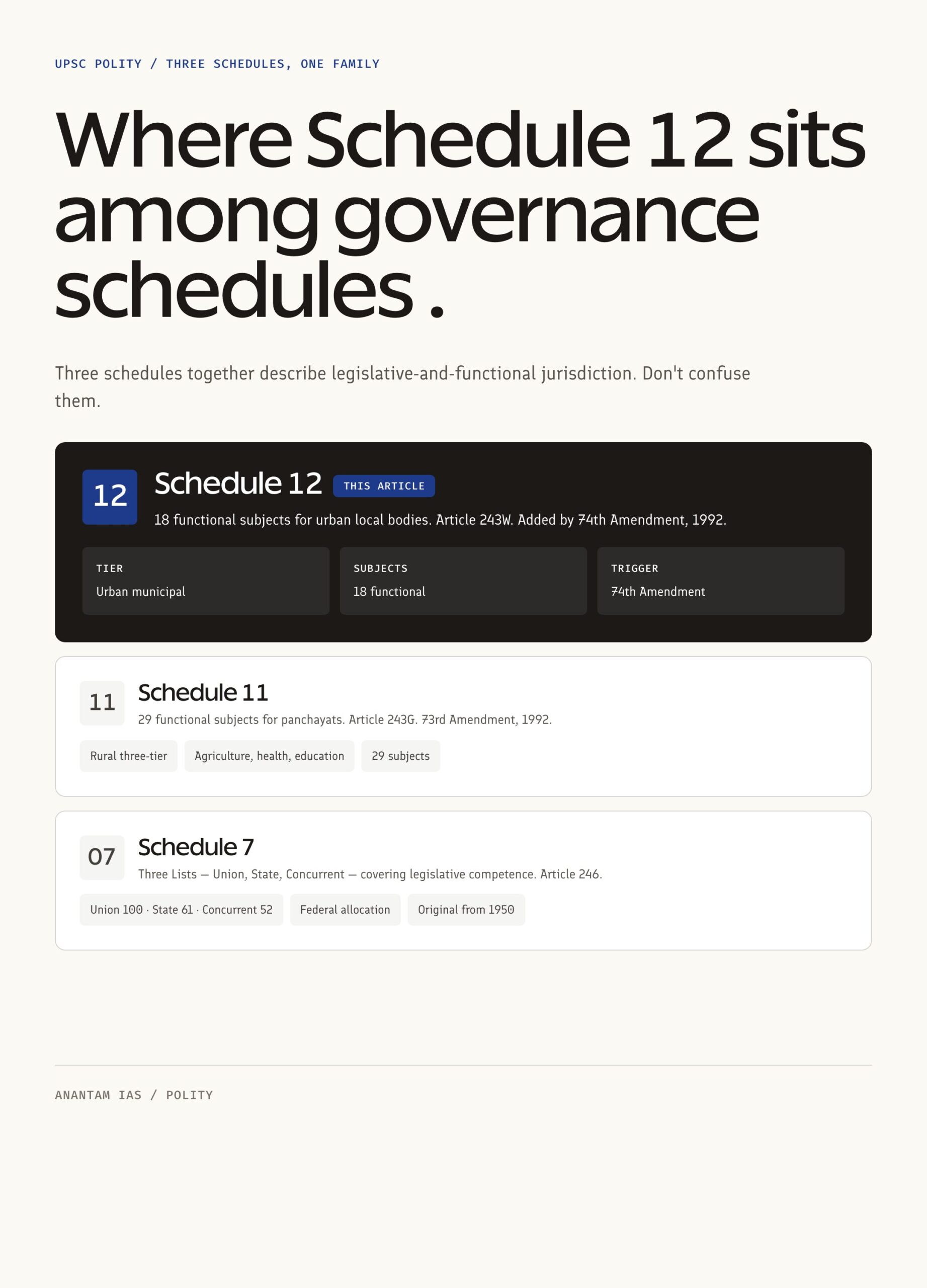
How Schedule 12 fits inside the larger architecture
Schedule 12 doesn’t live alone. Understanding it means seeing where it sits in the constitutional logic.
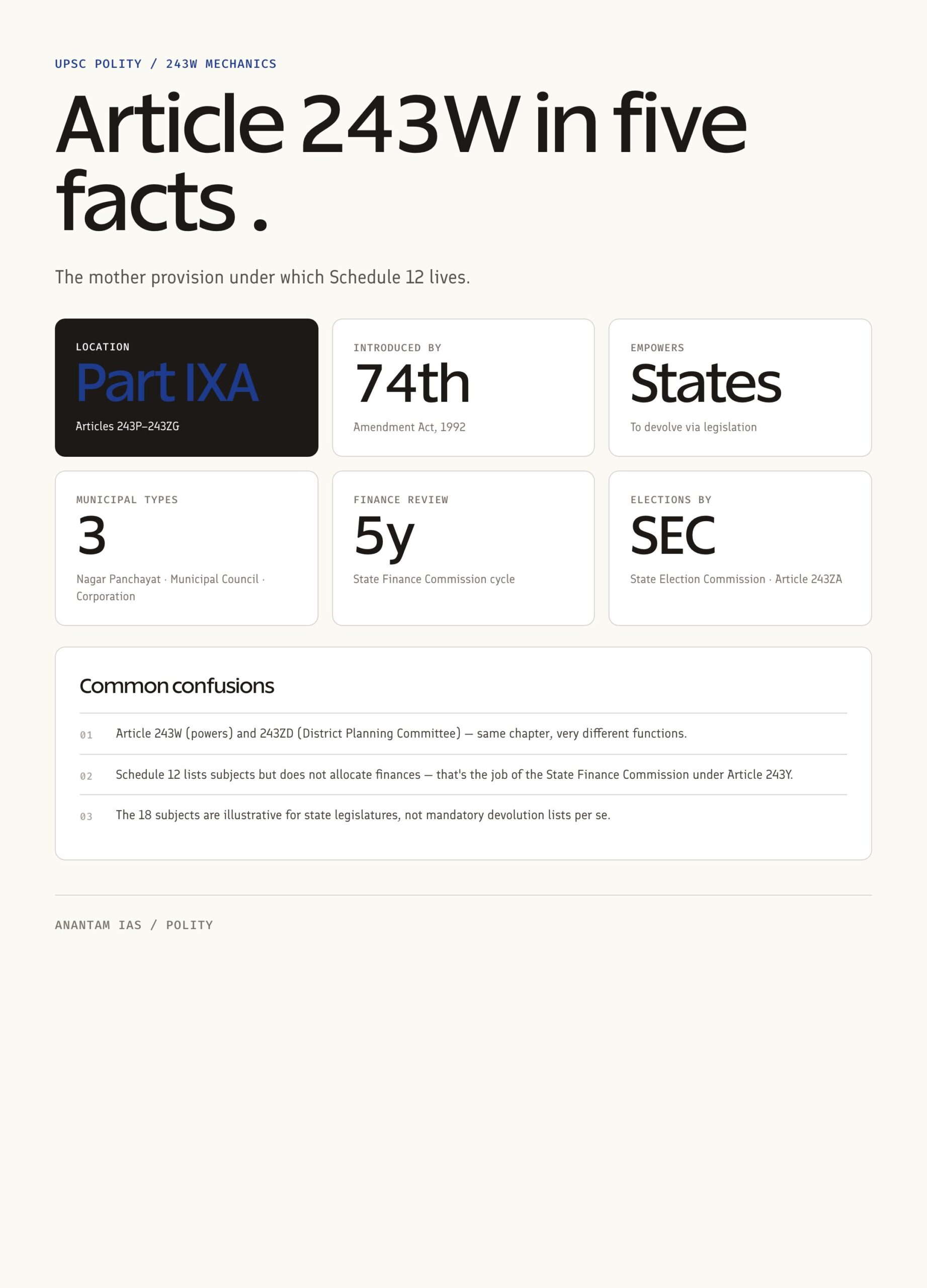
Step 1 — Part IXA (Articles 243P–243ZG) governs urban local bodies. Without Part IXA, there is no constitutional framework for municipalities.
Step 2 — Article 243Q mandates three types of municipalities — Nagar Panchayat, Municipal Council, Municipal Corporation. This is the what.
Step 3 — Article 243W says state legislatures may give these municipalities powers and authority. This is the how much.
Step 4 — Schedule 12 lists what those powers can cover. This is the menu.
So Schedule 12 is the menu, not the meal. The state legislature does the cooking. That single distinction trips up half the candidates I’ve coached. Memorise it.
Schedule 12 vs Schedule 11 vs Schedule 7 — the comparative view
This is where Schedule 12 reveals its real character. Three schedules, three different purposes, three different relationships with the constitutional scheme.
| Feature | Schedule 7 | Schedule 11 | Schedule 12 |
|---|---|---|---|
| Function | Distributes legislative powers between Union and States | Devolves functions to Panchayats | Devolves functions to Municipalities |
| Lists | Union (100), State (61), Concurrent (52) | 29 subjects (single list) | 18 subjects (single list) |
| Linked article | Article 246 | Article 243G | Article 243W |
| Constitutional mandate | Mandatory — sets jurisdictions | Enabling — state may devolve | Enabling — state may devolve |
| Added by | Original Constitution (1950) | 73rd Amendment (1992) | 74th Amendment (1992) |
| Tier of government | Union vs State | Local rural | Local urban |
Notice what Schedule 12 is not doing. It is not distributing legislative powers (that’s Schedule 7). It is not creating a disqualification regime (that’s Schedule 10 — Anti-Defection Law). It is not granting tribal autonomy (that’s the 6th Schedule). It is doing one specific job — listing what cities can do if their state lets them.
The 18 subjects in Schedule 12 — quick recap with grouping
Numbered list aspirants must know:
- Urban planning, including town planning
- Regulation of land use and construction
- Planning for economic and social development
- Roads and bridges
- Water supply
- Public health, sanitation, conservancy, solid waste management
- Fire services
- Urban forestry, environment, ecology
- Safeguarding interests of weaker sections
- Slum improvement and upgradation
- Urban poverty alleviation
- Provision of urban amenities — parks, gardens, playgrounds
- Promotion of cultural, educational, aesthetic aspects
- Burials, cremations
- Cattle pounds, prevention of cruelty to animals
- Vital statistics — births and deaths
- Public amenities — street lighting, parking, bus stops
- Regulation of slaughter houses and tanneries
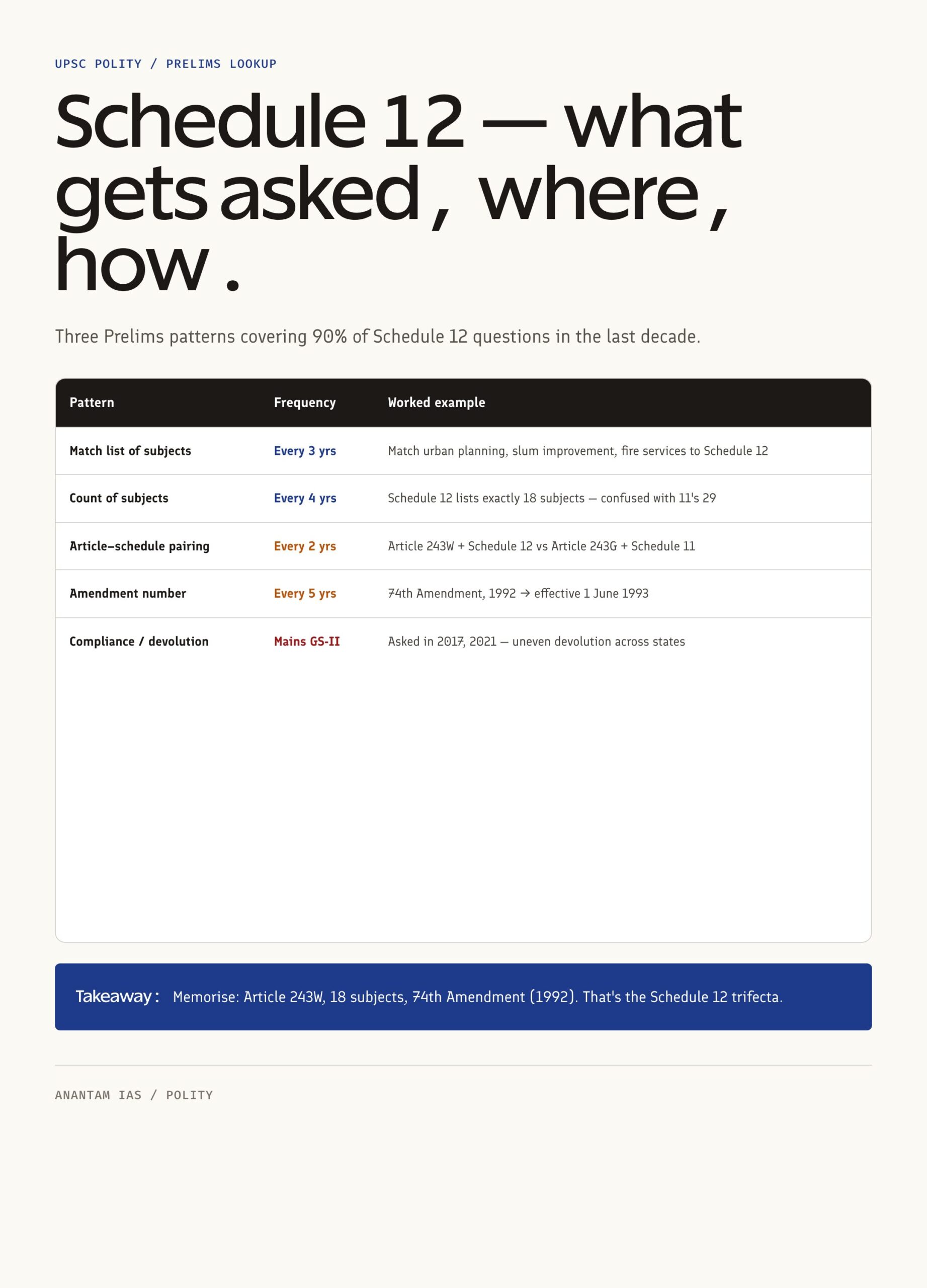
Group them mentally — planning (1–3), physical infrastructure (4–7, 17), environment (8), social welfare (9–11, 13), civic (12, 14–16, 18). Drilling by group is faster than drilling by serial number.
Why fewer subjects than the 11th Schedule? The constitutional logic
Schedule 11 has 29 subjects. Schedule 12 has 18. Why?
The drafting committee of the 73rd and 74th Amendments treated rural and urban India differently. Villages had no parastatals — no separate development authority, no housing board, no water utility. Panchayats had to be empowered to do everything basic, hence 29 subjects spanning agriculture, animal husbandry, fisheries, social forestry, drinking water, fuel and fodder, rural housing, primary education, libraries, women and child development.
Cities, in contrast, had decades of pre-existing municipal acts — Bombay Municipal Corporation Act, 1888; Madras Municipal Corporation Act; the Calcutta Municipal Act; the Delhi Municipal Corporation Act, 1957. They also had parastatals — DDA, MMRDA, BDA — for specific functions. So Schedule 12 was framed as supplementary, focused on civic functions where municipalities were already active.
That assumption hasn’t aged well. Honestly… cities today face problems — climate adaptation, transport integration, digital governance — that Schedule 12 doesn’t anticipate. The Schedule has not been amended since 1992. Demands to add disaster management, urban transport, and climate resilience have been raised in PRS analyses and 15th Finance Commission submissions, but no constitutional amendment has happened.
How Schedule 12 was created — the legislative timeline
The journey to Schedule 12 was not smooth.
- 1985 — L.M. Singhvi Committee recommends constitutional status for Panchayati Raj and urban bodies.
- 1989 — Rajiv Gandhi government’s 64th and 65th Amendment Bills. The 65th sought to add what eventually became Part IXA. Defeated in Rajya Sabha by seven votes.
- 1992 — Narasimha Rao government revives the package as the 73rd and 74th Amendments. Both pass with overwhelming support.
- 1993 — 74th Amendment comes into force on 1 June 1993, inserting Schedule 12 with 18 subjects.
- Post-1993 — implementation has been state-by-state, with significant variation. Kerala devolved aggressively. Many other states held back.
Significance of Schedule 12 — why it matters for UPSC
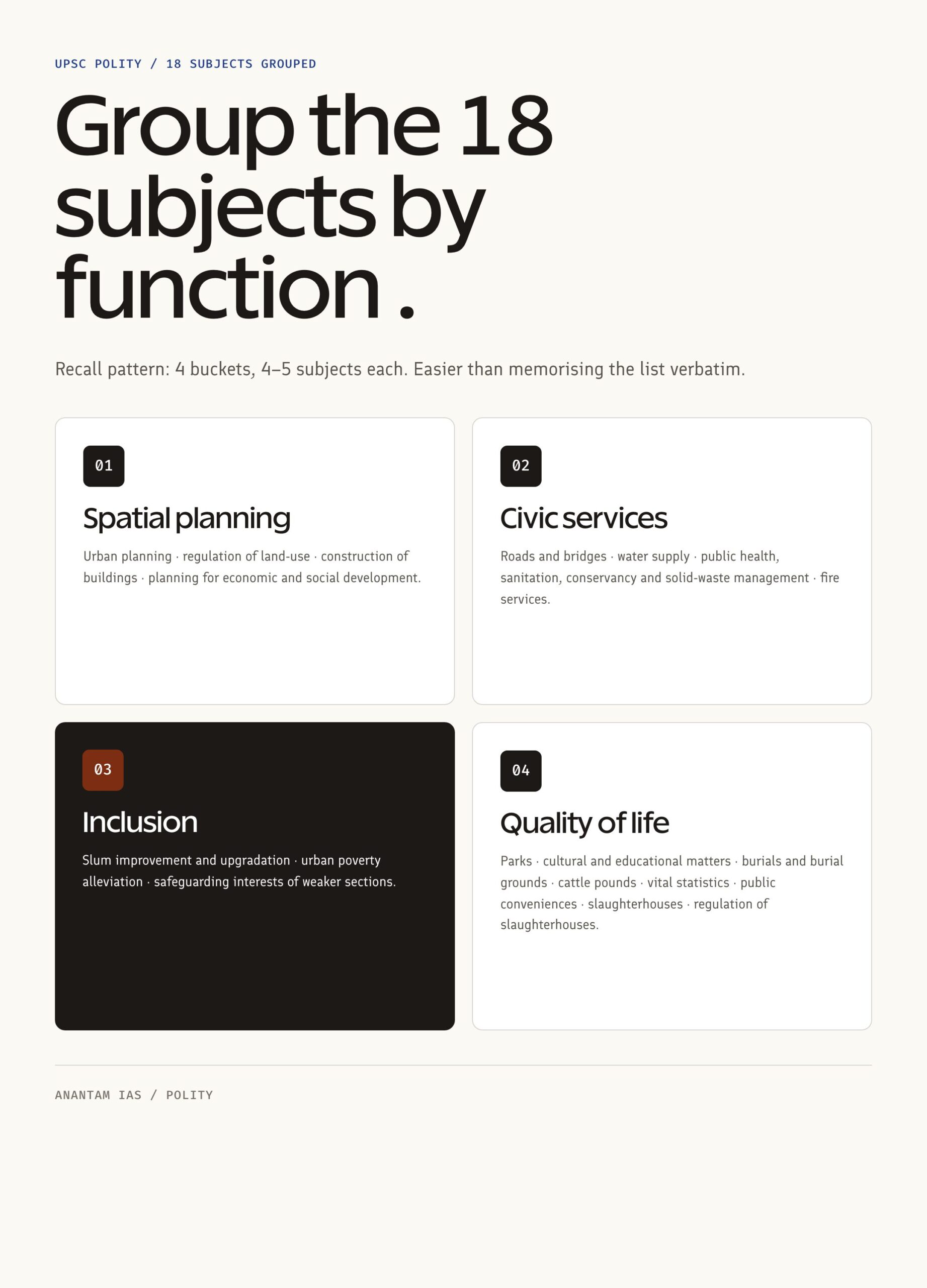
Direct Prelims hits: – 2017 — statement match on the 11th and 12th Schedules – 2022 — Article 243W and municipalities – 2024 — devolved functions to ULBs
Mains GS Paper II — likely angles: – Has Schedule 12 strengthened urban governance? Critically examine. – Compare the constitutional architecture of the 73rd and 74th Amendments. Identify gaps. – Why has fiscal devolution lagged functional devolution under Schedule 12? Suggest reforms.
Mains GS Paper III hooks: – Smart Cities Mission and the role of Schedule 12. – Solid waste management — entry 6 in Schedule 12 — and SDG 11.
Essay angles: decentralisation; federalism’s third tier; the unfinished agenda of 1992.
Interview common ground: Why are Indian cities so badly governed? What is the role of mayors? Why is property tax collection in India among the lowest in BRICS? All trace back to weak devolution under Schedule 12.
For the larger frame, see Federalism in India, Urban Local Bodies in India, and Panchayati Raj Institutions.
How Schedule 12 connects to recent governance debates
Schedule 12 isn’t a fossil. It surfaces in current affairs constantly.
One — solid waste management. Entry 6 covers SWM. The 2016 SWM Rules, the Swachh Bharat Mission, the National Green Tribunal‘s repeated orders on landfill management — all sit on top of this entry.
Two — urban planning and land use. Entries 1 and 2. The NITI Aayog’s Reforms in Urban Planning Capacity in India report (2021) flagged that 65% of cities lack a master plan. That’s a Schedule 12 failure.
Three — water supply. Entry 5. The Jal Jeevan Mission (rural) and AMRUT 2.0 (urban) both rely on local bodies executing devolved functions. AMRUT 2.0 has a target of universal water supply across 4,500+ statutory towns by 2026.
Four — climate adaptation. Not in Schedule 12 explicitly. This is the gap. Cities face heatwaves, urban flooding, and air pollution — none of which fit neatly into the 1992 list. Several scholars and the 15th Finance Commission have argued for a Schedule 12 amendment.
Common misconceptions
Myth 1: Schedule 12 has 12 subjects (because it’s the 12th Schedule). Wrong. Schedule 12 has 18 subjects. The number 12 refers to the Schedule’s serial position, not its content count.
Myth 2: All 18 subjects are automatically with municipalities. Wrong. Article 243W is enabling. State legislatures must pass enabling laws.
Myth 3: Schedule 12 covers everything cities do. Wrong. Many urban functions — primary education, public transport, electricity distribution, traffic policing — sit with state departments or parastatals, not municipalities.
Myth 4: Schedule 12 came with the original Constitution. Wrong. It was inserted by the 74th Amendment in 1992. The original Constitution had only 8 schedules.
How to revise this in 30 minutes
- Laxmikanth, Indian Polity, Chapter 38 — 12 minutes
- NCERT Class 11, Indian Constitution at Work, Chapter 8 — 5 minutes
- PRS Legislative Brief — Functioning of Urban Local Bodies — 8 minutes
- One Indian Express explainer on the 16th Finance Commission and ULB grants — 5 minutes
Frequently Asked Questions
How many subjects does Schedule 12 contain?
Eighteen subjects, ranging from urban planning to regulation of slaughter houses.
Which article connects to Schedule 12?
Article 243W. It empowers state legislatures to devolve these functions to municipalities.
When was Schedule 12 added?
By the 74th Constitutional Amendment Act, 1992, which came into force on 1 June 1993.
What is the difference between Schedule 11 and Schedule 12?
Schedule 11 lists 29 subjects for Panchayats (rural) under Article 243G; Schedule 12 lists 18 subjects for Municipalities (urban) under Article 243W.
Are the subjects in Schedule 12 binding on state governments?
No. Schedule 12 is enabling. State legislatures choose which subjects to actually devolve through state municipal acts.
Has Schedule 12 been amended?
No. The 18 subjects have remained unchanged since 1992.
What is Article 243ZD’s relevance to Schedule 12?
Article 243ZD requires every state to constitute a District Planning Committee to consolidate plans prepared by Panchayats and Municipalities — bridging Schedule 11 and Schedule 12 functions at the district level.
How does Schedule 12 connect to the Smart Cities Mission?
Smart Cities Mission projects largely operate within entries 1, 2, 4, 5, 6, 12, and 17 of Schedule 12 — though execution is often via SPVs (Special Purpose Vehicles) rather than municipalities directly.