Shankar Ganesh Economy Book for UPSC
Use Indian Economy Key Concepts to repair a specific foundation gap. Check the author and edition, follow a NCERT crosswalk and calculate nominal and real growth.
The Shankar Ganesh economy book can help when economic terms keep interrupting your reading, but a compact concept book still needs active use. I’d choose it to repair a foundation gap, especially if national income, inflation or financial markets feel like disconnected definitions. If you already explain those concepts comfortably, spend the time applying them.
The author is Sankarganesh Karuppiah, and the title is Indian Economy Key Concepts. If you own it, begin with one concept you can’t explain and test it with numbers. If you’re considering buying it, check a sample and your existing notes first. The worked output below separates a price increase from real growth.
Resolve The Name And Edition
“Shankar Ganesh” is a common search form. The McGraw Hill publisher page identifies Sankarganesh Karuppiah as the author of Indian Economy Key Concepts (2026-27).
- 10th edition, published April 22, 2026.
- ISBN 9789364445962.
- A contents list of 13 chapters, including National Income, Public Finance, Money Stock Measures and Inflation and Deflation.
The publisher describes conceptual videos and practice features. Check the copy’s access conditions before treating digital extras as part of your study plan. This guide doesn’t depend on them.
Use the Amazon tenth-edition listing to compare title and ISBN. Older editions and older publisher listings can appear in the same search. The similarly named Shankar IAS environment book is a different title.
Choose It For A Specific Gap
A concept reference earns its place when it resolves a difficulty you can name. I wouldn’t add it simply to make the economy shelf feel complete.
- Use it as a bridge: you know basic school economics but cannot connect the terms in policy questions.
- Use it for repair: a practice question exposed a specific gap in income accounting or inflation.
- Delay the purchase: your current main reference explains those ideas and you haven’t tested recall yet.
- Don’t treat it as complete preparation: you still need current official updates, relevant questions and analytical answer practice.
Our economy book selection guide covers the broader choice of reference. If you need school-level foundations first, use the NCERT reading guide to choose the appropriate texts instead of collecting another stack.
Connect It To NCERT Foundations
Use topic names to connect your concept book with the relevant foundation reading. This is a suggested crosswalk, not a claim that chapters contain identical explanations or have the same depth.
| Key Concepts topic | Foundation to revisit | Output to make |
|---|---|---|
| Introduction to Economics | Basic economic choices and sectors | Explain a choice with a cost or constraint |
| National Income | Class XII Introductory Macroeconomics, National Income Accounting | Calculate nominal and real output |
| Public Finance | Class XII Introductory Macroeconomics, Government Budget and the Economy | Separate borrowing, receipts and spending |
| Financial system and money stock | Class XII Introductory Macroeconomics, Money and Banking | Map deposits, credit and institutions |
| External trade and capital | Class XII Introductory Macroeconomics, Open Economy Macroeconomics | Separate trade transactions from financial flows |
| Poverty and human development | Indian Economic Development themes | Explain why output and well-being need different indicators |
Read the relevant foundation only when you need it. For example, if you can explain a bank deposit and a loan, don’t reread an entire school textbook before repairing one money-supply question.
Work Through Real And Nominal Output
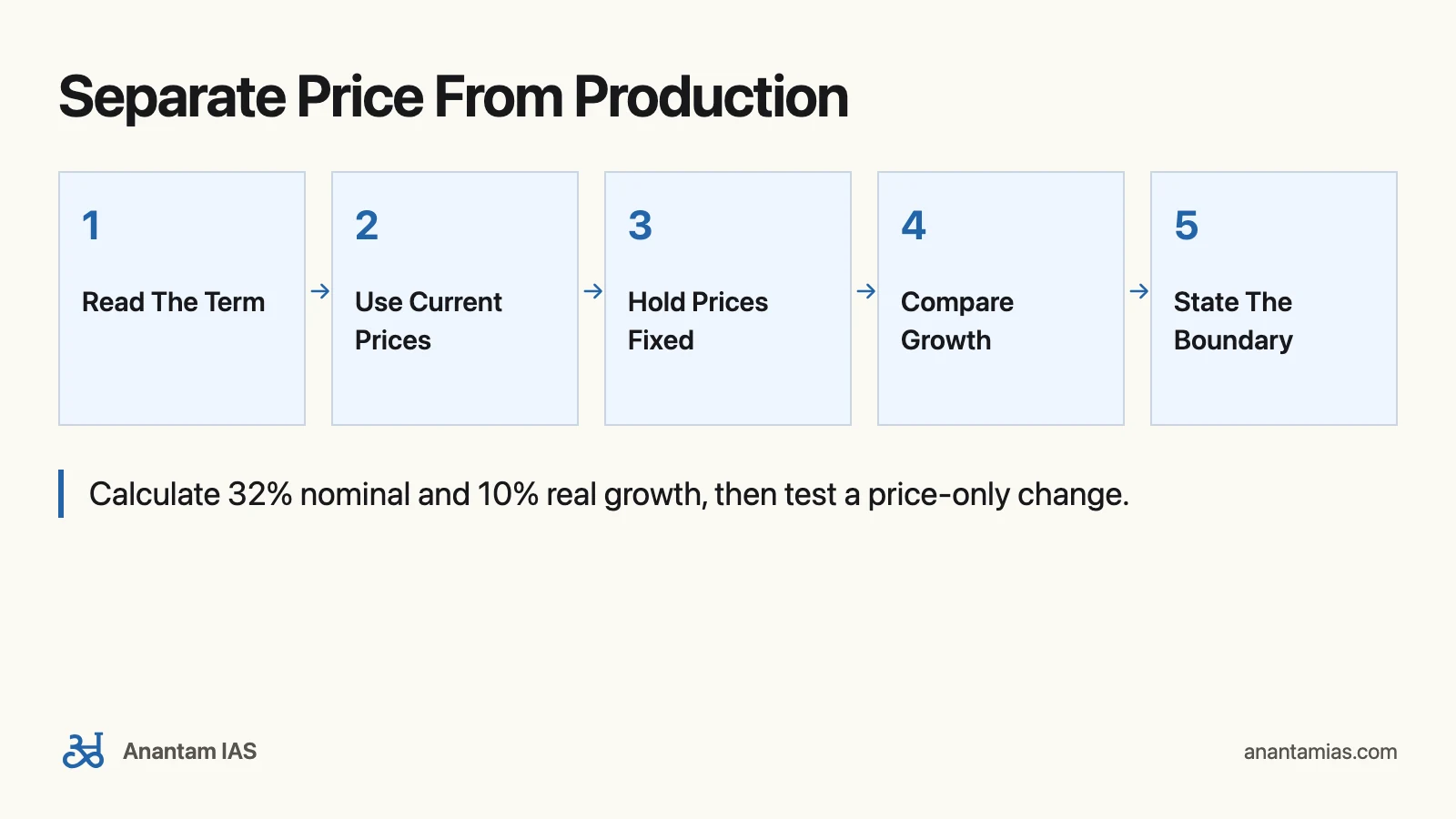
Nominal GDP uses current prices. Real GDP values output using constant prices so price changes don’t masquerade as output growth. The NCERT National Income Accounting chapter explains this distinction.
This is an original practice example, not a UPSC question or actual national data. Assume a tiny economy produces only one final good: notebooks. There are no intermediate goods to subtract and no other goods, services or production changes to account for.
| Year | Notebooks produced | Price per notebook | Output at current prices |
|---|---|---|---|
| A | 200 | Rs 50 | Rs 10,000 |
| B | 220 | Rs 60 | Rs 13,200 |
First calculate nominal growth:
- Year A output value = 200 x 50 = Rs 10,000.
- Year B output value = 220 x 60 = Rs 13,200.
- Increase = 13,200 – 10,000 = Rs 3,200.
- Nominal growth = 3,200 / 10,000 x 100 = 32%.
It would be wrong to say that the economy produced 32% more notebooks. Production rose from 200 to 220, an increase of 20 notebooks. Price also changed.
Hold the Year A price fixed to calculate real growth:
- Year B output at the base price = 220 x 50 = Rs 11,000.
- Increase at constant prices = 11,000 – 10,000 = Rs 1,000.
- Real growth = 1,000 / 10,000 x 100 = 10%.
- GDP deflator for Year B = 13,200 / 11,000 x 100 = 120, with Year A = 100.
The price rose 20% and quantity rose 10%. Their joint effect is 1.20 x 1.10 = 1.32, which explains nominal growth of 32%. Simply adding 20% and 10% would miss the interaction.
Now keep production at 200 but keep the new price at Rs 60. Nominal output becomes Rs 12,000, a 20% increase. Real output remains Rs 10,000 at the base price, so real growth is 0%. You have isolated a price rise without a production rise.
This model helps with the distinction, but actual national accounts aggregate many goods and services. Don’t treat the notebook price rise as India’s CPI inflation. A GDP deflator and consumer-price index cover different things.
Make A Concept Ladder
Your revision note should let you move from a term to a testable explanation. Use the notebook exercise as the first entry.
- Term: nominal GDP.
- Meaning: output valued at the current year’s prices.
- Test: Rs 13,200 can rise because quantity, price or both have risen.
- Correction: hold prices fixed before claiming real output growth.
- Application: identify whether an official release uses current or constant prices, and record its base year and period.
Add a boundary beside each concept. For GDP, higher real output alone doesn’t show how gains are distributed or whether environmental costs increased. For fiscal deficit, a lower figure alone doesn’t establish that every spending cut is desirable.
The boundary is part of understanding. It prevents you from extending a correct definition into an unsupported conclusion.
Use A Short Revision Cycle
A 14-session cycle can work as a starting plan. A session is a unit of study, not necessarily a calendar day, and difficult topics can take more than one.
| Sessions | Suggested focus | Completion check |
|---|---|---|
| 1-3 | Basic concepts and national income | Reproduce the nominal/real calculation |
| 4-6 | Public finance and financial system | Classify a receipt and trace a credit flow |
| 7-9 | Money measures and inflation | Explain a change with its assumptions |
| 10-12 | External sector, poverty and development | Connect a concept to a policy question |
| 13-14 | Recall and gap repair | Solve relevant questions without open notes |
With 20 minutes available, do one concept and one recall check. With 45 minutes, add a worked variation. With 75 minutes, add question practice and a short analytical answer. Stretch the cycle when needed; don’t rush finance topics to protect a neat finish date.
Keep A Gap Checklist
After each session, record what the concept book did and what still needs a different source. Use our NCERT guide for foundations and official releases for changing data.
- Can I explain the term without reading the definition?
- Can I change one number and recalculate correctly?
- Can I state one conclusion that the result does not justify?
- Have I confused current prices with constant prices, or a level with a growth rate?
- Does this topic need a current policy, legal rule or dated figure checked separately?
The useful result is a repaired concept you can apply. Rebuild the notebook example today, then replace both quantities and prices with your own invented values. If the two growth rates make sense, you are ready to move on.
Frequently Asked Questions
Who is the author of the Shankar Ganesh economy book?
The publisher uses Sankarganesh Karuppiah. The verified title is Indian Economy Key Concepts, a different book from Shankar IAS Environment.
Which edition and ISBN are discussed?
McGraw Hill’s tenth edition, Indian Economy Key Concepts (2026-27), ISBN 9789364445962, published April 22, 2026.
Can Key Concepts replace all economy preparation?
No. Use it for identified conceptual gaps. Current official updates, relevant exam questions and analytical answer practice remain separate tasks.
Why is nominal growth higher in the notebook example?
Both quantity and price rise. Nominal output rises 32%, while output valued at the base price rises 10%. Keeping prices fixed isolates the quantity change.
Must I finish the revision cycle in fourteen days?
No. The plan has fourteen study sessions, which can span more days. Extend difficult topics and adjust the session size to your background and time.