Chief Ministers of Sikkim: Complete List, Tenure and Party
Prem Singh Tamang has led Sikkim since 27 May 2019. Here is every Chief Minister since the 1975 merger, with exact term dates, party and both President's Rule spells marked.
Sikkim’s Chief Minister is Prem Singh Tamang of the Sikkim Krantikari Morcha. He took office on 27 May 2019 and was sworn in for a second term on 10 June 2024 after his party won 31 of the assembly’s 32 seats. Six people have held the office since Sikkim merged with India in 1975.
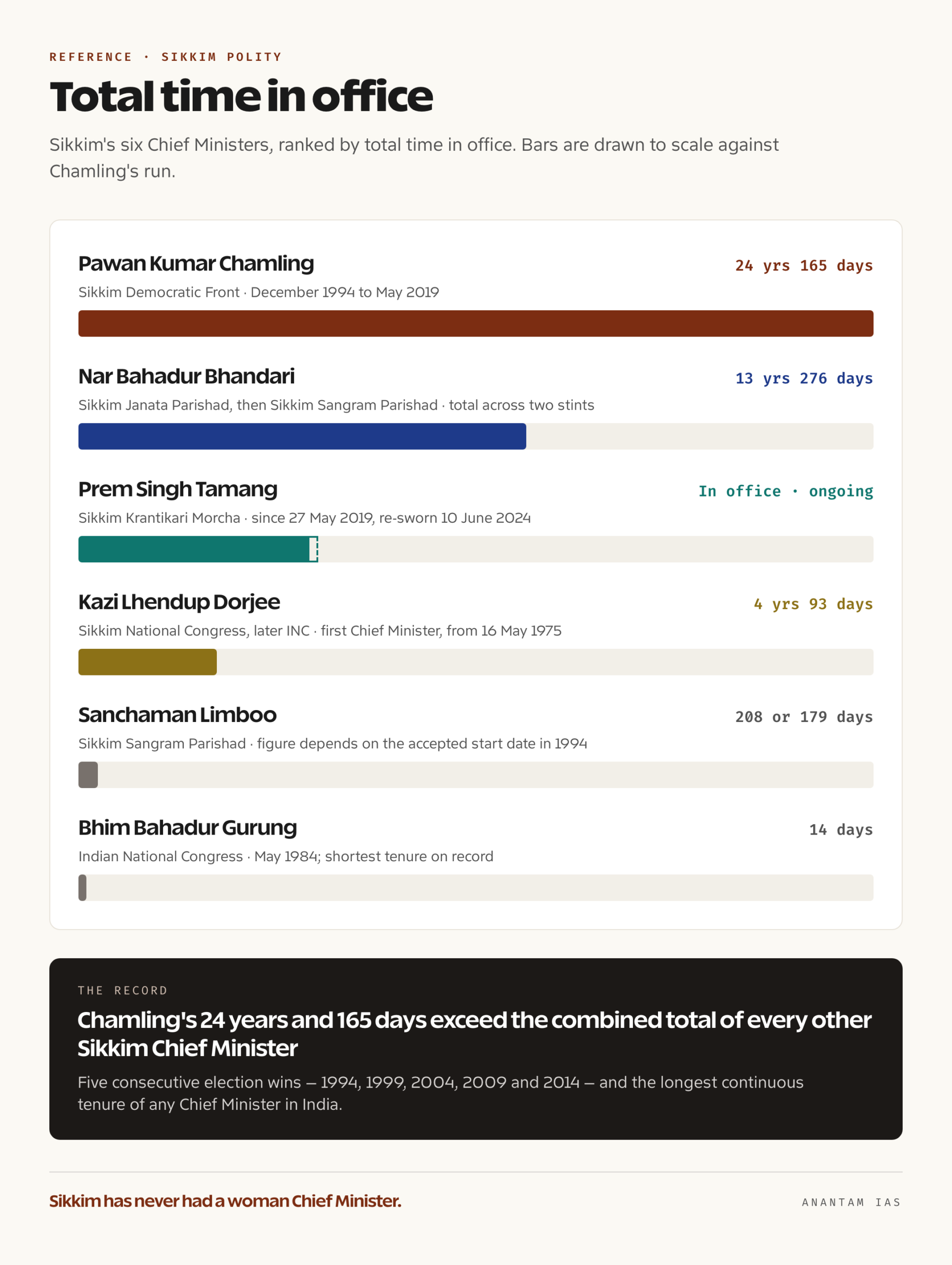
Six names in half a century is the fewest of almost any Indian state, and there is a single reason for it. Pawan Kumar Chamling governed Sikkim for 24 years and 165 days without a break — longer than every other Sikkim Chief Minister put together, and the longest run any Chief Minister in India has managed. The table below lists every holder in order with exact dates, party and both spells of President’s Rule marked, along with the two places where reliable sources genuinely disagree.
How the Office Works in Sikkim
The Chief Minister is appointed by the Governor under Article 164 of the Constitution, and the appointment goes to whoever can command a majority in the Sikkim Legislative Assembly. Other ministers are appointed on the Chief Minister’s advice, and the Council of Ministers is collectively responsible to the assembly. Lose the confidence of the house and the office goes with it.
The formal term is five years, tied to the assembly rather than the person, with no cap on how many terms one individual may serve. Where no majority can be put together, Article 356 permits President’s Rule. Sikkim has been under it twice, both times in the early years.
The assembly has 32 seats — the smallest in the country — of which twelve are reserved for Bhutias and Lepchas and two for Scheduled Castes, and one seat is reserved for the Sangha, elected by the state’s monasteries. Sikkim sends one member to the Lok Sabha and one to the Rajya Sabha. Article 371F, inserted by the Thirty-sixth Amendment in 1975, carries the special provisions under which Sikkim joined the Union and protects the old laws and land arrangements that predate the merger.
Complete List of Chief Ministers of Sikkim
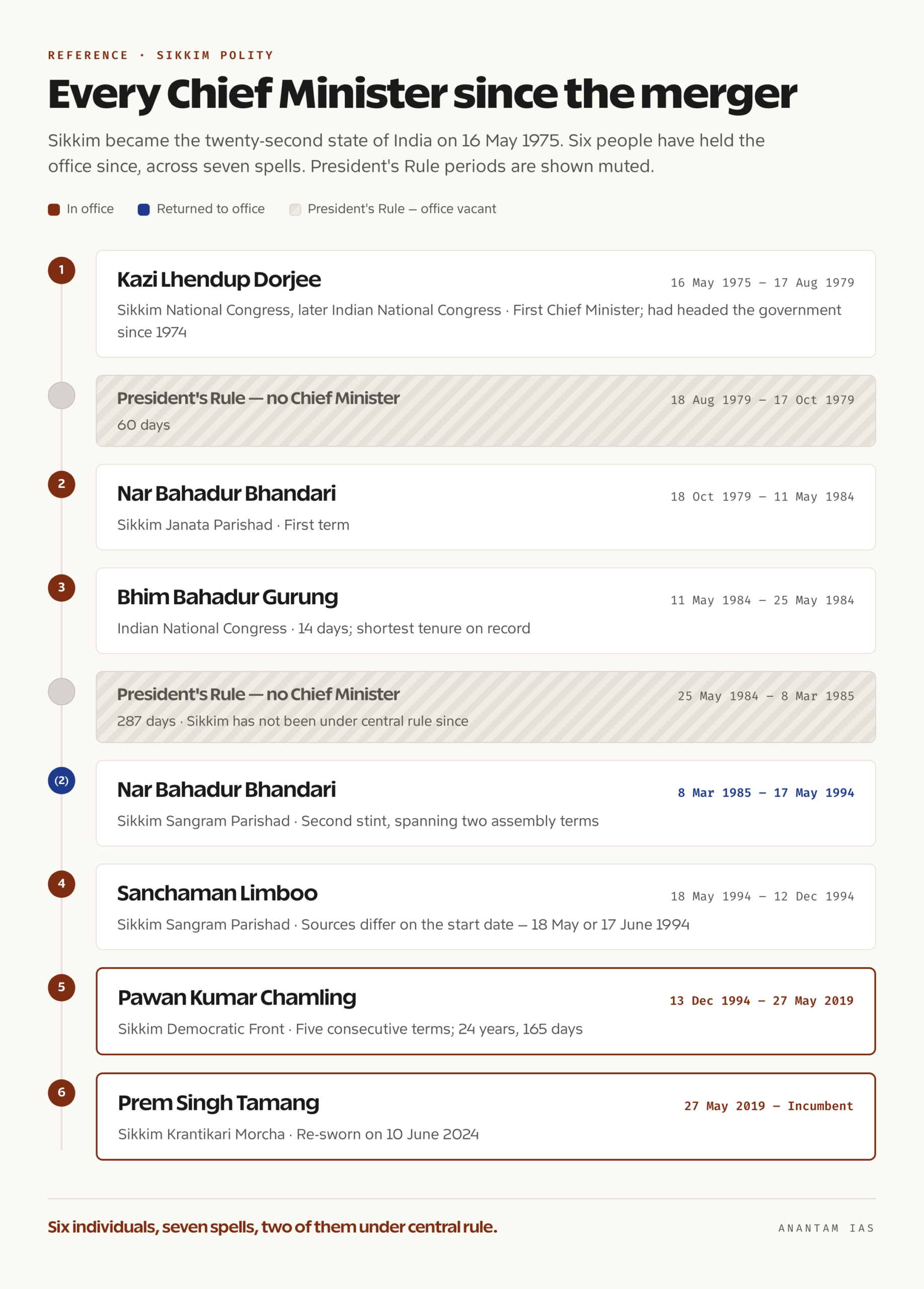
Sikkim became the twenty-second state of India on 16 May 1975. The office of Chief Minister was created a year earlier, under the Government of Sikkim Act, 1974, when Sikkim was still a protectorate with the Chogyal as head of state — Kazi Lhendup Dorjee headed that government from mid-1974. Standard listings, including the state’s own records, date the office from 16 May 1975, and the list below follows that convention while noting the earlier start.
| # | Name | Term Start | Term End | Party | Notes |
|---|---|---|---|---|---|
| 1 | Kazi Lhendup Dorjee | 16 May 1975 | 17 August 1979 | Sikkim National Congress, later Indian National Congress | First Chief Minister; had headed the government since 1974 |
| — | President’s Rule | 18 August 1979 | 17 October 1979 | — | No Chief Minister; 60 days |
| 2 | Nar Bahadur Bhandari | 18 October 1979 | 11 May 1984 | Sikkim Janata Parishad | First term |
| 3 | Bhim Bahadur Gurung | 11 May 1984 | 25 May 1984 | Indian National Congress | 14 days; shortest tenure on record |
| — | President’s Rule | 25 May 1984 | 8 March 1985 | — | No Chief Minister; 287 days |
| (2) | Nar Bahadur Bhandari | 8 March 1985 | 17 May 1994 | Sikkim Sangram Parishad | Second stint, spanning two assembly terms |
| 4 | Sanchaman Limboo | 18 May 1994 | 12 December 1994 | Sikkim Sangram Parishad | Sources differ on the start date — see below |
| 5 | Pawan Kumar Chamling | 13 December 1994 | 27 May 2019 | Sikkim Democratic Front | Five consecutive terms; 24 years, 165 days |
| 6 | Prem Singh Tamang | 27 May 2019 | Incumbent | Sikkim Krantikari Morcha | Re-sworn on 10 June 2024 |
Two clarifications the list cannot hold. Nar Bahadur Bhandari’s second stint of 8 March 1985 to 17 May 1994 covers two assembly terms — he was returned in 1985 and again in 1989, with a brief formal break around 25-26 November 1989 between ministries — so some listings count it as two terms rather than one. And Sanchaman Limboo’s start date is genuinely contested: the standard chief-ministerial listings put it at 18 May 1994, the day after Bhandari lost a confidence motion and Limboo was elected Leader of the House, while Limboo’s own biographical entries and several Sikkim sources give 17 June 1994 as the day he formally took office. So the tenure gets quoted as either 208 days or 179 days, depending on which date you accept.
Longest-Serving and Most Notable Chief Ministers
Pawan Kumar Chamling is the central figure, and the numbers are worth stating precisely. He was Chief Minister from 13 December 1994 to 27 May 2019 — 24 years and 165 days, across five consecutive election wins in 1994, 1999, 2004, 2009 and 2014. That surpassed Jyoti Basu’s 23 years and 137 days in West Bengal and stands as the longest continuous tenure of any Chief Minister in India. His Sikkim Democratic Front took every one of the 32 seats in the 2009 election.
His governments are associated with Sikkim’s shift to full organic farming, declared complete in 2016, with a ban on grazing in reserve forests, and with the state’s climb up national indicators on literacy and per-capita income. The run ended in 2019, when the Sikkim Krantikari Morcha — founded by his own former minister — took 17 seats to the SDF’s 15.
Nar Bahadur Bhandari is second, with 13 years and 276 days in total across two stints. He dominated Sikkim politics through the 1980s and early 1990s and is remembered for pressing the case that led to Nepali being included in the Eighth Schedule in 1992, and for the state’s early assertion of its distinct linguistic and land arrangements under Article 371F.
Kazi Lhendup Dorjee matters for reasons that go beyond his four years and 93 days in office. He led the movement that ended the Chogyal’s rule and brought Sikkim into the Indian Union, and he was the first Chief Minister of the new state. He was awarded the Padma Vibhushan in 2002 and died in 2007 at the age of 102.
Prem Singh Tamang’s tenure is the current chapter. A former SDF minister who broke away to form the SKM in 2013, he became Chief Minister on 27 May 2019 while not a member of the assembly, and won the Poklok-Kamrang by-election in October that year to regularise his position. His party’s 2024 result — 31 of 32 seats — was the most lopsided in the state’s history, and he shifted to the Rhenock seat for that term.
Sikkim has never had a woman Chief Minister.
How Power Has Shifted: Party Trends in Sikkim
Sikkim’s party history is a sequence of state-specific formations rather than a national two-party contest. The Indian National Congress has never won a Sikkim assembly election on its own strength; the two Congress-labelled tenures came through mergers and defections, not the ballot.
The pattern runs in long blocks. Kazi Lhendup Dorjee’s Sikkim National Congress held the first four years. Bhandari’s Sikkim Janata Parishad and then Sikkim Sangram Parishad held most of 1979 to 1994. Chamling’s Sikkim Democratic Front held the next twenty-five. The Sikkim Krantikari Morcha has held office since 2019. Each of the last three transitions came from a split inside the ruling party rather than from a rival tradition: Bhandari left Congress-aligned politics, Chamling left Bhandari’s SSP, and Tamang left Chamling’s SDF.
| Party | Chief Ministers | Periods in office |
|---|---|---|
| Sikkim Democratic Front | 1 (Chamling) | 1994-2019 |
| Sikkim Sangram Parishad | 2 (Bhandari, Limboo) | 1985-1994 |
| Sikkim Krantikari Morcha | 1 (Tamang) | 2019-present |
| Sikkim Janata Parishad | 1 (Bhandari) | 1979-1984 |
| Sikkim National Congress / INC | 1 (Dorjee) | 1975-1979 |
| Indian National Congress | 1 (Gurung) | 1984 (14 days) |
Two features follow from this. Governing parties in Sikkim rarely lose narrowly — they get replaced wholesale. And the winning formation is almost always led by someone who served in the outgoing government.
Records and Quick Facts
Longest tenure: Pawan Kumar Chamling, 24 years and 165 days from December 1994 to May 2019 — the longest continuous tenure of any Chief Minister in India.
Shortest tenure: Bhim Bahadur Gurung, 14 days in May 1984.
Most terms: Chamling, five consecutive assembly terms. Bhandari is next with three.
President’s Rule spells: two — 18 August to 17 October 1979, and 25 May 1984 to 8 March 1985. Sikkim has not been under central rule since March 1985, a run of more than forty years.
Returned to office: one — Nar Bahadur Bhandari, in March 1985 after the 1984-85 spell of President’s Rule.
Total holders: six individuals across seven separate spells.
First Chief Minister: Kazi Lhendup Dorjee, from 16 May 1975, having headed the government since 1974 under the Government of Sikkim Act.
Oldest former Chief Minister: Kazi Lhendup Dorjee, who lived to 102.
Women Chief Ministers: none so far.
On the counting: some listings show five Chief Ministers rather than six by treating the two Congress-labelled tenures differently, and some show seven terms rather than six by splitting Bhandari’s second stint at the 1989 election. The underlying facts are the same; only the convention differs.
FAQ
Who is the current Chief Minister of Sikkim? Prem Singh Tamang of the Sikkim Krantikari Morcha, in office since 27 May 2019. He was sworn in for a second term on 10 June 2024 after the SKM won 31 of the 32 assembly seats.
Who was the first Chief Minister of Sikkim? Kazi Lhendup Dorjee, from 16 May 1975, when Sikkim became the twenty-second state of India. He had already headed the government since 1974 under the Government of Sikkim Act, when Sikkim was still a protectorate.
Who served the longest as Chief Minister of Sikkim? Pawan Kumar Chamling, for 24 years and 165 days between December 1994 and May 2019. That is the longest unbroken tenure of any Chief Minister in India, ahead of Jyoti Basu’s 23 years and 137 days.
How many Chief Ministers has Sikkim had? Six individuals since 1975, across seven separate spells — Nar Bahadur Bhandari served twice, with a period of President’s Rule in between.
How is the Chief Minister of Sikkim appointed? The Governor appoints the person who can command a majority in the 32-member Sikkim Legislative Assembly, under Article 164. Sikkim’s special constitutional arrangements sit in Article 371F, inserted when the state joined the Union in 1975.
Practice Questions
Practice MCQs
- Sikkim became a state of the Indian Union on which date? (a) 4 July 1974 (b) 26 April 1975 (c) 16 May 1975 (d) 20 February 1987 Answer: (c) Sikkim became India’s twenty-second state on 16 May 1975 through the Thirty-sixth Constitutional Amendment.
- Which Article contains the special provisions with respect to Sikkim? (a) Article 371A (b) Article 371F (c) Article 371G (d) Article 371H Answer: (b) Article 371F was inserted in 1975 and protects Sikkim’s pre-merger laws and land arrangements.
- Who holds the record for the longest continuous tenure as a Chief Minister in India? (a) Jyoti Basu (b) Nar Bahadur Bhandari (c) Pawan Kumar Chamling (d) Naveen Patnaik Answer: (c) Pawan Kumar Chamling served 24 years and 165 days in Sikkim, ahead of Jyoti Basu’s 23 years and 137 days in West Bengal.
- How many seats does the Sikkim Legislative Assembly have? (a) 30 (b) 32 (c) 40 (d) 60 Answer: (b) The assembly has 32 seats, the smallest of any Indian state, including one seat reserved for the Sangha.
- How many spells of President’s Rule has Sikkim seen since 1975? (a) None (b) One (c) Two (d) Four Answer: (c) Two — in 1979 and from May 1984 to March 1985. There has been none since.