Spatial Computing and Mixed Reality: The Post-Smartphone Interface (UPSC Science & Tech)
Spatial computing puts digital objects into the room around you and lets you control them with your eyes, hands and voice instead of a flat screen. Here is the full picture — the AR-VR-MR-XR spectrum, the tech that makes it work, the quieter return of the metaverse, and India's AVGC-XR push — explained for UPSC Science & Tech.
Spatial computing is computing that operates in the three-dimensional space around you rather than on a flat screen. A headset or pair of glasses maps your physical room, places digital content into it, and lets you control that content by looking, pinching your fingers and speaking — instead of using a mouse or a touchscreen. It is the broad umbrella idea behind augmented, virtual and mixed reality (AR, VR and MR — together called XR), and Apple branded its Vision Pro a “spatial computer” precisely to signal this shift toward a post-smartphone, room-scale interface.
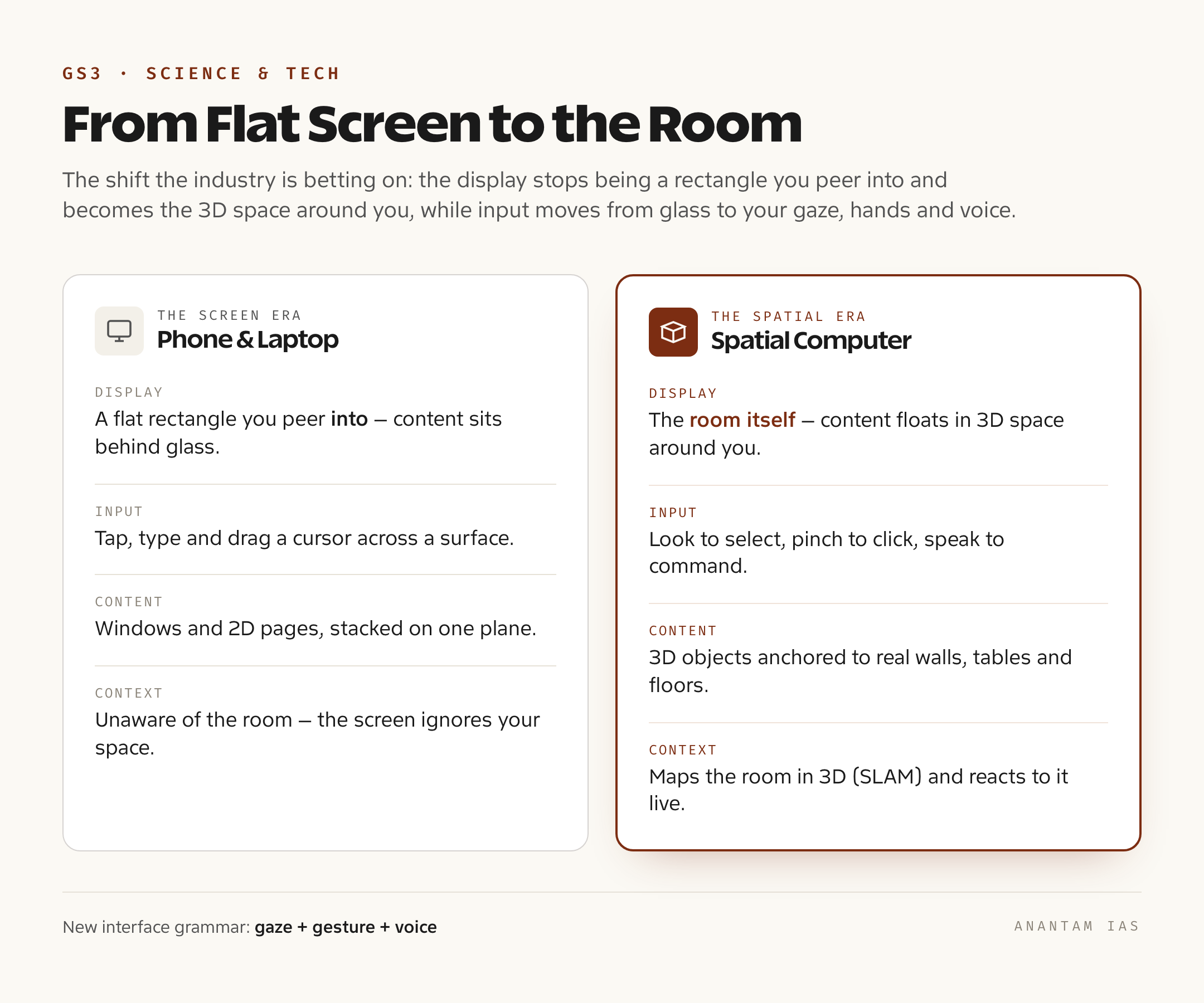
For nearly two decades, computing has meant staring at a rectangle. The desktop monitor, the laptop lid, the smartphone in your palm — all of them are flat windows you peer into, tapping glass and dragging a cursor across a surface that has nothing to do with the room you’re sitting in. Spatial computing is the bet that this era is ending. The idea is simple to state and strange to imagine: instead of putting your content behind glass, the computer puts it into the space around you. A spreadsheet floats beside your desk, a 3D heart model hangs in the air for a surgeon to walk around, a video call partner appears to sit across the table. You don’t touch a screen. You look at what you want, pinch your fingers, or speak — and the machine, which has mapped the room in three dimensions, responds as if the digital object were really there.
When Apple shipped the Vision Pro in 2024 it pointedly refused to call the device a “headset,” branding it a spatial computer instead, and that single marketing choice captured a genuine shift in how the industry thinks. For a UPSC aspirant, this is not a gadget story. Spatial computing sits at the centre of the emerging-technology syllabus in GS Paper 3, it touches privacy and ethics in GS2, and it has a fast-moving India angle in the government’s push to build a creative-technology and extended-reality industry. The technology rewards a candidate who can do three things cleanly: place it on the spectrum of immersive tech, explain the hardware and software that make it work, and weigh its promise against its real costs.
What Spatial Computing Is and the AR-VR-MR-XR Spectrum
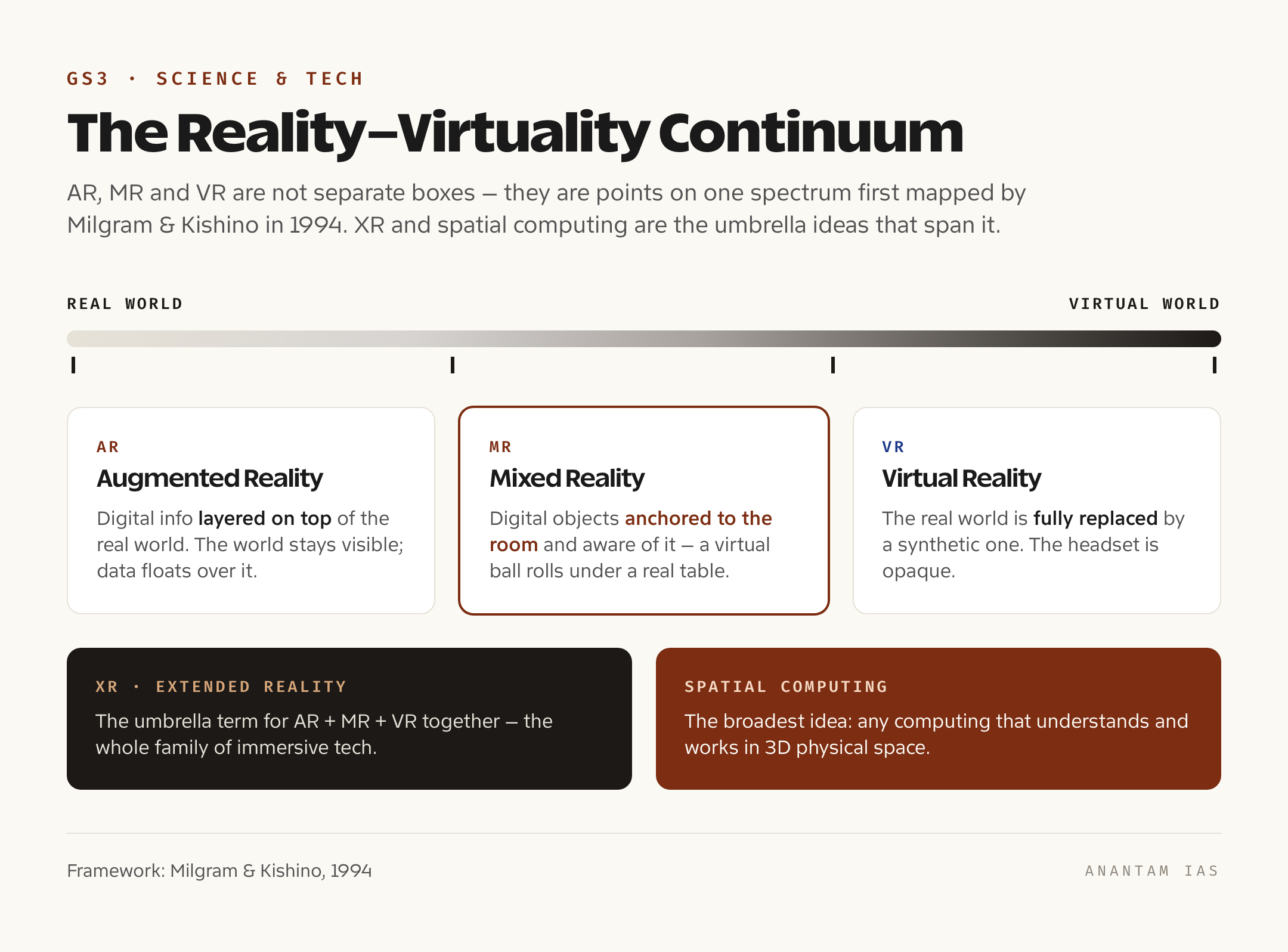
Start with the words, because the alphabet soup of this field trips up more answers than the concepts do. The cleanest mental model is the reality-virtuality continuum, a framework proposed by researchers Paul Milgram and Fumio Kishino back in 1994 and still the standard reference today. Picture a line. At the far left sits the completely real world — what you see with your bare eyes. At the far right sits a completely virtual world — a fully computer-generated environment. Everything interesting happens in between, and the different “realities” are just points along that line rather than separate, walled-off categories.
Augmented Reality, or AR, sits near the real end: it overlays digital information on the real world without replacing it — think of directions painted onto the road through a car windscreen, or a phone camera showing how a sofa would look in your living room. Virtual Reality, or VR, sits at the far virtual end: it shuts out the real world entirely and drops you inside a synthetic one, which is why VR headsets are opaque. Mixed Reality, or MR, is the genuinely new middle ground — here digital objects don’t just float on top of reality, they’re anchored to it and aware of it, so a virtual ball can roll under your real table and a digital window can stay pinned to your real wall even as you walk around it. And Extended Reality, or XR, is simply the umbrella term that covers all three — AR, VR and MR together. So the relationship is easy to remember: XR is the family, and AR, MR and VR are the siblings sitting at different points on Milgram’s line.
Where does “spatial computing” fit? It is the broadest and most recent term of all, and it describes the goal rather than a single point on the spectrum. Spatial computing means any computing that understands and operates in three-dimensional physical space — blending digital content with the real world, tracking where you and your hands and your eyes are, and letting you interact through natural actions instead of a keyboard and mouse. A device like the Vision Pro can swing from near-total AR (your room visible, a few apps floating in it) to near-total VR (your room replaced by a mountainside) by simply turning a dial, which is why a fixed label like “AR headset” no longer fits. That’s the deeper reason Apple chose “spatial computer.” The point isn’t which slice of the continuum you’re on. The point is that the computer has finally learned to think in space the way humans do.
How Spatial Computing Actually Works: The Tech Stack
A spatial computer has to solve a problem your laptop never faces — it has to know where it is and what’s around it, continuously, in real time. So the magic is less in the display and more in a stack of sensing technologies working together. The foundation is something called SLAM, short for Simultaneous Localization and Mapping. SLAM lets a device build a 3D map of an unfamiliar room while simultaneously tracking its own position inside that map, using onboard cameras and motion sensors and no external beacons. This is what lets a digital window stay glued to your real wall when you turn your head: the headset always knows precisely where it is and where the wall is. The same family of techniques powers self-driving cars and warehouse robots, which is worth flagging in an answer because it links spatial computing to robotics and autonomous systems.
Layered on top of SLAM are the input technologies that replace the mouse. Eye tracking uses tiny inward-facing cameras to follow your gaze, so the thing you’re looking at becomes the thing you’re selecting — and it doubles as an efficiency trick called foveated rendering, where the device draws only the small patch you’re directly looking at in full detail and lets the periphery stay soft, saving enormous processing power. Hand tracking uses outward-facing cameras to read your fingers, so a pinch becomes a click and a flick becomes a scroll, with no controller required. Voice handles the rest. Together, gaze plus gesture plus voice make up the new interface grammar, the spatial equivalent of the mouse-and-keyboard combination that defined the PC era.
The Hardware Race and the Quiet Return of the Metaverse
Then there’s passthrough, the feature that makes mixed reality feel real. An opaque VR headset would normally blind you to your surroundings, so passthrough uses external cameras to film the real world and pipe a live video feed onto the screens inside, then paints digital objects on top of that feed. You see your real room — your coffee cup, your colleague, your hands — with virtual content composited into it convincingly. High-quality passthrough is the single hardest engineering problem in the field, because the human eye is brutally sensitive to lag and distortion, and it’s the dividing line between a device that feels like a window onto reality and one that feels like a fishtank. Increasingly all of this runs alongside on-device AI, which interprets the sensor streams, recognises objects and gestures, and turns raw camera data into a usable understanding of the scene.
This stack is what the current hardware race is really about. Apple’s Vision Pro, refreshed in October 2025 with the faster M5 chip and a smoother 120 Hz display, anchors the premium end and is explicitly pitched as spatial computing rather than gaming. Meta, which still commands roughly 80 per cent of headset sales through its cheaper Quest line, has pushed hard into both consumer MR and lightweight AR glasses. Samsung and Google have entered with Android-based XR devices. The competition is no longer about who builds the most immersive game — it’s about who owns the interface that might one day sit between you and all your computing, the way the smartphone does now. That is the “post-smartphone interface” thesis in a sentence: the same way the iPhone displaced the PC as most people’s primary computer, spatial computers could one day displace the phone.
And this is where the metaverse fits — the much-hyped idea, peaking around 2021, of persistent shared 3D worlds where people would work, play and socialise as avatars. The consumer metaverse, with its cartoon avatars and empty virtual malls, mostly fizzled. But the underlying vision didn’t die so much as grow up and go to work. Today its real momentum is in the enterprise: factories building “digital twins,” meaning live 3D simulations of a real machine or whole production line that engineers can inspect and test in mixed reality before touching the physical thing; surgeons who have used Vision Pro headsets during operations to magnify their view and pull up CT scans hands-free; medical and industrial trainees practising risky procedures in safe virtual replicas; architects walking clients through unbuilt buildings; and dispersed teams collaborating around shared 3D models. The flashy metaverse promised a second life. The quieter, more durable version is simply a better way to do real work — and that reframing is exactly the nuance examiners reward.
Promise, Problems and the India Angle
So what’s holding it back, and where does India stand? The promise is large — a more natural, embodied way to compute, with clear wins in training, design, healthcare and remote collaboration. But the obstacles are just as real, and a balanced answer names them. Cost is the first: a premium spatial computer can run to several lakh rupees, far beyond a mass-market price. Comfort and social acceptance are the second — the devices are still heavy, can cause fatigue or nausea over long sessions, and wearing a face computer in public remains awkward in a way smartphones never were. There’s a content gap: hardware has outrun the supply of genuinely useful spatial apps. And there is a deep privacy problem that aspirants should treat as a GS2 issue, not a footnote. A spatial computer is, by design, an always-on array of cameras and sensors scanning your home, your face and the people around you, and eye-tracking data in particular can reveal what you look at, how long, and what it makes you feel — an intimate stream of behavioural and biometric information with no settled rules yet for who may collect or sell it.
For India, the opportunity is being pursued less through hardware than through content and skilling, under the banner of AVGC-XR — Animation, Visual Effects, Gaming, Comics and Extended Reality. In September 2024 the Union Cabinet approved a National Centre of Excellence for the sector, the Indian Institute of Creative Technologies (IICT) in Mumbai, with a one-time budgetary support of about ₹391 crore and a public-private model that has drawn in industry bodies FICCI and CII alongside global partners like Google, Meta, Adobe, Microsoft and NVIDIA. IICT began its first phase of operations in July 2025 with specialised programmes, and the government has signalled plans to seed creative-technology and content-creator labs, including groundwork for labs across thousands of schools. Several states — Karnataka, Maharashtra, Madhya Pradesh, Telangana, Rajasthan and Kerala among them — have rolled out their own AVGC-XR policies with investment and jobs targets. The logic mirrors India’s IT-services story: rather than trying to out-build Apple on silicon, the country is positioning itself as the world’s workshop for the immersive content and the talent that spatial computing will need, while public health and education systems experiment with XR for surgical training, classroom learning and skilling. It’s an industrial-policy bet on the software-and-skills layer of the next interface, not the device itself.
For Your Mains Answer
This is a core GS Paper 3 topic under science and technology — “developments and their applications and effects in everyday life” and “awareness in the fields of IT, computers, robotics.” It also reaches into GS Paper 2 through the privacy, data-protection and digital-rights angle, and into Essay as a clean example for prompts on technology, the future of work, or human-machine relationships. The marking skill is the same one this article models: define the technology precisely, show how it works, and then judge it with named benefits and named risks rather than vague enthusiasm.
How to Build the Answer
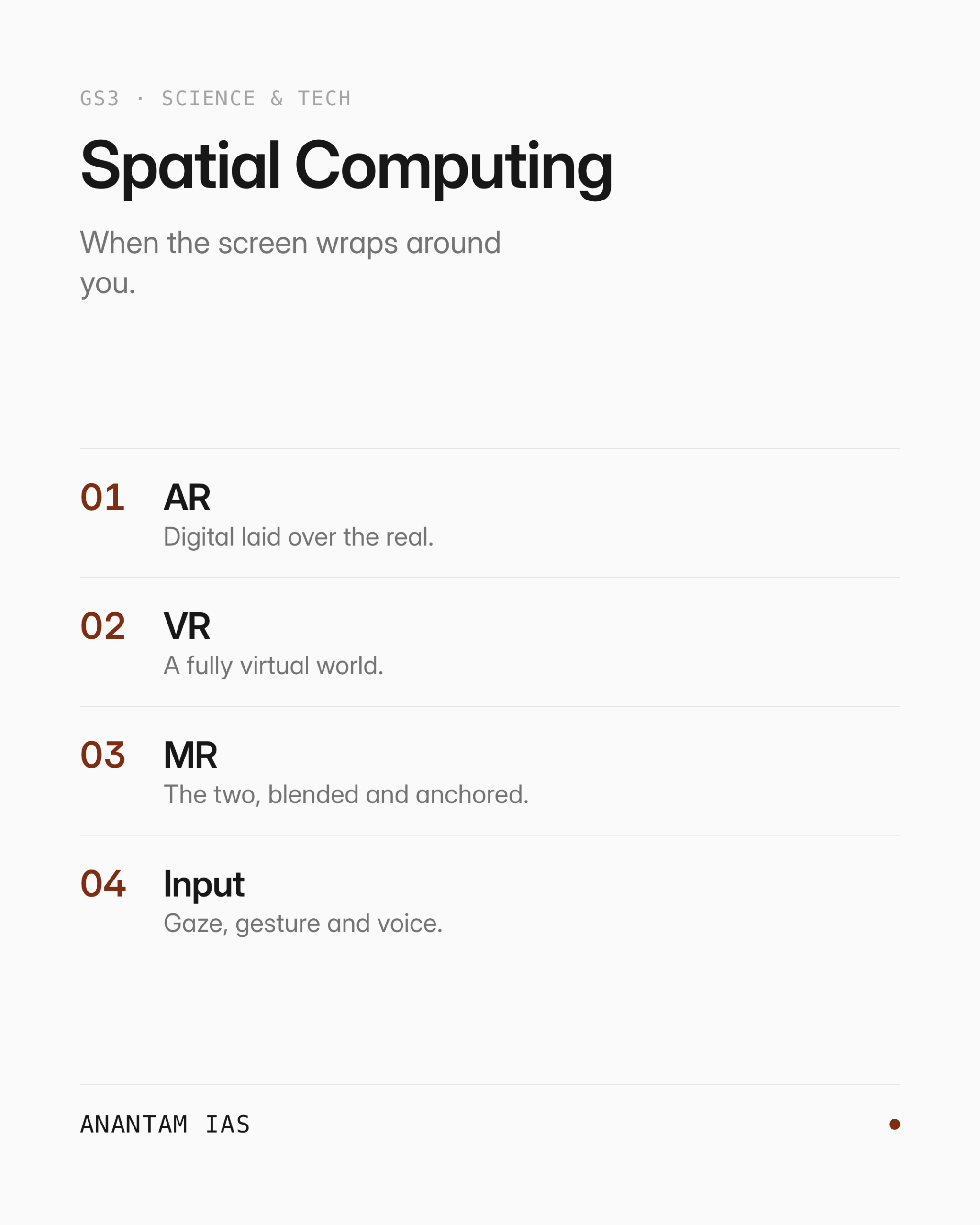
Move in a logical chain. Define spatial computing as 3D computing that blends the digital and physical and is controlled by gaze, gesture and voice. Locate it on the reality-virtuality continuum (AR-MR-VR, with XR and spatial computing as umbrellas). Explain the enabling stack (SLAM, eye and hand tracking, passthrough, on-device AI). Give the “post-smartphone interface” thesis and the enterprise re-emergence of the metaverse. Then weigh promise against problems (cost, comfort, social acceptance, content, privacy). Close on the India angle (AVGC-XR, IICT, state policies). That arc — define, locate, build, apply, evaluate, Indianise — fits almost any question on this theme.
Common Mistakes to Avoid
Don’t use AR, VR, MR and XR as if they were synonyms — placing them on Milgram’s continuum is itself a scoring point. Don’t treat the metaverse as dead; the sharper line is that the consumer hype faded while enterprise use grew. Don’t describe spatial computing as only entertainment — lead with training, healthcare, design and collaboration. And don’t skip privacy: always-on cameras and biometric eye-tracking data are the standout ethical concern, and ignoring them flattens the answer.
A Compact Answer Spine
Spatial computing = computing in 3D physical space, content blended with the real world, controlled by gaze + gesture + voice → reality-virtuality continuum (Milgram & Kishino, 1994): AR near real, VR fully virtual, MR the anchored middle, XR the umbrella → enabling tech: SLAM (map + locate), eye tracking (+ foveated rendering), hand tracking, passthrough, on-device AI → post-smartphone interface thesis; metaverse’s quiet enterprise return via digital twins, surgery, training, collaboration → challenges: cost, comfort, social acceptance, content gap, privacy of always-on cameras and biometrics → India: AVGC-XR push, IICT (₹391 crore, 2024), state policies → verdict: a promising next interface whose adoption hinges on cost, comfort and clear rules for data.
Diagram or Flowchart Idea
Draw Milgram’s continuum as a single horizontal arrow: “Real World” on the left, “Virtual World” on the right, with AR, MR and VR marked at their points and a bracket labelled “XR / Spatial Computing” spanning the whole line. Beside it, a small two-column table contrasting the flat screen (display behind glass, mouse-and-touch input) with spatial computing (display in the room, gaze-gesture-voice input). Two quick visuals like these capture the entire conceptual core.
A Balanced-Conclusion Line
A line that lands the marks: “Spatial computing could do for the room what the smartphone did for the pocket — but whether it becomes the next universal interface or stays a high-end niche will depend less on sharper displays than on bringing down cost, easing the human discomfort of wearing a computer, and writing clear rules for the intimate data these always-on devices can see.”
How to Use Data Without Cramming
You need only a handful of anchors: the Milgram-Kishino year (1994) for the continuum, the Vision Pro’s 2024 launch and 2025 M5 refresh, Meta’s roughly 80 per cent share of headset sales, and India’s ₹391 crore IICT approved in September 2024. Drop those into the right sentences and attribute them plainly — “the Cabinet’s September 2024 approval,” “the framework set out by Milgram and Kishino” — rather than scattering numbers loosely.
Frequently Asked Questions
What is spatial computing in simple terms?
Spatial computing is computing that works in the three-dimensional space around you instead of on a flat screen. Rather than tapping glass, you wear a device that maps your room, places digital objects into it, and lets you control them by looking, pinching your fingers and speaking. Apple branded its Vision Pro a “spatial computer” precisely to capture this shift away from the phone-and-laptop model of interaction.
How are AR, VR, MR and XR different?
They’re points on a single spectrum called the reality-virtuality continuum. Augmented Reality (AR) overlays digital information on the real world; Virtual Reality (VR) replaces the real world with a fully synthetic one; Mixed Reality (MR) anchors digital objects into the real world so they interact with it. Extended Reality (XR) is the umbrella term covering all three, and spatial computing is the broader idea of computing that understands physical 3D space.
Is spatial computing the same as the metaverse?
No. The metaverse refers to persistent shared 3D virtual worlds where people interact as avatars; spatial computing is the underlying technology of blending digital and physical space. The consumer metaverse hype of 2021 largely faded, but the same technologies found durable use in enterprise — digital twins, surgical guidance, training simulations and remote collaboration — which is the metaverse’s quieter, more practical second life.
What is India doing in this field?
India’s main bet is on content and skilling rather than hardware, under the AVGC-XR banner (Animation, Visual Effects, Gaming, Comics and Extended Reality). In September 2024 the Cabinet approved a National Centre of Excellence — the Indian Institute of Creative Technologies in Mumbai — with about ₹391 crore in support and global industry partners. Several states have their own AVGC-XR policies, and XR is being trialled in surgical training, education and skilling.
Practice Questions
Prelims MCQs
- With reference to the reality-virtuality continuum proposed by Milgram and Kishino, which statement is correct?
(a) Augmented Reality replaces the real world entirely with a virtual one
(b) Virtual Reality overlays digital data on the visible real world
(c) Mixed Reality anchors digital objects into the real world so they interact with it
(d) Extended Reality refers only to fully virtual environments
Answer: (c) Mixed Reality (MR) is the middle of the continuum, where digital objects are anchored to and aware of the real environment; XR is the umbrella term for AR, VR and MR. - The technology that allows a device to build a 3D map of an unknown space while simultaneously tracking its own position within that map is known as:
(a) SLAM
(b) GPS triangulation
(c) Foveated rendering
(d) Passthrough
Answer: (a) SLAM (Simultaneous Localization and Mapping) lets a headset map a room and locate itself in real time using onboard cameras and sensors, and it also underpins self-driving cars and robots. - “Foveated rendering” in a spatial computing headset refers to:
(a) Filming the real world with external cameras for mixed reality
(b) Drawing only the area the user is directly looking at in full detail to save processing power
(c) Tracking the user’s hands to replace a controller
(d) Anchoring a digital window to a real wall
Answer: (b) Foveated rendering uses eye-tracking to render the gaze point in high detail while keeping the periphery softer, sharply reducing the processing load. - The Indian Institute of Creative Technologies (IICT), approved as a National Centre of Excellence in 2024, is associated with which sector?
(a) Semiconductor fabrication
(b) Quantum computing
(c) AVGC-XR — Animation, Visual Effects, Gaming, Comics and Extended Reality
(d) Space launch vehicles
Answer: (c) The Cabinet approved IICT in Mumbai in September 2024 as the National Centre of Excellence for the AVGC-XR sector, with about ₹391 crore in support and a public-private model. - “Passthrough” technology in mixed-reality headsets refers to:
(a) Letting voice commands pass through to a cloud server
(b) Using external cameras to show a live feed of the real world inside an otherwise opaque headset
(c) Passing eye-tracking data to advertisers
(d) Allowing multiple users to share one virtual world
Answer: (b) Passthrough films the surroundings with outward-facing cameras and displays them on the internal screens, with digital content composited on top, enabling mixed reality on an opaque device.
Mains Practice Questions
- Explain the concept of spatial computing and locate it on the reality-virtuality continuum. How does it differ from the conventional flat-screen interface? (15 marks, 250 words)
- Discuss the key enabling technologies behind mixed reality and spatial computing. To what extent do these technologies overlap with robotics and artificial intelligence? (15 marks, 250 words)
- “The metaverse did not fail; it changed address from the living room to the workplace.” Critically examine the enterprise applications of immersive technologies in India. (15 marks, 250 words)
- Always-on cameras and biometric eye-tracking make spatial computing a significant privacy and data-protection challenge. Examine the ethical and regulatory issues involved. (10 marks, 150 words)
- Evaluate India’s strategy of promoting the AVGC-XR sector as a route to participating in the spatial-computing economy. What are its strengths and limitations? (15 marks, 250 words)