Sustainable Development Report (SDR): India’s Rank, SDGs, UPSC Notes
The Sustainable Development Report 2026 by the UN SDSN ranks India 94th out of 167 countries, its highest ever. Full UPSC guide on the SDG index, methodology, top performers, India's progress, and the gaps that remain.
The Sustainable Development Report 2025, released by the United Nations Sustainable Development Solutions Network (SDSN), arrived in mid-2025 with a sobering message and a small consolation. The sobering message: with five years left on the 2030 clock, not a single one of the 17 Sustainable Development Goals is on track globally. The consolation, at least for India: India reached its highest placing since the index began, ranking 94th out of 167 nations. The climb is real and it is sustained. But a rising rank in a field where almost nobody is on track is a weaker signal than it looks.
The SDR is the closest thing the international system has to a yearly report card on the SDGs. It is independent of the official UN process, produced by SDSN and Bertelsmann Stiftung, and built on an index that combines roughly 100 indicators across the 17 goals. Governments, donors, NGOs, and university researchers treat it as the canonical reference for cross-country SDG comparison. For UPSC aspirants, the SDR connects directly to GS-II (international institutions, governance), GS-III (environment, sustainable development), and GS-I (geography of human development).
This guide unpacks what the SDR 2026 says, where India sits, what the methodology covers and excludes, and how the report fits into prelims and mains preparation.
Quick Facts
- Full name: Sustainable Development Report 2026
- Released by: UN Sustainable Development Solutions Network (SDSN), with Bertelsmann Stiftung
- First edition: 2016
- Released: June 2026, at the Hamburg Sustainability Conference
- Countries ranked: 167
- India’s rank (2026): 94th, its highest ever
- Top three: Finland (1st), Sweden (2nd), Denmark (3rd)
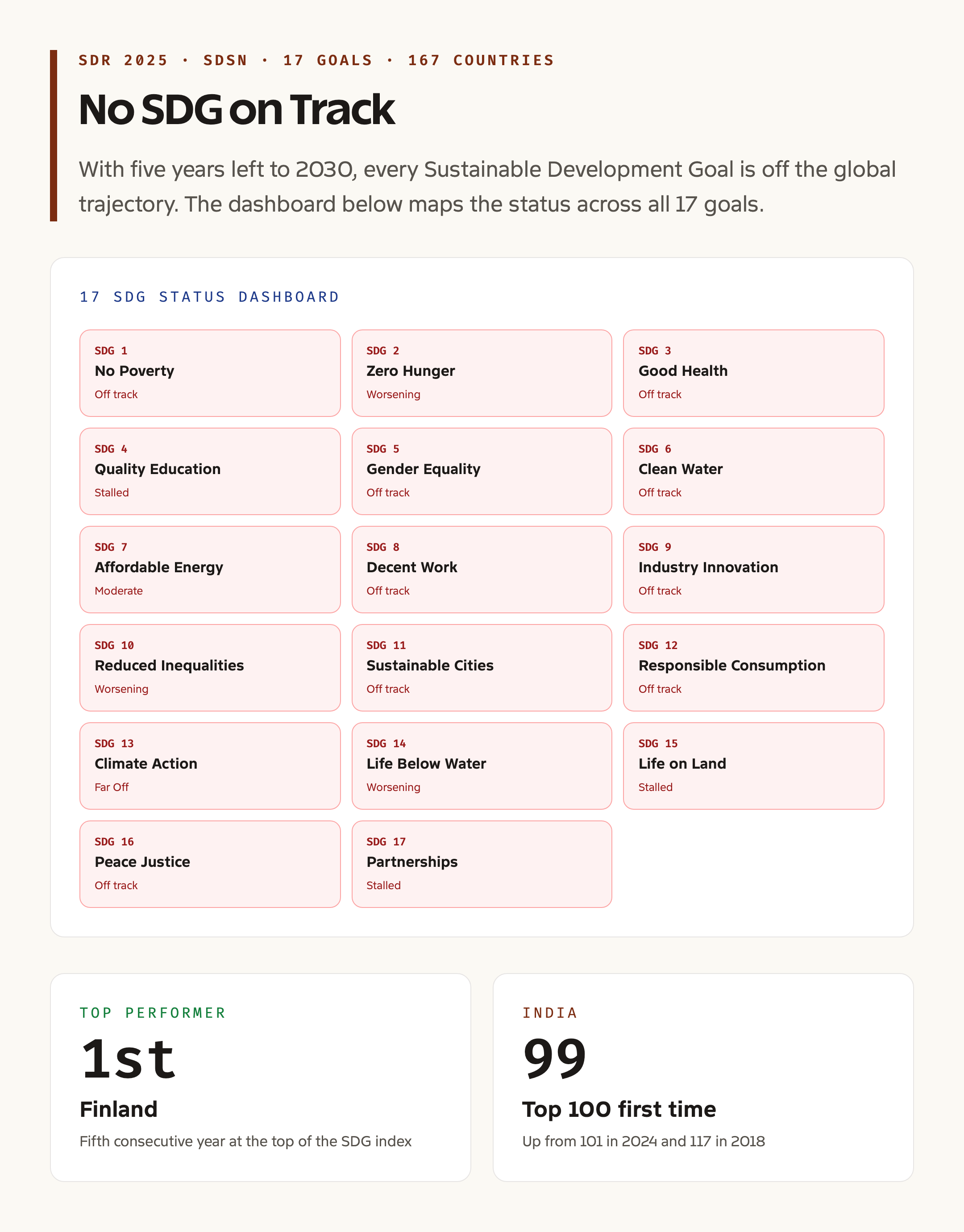
- Global headline: None of the 17 SDGs is on track for 2030; only about 16.5 percent of individual targets are progressing as planned
- India’s score: 68.3 on a 0 to 100 SDG index scale
- Companion product: SDG Index dashboard at sdgindex.org
What Is the SDR
The Sustainable Development Report is an annual benchmarking exercise that scores every country against the 17 Sustainable Development Goals adopted by the 193 UN member states in September 2015. The SDGs cover ending poverty, zero hunger, good health, quality education, gender equality, clean water, affordable energy, decent work, industry and innovation, reduced inequalities, sustainable cities, responsible consumption, climate action, life below water, life on land, peace and justice, and partnerships.
For each goal, the report aggregates indicators from official statistics, household surveys, and modelled estimates. The indicators are normalised to a 0 to 100 scale, where 100 represents full achievement. Each country gets 17 goal scores, an overall index score, and a colour-coded dashboard showing whether the country is on track, on track but moderately, off track, or has stagnated or worsened. The methodology is published openly and revised most years.
The SDR is not a UN document. The official SDG progress is tracked by the UN Statistical Commission and the Global Indicator Framework. The SDR fills a gap because the official process moves slowly and avoids country rankings. SDSN, founded in 2012 under the auspices of the UN Secretary-General, took on the role of producing a comparable, country-level scorecard.
Background and the 2030 Agenda
The SDGs replaced the Millennium Development Goals in 2015 with a broader, more ambitious framework. Where the MDGs were eight goals focused mostly on poverty and basic services in developing countries, the SDGs are 17 goals that apply to every country, integrate environment with development, and place sustainability at the centre. The 2030 deadline gives a fixed 15-year horizon, half of which has now elapsed.
Global Findings of SDR 2026
The headline finding is uncomfortable. Globally, none of the 17 SDGs is on track to be achieved by 2030. The pandemic, the war in Ukraine, the cost of living crisis, the debt distress in low-income countries, and a slow climate response all show up in the data. SDG 2 (zero hunger) is moving backwards. SDG 13 (climate action) is far from any reasonable trajectory. SDG 14 (life below water) and SDG 15 (life on land) are stagnating or declining in most regions. SDG 10 (reduced inequalities) shows widening gaps within and between countries.
A second finding is the persistent lead of the Nordic and continental European countries. Finland tops the index for the sixth consecutive year, with Sweden and Denmark close behind. Germany, France, Norway, and Austria also feature in the top ten. These countries do well on social goals (health, education, gender), do reasonably on environmental goals, and have well-resourced statistical systems that generate high-quality data.
A third finding is the spillover problem. Rich countries score well on domestic SDG indicators but generate negative spillovers through their consumption patterns, trade, and tax practices. The 2026 report continues to expose how high-income countries shift environmental and social burdens to lower-income countries. The Nordic lead, when adjusted for spillovers, narrows considerably.
India’s Performance
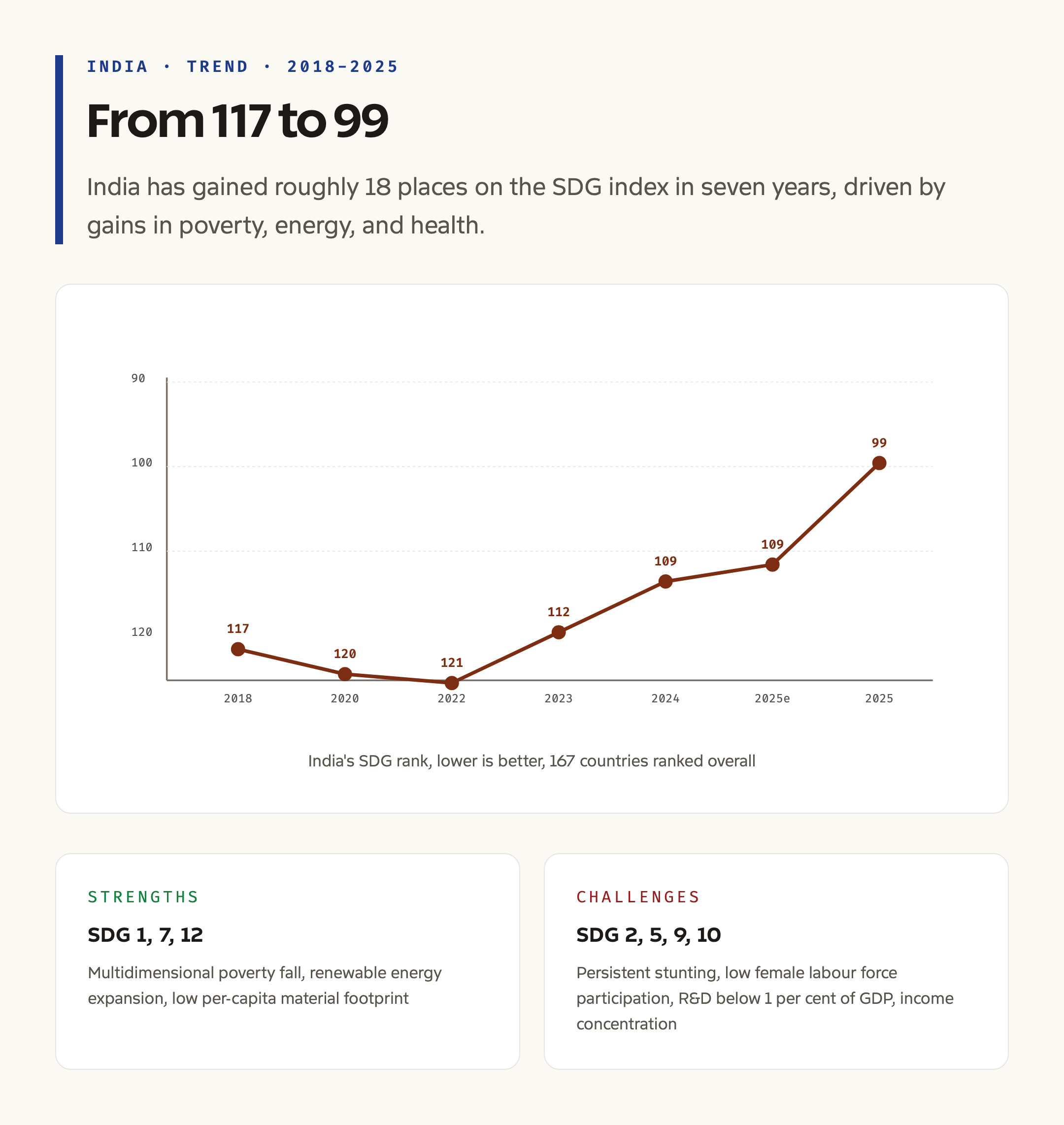
India’s rank of 94 is its highest since the index began, up five places from 99th in 2025 and eighteen places from 112th in 2015 — one of the largest climbs by any major economy over that period, alongside China’s fourteen. Within South Asia India now sits ahead of Bangladesh and Pakistan, but still behind Bhutan, the Maldives, Nepal and Sri Lanka.
The rank flatters the substance, though, and the target-level data is the part worth quoting in an answer. Only about a third of India’s SDG targets, 33.3 percent, are on track. Another 42.7 percent are moving too slowly to arrive by 2030, and 24 percent have gone backwards. A rising rank in a field where almost everyone is slipping is not the same as being on course.
India’s overall index score sits at 68.3 on the 0 to 100 scale. Strong performance shows up on SDG 1 (no poverty), driven by the multidimensional poverty fall, SDG 7 (affordable and clean energy), driven by renewable capacity and rural electrification, and SDG 12 (responsible consumption), where India’s per-capita material footprint stays modest. India also performs adequately on SDG 4 (quality education) thanks to enrolment gains, though learning outcomes remain a weakness.
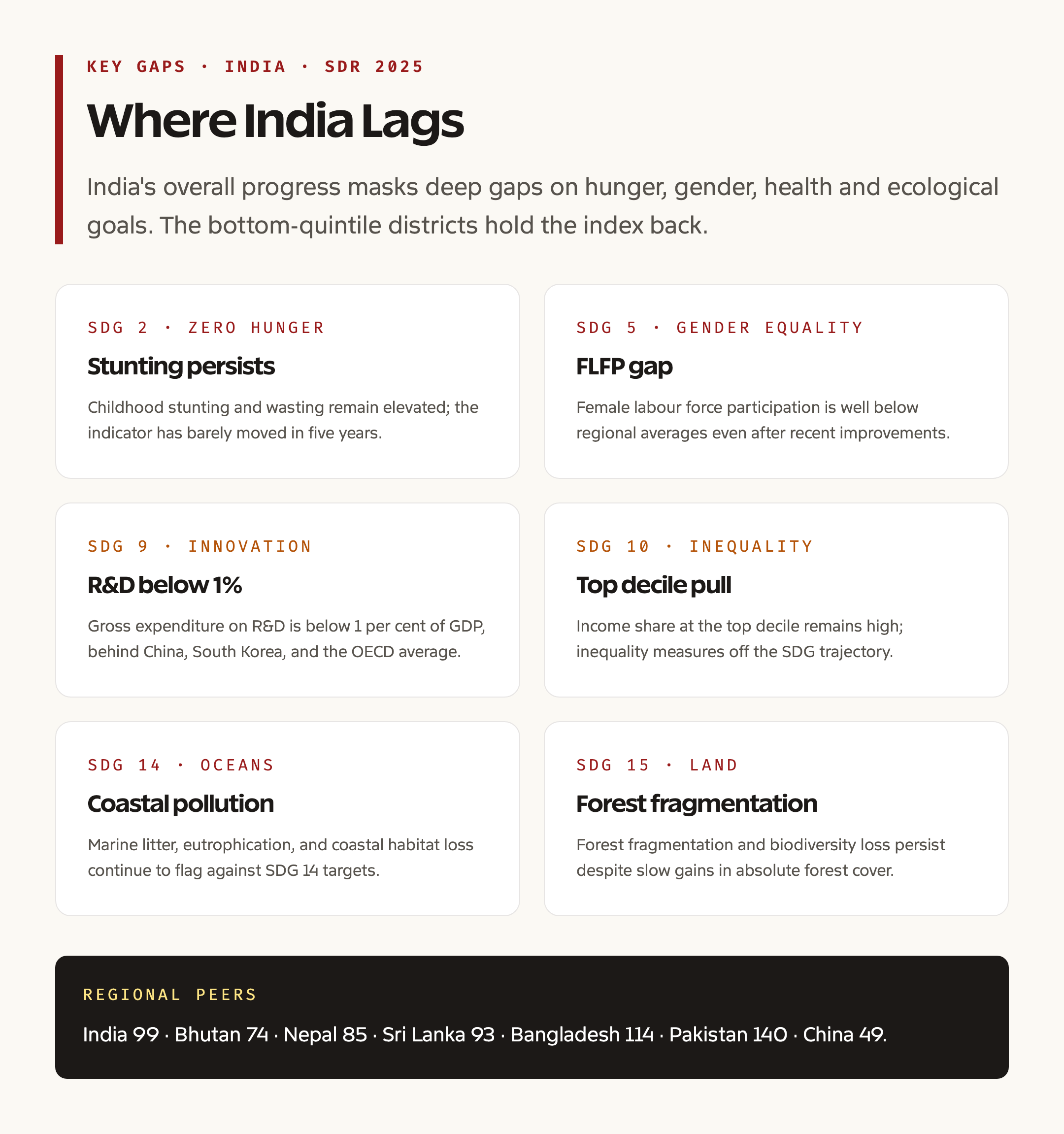
The challenges are concentrated. SDG 2 (zero hunger) shows persistent stunting and wasting in children. SDG 3 (good health) shows a high non-communicable disease burden and neonatal mortality. SDG 5 (gender equality) shows low female labour force participation. SDG 9 (industry and innovation) reflects a research and development spend below 1 per cent of GDP. SDG 10 (reduced inequalities) flags income concentration at the top decile. SDG 14 (life below water) and SDG 15 (life on land) reflect coastal pollution and forest fragmentation.
Methodology and Critiques
The SDR methodology has several known limitations that come up regularly in mains questions. The data lag is real: many indicators draw on surveys that are two to four years old by the time they are published. The weighting is equal across goals, which masks the fact that some goals are foundational while others depend on the foundations. Coverage of small island states and conflict-affected states is uneven because their statistical systems are stretched.
The official Indian critique focuses on indicator choice. Some indicators in the SDR draw from international datasets that disagree with national surveys. NITI Aayog publishes its own SDG India Index, which uses Indian official data and produces a different ranking of states. The two indices are complementary rather than contradictory. UPSC mains answers should mention both.
A more philosophical critique is that the SDGs themselves are too many, too overlapping, and too dependent on goodwill. Critics in the policy literature argue for a tighter set of priority goals with binding national targets. The SDR sidesteps this by treating the 17 goals as given.
Comparison with Past Editions
| Edition | India’s Rank | India’s Score | Top Country | Global Headline |
|---|---|---|---|---|
| SDR 2020 | 117 | 61.9 | Sweden | COVID-19 reverses progress |
| SDR 2021 | 120 | 60.1 | Finland | Pandemic deepens setbacks |
| SDR 2022 | 121 | 60.3 | Finland | Energy crisis, food prices |
| SDR 2023 | 112 | 63.4 | Finland | Halftime, off track on most |
| SDR 2024 | 109 | 64.0 | Finland | Stalled progress, financing gap |
| SDR 2025 | 99 | ~67 | Finland | Five years left, no goal on track |
| SDR 2026 | 94 | 68.3 | Finland | No goal on track; ~16.5% of targets progressing |
The trend is clear. India has gained roughly 18 places in five years and added five points to the index score. The gains owe to renewable energy expansion, multidimensional poverty reduction under the National Family Health Survey indicators, and improvements in maternal mortality and electrification. The rise is consistent across editions, which suggests it is methodology-robust.
Linkages and Multi-Topic Connections
The SDR connects to almost every environment and development topic. It links to the Paris climate targets, the Convention on Biological Diversity post-2020 Global Biodiversity Framework, the UN Convention to Combat Desertification, and the World Bank’s poverty estimates. It also links to India’s Voluntary National Review process, which the country has submitted twice (2017 and 2020) to the High-Level Political Forum at the UN.
For prelims, the SDR is a regular source of factual questions. Top performers, India’s rank, the issuing body, and the year of SDG adoption are repeat patterns. For mains, the SDR is a useful citation in answers on India’s development trajectory, climate finance, gender, and health.
The report also feeds into the financing for sustainable development debate. The 2025 edition’s theme on financing dovetails with the Fourth International Conference on Financing for Development (FfD4) and India’s calls for reform of multilateral development banks. The connection between the SDR’s diagnosis and the FfD4’s prescriptions is a useful mains thread.
Way Forward
The SDR’s prescriptions for the next five years are not new but are sharper. First, raise the financing for development substantially, with a focus on concessional flows to low-income countries and reform of the international tax architecture. Second, fix the data gaps so that least developed countries can measure their progress. Third, integrate climate, biodiversity, and SDG agendas into a single planning frame, since the institutional fragmentation is one reason none of the goals is on track. Fourth, pay attention to spillovers so that the development of one country does not undermine another.
For India, the SDR’s implicit advice is to consolidate the gains in poverty and energy while accelerating on hunger, gender, health, and ecological goals. The Indian National Determined Contribution, the National Health Mission, the Aspirational Districts and Aspirational Blocks programme, the Mission Indradhanush, and the Mission LiFE all map to specific SDG indicators. A focused effort on the bottom-quintile districts can shift the national score considerably.
UPSC Relevance
For prelims, candidates should remember the issuing body (UN SDSN), the year of SDG adoption (September 2015 by 193 countries), India’s rank (94th in 2026), the top three (Finland, Sweden, Denmark), and the headline that none of the 17 SDGs is on track. The number 17 (goals) and the number 169 (targets) are repeat-frequency facts.
For mains, the SDR feeds into questions on India’s SDG progress, the financing for development debate, the limits of international rankings, the role of the UN system in development, and the integration of climate and development goals. A useful framing is to compare the SDR with NITI Aayog’s SDG India Index and to note both the convergence and the divergence. Other reports that pair well with the SDR include the Frontiers Report on disasters and ageing, the Global Drought Outlook, and the State of Forest Report.
Frequently Asked Questions
Who releases the Sustainable Development Report?
The Sustainable Development Report is released annually by the UN Sustainable Development Solutions Network (SDSN) in partnership with Bertelsmann Stiftung. It is independent of the official UN tracking process and has been published every year since 2016.
What is India’s rank in SDR 2026?
India ranks 94th out of 167 countries in the Sustainable Development Report 2026, its highest placing since the index began, up from 99th in 2025 and 112th in 2015. India’s score on the SDG index is 68.3 on a 0 to 100 scale.
Which countries top the SDR 2026?
Finland tops the SDR 2026 for the sixth year running, followed by Sweden in second place and Denmark in third. The top ten is dominated by Nordic and continental European countries with strong social-policy systems and good statistical capacity.
What is the global headline of SDR 2026?
The global headline is that none of the 17 Sustainable Development Goals is on track to be achieved by 2030, with only about 16.5 percent of individual targets progressing as planned. SDG 2 (zero hunger), SDG 13 (climate action), SDG 14 (life below water), and SDG 15 (life on land) are particularly off track.
How does the SDR differ from NITI Aayog’s SDG India Index?
The SDR is an international cross-country index produced by SDSN, while NITI Aayog’s SDG India Index ranks Indian states using national official data. The two are complementary; the SDR places India in a global frame, while NITI Aayog’s index drives state-level policy action.
Is the SDR an official UN document?
No, the SDR is produced by SDSN, a non-governmental network founded under the auspices of the UN Secretary-General. The official UN tracking is done by the UN Statistical Commission and the Global Indicator Framework, which avoid country rankings.