Chief Ministers of Tamil Nadu: Complete List, Tenure and Party
Every Chief Minister of Madras State and Tamil Nadu since 1950, with exact term dates, party, acting heads and all four President's Rule spells clearly marked.
The current Chief Minister of Tamil Nadu is C. Joseph Vijay of the Tamilaga Vettri Kazhagam, who was sworn in on 10 May 2026 after the party emerged as the largest bloc in the 2026 assembly election. He is the ninth person to hold the office under the name Tamil Nadu, and the first from a party other than the Congress, the DMK or the AIADMK.
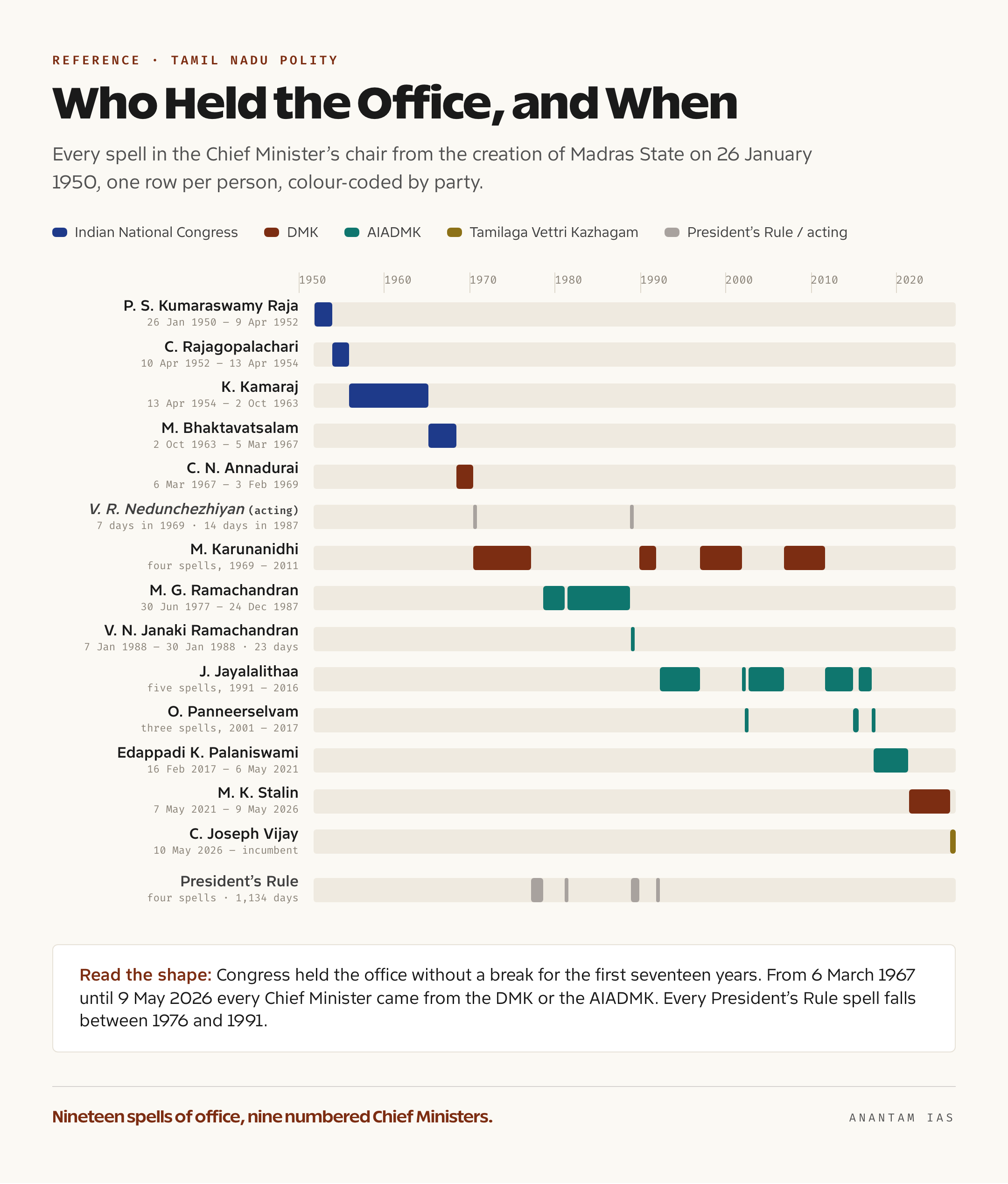
Counting from the creation of Madras State on 26 January 1950, thirteen people have served as full Chief Minister of the state, with one more — V. R. Nedunchezhiyan — holding charge twice as acting Chief Minister. The state has also seen four spells of President’s Rule, the last of them in 1991. Below is the full record, in order, with exact dates.
How the Office Works in Tamil Nadu
The office rests on Article 164 of the Constitution, which says the Chief Minister is appointed by the Governor and the other ministers are appointed by the Governor on the Chief Minister’s advice. The Governor’s discretion here is thin by convention: the person invited is the one who can command a majority in the Tamil Nadu Legislative Assembly, and the Council of Ministers is collectively responsible to that assembly.
The assembly has 234 elected seats, and a government needs 118 MLAs to survive a confidence vote. A term runs five years from the assembly’s first sitting unless the house is dissolved earlier. There is no limit on how many times the same person can be reappointed — which is exactly why Tamil Nadu’s list has far more entries than it has names.
When no ministry can command the house, Article 356 allows the President to take over the state’s administration. The office of Chief Minister then lies vacant, and the Governor runs the state on the Union government’s behalf. Those spells are shown as separate rows in the table below, because leaving them out would make the chain of succession look continuous when it wasn’t.
Tamil Nadu also had a Legislative Council until 1 November 1986, when it was abolished and the state became unicameral. Several early Chief Ministers, including K. Kamaraj in his first stint and C. N. Annadurai, sat in that council rather than the assembly.
Complete List of Chief Ministers of Tamil Nadu
The list starts on 26 January 1950, the day Madras State came into being under the new Constitution. Madras State was renamed Tamil Nadu on 14 January 1969 under the Madras State (Alteration of Name) Act, 1968, and standard listings restart the numbering from that date — which is why C. Joseph Vijay is called the ninth Chief Minister of Tamil Nadu even though many more people have run the state since 1950. Numbers in brackets mean a person returning to office after an interruption.
| # | Name | Term Start | Term End | Party | Notes |
|---|---|---|---|---|---|
| Madras State (1950-1969) | |||||
| M1 | P. S. Kumaraswamy Raja | 26 Jan 1950 | 9 Apr 1952 | Indian National Congress | First Chief Minister of Madras State |
| M2 | C. Rajagopalachari | 10 Apr 1952 | 13 Apr 1954 | Indian National Congress | Resigned; had earlier headed the Madras Presidency ministry, 1937-39 |
| M3 | K. Kamaraj | 13 Apr 1954 | 2 Oct 1963 | Indian National Congress | 9 years, 172 days; stepped down under the Kamaraj Plan |
| M4 | M. Bhaktavatsalam | 2 Oct 1963 | 5 Mar 1967 | Indian National Congress | Last Congress Chief Minister of the state |
| M5 | C. N. Annadurai | 6 Mar 1967 | 13 Jan 1969 | DMK | First non-Congress Chief Minister; continued in office after the rename |
| — | State renamed Tamil Nadu, 14 January 1969 | ||||
| Tamil Nadu (1969-present) | |||||
| 1 | C. N. Annadurai | 14 Jan 1969 | 3 Feb 1969 | DMK | Died in office; 20 days under the new name |
| — | V. R. Nedunchezhiyan (acting) | 3 Feb 1969 | 10 Feb 1969 | DMK | Acting Chief Minister, 7 days |
| 2 | M. Karunanidhi | 10 Feb 1969 | 31 Jan 1976 | DMK | First spell; two ministries (1969 and 1971) |
| — | President’s Rule | 31 Jan 1976 | 29 Jun 1977 | — | 1 year, 149 days; assembly dissolved |
| 3 | M. G. Ramachandran | 30 Jun 1977 | 17 Feb 1980 | AIADMK | First spell |
| — | President’s Rule | 17 Feb 1980 | 8 Jun 1980 | — | 112 days; ministry dismissed after the Lok Sabha election |
| (3) | M. G. Ramachandran | 9 Jun 1980 | 24 Dec 1987 | AIADMK | Died in office; two ministries (1980 and 1985) |
| — | V. R. Nedunchezhiyan (acting) | 24 Dec 1987 | 7 Jan 1988 | AIADMK | Acting Chief Minister, 14 days |
| 4 | V. N. Janaki Ramachandran | 7 Jan 1988 | 30 Jan 1988 | AIADMK | First woman Chief Minister; 23 days |
| — | President’s Rule | 30 Jan 1988 | 26 Jan 1989 | — | 362 days |
| (2) | M. Karunanidhi | 27 Jan 1989 | 30 Jan 1991 | DMK | Second spell |
| — | President’s Rule | 30 Jan 1991 | 23 Jun 1991 | — | 144 days; the most recent spell to date |
| 5 | J. Jayalalithaa | 24 Jun 1991 | 12 May 1996 | AIADMK | First term; youngest to take the office, at 43 |
| (2) | M. Karunanidhi | 13 May 1996 | 13 May 2001 | DMK | Third spell; a full five years |
| (5) | J. Jayalalithaa | 14 May 2001 | 21 Sep 2001 | AIADMK | Left office following a court ruling on her appointment |
| 6 | O. Panneerselvam | 21 Sep 2001 | 2 Mar 2002 | AIADMK | First spell |
| (5) | J. Jayalalithaa | 2 Mar 2002 | 12 May 2006 | AIADMK | Returned after winning the Andipatti by-election |
| (2) | M. Karunanidhi | 13 May 2006 | 15 May 2011 | DMK | Fourth and final spell; fifth ministry |
| (5) | J. Jayalalithaa | 16 May 2011 | 27 Sep 2014 | AIADMK | Vacated office on conviction in a disproportionate assets case |
| (6) | O. Panneerselvam | 28 Sep 2014 | 23 May 2015 | AIADMK | Second spell |
| (5) | J. Jayalalithaa | 23 May 2015 | 5 Dec 2016 | AIADMK | Returned after acquittal; died in office |
| (6) | O. Panneerselvam | 6 Dec 2016 | 15 Feb 2017 | AIADMK | Third spell; resigned |
| 7 | Edappadi K. Palaniswami | 16 Feb 2017 | 6 May 2021 | AIADMK | 4 years, 79 days |
| 8 | M. K. Stalin | 7 May 2021 | 9 May 2026 | DMK | Completed a full term of 5 years, 2 days |
| 9 | C. Joseph Vijay | 10 May 2026 | Incumbent | Tamilaga Vettri Kazhagam | First TVK Chief Minister |
Two things jump out of the table. First, the count of terms and the count of people are nowhere near each other — nineteen separate spells of office since 1969 were shared among nine numbered Chief Ministers, plus two short acting stints, because Karunanidhi, Ramachandran, Jayalalithaa and Panneerselvam all returned repeatedly. Second, every single President’s Rule spell falls between 1976 and 1991; the thirty-five years since have been unbroken elected government.
The other pattern is the party of the incumbent. Congress held the office continuously for the first seventeen years. From 6 March 1967 until 9 May 2026, every Chief Minister came from either the DMK or the AIADMK — a fifty-nine-year duopoly that ended only with the 2026 result.
Longest-Serving and Most Notable Chief Ministers
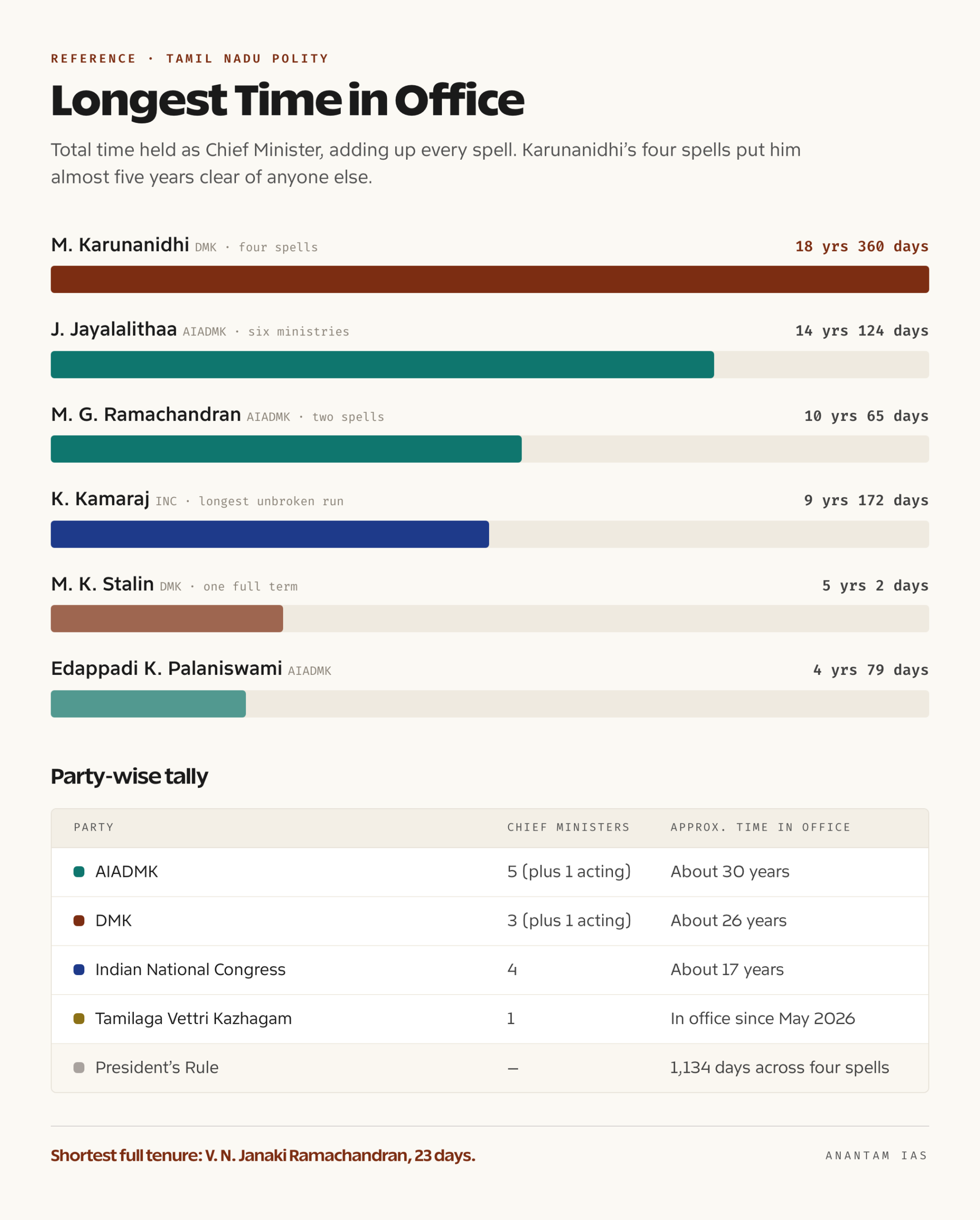
M. Karunanidhi (DMK) is the longest-serving Chief Minister in the state’s history, with 18 years and 360 days in office. That total came from four separate spells and five ministries, since he was sworn in twice during 1969-76 — once on Annadurai’s death and again after winning the 1971 election. His longest continuous run was 6 years and 355 days.
J. Jayalalithaa (AIADMK) is second, with 14 years and 124 days spread across six ministries. She first took office in June 1991 at the age of 43, the youngest person to become Chief Minister of the state, and died in office in December 2016.
M. G. Ramachandran (AIADMK) served 10 years and 65 days across two spells split by the 1980 President’s Rule. He founded the AIADMK in 1972 after splitting from the DMK, won three consecutive elections, and died in office in December 1987 while still Chief Minister.
K. Kamaraj (INC) holds the longest unbroken single run in the state’s post-1950 history: 9 years and 172 days, from April 1954 to October 1963. He resigned voluntarily under what became known as the Kamaraj Plan, under which senior Congress leaders quit office to work for the party organisation. His government is remembered for the midday meal scheme in schools and a sharp expansion in school enrolment.
Two firsts are worth pinning down. P. S. Kumaraswamy Raja was the first Chief Minister of Madras State, taking office on the day the Constitution came into force. C. N. Annadurai was the first non-Congress Chief Minister and the first from the Dravidian movement, and he is the one who piloted the change of the state’s name — though he died on 3 February 1969, only three weeks after the rename took effect.
V. N. Janaki Ramachandran became the first woman to hold the office on 7 January 1988, after her husband MGR’s death split the AIADMK. Her government lasted 23 days before President’s Rule was imposed, which remains the shortest tenure by a full Chief Minister of the state.
How Power Has Shifted: Party Trends in Tamil Nadu
Tamil Nadu’s political history divides cleanly into three phases. From 1950 to 1967 the Congress governed without interruption, producing four Chief Ministers. The 1967 election ended that permanently — no Congress Chief Minister has held office in the state since 5 March 1967, a gap of more than fifty-nine years and one of the longest continuous absences of the Congress from power in any Indian state.
The second phase, from 1967 to 2026, belonged entirely to the two Dravidian parties. The AIADMK, formed in 1972, has held the office for the greater share of that time. The DMK’s spells were fewer but longer on average, anchored by Karunanidhi and then by M. K. Stalin’s full five-year term from 2021.
The third phase began on 10 May 2026, when C. Joseph Vijay of the Tamilaga Vettri Kazhagam was sworn in at the head of a coalition, breaking the DMK-AIADMK alternation for the first time since 1967.
| Party | Chief Ministers | Approximate time in office |
|---|---|---|
| AIADMK | 5 (plus 1 acting) | About 30 years |
| DMK | 3 (plus 1 acting) | About 26 years |
| Indian National Congress | 4 | About 17 years |
| Tamilaga Vettri Kazhagam | 1 | In office since May 2026 |
| President’s Rule | — | 1,134 days across four spells |
One caution on party tallies: V. R. Nedunchezhiyan served as acting Chief Minister once for the DMK in 1969 and once for the AIADMK in 1987, so he appears under both parties in the count of individuals but is not counted as a numbered Chief Minister in either.
Records and Quick Facts
- Longest total tenure: M. Karunanidhi, 18 years 360 days across four spells.
- Longest single unbroken tenure: K. Kamaraj, 9 years 172 days (1954-1963).
- Shortest tenure by a full Chief Minister: V. N. Janaki Ramachandran, 23 days in January 1988.
- Shortest tenure of any kind: V. R. Nedunchezhiyan’s first acting stint, 7 days in February 1969.
- Most times sworn in: J. Jayalalithaa, six ministries; Karunanidhi was sworn in five times.
- Died in office: three — C. N. Annadurai (1969), M. G. Ramachandran (1987) and J. Jayalalithaa (2016).
- President’s Rule spells: four — 1976-77, 1980, 1988-89 and 1991, totalling 1,134 days.
- Youngest to take office: J. Jayalalithaa, aged 43 in June 1991.
- First woman Chief Minister: V. N. Janaki Ramachandran, 1988.
- Assembly strength: 234 elected seats; 118 needed for a majority.
A note on one date that sources differ over. Most listings, including the Tamil Nadu assembly record, date the 1980 President’s Rule from 17 February 1980, the day MGR’s ministry was dismissed after the Lok Sabha election. A few secondary compilations give 7 February instead, which appears to be a transcription slip; the dismissal itself is firmly documented as 17 February. The end date is given as 8 or 9 June 1980 depending on whether the day MGR was sworn in again is counted.
For comparable state records, see the Andhra Pradesh Chief Ministers list and the list of Gujarat Chief Ministers.
FAQ
Who is the current Chief Minister of Tamil Nadu? C. Joseph Vijay of the Tamilaga Vettri Kazhagam has been Chief Minister since 10 May 2026. He is the ninth Chief Minister under the name Tamil Nadu and the first from outside the Congress-DMK-AIADMK line.
Who was the first Chief Minister of Tamil Nadu? Under the name Tamil Nadu, C. N. Annadurai was the first, from 14 January 1969. Under the state’s earlier name of Madras State, the first Chief Minister was P. S. Kumaraswamy Raja, from 26 January 1950.
Who served the longest as Chief Minister of Tamil Nadu? M. Karunanidhi, with 18 years and 360 days in total across four spells between 1969 and 2011. K. Kamaraj holds the longest unbroken stretch at 9 years and 172 days.
How many Chief Ministers has Tamil Nadu had? Thirteen people have served as full Chief Minister since 1950, plus V. R. Nedunchezhiyan as acting Chief Minister twice. Nine are numbered as Chief Ministers of Tamil Nadu from the 1969 rename onward. The number of terms is much higher, because four of them returned to office repeatedly.
How is the Chief Minister of Tamil Nadu appointed? Under Article 164, the Governor appoints as Chief Minister the person who can command a majority in the 234-member Legislative Assembly, and appoints the rest of the ministers on that person’s advice. The Council of Ministers stays in office only as long as it retains the assembly’s confidence.
Practice Questions
Practice MCQs
- Madras State was renamed Tamil Nadu with effect from which date? (a) 26 January 1950 (b) 6 March 1967 (c) 14 January 1969 (d) 1 November 1986 — Answer: (c) The Madras State (Alteration of Name) Act, 1968 came into force on 14 January 1969.
- Who among the following served the longest total tenure as Chief Minister of the state? (a) K. Kamaraj (b) M. Karunanidhi (c) J. Jayalalithaa (d) M. G. Ramachandran — Answer: (b) Karunanidhi held office for 18 years and 360 days across four separate spells.
- How many spells of President’s Rule has Tamil Nadu seen? (a) Two (b) Three (c) Four (d) Six — Answer: (c) They fell in 1976-77, 1980, 1988-89 and 1991.
- Who was the first woman Chief Minister of Tamil Nadu? (a) J. Jayalalithaa (b) V. N. Janaki Ramachandran (c) Sasikala Natarajan (d) Padmini Ramachandran — Answer: (b) She took office on 7 January 1988 and served 23 days.
- Under which Article of the Constitution is a Chief Minister appointed by the Governor? (a) Article 154 (b) Article 163 (c) Article 164 (d) Article 167 — Answer: (c) Article 164 provides for the appointment of the Chief Minister and, on the Chief Minister’s advice, the other ministers.