Terrestrial Ecosystem: Types, Components, and Ecological Significance
Terrestrial ecosystem explained: definition, biotic and abiotic components, major biomes like forest, grassland, desert, tundra, and UPSC-ready analysis.
A terrestrial ecosystem is a land-based community of living organisms interacting with their non-living physical environment through flows of energy and nutrients. Unlike aquatic ecosystems, terrestrial systems are shaped primarily by soil, temperature, rainfall, sunlight, and altitude, producing distinct biomes ranging from dense tropical rainforests to frozen tundra. They cover roughly 29% of Earth's surface and host the majority of the planet's vascular plant and animal diversity. For UPSC, terrestrial ecosystems are foundational to the Environment and Ecology syllabus, linking biodiversity, climate, conservation, and sustainable development.
What is a Terrestrial Ecosystem?
A terrestrial ecosystem is defined by the interaction between biotic components (plants, animals, fungi, microbes) and abiotic components (sunlight, temperature, rainfall, soil, topography) on land.
Its core features are:
- Low water availability compared with aquatic ecosystems.
- Wide temperature range, both diurnal and seasonal.
- Soil as the primary medium for nutrient cycling and plant anchorage.
- Atmospheric gases (oxygen, carbon dioxide) directly available for exchange.
- Greater exposure to solar radiation and wind.
The concept of an ecosystem was introduced by British ecologist Arthur Tansley in 1935, and terrestrial ecosystems form one of the two broad categories of ecosystems, the other being aquatic.
Components of a Terrestrial Ecosystem
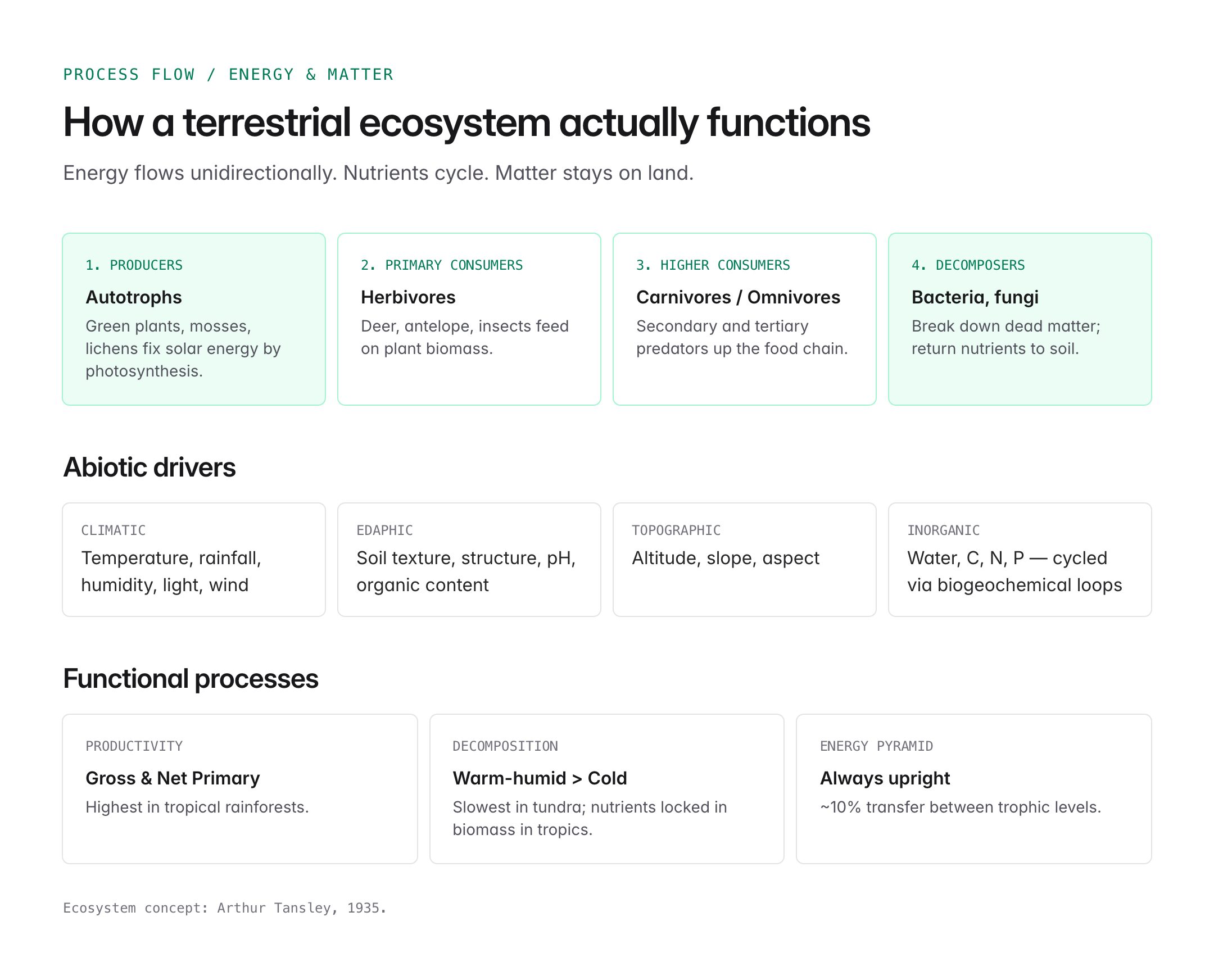
Every terrestrial ecosystem has two interlinked sets of components.
Biotic components
- Producers (autotrophs): Green plants, mosses, and lichens that fix solar energy via photosynthesis.
- Consumers (heterotrophs): Herbivores (primary), carnivores (secondary, tertiary), and omnivores.
- Decomposers: Bacteria and fungi that break down dead organic matter and recycle nutrients.
Abiotic components
- Climatic factors: Temperature, rainfall, humidity, light, wind.
- Edaphic factors: Soil texture, structure, pH, organic content.
- Topographic factors: Altitude, slope, aspect.
- Inorganic substances: Water, carbon, nitrogen, phosphorus.
Energy flows unidirectionally from the sun through food chains, while nutrients cycle through biogeochemical cycles (carbon, nitrogen, phosphorus, water).
Major Types of Terrestrial Ecosystems
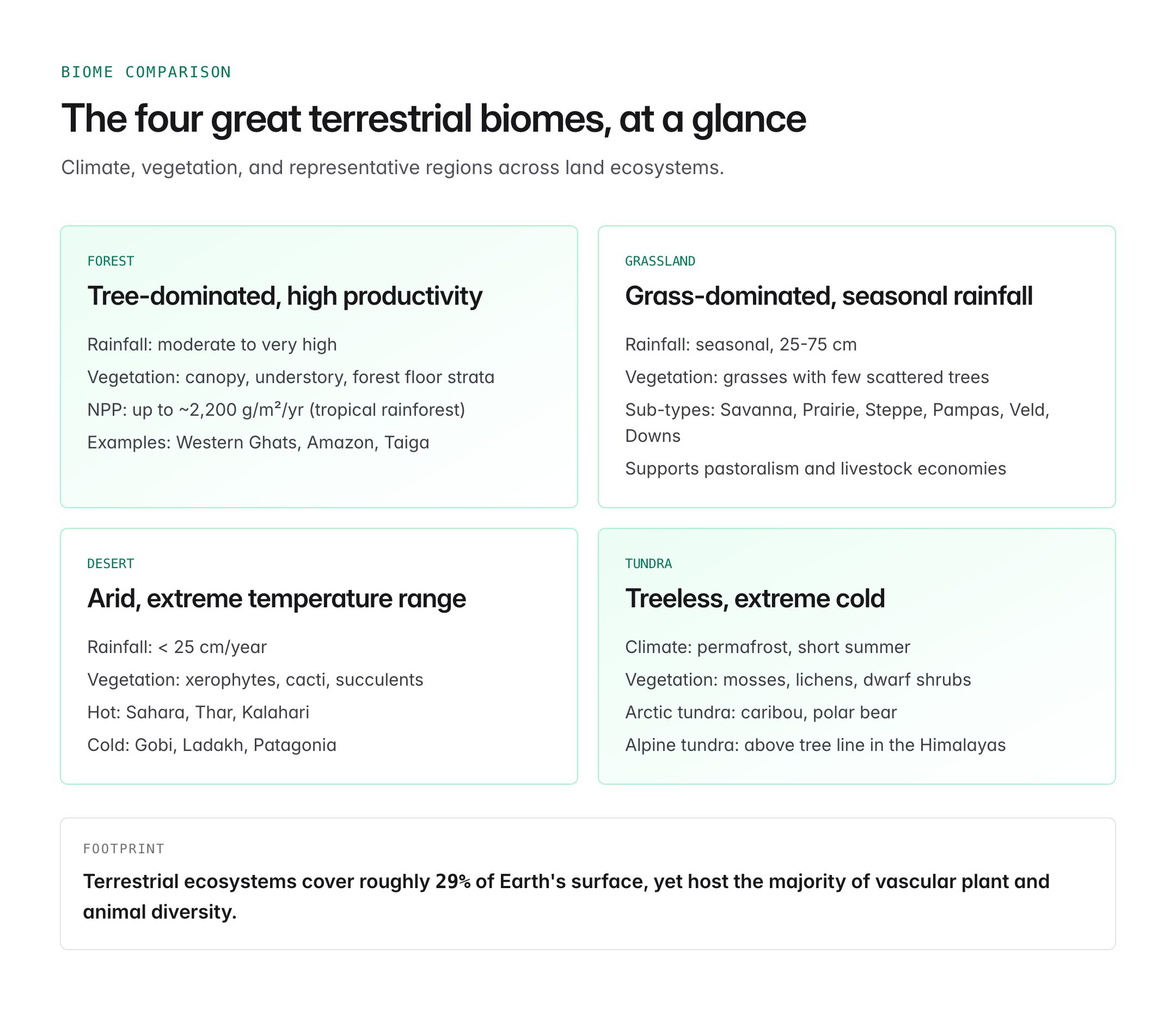
Terrestrial ecosystems are typically classified into four broad biomes, each with sub-types.
| Biome | Climate | Dominant Vegetation | Example |
|---|---|---|---|
| Forest | Moderate to high rainfall | Trees | Western Ghats, Amazon, Taiga |
| Grassland | Seasonal rainfall | Grasses, few trees | Savanna, Prairies, Steppes |
| Desert | Very low rainfall (<25 cm) | Xerophytes, cacti | Thar, Sahara, Gobi |
| Tundra | Extremely cold | Mosses, lichens, shrubs | Arctic tundra, Alpine tundra |
Forest ecosystem
- Tropical rainforest: Near the Equator, very high rainfall, evergreen trees, highest biodiversity.
- Tropical deciduous (Monsoon) forest: Found in India, shed leaves in dry season; teak and sal dominate.
- Temperate deciduous forest: Oak, maple, beech in mid-latitudes.
- Taiga (Boreal): Coniferous forests of Canada, Russia, Scandinavia; pines, spruces.
Grassland ecosystem
- Tropical grasslands (Savannas): East Africa, with scattered trees and large herbivores.
- Temperate grasslands: Prairies (North America), Pampas (South America), Steppes (Eurasia), Velds (South Africa), Downs (Australia).
Desert ecosystem
- Hot deserts: Sahara, Thar, Kalahari – high daytime temperatures, xerophytic plants.
- Cold deserts: Gobi, Ladakh, Patagonia – low temperatures and low precipitation.
Tundra ecosystem
- Arctic tundra: Permafrost, short growing season, home to caribou, polar bears.
- Alpine tundra: Above the tree line on high mountains; found in the Himalayas.
Structure and Functioning
Terrestrial ecosystems are organised in vertical and horizontal strata.
- Vertical strata in a forest: canopy, understory, shrub layer, herb layer, forest floor.
- Horizontal variation reflects changes in moisture, soil, and disturbance.
Key functional processes include:
- Productivity: Gross and net primary productivity, highest in tropical rainforests (~2200 g/m²/year of NPP).
- Decomposition: Fastest in warm, humid forests; slowest in tundra.
- Nutrient cycling: Tight in tropical forests, where most nutrients are stored in biomass.
- Energy flow: Described by food chains, food webs, and ecological pyramids (energy pyramid is always upright).
Ecological and Economic Significance
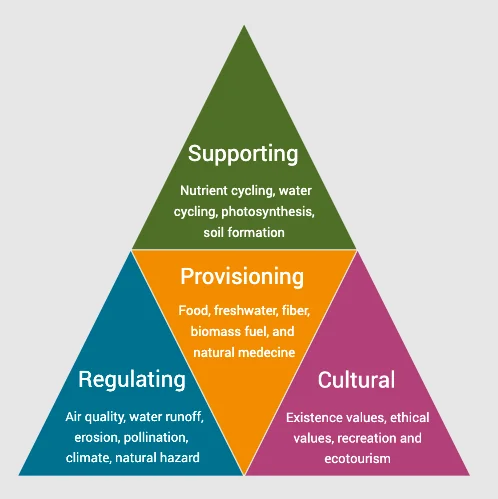
Terrestrial ecosystems provide a wide range of ecosystem services.
- Provisioning services: Food, timber, fibre, fuelwood, medicinal plants.
- Regulating services: Climate regulation, carbon sequestration, pollination, water purification.
- Supporting services: Soil formation, nutrient cycling, habitat provision.
- Cultural services: Recreation, spiritual value, tourism.
Forests alone sequester a significant share of global anthropogenic carbon emissions. Grasslands support livestock economies; drylands host unique biodiversity and pastoral livelihoods.
In India, terrestrial ecosystems underpin the livelihoods of hundreds of millions through agriculture, forestry, and pastoralism, and form the backbone of biosphere reserves, national parks, and tiger reserves.
Threats and Conservation
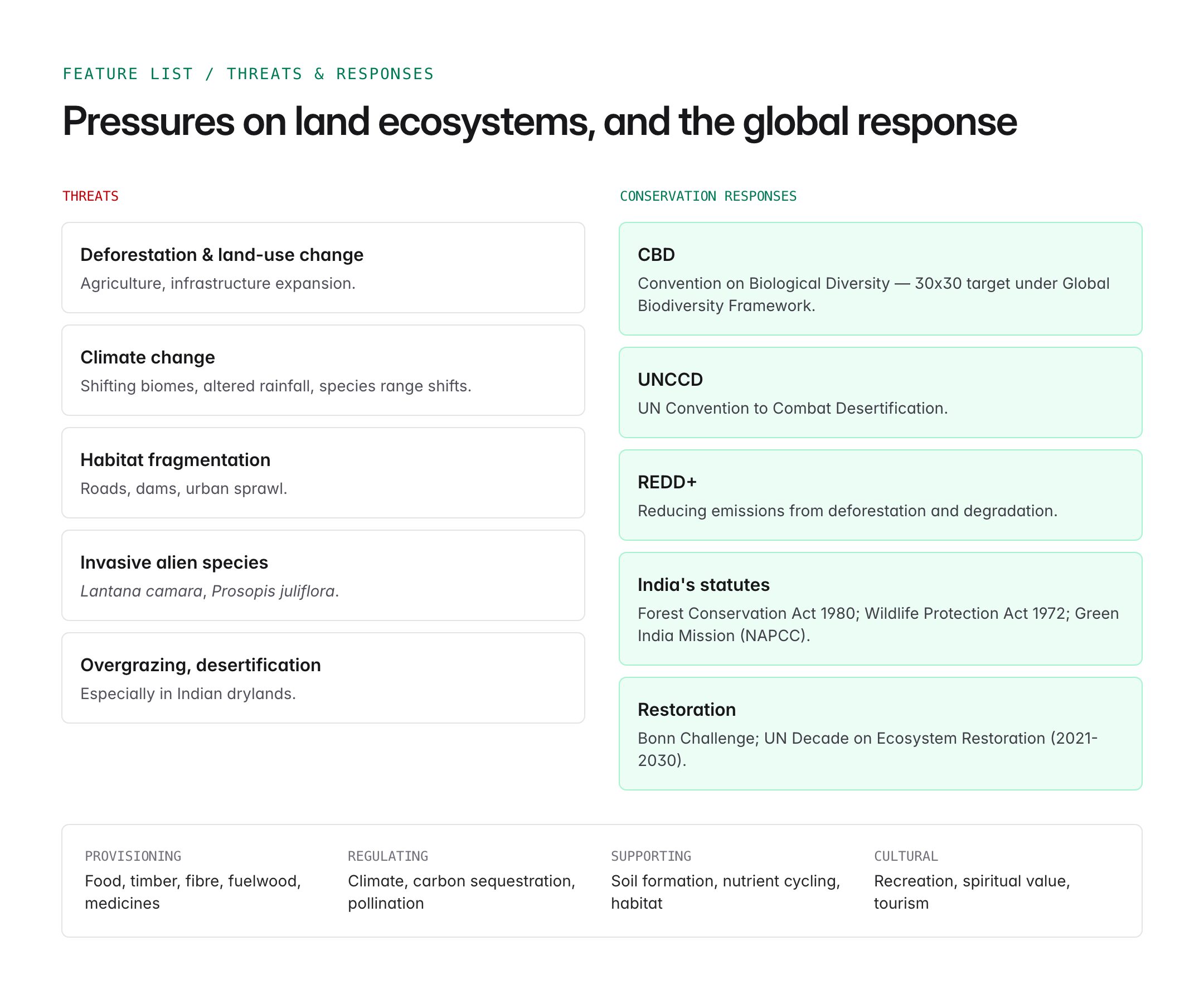
Major pressures on terrestrial ecosystems include:
- Deforestation and land-use change for agriculture and infrastructure.
- Climate change: Shifting biomes, altered rainfall, species range shifts.
- Habitat fragmentation due to roads, dams, urbanisation.
- Invasive alien species such as Lantana camara and Prosopis juliflora in India.
- Pollution: Air, soil, and chemical contamination.
- Overgrazing and desertification, especially in drylands.
Conservation responses include the Convention on Biological Diversity (CBD), the UN Convention to Combat Desertification (UNCCD), REDD+ for forests, India's Forest Conservation Act, 1980, Wildlife Protection Act, 1972, the Green India Mission under NAPCC, and the 30×30 target under the Global Biodiversity Framework. Restoration initiatives such as the Bonn Challenge and the UN Decade on Ecosystem Restoration (2021-2030) prioritise terrestrial ecosystems.
UPSC Relevance
Prelims focus:
- Components of an ecosystem (biotic, abiotic) and definitions by Tansley.
- Classification of biomes and their representative regions and vegetation.
- Concepts of productivity, food chain, food web, ecological pyramids.
- Major Indian terrestrial ecosystems: Western Ghats, Sundarbans fringe forests, Thar, Himalayas.
Mains GS-III angle:
- Role of terrestrial ecosystems in climate mitigation through carbon sequestration.
- Trade-offs between development and conservation in forests and grasslands.
- Impact of invasive species and land degradation on ecosystem services.
- India's commitments under CBD, UNCCD, and the Global Biodiversity Framework.
Sample PYQ angle: "How does biodiversity vary in India? How is the Biological Diversity Act, 2002 helpful in conservation of flora and fauna?" Terrestrial ecosystem concepts – biomes, productivity, fragmentation – form the analytical base for answering such questions with structure and ecological rigour.