Thomas Aquinas: Natural Law, Cardinal and Theological Virtues, Just War (UPSC GS IV)
Thomas Aquinas for UPSC GS IV — life, natural law, four cardinal plus three theological virtues, Just War theory, and relevance to Indian governance.
Thomas Aquinas stands at the meeting point of two traditions. From classical Greek philosophy he inherited Aristotle's account of virtue, eudaimonia and the rational soul. From Christian theology he inherited the doctrine of revelation and the idea that human life is ordered to a transcendent good. His achievement — the achievement that defines medieval Western philosophy — was the integration of these two traditions into a single ethical framework still influential 750 years after his death.
For the UPSC aspirant, Aquinas matters because his ideas reach directly into modern questions about natural law, human rights, just war and the distinction between moral and theological virtues. This article works through Aquinas's life and times, his philosophical contributions, his major works, his influence on subsequent ethical theory, and his relevance to Indian governance.
Life and times
Thomas Aquinas was born in 1225 in Roccasecca, in the Kingdom of Sicily (today southern Italy), into a noble family. Sent at five to the Benedictine abbey of Monte Cassino, he later studied at the University of Naples, where he encountered the newly available Aristotelian texts that would transform his thought.
Against his family's wishes, he joined the recently founded Dominican Order — a mendicant religious order committed to teaching and learning. His family imprisoned him for over a year to dissuade him; he refused. He went on to study under Albertus Magnus at Cologne and then Paris, becoming a master of theology at the University of Paris by 1256.
Aquinas's career unfolded against a background of intellectual turbulence. The Aristotelian texts arriving in Western Europe via Arabic translations from Spain were initially regarded as a threat to Christian theology. Aquinas's life work was the demonstration that reason (Aristotle) and faith (revelation) were compatible — that natural reason and divine revelation were not enemies but complementary paths to the same truth.
He died in 1274, on his way to the Council of Lyon, aged 49. He was canonised in 1323 and named a Doctor of the Church.
Philosophical contributions
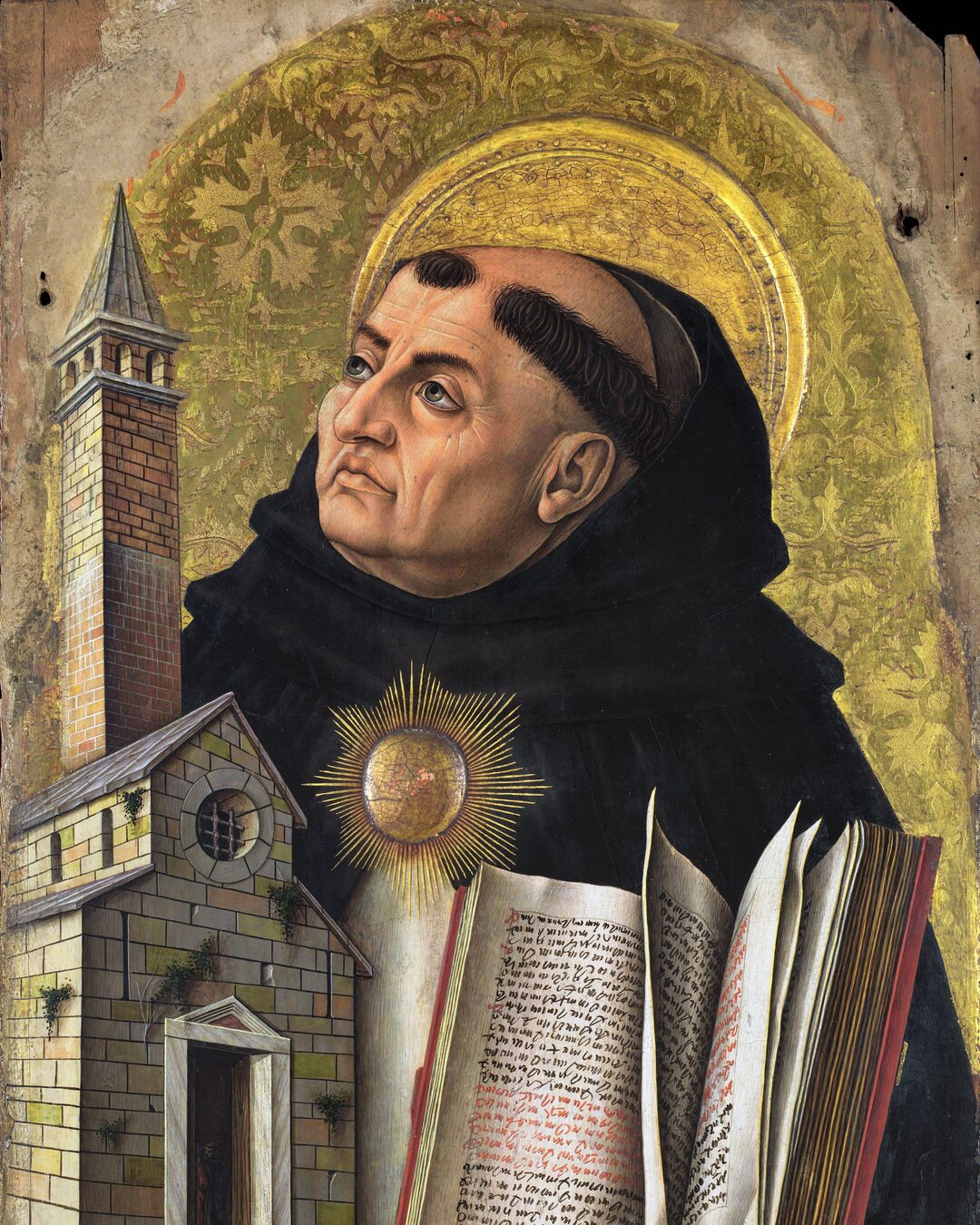
Aquinas's contributions can be grouped under five heads.
1. Natural law theory
The most enduring of Aquinas's contributions. Natural law is the moral order built into the structure of reality — knowable by human reason without recourse to revelation. The basic precept of natural law, Aquinas argued, is that good is to be done and pursued, and evil avoided. From this first principle, more specific moral rules follow — the prohibition of murder, the duty to preserve life, the duty to live in society.
Natural law is binding on everyone, not just believers, because it is grounded in reason and shared human nature. This is the foundation on which later theorists — Hugo Grotius, John Locke — built modern theories of human rights.
2. Synthesis of virtue ethics and theology
From Aristotle, Aquinas took the four cardinal virtues — prudence, justice, fortitude (courage), temperance. To these he added the three theological virtues drawn from St Paul's letters — faith, hope and charity (love).
Together, these constitute the seven virtues of Christianity.
| Cardinal virtues (from reason) | Theological virtues (from grace) |
|---|---|
| Prudence — practical wisdom | Faith — assent to divine truth |
| Justice — giving each their due | Hope — trust in ultimate good |
| Fortitude (Courage) — facing danger for the good | Charity (Love) — willing the good of the other |
| Temperance — moderation of desire |
The cardinal virtues are accessible by natural reason; the theological virtues require divine grace. This bifurcated structure — virtues of reason plus virtues of grace — is characteristic of Aquinas.
3. The doctrine of double effect
Aquinas formulated the principle that an action with both good and bad effects can be morally permissible if four conditions are met: the action itself is not evil, the bad effect is not intended, the bad effect is not the means to the good, and the good effect is proportionately important. This principle remains central to medical ethics, just war theory, and the ethics of policing.
4. Just War theory
Aquinas systematised the criteria by which a war can be morally justified. His three core criteria.
- War as last resort. All non-violent means must be exhausted first.
- Defence against aggression or atrocity. War can be justified only to defend against aggression or to stop grave injustice; aggressive war for gain is not justified.
- Proportionality. The expected good must outweigh the cost in killing and destruction.
Later refinements added just authority, right intention, reasonable hope of success, and jus in bello (rules of conduct in war: discrimination between combatants and non-combatants, proportionality of force). The contemporary law of armed conflict — Geneva Conventions, ICC statute — descends in part from this Thomistic framework.
5. The relationship of reason and faith
Aquinas argued that reason and faith are complementary, not in conflict. Some truths (the existence of God, basic moral law) are accessible to reason; others (the Trinity, redemption) are known only through revelation. But there is no genuine conflict between the two — apparent conflicts arise from incomplete reason or misinterpreted revelation. This integration shaped the Western intellectual tradition's approach to science and religion for centuries.
Key works
Aquinas was prodigiously productive. His major works.
- Summa Theologica (1265–73, unfinished) — the magnum opus. A systematic exposition of theology built around carefully framed questions and answers. The treatment of ethics in the Secunda Pars is the foundational text for natural law theory.
- Summa contra Gentiles (1259–65) — addressed to non-Christians; argues for Christian truth on rational grounds.
- Commentaries on Aristotle — on the Nicomachean Ethics, Metaphysics, De Anima. These commentaries shaped how Aristotle was read in Europe for centuries.
- De Regno (On Kingship) — political philosophy, on the duties of rulers and the good of political community.
Influence on ethical theory

Aquinas's reach extends far beyond Catholic theology.
- Modern human rights — the natural-law foundation supplied by Aquinas (and his successors) underpins the conviction that all humans have dignity and rights regardless of jurisdiction.
- International law — Hugo Grotius, founder of modern international law, drew explicitly on Thomistic natural-law thinking.
- Just War tradition — from Aquinas to Vitoria, Suárez, Walzer; the framework remains in active use.
- Bioethics and medical ethics — the doctrine of double effect remains foundational in debates about end-of-life care, abortion, triage decisions.
- Catholic social teaching — Rerum Novarum (1891) onwards builds on Thomistic principles to address modern economic and political questions.
Relevance to civil services and Indian governance
Aquinas's framework has direct application to Indian public administration.
Natural law and constitutional rights
Article 21 of the Indian Constitution — the right to life and personal liberty — has been progressively expanded by the Supreme Court (Maneka Gandhi v. Union of India, 1978; Puttaswamy v. Union of India, 2017) on grounds that resemble natural-law reasoning: certain rights inhere in the human person and the state must respect them.
Cardinal virtues in administration
The four cardinal virtues map directly onto civil-service competence.
- Prudence — practical wisdom in case-by-case decisions.
- Justice — fair distribution of public goods.
- Fortitude — courage to make hard decisions and stand by them.
- Temperance — moderation in the use of power and personal advantage.
These match the Indian civil-service tradition's foundational values almost exactly.
Just War theory and Indian strategic doctrine
India's stated commitment to "no first use" of nuclear weapons, its preference for political resolution before military action, and its emphasis on proportionality in counter-terror operations all reflect just-war thinking. The 2016 Uri response and the 2019 Balakot strikes were debated in part on just-war terms — proportionality, last resort, defence against ongoing aggression.
Doctrine of double effect in policing and disaster response
Police use of force, hospital triage decisions, evacuation orders that save many at the cost of harm to a few — all involve double-effect reasoning. The framework helps practitioners distinguish acceptable harm from unacceptable harm.
Two Indian case studies
Case study 1 — Kashmir flood evacuation, 2014
Officials had to choose between evacuating low-lying neighbourhoods (saving most lives but stranding some elderly residents in temporary disruption) and waiting for fuller information (with rising water threatening all). Double-effect reasoning supported early evacuation: the evacuation was not itself evil, the disruption was not intended as a means but as a side-effect, the lives saved proportionately outweighed the costs. Officers using the framework explicitly made faster, defensible decisions.
Case study 2 — humanitarian intervention debates
India's interventions in Bangladesh (1971) and Sri Lanka (IPKF, 1987–90) have been analysed in just-war terms. The Bangladesh intervention has been broadly endorsed under just-war principles (response to atrocity, last resort, proportionate force, success in liberation). The Sri Lanka intervention is more contested, particularly on the criteria of proportionality and reasonable hope of success.
UPSC past-year question references
- GS IV often invokes natural law and the cardinal virtues directly.
- 2018 GS IV: the role of moral philosophers in shaping public conscience.
- GS Paper II frequently discusses constitutional rights in language that resonates with natural-law thinking.
Mains answer hook
Thomas Aquinas's distinctive contribution was the integration of Aristotelian virtue ethics with Christian theology, producing natural-law theory, the doctrine of double effect, the synthesis of cardinal and theological virtues, and a still-current Just War tradition. Each of these has direct application to Indian governance — natural law in constitutional rights, cardinal virtues in civil-service ethics, double effect in disaster and policing decisions, just war in strategic doctrine. Aquinas, though writing 750 years ago, remains a live presence in any serious treatment of public ethics.
Prelims pointers
- Thomas Aquinas — 1225–1274; Italian Dominican; Summa Theologica.
- Natural law — moral order knowable by reason; foundation of modern human-rights thinking.
- Four cardinal virtues — prudence, justice, fortitude, temperance.
- Three theological virtues — faith, hope, charity.
- Just War theory — last resort, defensive purpose, proportionality.
- Doctrine of double effect — four-part test for actions with mixed effects.
FAQ
Is Thomistic natural law tied to Christianity?
Aquinas held that natural law is accessible to all rational beings, not just Christians. His broader philosophical apparatus has been used by non-Christian and secular thinkers.
How does natural law relate to positive law?
Natural law is moral law knowable by reason; positive law is enacted human law. Aquinas held that positive law derives its authority from conformity to natural law; an unjust positive law is not, strictly, law.
Are theological virtues relevant to civil servants?
The cardinal virtues (prudence, justice, fortitude, temperance) are directly applicable. The theological virtues (faith, hope, charity) are framed by Aquinas as gifts of grace, but secular analogues — confidence in good outcomes, sustained hope, principled love of the public — function similarly.
What is the difference between Aquinas’s just-war theory and pacifism?
Pacifism rejects war absolutely. Aquinas's just-war theory permits war under strictly limited conditions — and the conditions are restrictive enough to rule out most actual wars.
How is the doctrine of double effect used in modern administration?
In medical triage, in policing use-of-force, in disaster evacuation, in environmental regulation — wherever a decision produces a desired good and a foreseen bad simultaneously.
Aquinas built a bridge between two intellectual worlds — classical Greek and Christian — and the bridge has carried far more traffic than he could have imagined. For the modern civil servant, the value lies in the conceptual machinery: a vocabulary for moral reasoning that survives all of the changes in religion, politics and science that have come since.