Tipeshwar Wildlife Sanctuary: Maharashtra’s Hidden Tiger Land
Tipeshwar Wildlife Sanctuary in Yavatmal, Maharashtra spans 148.63 sq km. Known for tigers, it's a key Vidarbha corridor. Full UPSC notes.
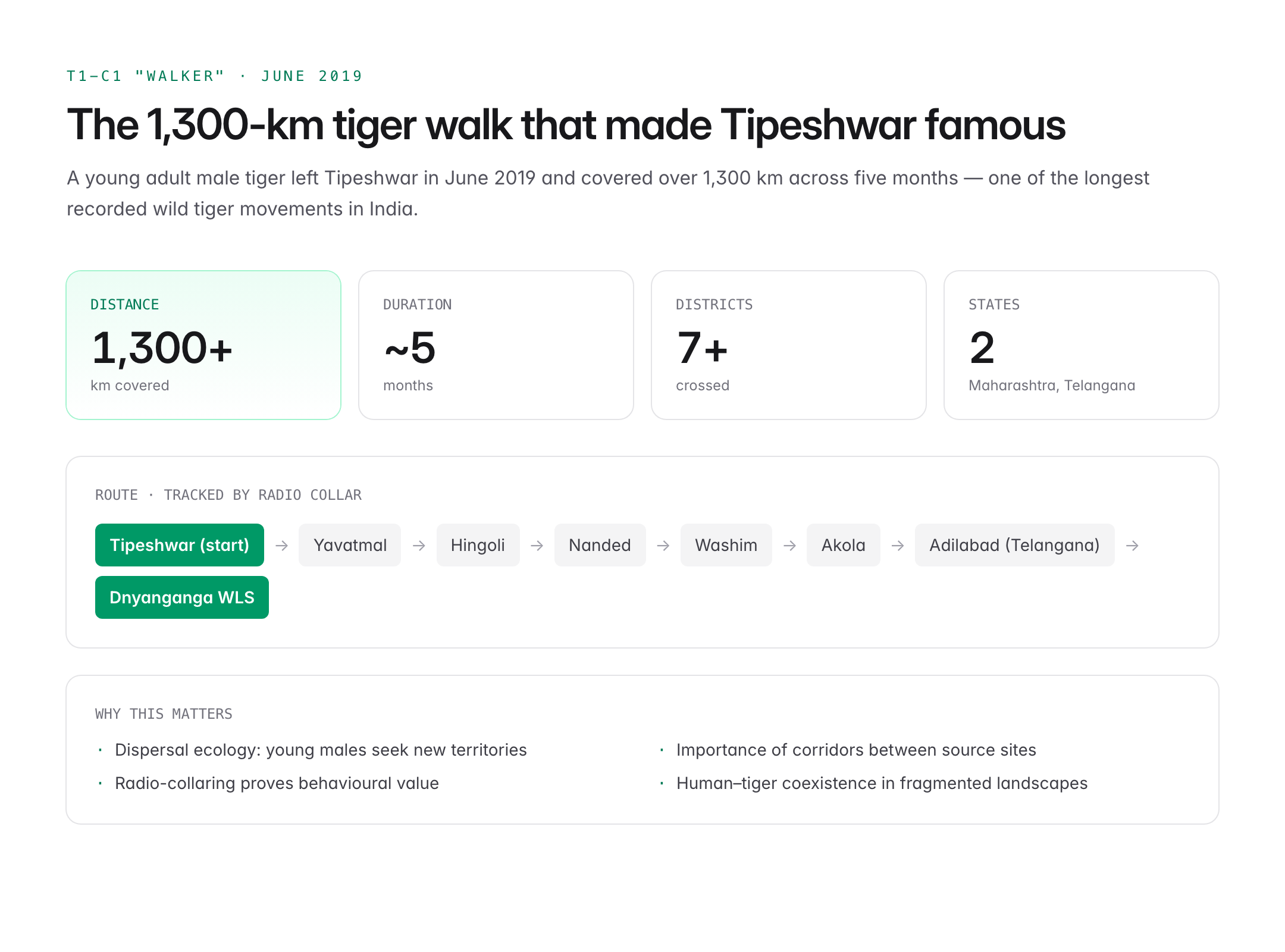
The Tipeshwar Wildlife Sanctuary is a 148.63 sq km protected area in the Yavatmal district of Maharashtra, on the southern edge of the Vidarbha region, and has emerged as one of India's most important tiger-bearing sanctuaries outside tiger reserves. Notified in 1997 under the Wildlife (Protection) Act, 1972, Tipeshwar lies in the tri-junction of Maharashtra, Telangana, and Andhra Pradesh, and serves as a critical wildlife corridor between the tiger landscapes of Tadoba-Andhari, Kawal, and Indravati. It gained global fame in 2019 when the young tiger T1-C1 ("Walker") dispersed more than 1,300 km from Tipeshwar across Maharashtra and Telangana — one of the longest recorded movements of a wild tiger in India. For UPSC, Tipeshwar is a recurring Prelims entry and a Mains case study on corridor conservation.
Where Is Tipeshwar Wildlife Sanctuary
Tipeshwar Wildlife Sanctuary is located in Pandharkawada tehsil of Yavatmal district, Maharashtra, close to the Maharashtra–Telangana border. Key geography:
- State: Maharashtra.
- District: Yavatmal.
- Area: 148.63 sq km.
- Nearest towns: Pandharkawada (15 km), Yavatmal (90 km).
- Terrain: Undulating hills of the Satpura spurs; altitude 360–490 m.
- Rivers: Drained by tributaries of the Penganga, which is itself a tributary of the Wardha–Godavari system.
The sanctuary is sometimes called the "Green Oasis of Maharashtra" because it remains densely wooded amid the cotton-growing plains of Vidarbha.
Establishment and Status
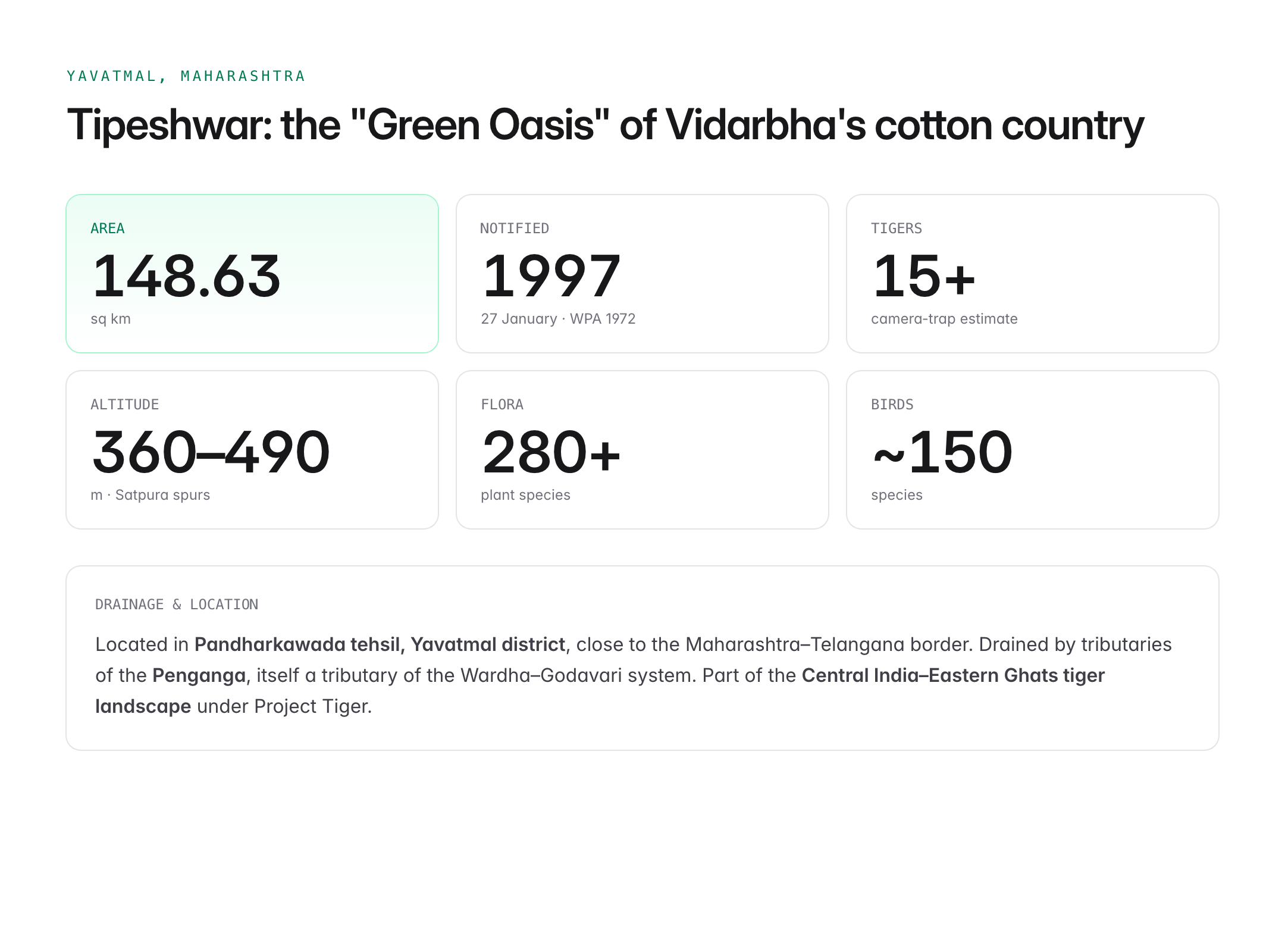
- Notified: 27 January 1997 as a wildlife sanctuary under the Wildlife (Protection) Act, 1972.
- Administrative control: Maharashtra Forest Department, Pandharkawada Division.
- Core and buffer: Functionally managed with a Tiger Conservation Plan by the Maharashtra Forest Department and NTCA guidance, even though it is not formally a tiger reserve.
- Eco-Sensitive Zone: Notified around the sanctuary, extending up to a variable width, under the Environment Protection Act, 1986.
Tipeshwar is part of the Central India-Eastern Ghats tiger landscape, a priority under Project Tiger.
Flora
The sanctuary falls in the Southern Tropical Dry Deciduous Forest zone (Champion & Seth classification) and hosts around 280+ plant species:
- Dominant trees: Teak (Tectona grandis), Ain (Terminalia alata), Mahua, Tendu, Bija, Dhawada, Salai (Boswellia serrata), Bamboo (Dendrocalamus strictus).
- Medicinal plants: Arjuna, Bahera, Harda (the "Triphala trio"), Amla, Safed Musli.
- Grasslands and scrub: Open meadows within the sanctuary provide excellent prey grazing.
- Invasive species: Lantana camara and Parthenium in patches.
Fauna
Mammals:
- Bengal tiger (Panthera tigris) — estimated 15+ tigers based on camera-trap surveys.
- Indian leopard, sloth bear, wild dog (dhole), Indian wolf.
- Nilgai, sambar, chital, chinkara, barking deer, wild boar.
- Jungle cat, rusty-spotted cat, honey badger, pangolin.
Birds (~150 species):
- Crested serpent eagle, crested hawk-eagle, peafowl, grey junglefowl, paradise flycatcher.
- Migratory waterbirds at check-dam reservoirs.
Reptiles: Indian rock python, Indian cobra, Russell's viper, saw-scaled viper, monitor lizard.
The Famous "Walker" (T1-C1) Story
In June 2019, a young adult male tiger, code-named T1-C1 (nicknamed "Walker") left Tipeshwar and walked over 1,300 km in roughly five months across Yavatmal, Hingoli, Nanded, Washim, Akola, and into Telangana's Adilabad, before settling temporarily in Dnyanganga Wildlife Sanctuary. It crossed highways, rivers, and farms, with the Maharashtra Forest Department tracking it through radio-collar telemetry.
The Walker's journey is now a textbook example of:
- Dispersal ecology in tigers: young males disperse to find new territories.
- Importance of corridors between tiger source sites.
- Data value of radio-collaring for behavioural research.
- Human-tiger coexistence challenges across fragmented landscapes.
Corridor Role in the Tiger Landscape
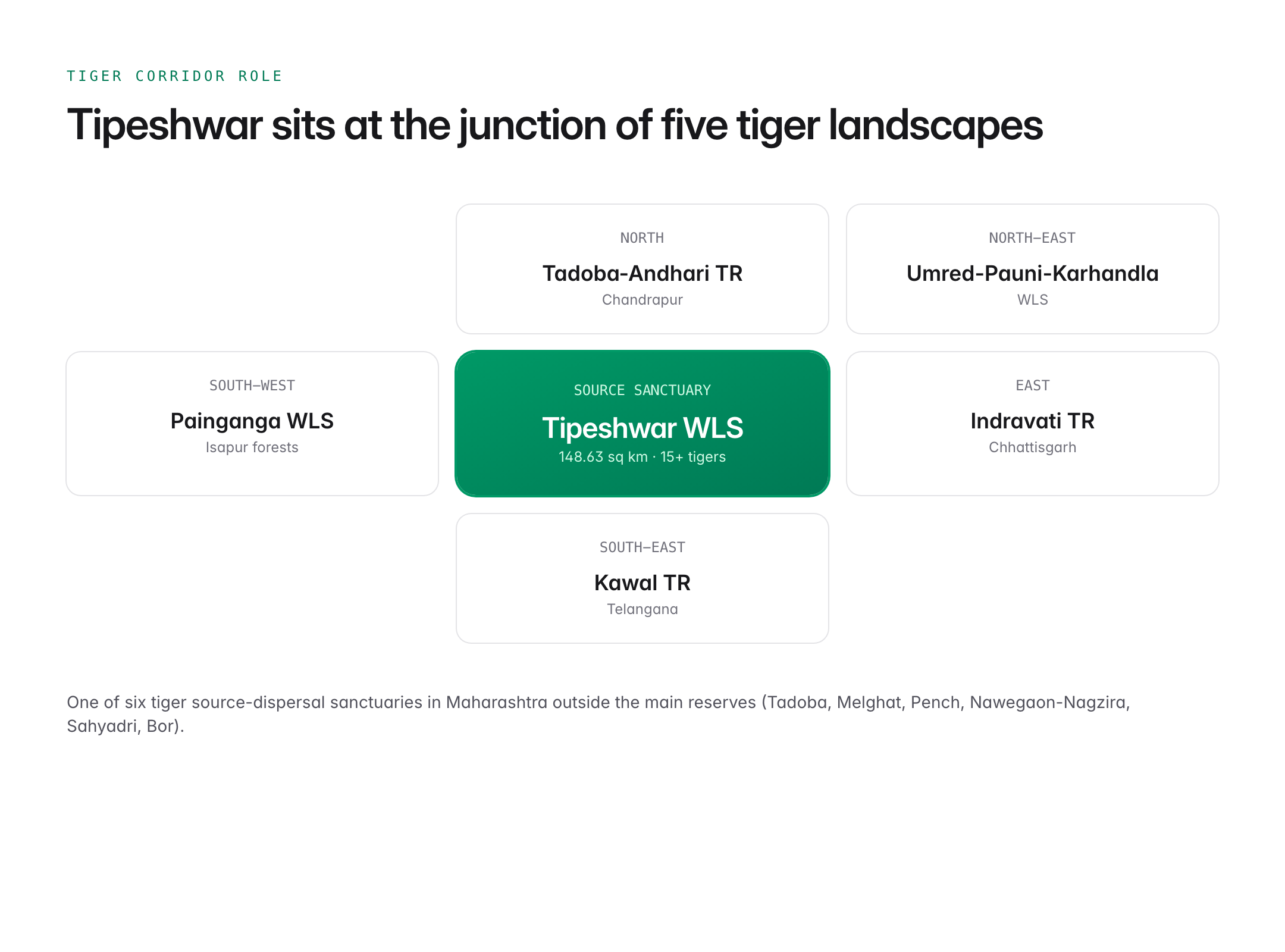
Tipeshwar is embedded in a web of tiger-bearing forests:
| Direction | Connected Protected Area |
|---|---|
| North | Tadoba-Andhari Tiger Reserve (Chandrapur) |
| North-east | Umred-Pauni-Karhandla Wildlife Sanctuary |
| East | Indravati Tiger Reserve (Chhattisgarh) |
| South-east | Kawal Tiger Reserve (Telangana) |
| South-west | Painganga Wildlife Sanctuary, Isapur forests |
This corridor function makes Tipeshwar one of the six tiger source-dispersal sanctuaries in Maharashtra outside the main Tadoba-Melghat-Pench-Nawegaon-Nagzira-Sahyadri-Bor reserves.
Threats and Conservation Issues
- Linear infrastructure: NH-44, railway lines, and state highways fragment corridors.
- Mining pressure: Coal and iron prospects in adjacent Yavatmal-Chandrapur region.
- Cattle grazing and fuelwood extraction from villages along the boundary.
- Human-wildlife conflict — occasional livestock depredation by tigers and leopards, and crop damage by wild boar and nilgai.
- Fire in the dry deciduous months of March–May.
- Invasive Lantana displacing native undergrowth.
Conservation Measures
- Relocation of core villages and ecological restoration of vacated lands.
- Voluntary relocation scheme with ~INR 15 lakh per family under NTCA norms.
- Anti-poaching camps and wildlife corridor monitoring.
- Radio-collaring and camera-trap based tiger monitoring.
- Eco-tourism via safari gates at Tipeshwar-Sunna and Mathani, generating local employment and stakeholder buy-in.
- Joint Forest Management Committees (JFMCs) in buffer villages.
Significance for India's Tiger Story
India hosts around 3,682 tigers (2022 census), over 70% of the world's wild tigers. Sanctuaries like Tipeshwar matter because:
- They act as source populations supplying tigers to larger reserves.
- They represent landscape-level conservation beyond formal tiger reserves.
- They support genetic connectivity across Central India.
- They demonstrate that buffer-sanctuary-reserve mosaics work better than isolated reserves.
UPSC Relevance
Prelims focus:
- Tipeshwar Wildlife Sanctuary is in Yavatmal district, Maharashtra.
- Area: 148.63 sq km; notified in 1997 under the Wildlife (Protection) Act, 1972.
- Famous for tiger T1-C1 "Walker" dispersal (2019).
- Part of the Central India-Eastern Ghats tiger landscape.
- Drainage: Penganga river basin, a tributary of the Wardha-Godavari system.
- Maharashtra's tiger reserves: Melghat, Tadoba-Andhari, Pench, Sahyadri, Nawegaon-Nagzira, Bor.
Mains GS-III angle:
- Importance of corridor sanctuaries in tiger conservation beyond formal tiger reserves.
- Role of scientific tools (radio-collaring, camera traps) and relocation schemes.
- Balancing linear infrastructure (NH-44 widening, railways) with wildlife movement — includes Kanha-Pench corridor lessons.
- India's tiger success story under Project Tiger (1973) and NTCA.
Sample PYQ angle: "Discuss the causes of depletion of mangroves and explain their importance in maintaining coastal ecology." — similar habitat-and-conservation questions on terrestrial ecosystems have been repeatedly asked. Tipeshwar fits answers on corridor conservation, tiger dispersal, and the need to treat protected areas as a landscape network rather than isolated islands.