UNEP Frontiers Report 2025: The Weight of Time, Disasters and Ageing
UNEP Frontiers Report 2025 'The Weight of Time' on the intersection of global ageing, climate disasters, permafrost thaw and zombie microbes. UPSC GS-III pointers.
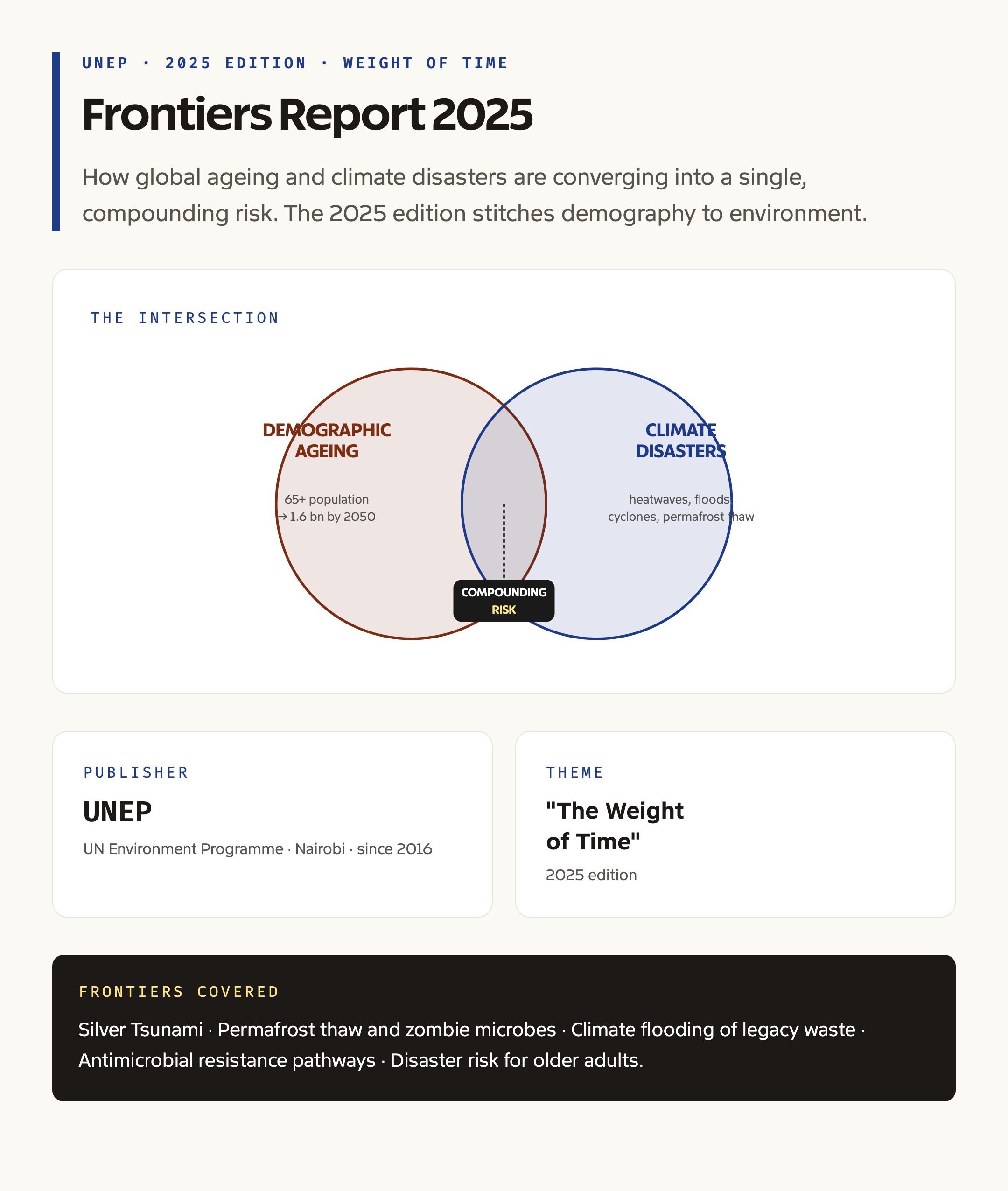
The United Nations Environment Programme has been releasing its Frontiers Report since 2016, and the series has built a reputation for flagging emerging environmental risks before they become mainstream. The 2025 edition, titled The Weight of Time, breaks new ground. Instead of treating climate, biodiversity and pollution as siloed crises, it stitches together a less obvious story: how the world’s rapidly ageing population intersects with intensifying climate disasters, permafrost thaw, and the resurfacing of ancient pathogens. The result is a report that reads less like an environmental document and more like a brief on the converging vulnerabilities of the 21st century.
For an Indian aspirant, the Frontiers Report 2025 matters on three counts. It updates the disaster-management syllabus with a demographic lens that India will face very soon. It reframes climate adaptation around the elderly, a category that NDMA and the National Action Plan on Climate Change still under-address. And it puts the spotlight back on permafrost, a topic that India’s polar science programme tracks closely through its Himalayan and Antarctic stations. Mains GS-III could pose a question on any of these threads.
This guide breaks down what the Frontiers Report 2025 says, why UNEP chose this combination of frontiers, what the silver tsunami and zombie microbes actually mean in scientific terms, and how an aspirant should map it onto the UPSC syllabus.
Quick Facts
- Report title: Frontiers Report 2025 — The Weight of Time
- Published by: United Nations Environment Programme (UNEP)
- Series since: 2016
- Theme: The intersection of demographic ageing and climate change
- Key projection: Population aged 65 and above will roughly double from about 800 million to 1.6 billion by 2050
- Major frontiers covered: Silver Tsunami; Permafrost thaw and zombie microbes; Disaster risk for the elderly; Antimicrobial resistance pathways; Climate-induced flooding of legacy waste
- Ministry tracking it in India: Ministry of Environment, Forest and Climate Change; National Disaster Management Authority (NDMA)
- Indian linkage: India’s 60+ population projected to reach 347 million by 2050 (UNFPA India Ageing Report)
- Source: UNEP Frontiers Report 2025 — The Weight of Time
- Series purpose: Early-warning identification of emerging environmental issues for governments
What Is the UNEP Frontiers Report
The Frontiers Report is the UN Environment Programme’s flagship horizon-scanning publication. Each edition picks a small number of emerging environmental issues that are not yet on the policy mainstream but are likely to define the next decade. Past editions have flagged microplastics in 2016, antimicrobial resistance in 2017, and permafrost peatlands in the 2022 Noise, Blazes and Mismatches edition. The 2025 report, The Weight of Time, focuses on how the slow accumulation of demographic, climatic and geophysical pressures is producing fast, compounding disasters.
The report is not a primary scientific assessment in the IPCC sense. It is a synthesis aimed at policymakers, developed in partnership with international research institutions and reviewed by UNEP’s scientific board. Its strength is in surfacing connections between issues that are usually treated separately. The Weight of Time does that by linking ageing, disaster vulnerability and permafrost.
Where Does the 2025 Report Fit in the UNEP Series
UNEP releases the Frontiers Report every two to three years. The 2025 edition follows the 2022 issue and is timed to feed into the UNEA-7 negotiations and the global stocktake on disaster risk reduction under the Sendai Framework’s mid-term review. The report is also a deliberate companion to the UN Decade of Healthy Ageing 2021–2030, led by the World Health Organization, and seeks to push environment ministries to engage with demographic policy.
Background and Why UNEP Picked This Theme
UNEP’s choice of theme is not accidental. Three signals converged in the run-up to 2025. First, the Sendai mid-term review found that disaster mortality remains heavily skewed towards older adults. The 2003 European heatwave killed more than 70,000 people, the great majority above 65. The 2018 Japan heatwave, the 2021 British Columbia heat dome, and the 2022 Pakistan floods repeated the pattern. Second, World Population Prospects 2024 confirmed that the population aged 65 and above will roughly double from 808 million in 2022 to 1.6 billion by 2050. Third, Arctic permafrost monitoring stations recorded a 2024 thaw season that pushed several long-frozen sites past their historic melting envelopes.
UNEP read these three signals together and concluded that the next decade’s environmental agenda must shift. The Weight of Time is the result. It argues that disaster preparedness, infrastructure planning and health systems will fail unless they are designed for an older, more frail population living in a more volatile climate.
Key Frontiers Identified in the 2025 Report
The Silver Tsunami
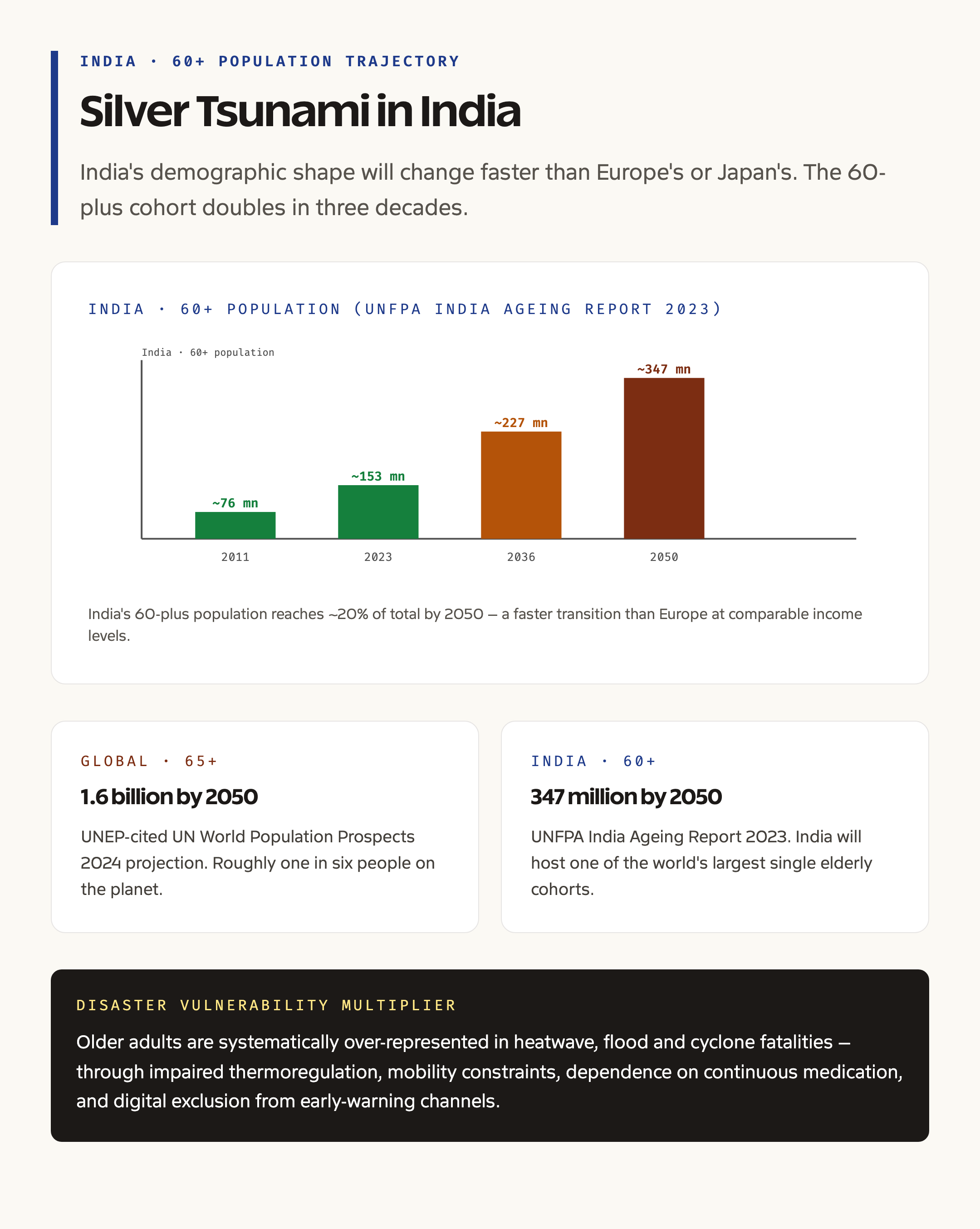
The phrase silver tsunami captures the rapid and large-scale ageing of the global population. UNEP’s central data point is that adults aged 65 and above will reach 1.6 billion by 2050, roughly one in six people on the planet. In low- and middle-income countries, the transition is faster than the historic European or Japanese curves, leaving less time for health systems and disaster machinery to adapt.
The report links this to climate risk in three ways. Older adults are more vulnerable to extreme heat because of impaired thermoregulation and chronic disease. They are over-represented among flood casualties because of mobility constraints. And they are systematically excluded from emergency communication channels designed around digital alerts and smartphone apps.
Permafrost Thaw and Zombie Microbes
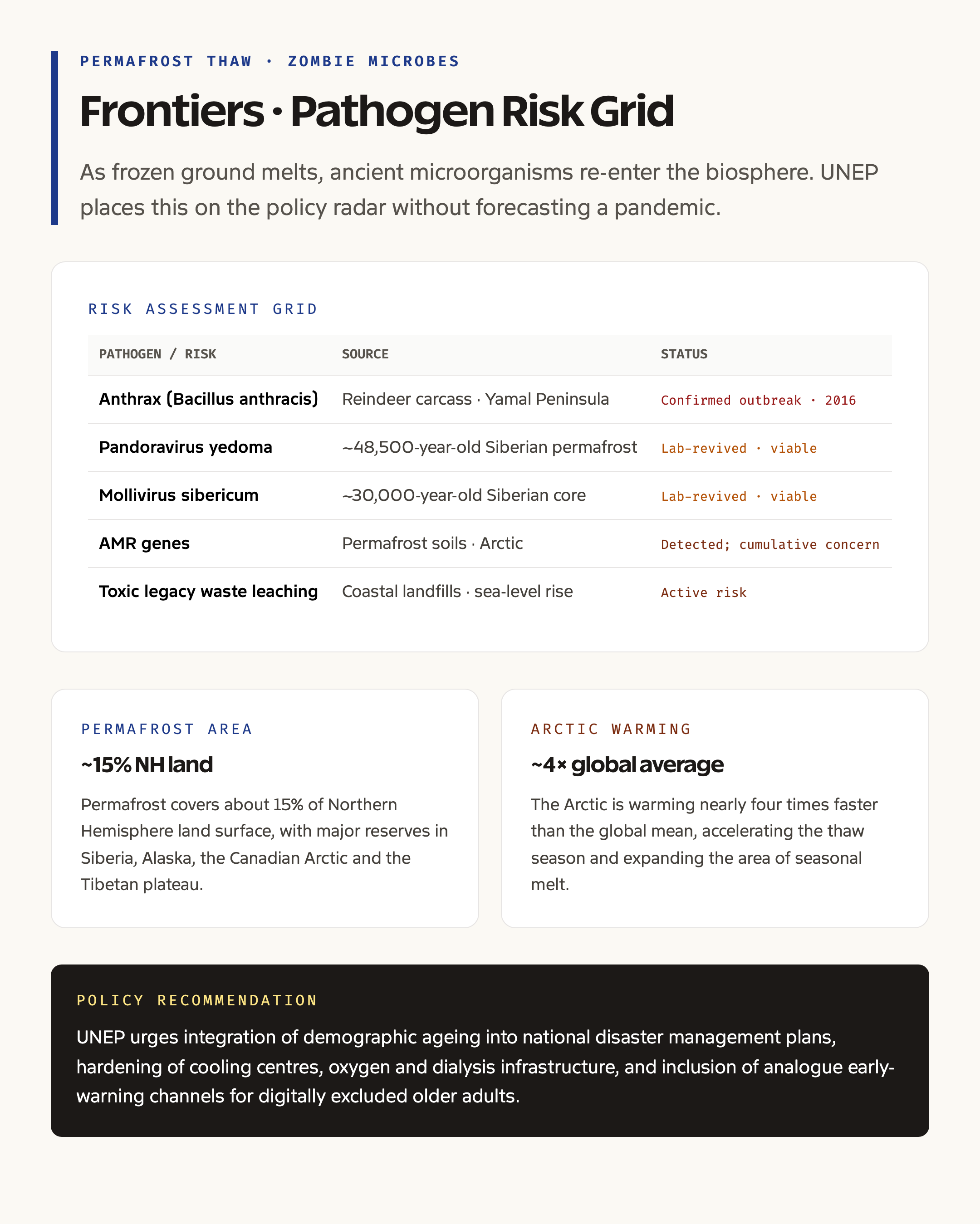
Permafrost, ground that has been continuously frozen for at least two consecutive years, covers about 15 per cent of the Northern Hemisphere land surface. As the Arctic warms at nearly four times the global average, permafrost is thawing across Siberia, Alaska, the Canadian Arctic and parts of the Tibetan plateau. The frozen ground holds vast stores of organic carbon, but it also contains preserved microorganisms.
Zombie microbes are bacteria, viruses and fungi that have been frozen, sometimes for tens of thousands of years, and are released as the permafrost melts. The 2016 Yamal anthrax outbreak in Siberia, traced to a thawed reindeer carcass, is the textbook example. Scientists have since revived a 48,500-year-old Pandoravirus from Siberian permafrost in laboratory conditions. UNEP’s concern is not that ancient pathogens will trigger a pandemic tomorrow, but that modern immune systems have no exposure history with these microbes, and the cumulative risk over a multi-decade thaw is poorly modelled.
Climate-Induced Flooding of Legacy Waste
A third frontier flagged by the report is the inundation of toxic legacy sites — old landfills, mine tailings, abandoned chemical plants — by sea-level rise, riverine flooding and storm surge. As coastlines erode and rainfall intensifies, contaminants that were considered safely contained begin to leach into floodplains and groundwater.
Antimicrobial Resistance Pathways
The report extends earlier UNEP work on antimicrobial resistance by tracing how environmental pathways (agricultural runoff, untreated wastewater, hospital effluent) interact with permafrost-released microbes and an ageing population that consumes the largest share of antibiotics.
Why the Frontiers Report Matters for India
India will be one of the largest single contributors to the silver tsunami. The 2023 UNFPA India Ageing Report projects the 60-plus population to grow from 153 million in 2023 to 347 million by 2050, roughly 20 per cent of the population. The transition will happen faster than in Europe or Japan, and at a lower per-capita income. This is the demographic context against which India’s disaster management system, already stretched by floods, heatwaves, cyclones, and earthquakes, must be redesigned.
India’s exposure to extreme heat is a particular concern. The 2024 heatwave saw temperatures cross 50°C in north India and triggered excess mortality concentrated among older adults. Cities such as Ahmedabad have pioneered Heat Action Plans, but coverage remains uneven. The Frontiers Report’s framing pushes India to mainstream age-disaggregated risk assessments into the National Disaster Management Plan and the Disaster Management framework operated by NDMA.
Detailed Look: The Disaster-Ageing Intersection
The intersection of disasters and ageing operates through five mechanisms identified in the report.
- Heat vulnerability — older adults have reduced thirst response and slower vasodilation, increasing heatstroke risk.
- Mobility constraints — evacuation during floods, cyclones, and tsunamis is harder for those with limited mobility.
- Medication dependence — disruption of supply chains in disasters disproportionately affects insulin, antihypertensives, and dialysis, all skewed older.
- Social isolation — single-occupant elderly households are harder to locate after a disaster.
- Cognitive decline — early dementia reduces compliance with evacuation orders and weather warnings.
UNEP recommends that disaster risk assessments use age-disaggregated data, that early-warning systems include analogue channels (door-to-door, radio, community volunteers), and that critical infrastructure such as cooling centres, oxygen supply, and dialysis stations be hardened against climate extremes.
Comparative Snapshot: Frontiers Reports 2016–2025
| Edition | Year | Selected Frontier |
|---|---|---|
| Frontiers 2016 | 2016 | Microplastics, zoonotic diseases |
| Frontiers 2017 | 2017 | Antimicrobial resistance, marine plastics |
| Frontiers 2018/19 | 2019 | Synthetic biology, salt-marsh nitrogen |
| Frontiers 2022 | 2022 | Noise pollution, wildfires, peatland permafrost |
| Frontiers 2025 | 2025 | Silver Tsunami, zombie microbes, legacy-waste flooding |
The 2025 edition is the first to combine demographic and environmental risk explicitly.
Challenges and Critique
The Frontiers Report 2025 has been broadly welcomed, but three critiques deserve mention. The zombie microbe framing has been criticised as alarmist by some virologists who argue that environmental survival rates of revived pathogens are low. The age-vulnerability framing risks portraying older adults as passive victims, when many low- and middle-income societies rely heavily on the labour and care contributions of older adults during disasters. And the report does not yet integrate insights from the Biological Diversity Act 2002 framework on traditional knowledge, which is often the missing link between an ageing population and adaptive disaster response.
UPSC Prelims Pointers
- The UNEP Frontiers Report is published by the United Nations Environment Programme, headquartered in Nairobi, Kenya.
- The 2025 edition is titled The Weight of Time.
- The report’s central theme is the intersection of global ageing and climate change.
- The 65-plus global population is projected to reach 1.6 billion by 2050.
- The silver tsunami refers to rapid and large-scale demographic ageing.
- Zombie microbes are ancient bacteria and viruses released by thawing permafrost.
- The 2016 Yamal anthrax outbreak is the most cited real-world example of permafrost-released pathogen risk.
- Permafrost covers roughly 15 per cent of the Northern Hemisphere land surface.
- The Frontiers Report has been published since 2016.
- India’s 60-plus population is projected to reach about 347 million by 2050 (UNFPA).
UPSC Mains Pointers
- Discuss how India’s disaster management framework, including the National Disaster Management Plan, should adapt to a rapidly ageing population in the context of climate change.
- Examine the science of permafrost thaw and assess the public-health risks posed by the release of ancient pathogens, with reference to the UNEP Frontiers Report 2025.
- Critically analyse the silver tsunami concept and its relevance to climate-resilient urban planning in Indian cities.
- Compare the Frontiers Report 2025 with the IPCC AR6 framing of vulnerability and exposure, highlighting where the two converge and diverge.
Way Forward
The value of the Frontiers Report is not in the alarm it raises but in the policy redesign it provokes. For India, three priorities follow. Mainstream age-disaggregated data into every disaster risk assessment, building on the work of the NDMA and state disaster management authorities. Strengthen analogue and community-based warning systems for heatwaves, floods, and cyclones, recognising that an estimated quarter of older Indians are not digitally connected. Integrate permafrost and high-altitude microbial monitoring into India’s polar science and Himalayan glacier programmes through the National Centre for Polar and Ocean Research and the Wadia Institute of Himalayan Geology.
Frequently Asked Questions
What is the UNEP Frontiers Report 2025 about?
The UNEP Frontiers Report 2025, titled The Weight of Time, focuses on the intersection of global ageing and climate change. It identifies the silver tsunami of population ageing, permafrost thaw and zombie microbes, and the flooding of legacy toxic waste sites as emerging frontiers that demand integrated policy responses.
Who publishes the Frontiers Report and how often?
The Frontiers Report is published by the United Nations Environment Programme (UNEP), headquartered in Nairobi, Kenya. The series began in 2016 and editions are released roughly every two to three years.
What is the silver tsunami?
The silver tsunami is shorthand for the rapid and large-scale ageing of the global population. UNEP projects that the number of people aged 65 and above will roughly double from about 808 million in 2022 to 1.6 billion by 2050.
What are zombie microbes?
Zombie microbes are bacteria, viruses and fungi that have been preserved in frozen ground (permafrost) for thousands to tens of thousands of years and are released as the permafrost thaws. The 2016 Yamal anthrax outbreak in Siberia is the most cited real-world incident.
Why does the Frontiers Report 2025 link ageing with climate disasters?
Older adults are systematically over-represented among casualties of heatwaves, floods, and cyclones because of impaired thermoregulation, mobility constraints, and digital exclusion. As both the global population ages and climate disasters intensify, the overlap creates a compounding risk that disaster systems are not designed for.
How does the report affect India?
India’s 60-plus population is projected to reach about 347 million by 2050 according to the UNFPA India Ageing Report. India also faces severe heatwaves, floods, and cyclones. The Frontiers Report 2025 provides a framework for redesigning the National Disaster Management Plan around age-disaggregated risk.
What is permafrost and where is it found?
Permafrost is ground that has remained continuously frozen for at least two consecutive years. It covers roughly 15 per cent of the Northern Hemisphere land surface, primarily in Siberia, Alaska, the Canadian Arctic, parts of Scandinavia and the Tibetan plateau. Patches occur in India’s high Himalaya.
Has the Frontiers Report been criticised?
Yes. Some virologists argue the zombie microbe framing overstates the public-health risk because environmental survival of revived pathogens is uncertain. Demographers caution that the silver tsunami framing risks portraying older adults only as passive victims, when many contribute actively during disasters.
How is the Frontiers Report different from the IPCC reports?
The IPCC produces large, peer-reviewed scientific assessments at multi-year intervals. The Frontiers Report is a shorter, faster horizon-scanning synthesis aimed at flagging emerging risks. The Frontiers Report is policy-oriented rather than primary science.
What is the Sendai Framework, and how does the Frontiers Report 2025 relate to it?
The Sendai Framework for Disaster Risk Reduction 2015–2030 is the UN agreement that guides national disaster strategies. The Frontiers Report 2025 contributes to the Sendai mid-term review by surfacing demographic ageing as an under-recognised disaster risk multiplier.