Best Books for UPSC Mains 2026: GS I–IV
Paper-by-paper UPSC Mains 2026 booklist covering GS I to GS IV plus Essay — short, practical, and grounded in what toppers actually revise and reject.
Mains is where UPSC stops being a quiz and becomes a thinking exam. You don’t win Mains with more books — you win with clearer thinking, better structure, and the ability to connect a 1920s freedom struggle event to a 2026 policy debate in four lines. Which means your book list for Mains is shorter than your Prelims list, not longer.
For GS I to GS IV, here are the books that work — plus what each paper actually demands.
GS Paper I: Indian Heritage, History, Geography, Society
GS-I is vast in syllabus but slim in book requirement because most foundational reading overlaps with Prelims. The key additions are society and world history.
- Spectrum — Modern India (revisit for Mains depth)
- Bipan Chandra — India’s Struggle for Independence
- Bipan Chandra — India Since Independence (for post-1947 topics)
- Nitin Singhania — Indian Art and Culture
- NCERT Class 12 — Themes in Indian History (Parts I, II, III)
- Norman Lowe — Mastering Modern World History (for World History section)
- NCERT Class 12 — Sociology (for society topics)
- G.C. Leong + NCERT Geography for physical geography section
GS Paper II: Polity, Governance, IR
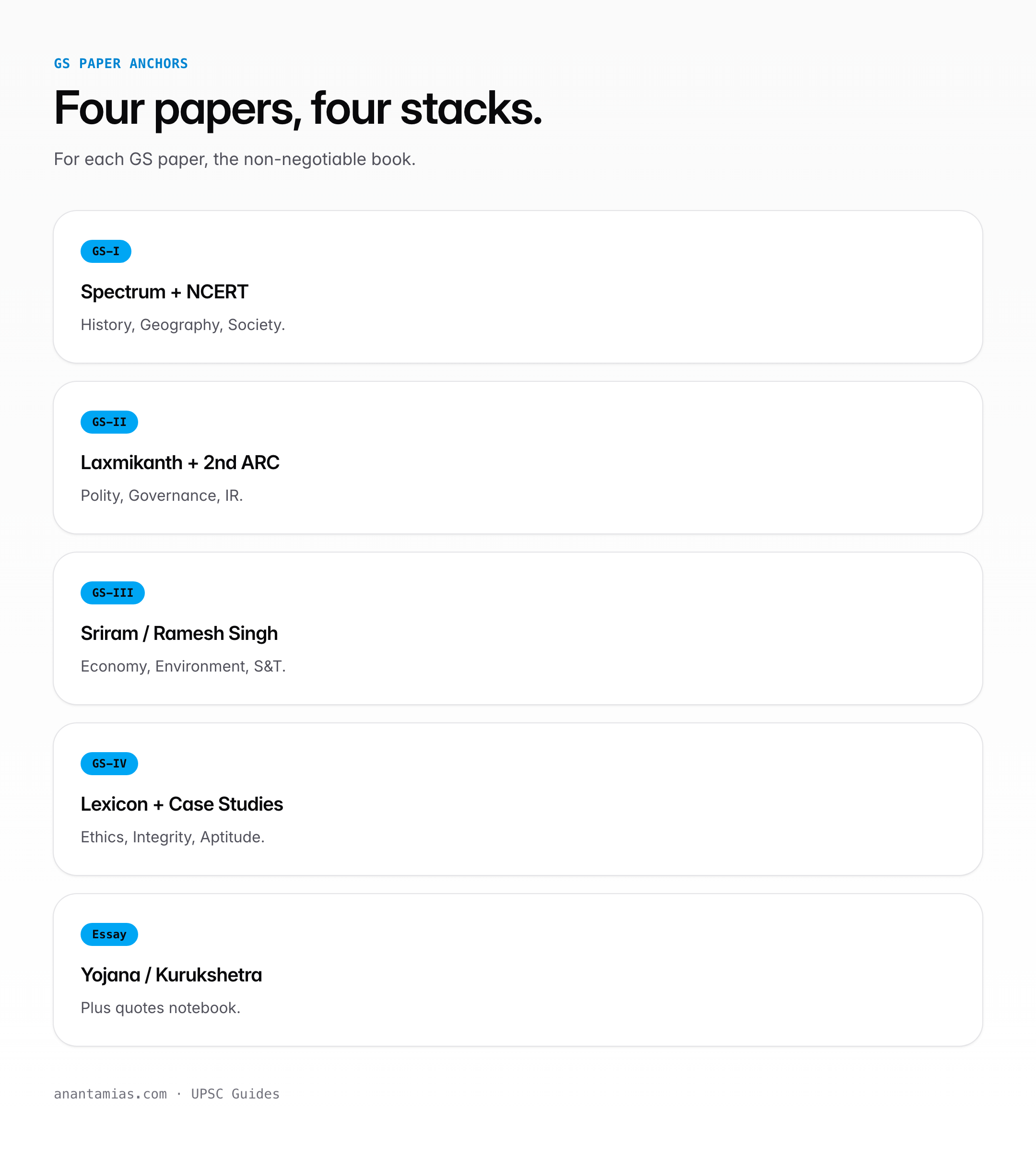
GS-II is the paper closest to daily newspaper content. Good newspaper reading plus Laxmikanth’s Mains companion plus 2nd ARC summaries is enough.
- M. Laxmikanth — Governance in India (the Mains companion, not the Polity book)
- 2nd ARC Reports — summaries (from Vision IAS or any compilation)
- Rajiv Sikri — Challenge and Strategy: Rethinking India’s Foreign Policy (IR)
- Pushpesh Pant — India’s Foreign Policy (alternative IR text)
- The Hindu + Indian Express editorials on governance and IR — daily
- MEA annual report (for bilateral relations)
GS Paper III: Economy, Environment, S&T, Internal Security
The most unpredictable of the four GS papers because of its breadth. Strong current affairs is mandatory.
- Ramesh Singh — Indian Economy (select chapters — agriculture, banking, fiscal policy, inclusive growth)
- Economic Survey — Volume I (analytical chapters only, not data)
- India Year Book (selective — agriculture, environment, infrastructure)
- ShankarIAS — Environment
- Ashok Kumar — Internal Security (or M. Mahapatra for Internal Security)
- Budget + Economic Survey highlights — every year
GS Paper IV: Ethics, Integrity, Aptitude
GS-IV is where most candidates either score exceptionally or bomb. The paper rewards clarity, real examples, and personal authenticity — not quotation-bombing.
- Lexicon for Ethics, Integrity and Aptitude by Chronicle (the most-used base book)
- Subba Rao + P.N. Roy Chowdhury — Ethics, Integrity and Aptitude (alternative)
- 2nd ARC — Ethics in Governance (4th Report)
- Michael Sandel — Justice: What’s the Right Thing to Do? (for thinker-based questions)
- Build a personal case study file: 20 real incidents from your life + 20 from news
Essay Paper
No single book prepares you for Essay. But these shape thinking:
- Yojana monthly magazine (for data-driven development essays)
- Frontline and EPW (for sociological and economic essays)
- Anudeep Durishetty’s essay blog and Gaurav Agrawal’s IAS blog (free)
- Collect 50 quotations, 30 Indian thinkers, 30 real Indian case studies — structured in a single notebook
Mains Book List — Consolidated
| Paper | Core Books | Magazines |
|---|---|---|
| GS I | Spectrum, Bipan Chandra, Nitin Singhania, Norman Lowe | Yojana (culture/society issues) |
| GS II | Laxmikanth (Governance), 2nd ARC, Rajiv Sikri | Indian Express editorial |
| GS III | Ramesh Singh, Economic Survey, ShankarIAS Env, Ashok Kumar | Yojana, Down to Earth |
| GS IV | Lexicon, 2nd ARC Ethics, Michael Sandel | – |
| Essay | Yojana, Frontline, EPW | – |
Answer Writing: The Real Book
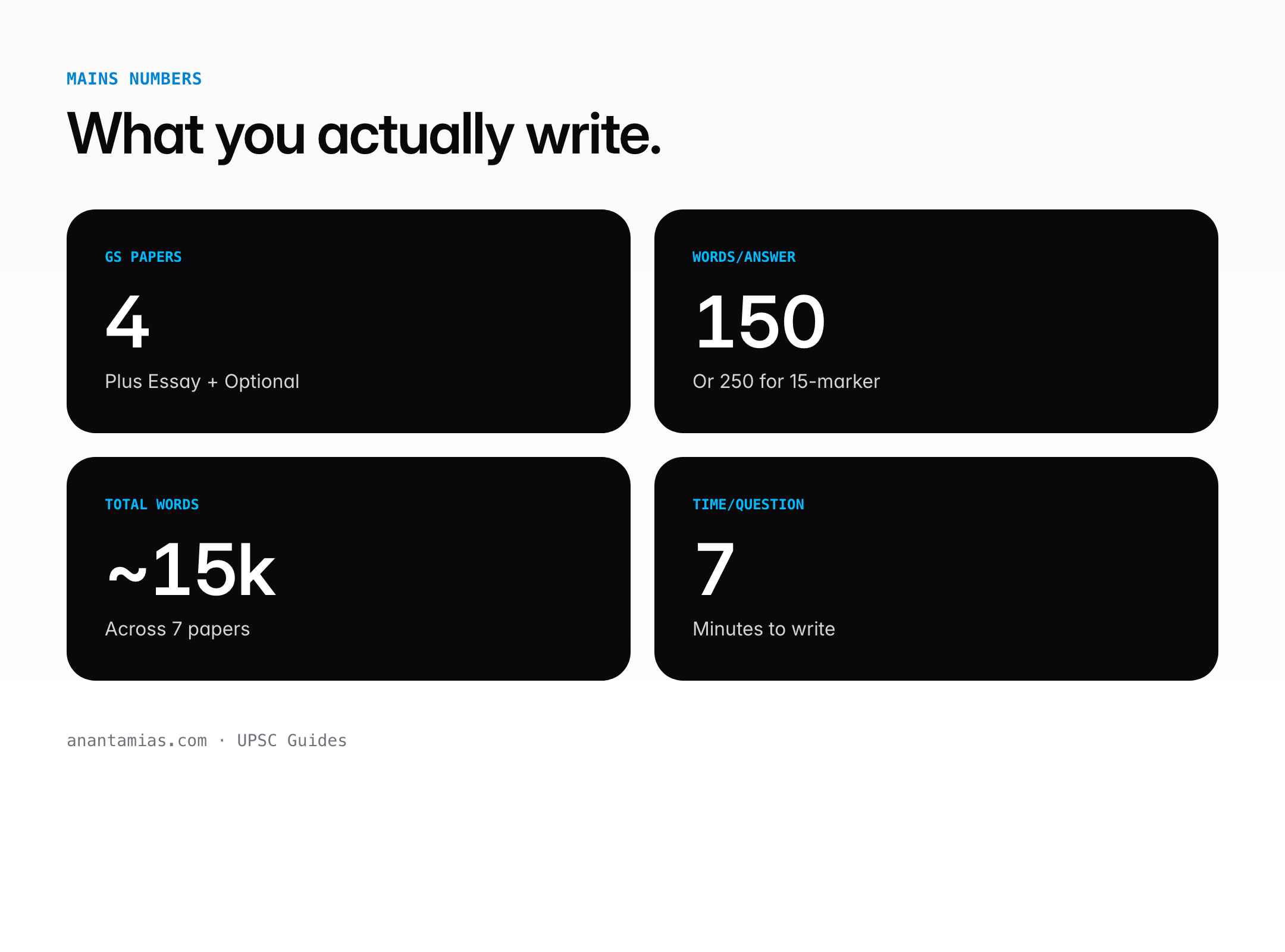
No book teaches Mains. Writing teaches Mains. Join one test series (Vision IAS, ForumIAS, InsightsIAS, or RauIAS) the moment Prelims is done. Write 4 full-length tests minimum per paper before the exam. Review your own copies every Sunday — compare with toppers’ copies from the previous year’s toppers’ blogs.
What to Skip
- Multiple books on the same paper unless one is clearly incomplete
- 500-page reference books bought to feel serious
- Yearly downloads of every PIB release — your notes should come from your own hand
- Inspirational topper interviews on YouTube — after 3, diminishing returns set in fast
A Mains candidate who has read 10 books four times each and written 40 answers outperforms one who has read 40 books once and written 10 answers. Every year. Without exception.
Frequently Asked Questions
Is Laxmikanth’s Indian Polity enough for GS-II Mains?
No. Pair it with Laxmikanth’s Governance in India and 2nd ARC summaries. GS-II Mains expects governance and institutional reforms, which the Polity book does not cover in depth.
Do I need Bipan Chandra if I have Spectrum?
For Prelims, Spectrum is enough. For Mains, add Bipan Chandra — his analytical framing on the freedom struggle helps produce better-structured answers.
Which ethics book is best?
Lexicon by Chronicle is the most widely used. Supplement with 2nd ARC’s 4th Report on Ethics in Governance and build your own case study bank.
How important is the Economic Survey?
Read Volume I (analytical chapters) carefully — Volume II is mostly data. Vision IAS or ForumIAS summaries work well if you’re short on time.
Can I prepare Mains without coaching material?
Yes. Standard books + newspaper + test series is enough. Many 2023 and 2024 toppers used only public resources plus one test series.
When should I start Mains-specific reading?
Start Mains-oriented reading from month 5 onwards, even while preparing Prelims. Answer writing must begin at least 6 months before Mains.