UPSC CSAT 2026 Exam Analysis: Section Distribution, Qualifying Rate, Strategy
The UPSC Civil Services Examination 2026 Preliminary Stage CSAT Paper-II (Civil Services Aptitude Test) was conducted on Sunday, 24 May 2026 from 14:30 to 16:30 IST. AnantamIAS rates the paper Moderate-to-Tough overall — not as brutal as 2023, but materially harder than the 2024-2025 cycle, with the Reading Comprehension section reviving some of the 2023-style inference difficulty. Below is a detailed exam analysis: section-wise distribution, year-on-year qualifying trend, expected qualifying rate, and a 120-minute time-allocation strategy.
Note. Based on AnantamIAS classification of all 80 CSAT stems and our own difficulty assessment. UPSC’s official answer key is released only after the CSE 2026 final result (expected April-May 2027). CSAT is a qualifying paper — aspirants need 33% (66 / 200) to be considered for Mains. CSAT marks do not add to the GS Paper-I cut-off. Cross-reference our companion GS Paper-I exam analysis for the morning shift.
Quick verdict: the CSAT 2026 paper at a glance
Three lines for the aspirant who has 30 seconds: Reading Comprehension dominated with 28 of 80 questions — and the passages were notably harder than 2024-2025. Quantitative Aptitude was a near-tie at 26 questions, with a clear lean toward number-theory tricks (unit digits, divisibility, modular reasoning) over heavy calculation. Decision-Making appeared at scale for the first time — only 2 questions, but situational-judgment style (now overlapping with the GS Paper-I case-study format introduced this year).
| Dimension | 2026 reading |
|---|---|
| Overall difficulty | Moderate-to-Tough |
| Total questions | 80 |
| Maximum marks | 200 (2.5 per question) |
| Negative marking | 1/3rd (0.833 mark per wrong answer) |
| Qualifying threshold | 66 / 200 (33%) |
| Largest section | Reading Comprehension — 28 questions (35%) |
| Lowest section | Data Interpretation — 1 question (1.25%) |
| New format scale-up | Decision Making (2 questions) — first appearance at this scale |
| Expected qualifying rate | 62-72% (AnantamIAS forecast) |
| Compared to 2025 (~71% qualify) | Likely slightly tougher |
| Compared to 2023 (~48% qualify) | Substantially easier |
Where the 80 questions came from
Across five recognised CSAT buckets, the distribution leaned heavily on three: Reading Comprehension, Quantitative Aptitude, and Logical Reasoning together accounted for 77 of 80 questions. UPSC made minimal use of Data Interpretation (1 question) and gave Decision Making a modest but symbolic presence (2 questions).
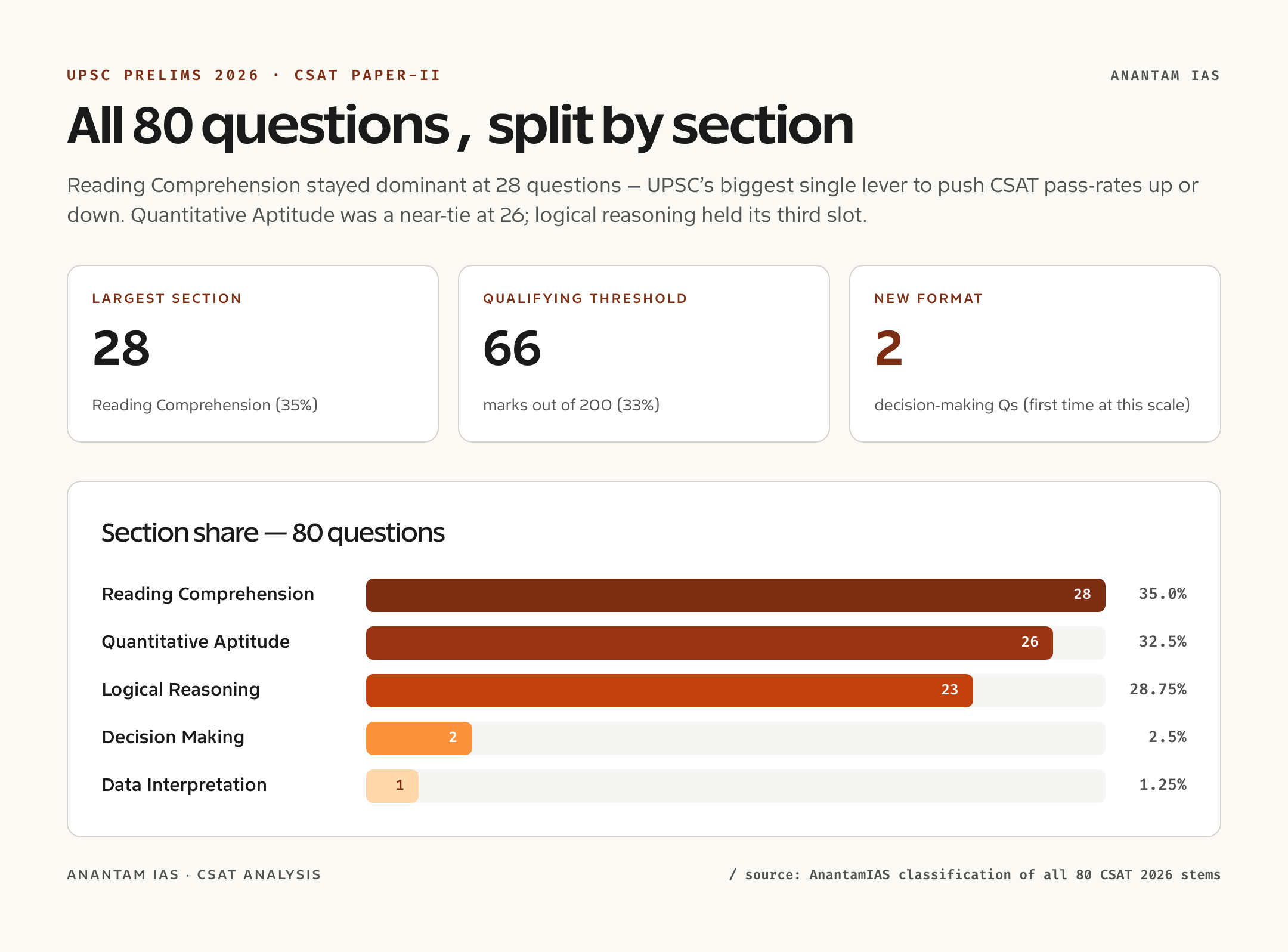
Reading Comprehension (28) stayed the dominant section, but the passages this year shifted from technical and policy abstracts toward dense argumentative prose — closer to GRE/GMAT comprehension than to the policy-brief style of 2024. Inference and tone questions outweighed direct-fact retrieval. Quantitative Aptitude (26) covered the full spread — arithmetic, percentage, ratio, number theory (unit digits, divisibility), mensuration, and a few algebra-light problems. Logical Reasoning (23) featured ranking, blood relations, coding-decoding, sequence, and seating — with several questions that yielded to a single-line reasoning shortcut if the candidate spotted it.
The two Decision-Making questions are the most discussed structural surprise. These were situational-judgment items closer in feel to GS Paper-IV (Ethics) than to traditional CSAT logic. They carry no negative marking and reward balanced administrative reasoning over textbook recall.
Year-on-year qualifying trend: 2020 to 2026
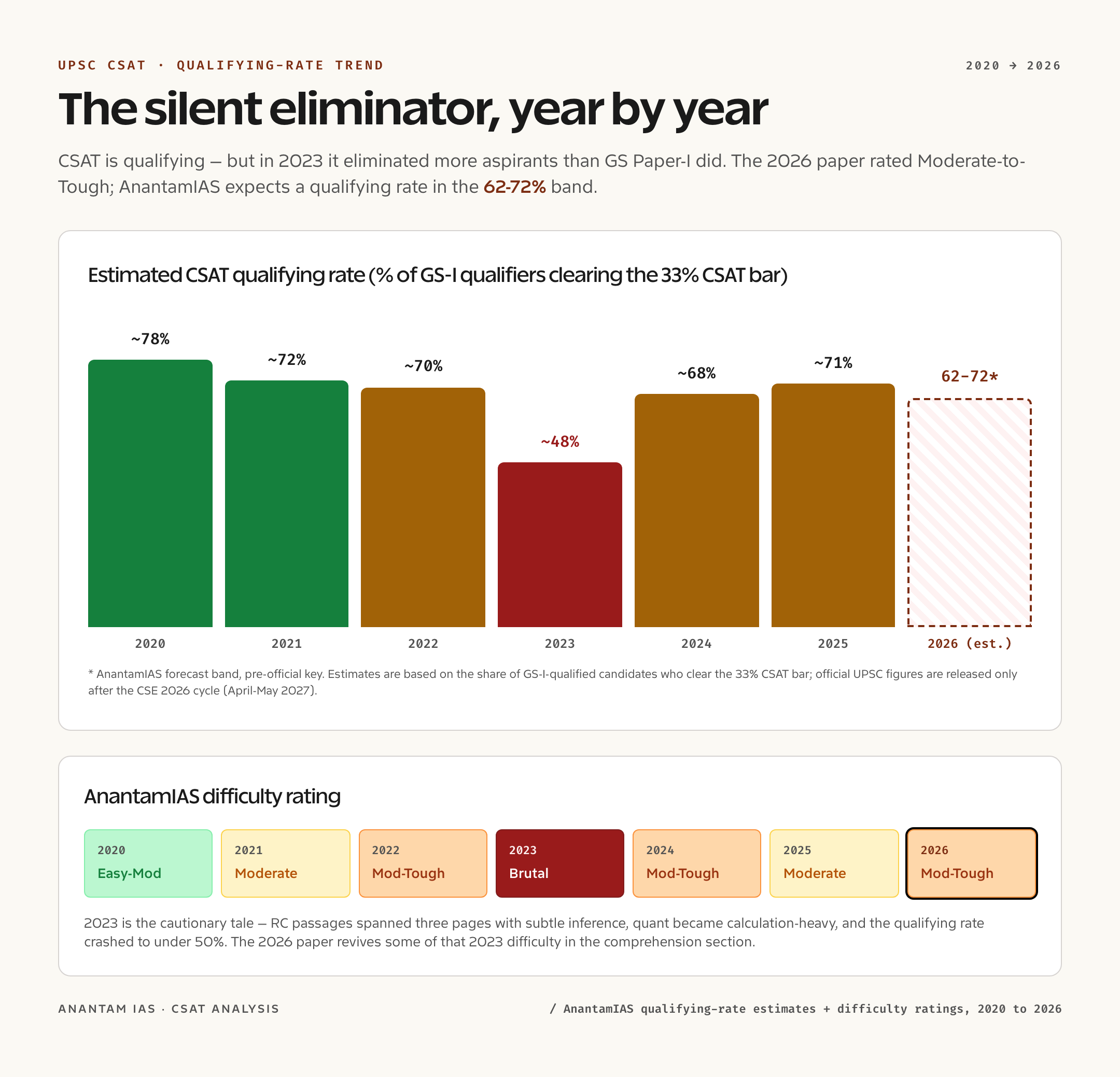
The seven-year qualifying-rate arc tells the story of CSAT’s quiet power. Most aspirants treat it as a formality; the data say otherwise. Between 2020 and 2022 the section was Easy-to-Moderate, with 70-78% of GS-I qualifiers clearing the 33% bar. 2023 broke the pattern — less than half (~48%) cleared, sinking thousands of otherwise-strong candidates to the disqualified list. 2024 and 2025 normalised back to the ~68-71% band.
What changed between 2025 and 2026
- RC inference difficulty rose — passages were longer, with more multi-clause sentences and counter-argument structure
- Quant got tricks-heavier, calculation-lighter — unit-digit cyclicity, divisibility, alligation, and identity-based shortcuts dominated over brute arithmetic
- Logical Reasoning held steady at ~23 questions, but the seating-arrangement and coding-decoding items leaned harder than 2025
- Decision Making appeared at scale — 2 dedicated questions, up from 0-1 in recent years
- Data Interpretation collapsed from a typical 3-5 questions to just 1 — a strategic call by UPSC that benefitted non-quant-strong aspirants
Why CSAT pass-rates swing so much
Three levers move CSAT pass-rates year over year: passage difficulty (RC alone is 35% of the paper, so even a small inference bump moves the median), quant complexity (calculation-heavy years reward only the prepared; trick-heavy years reward sharp readers), and negative-marking exposure (more multi-statement Qs in QA & LR means more candidates lose marks on wrong attempts). 2023 hit all three at once. 2026 hit two of three — harder RC and trickier QA, but milder LR.
How to allocate your 120 minutes
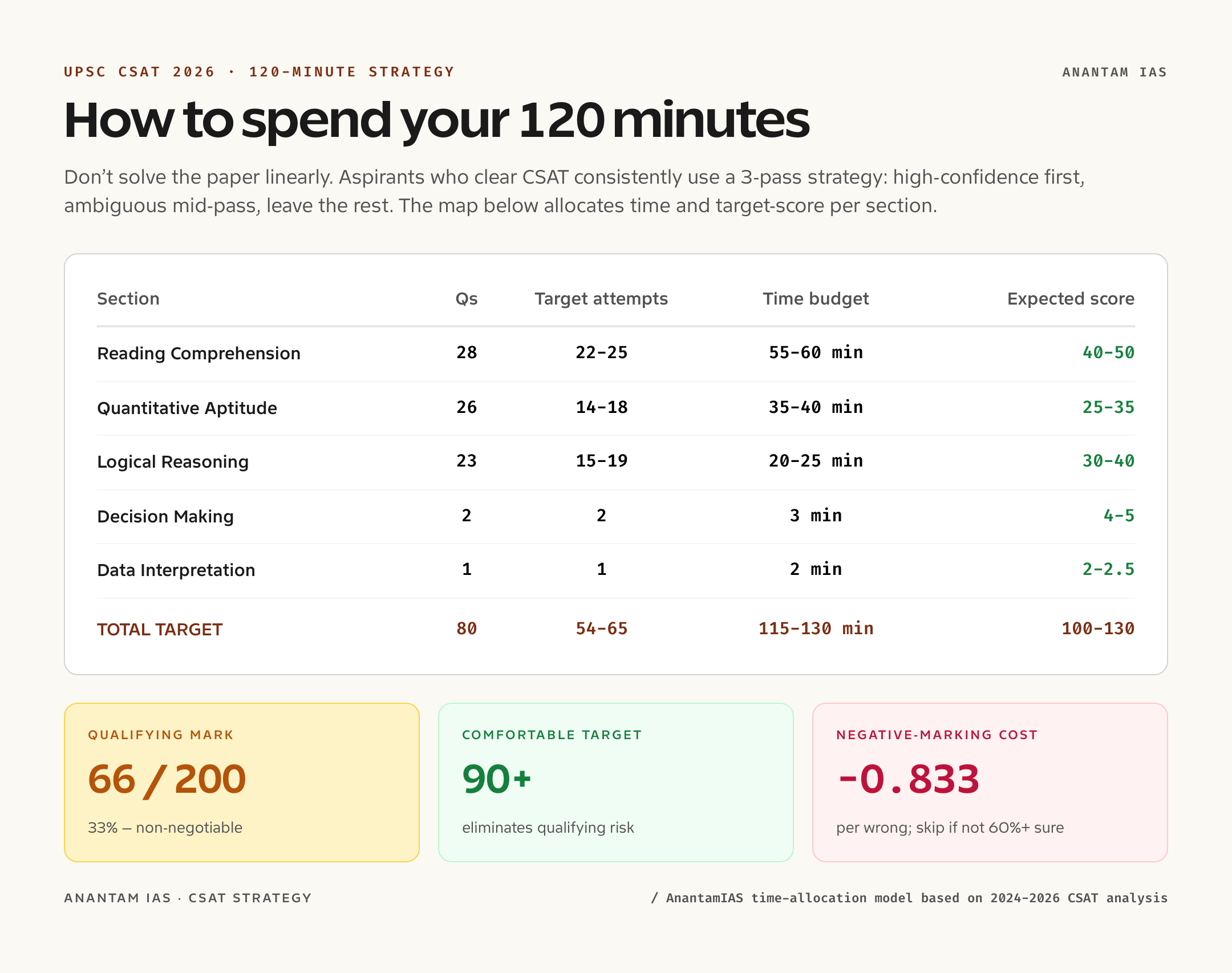
Don’t solve CSAT linearly. The candidates who consistently clear use a three-pass strategy: a high-confidence first pass (LR + easy QA), an ambiguous middle pass (medium QA + RC), and a deliberate skip on the bottom 15-20 hardest items. The map below allocates section-wise time and target attempts.
Three-pass strategy in practice
- Pass 1 (first 25 min): Sweep through Logical Reasoning and skim Quant for low-hanging fruit. Mark answers only where 80%+ confident. Aim for 30-35 attempts.
- Pass 2 (next 55-60 min): Settle into Reading Comprehension. Read each passage once, then answer all its questions in one sitting. Target 22-25 attempts. Re-attack medium Quant Qs after each passage cluster.
- Pass 3 (final 35-40 min): Return to Quant Qs you skipped. Attempt only those you can crack in under 90 seconds. Do the 2 Decision-Making and 1 DI question. Skip anything still unclear — remember, 1 wrong = −0.833 marks vs 0 from skipping.
Note. Target safely above the qualifying line. 66 marks clears, but candidates report mental fatigue and unforeseen errors during the actual paper. Aim for 90+ marks in your mocks — that gives a 20+ mark safety buffer for paper-day variance. Aspirants who target exactly 66 marks are the ones who fail.
Five structural shifts CSAT 2026 made
- Reading Comprehension got harder, not longer. Word counts per passage stayed similar, but inference complexity climbed. Skim-and-answer no longer works; close reading is required. Implication for 2027 prep: practice argumentative-prose RC, not just government-report excerpts.
- Quant rewarded shortcuts over calculations. Unit-digit cyclicity, divisibility identities, alligation, and clever number-substitution beat brute arithmetic on at least 12 of the 26 quant questions. The aspirant who memorised tables of cube-roots saved 10+ minutes over the one who didn’t.
- Decision Making arrived as a permanent section. Two dedicated questions this year, expect 3-5 next year. UPSC is bridging CSAT and Mains GS-IV. Prepare with the same case-study mental models you use for Ethics.
- Data Interpretation collapsed to a single question. Don’t over-invest in DI prep for 2027. Two questions max is the right planning assumption; treat any DI question as guaranteed-attempt low-hanging fruit.
- Negative-marking became more punitive. Multi-statement questions in QA and LR pushed up the cost of guessing. The candidates who scored 100+ this year were the ones who skipped 15-20 items deliberately rather than guessing across the board.
What this means for the 2027 aspirant
Three actionable takeaways for those preparing for UPSC CSAT 2027:
- Re-weight your CSAT prep. Cut DI time to under 10%. Invest the freed hours in close-reading RC and Quant shortcut techniques (cyclicity, alligation, identity-based number theory).
- Build a skip-discipline. Target 56-65 attempts out of 80, not all 80. A clean 60 attempts with 92% accuracy beats 80 attempts with 70% accuracy on the negative-marking math.
- Add Decision-Making practice. Borrow case-study material from your Ethics (GS-IV) prep. CSAT’s decision-making Qs reward the same balanced administrative reasoning — not legal correctness.
Related UPSC Prelims 2026 resources
- UPSC CSAT 2026 — Detailed Answer Key & Solutions to All 80 Questions — question-by-question reasoning with Class-10-style shortcuts
- UPSC CSAT 2026 PDF Download — original Series D English question paper
- UPSC GS Paper-I 2026 Answer Key & Solutions — companion morning-shift detailed answer key
- UPSC GS Paper-I 2026 Exam Analysis — subject distribution, cut-off forecast, structural shifts
- CSAT Quantitative Aptitude Complete Guide — full topic-wise strategy and formula sheet
- 343+ UPSC Prelims MCQs — practice questions in the multi-statement pattern
- UPSC Syllabus 2026 — complete Prelims + Mains syllabus map
- UPSC Result 2026 + Toppers + Cut-off
Frequently Asked Questions
How difficult was UPSC CSAT 2026?
Moderate-to-Tough. Reading Comprehension was notably harder than the 2024-2025 cycle, with denser argumentative passages and more inference-heavy questions. Quantitative Aptitude leaned trick-heavy over calculation-heavy. Logical Reasoning held its difficulty band.
What is the expected CSAT qualifying rate for 2026?
AnantamIAS forecasts the qualifying rate in the 62-72% band, most likely 65-68%. This is below the 2025 rate (~71%) but well above the 2023 brutal-year rate (~48%). Final official figures release after the CSE 2026 cycle (April-May 2027).
Which CSAT section had the most questions in 2026?
Reading Comprehension led with 28 questions (35% of the paper). Quantitative Aptitude was a close second at 26 questions (32.5%). Logical Reasoning had 23 questions (28.75%). Decision Making (2) and Data Interpretation (1) made up the remainder.
How many questions should I attempt in CSAT?
Target 54-65 attempts out of 80. The qualifying threshold is 66 marks (33%). With negative marking at 1/3rd, accuracy matters more than volume. Candidates clearing the 90+ mark target typically attempt 58-62 questions with high confidence.
What is the qualifying score for CSAT 2026?
66 marks out of 200 (33%). This is non-negotiable. Even a perfect score in GS Paper-I will not save a candidate who scores below 66 in CSAT. AnantamIAS recommends targeting 90+ in mocks to leave a safety buffer.
Did decision-making questions appear in CSAT 2026?
Yes — two dedicated decision-making questions appeared, a first at this scale. They are situational-judgment style, closer to GS Paper-IV (Ethics) case studies than to traditional CSAT logic. They carry no negative marking and reward balanced administrative reasoning.
How did CSAT 2026 compare to CSAT 2023?
CSAT 2026 is substantially easier than 2023, which crashed the qualifying rate to ~48%. 2026 RC matches some of 2023’s inference complexity, but Quant in 2026 is much more shortcut-friendly than 2023’s heavy-calculation paper.