How to Read the Newspaper for UPSC: Daily Strategy
A 45-minute daily newspaper system for UPSC — what to read, what to skip, how to take notes, and how to consolidate editorials into Mains-ready arguments.
Reading the newspaper for UPSC is the single most misunderstood habit in the preparation ecosystem. Aspirants either spend 4 hours on it and complete nothing else, or skip it entirely and rely on monthly magazines. The truth is in between: 45–60 minutes, done daily, with a specific system.
Which Newspaper?
Pick one. Not two, not three.
- The Hindu — strongest on governance, polity, editorials. Dense, sometimes verbose.
- Indian Express — strongest on policy, economy, and the Explained section. Cleaner, shorter pieces.
- Both — only if you are a full-time aspirant with 60+ minutes to spare. Otherwise a waste.
Business Standard, Mint, and Livemint are supplements for economy-heavy topics, not replacements. Read them weekly, not daily.
The 45-Minute Daily System
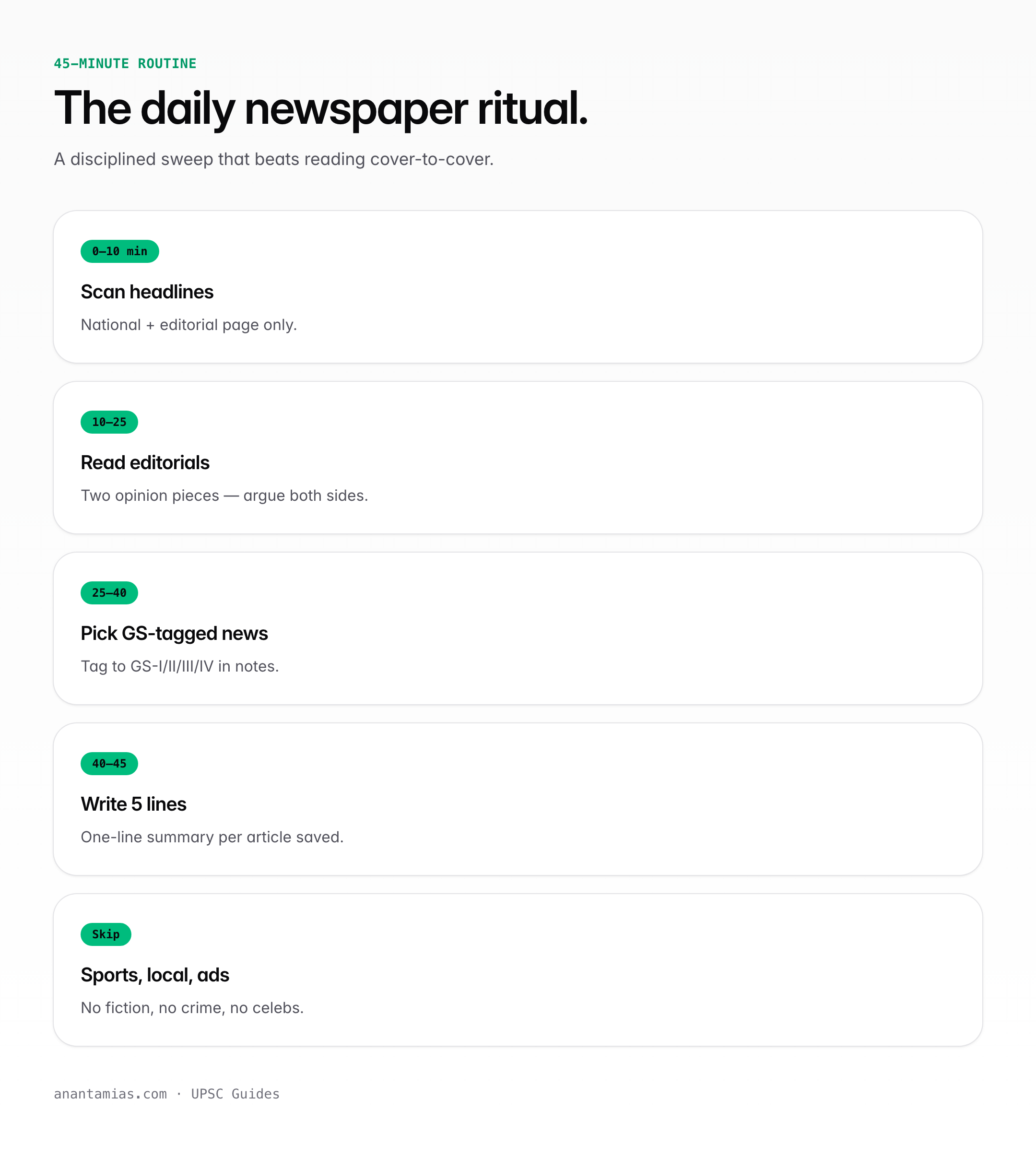
Here is the breakdown that works:
| Minutes | Section | Action |
|---|---|---|
| 5 | Front page headlines | Skim only. Read only policy/governance/major judgments. |
| 10 | National + States | Focus on Bills passed, SC judgments, government schemes, Centre-State issues. |
| 10 | Editorial page | Read 1 editorial + 1 op-ed fully. Mark 3 arguments from each. |
| 8 | Explained / Fact Check | Core section — read every Explained piece. |
| 5 | International | Read only India-related IR news (bilateral, multilateral). |
| 5 | Business / Economy | RBI policy, inflation, major schemes only. |
| 2 | Science & Tech | Short briefings only; detailed notes if ISRO/DRDO. |
What to Ignore (Completely)
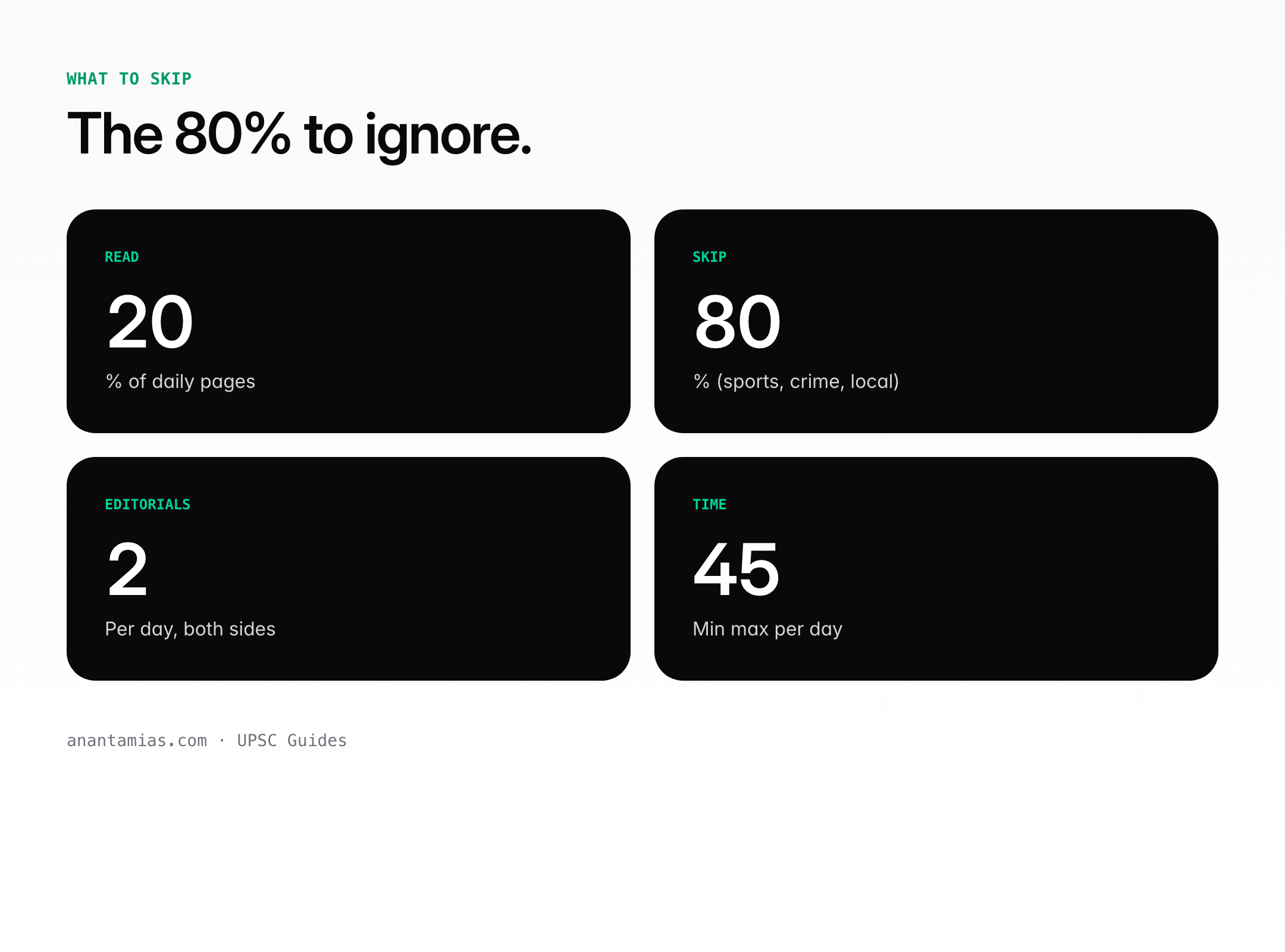
- Sports pages (unless it’s a major India-focused event with policy angle)
- City/local news
- Crime reporting (unless it has policy implications like CBI/ED reforms)
- Political party news (unless it concerns institutional bodies — ECI, EC rulings)
- Cricket, Bollywood, celebrity interviews
- Stock market daily moves
How to Take Notes
The newspaper is a funnel. Your goal is to leave behind 1 page of notes per day, not 10. Use one of these three systems — whichever fits your brain:
System 1: Syllabus-Tagged Notes
Maintain one notebook with sections for each GS paper (GS-I Society, GS-II Polity, GS-II IR, GS-III Economy, GS-III Environment, GS-III Security, GS-IV case studies). Each news item gets 2–4 lines under the correct section. Perfect for Mains preparation.
System 2: Digital Tool (Notion / Evernote / Obsidian)
Same tagging principle, but searchable. Useful if you study on a laptop. Cons: easy to over-research on internet, easy to procrastinate with formatting.
System 3: Date-wise One-Page
One ruled page per day with 5–7 bullet points. Simplest for beginners. Weakness: hard to revise 6 months of pages before Mains.
Monthly Consolidation
On the last Sunday of each month, spend 2 hours consolidating the month’s notes into 1 topic-wise document. This is what you actually revise in the last 30 days before Prelims and Mains. Without this step, daily notes become useless clutter.
Editorials: The Mains Goldmine
Editorials are where the newspaper earns its keep for Mains. Here’s the drill for every editorial:
- Identify the issue in one line
- Extract 3 arguments from one side
- Extract 3 arguments from the other side (find them from another paper if the editorial is one-sided)
- Note 1–2 data points or reports mentioned
- Write a 1-line personal view — this trains your opinion muscle for GS-IV and Essay
A Week’s Editorial Reading Plan
| Day | Editorial Theme |
|---|---|
| Monday | Polity / constitutional issue |
| Tuesday | Economy / fiscal / RBI |
| Wednesday | IR / foreign policy |
| Thursday | Environment / climate |
| Friday | Governance / reforms |
| Saturday | Society / gender / education / health |
| Sunday | Weekly consolidation — no new reading |
Common Newspaper Reading Mistakes
- Reading every article (80% is irrelevant to UPSC)
- Taking 2+ hours daily (diminishing returns after 60 minutes)
- Copying full articles into notes (extract, don’t photocopy)
- Using only a monthly magazine instead of newspapers (you lose nuance and opinion-building)
- Reading without underlining or note-making (passive reading wastes time)
Can I Skip Newspaper and Rely on Monthly Magazines?
No. Magazines give you facts; newspapers give you arguments. Mains answers require argumentation. GS-II and GS-III answers without newspaper exposure read like Wikipedia summaries — and UPSC marks them accordingly.
Newspaper Reading for Working Professionals
If you can’t spare 45 minutes in the morning, try this:
- 20 minutes with morning tea — front page + Explained
- 20 minutes on the commute — editorials via app
- 10 minutes at night — note-making from saved articles
The habit matters more than the duration. Ten minutes done every day for 365 days beats 2 hours done once a week. The newspaper rewards boring discipline.
Frequently Asked Questions
Which newspaper is best for UPSC?
The Hindu and Indian Express are the two standards. Pick one and stay with it. Switching between papers mid-preparation wastes time and disrupts the note-making system.
How much time should I spend on the newspaper daily?
Forty-five to sixty minutes is ideal. More than 90 minutes almost always means you are reading low-priority sections.
Should I read physical newspaper or digital?
Either works. Digital (e-papers, newspaper apps) is faster and portable; physical helps retention through underlining. Choose based on your schedule and environment.
Are monthly magazines enough instead of newspapers?
No. Magazines compile facts but miss the argumentation that Mains answers require. Use magazines as a backup to newspaper notes, not a replacement.
How do I stop getting distracted by political news?
Cover the political masthead with a piece of paper. Focus only on policy, institutional, and governance news. Remove yourself from WhatsApp political groups while you are preparing.
Should I watch TV news for UPSC?
Skip TV news debates. Instead, watch Rajya Sabha TV / Sansad TV policy discussions, AIR Spotlight, and monthly PIB videos.