How to Write Philosophical Essays in UPSC Mains
Decode philosophical essay prompts, build a 5-layer structure, draw from global thinkers, and write essays that stand out in the UPSC Mains paper.
Philosophical essay topics — ‘Wisdom finds truth’, ‘Courage to accept and dedication to improve’ — terrify most aspirants. They shouldn’t. These topics reward breadth of reading and calm thinking, not factual density. A philosophical essay scored 154/250 for Anudeep Durishetty. Here is how to write one.
1. Why Philosophical Essays Get High Marks
They are thinly attempted. Most candidates rush to policy topics, leaving philosophical prompts to candidates who can actually think. The average philosophical essay therefore faces a weaker pool — and a careful thinker dominates.
2. Decoding the Prompt
Step 1: Identify the abstraction
In ‘Courage is not the absence of fear’, the abstraction is ‘courage’. Write down five synonyms and antonyms. This unlocks dimensions.
Step 2: Identify the relationship
The word ‘not’ signals dialectic — courage versus fear. Most philosophical prompts are dialectical.
Step 3: Identify the domain
Courage can be physical, moral, intellectual, civic, artistic. Each becomes a body section.
3. The 5-Layer Structure
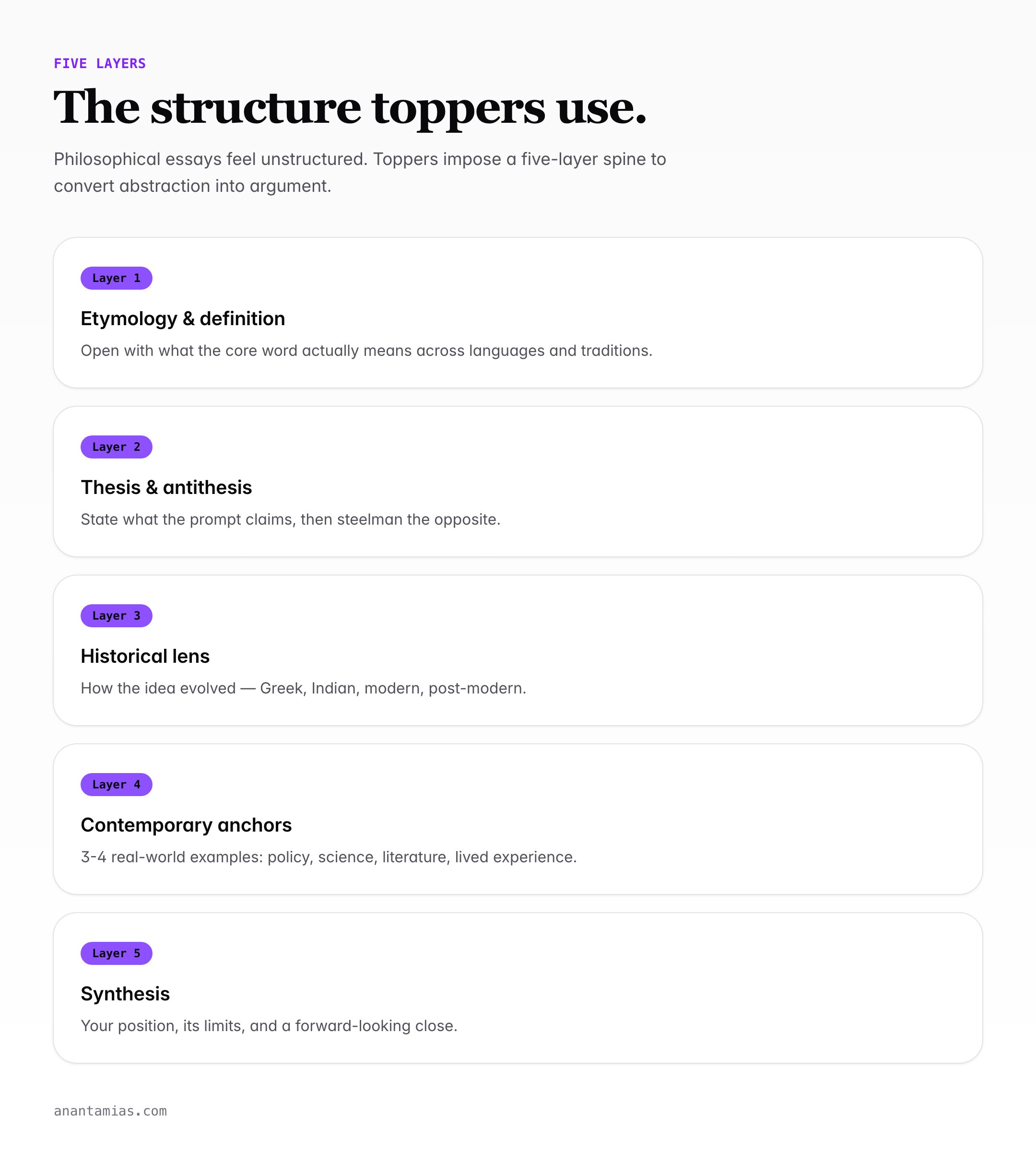
- Narrative hook: a short story or scene
- Define the abstraction in your own words
- Dialectic: the common view vs the deeper view
- Multi-domain illustration: history, literature, science, governance, personal
- Contemporary application: what does this mean for India in 2026?
4. Examples Bank
| Theme | Thinker | Application |
|---|---|---|
| Silence | Gandhi’s Mondays of silence | Discipline as activism |
| Courage | Malala, Socrates, Bhagat Singh | Moral vs physical courage |
| Patience | Nelson Mandela’s 27 years | Political long games |
| Wisdom | Buddha, Marcus Aurelius | Reflection over reaction |
| Freedom | Viktor Frankl | Inner freedom in constraint |
| Memory | Milan Kundera, Partition literature | Nations as mnemonic communities |
5. Quotes That Fit Almost Any Philosophical Topic
The unexamined life is not worth living.
— Socrates
You must be the change you wish to see in the world.
— Mahatma Gandhi
The mind is everything. What you think you become.
— Buddha
Freedom is not worth having if it does not include the freedom to make mistakes.
— Mahatma Gandhi
6. Common Mistakes
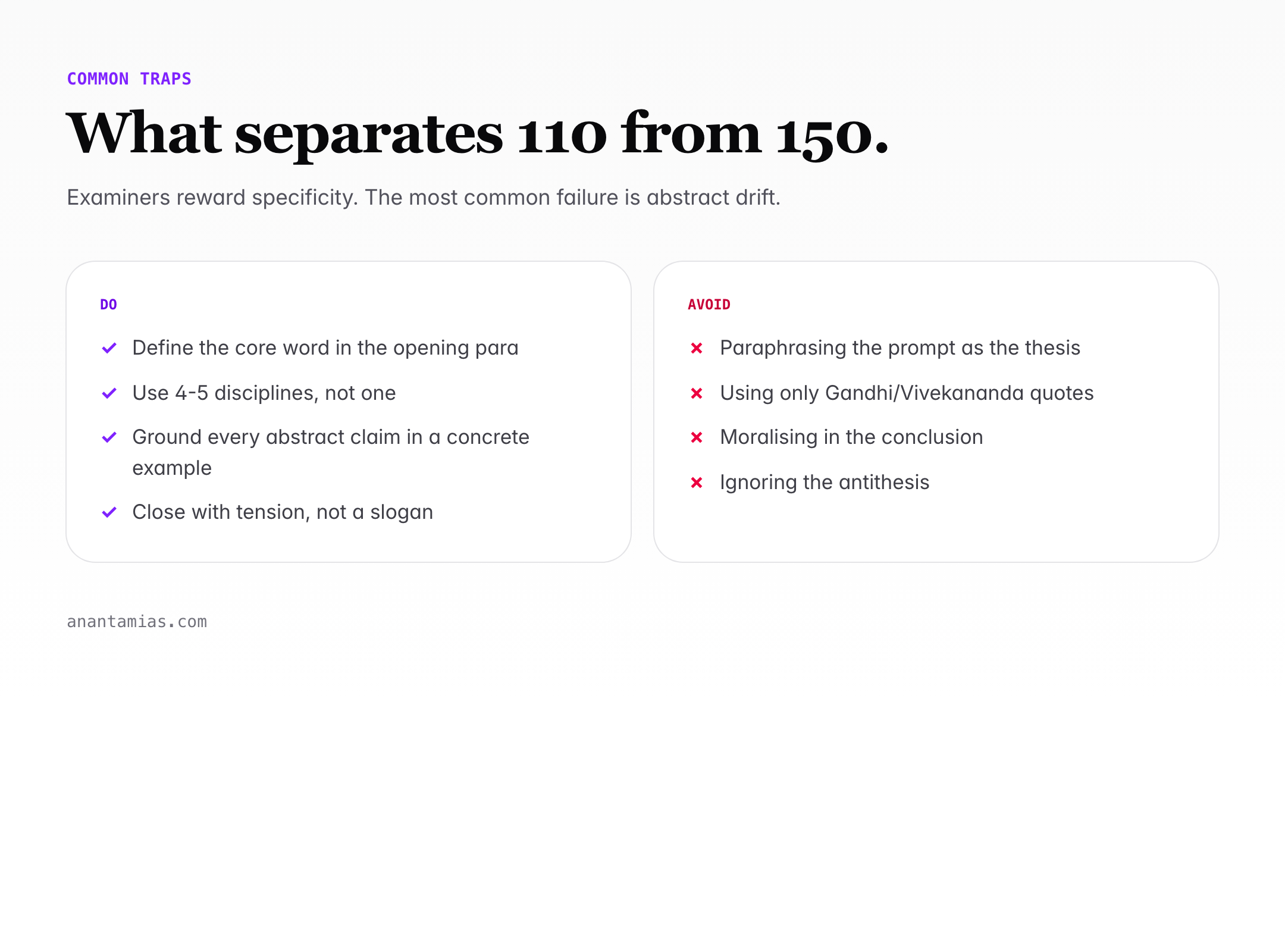
- Starting with a dictionary definition — a visible crutch
- Stacking quotes without analysis — garland writing
- Confining examples to Indian politics — globalise
- Avoiding personal voice — philosophy without a narrator reads flat
- Concluding with ‘Thus we see…’ — lazy
7. Sample Mini-Essay Arc on ‘Silence is the mother of truth’
- Hook: Wittgenstein’s ‘Whereof one cannot speak, thereof one must be silent’
- Body 1: Silence in spiritual traditions — Buddha, Upanishads, Sufi sama
- Body 2: Silence in science — Darwin’s 20-year silence before Origin
- Body 3: Silence in politics — Ambedkar’s Mahad march; Martin Luther King’s pauses
- Body 4: Silence in the digital age — the lost art in a notification economy
- Conclusion: Silence is not absence; it is the gestation of judgement
8. Books That Expand Your Philosophical Vocabulary
- Meditations — Marcus Aurelius
- Man’s Search for Meaning — Viktor Frankl
- Tao Te Ching — Lao Tzu
- The Discovery of India — Jawaharlal Nehru
- An Autobiography — M.K. Gandhi
- Annihilation of Caste — B.R. Ambedkar
9. Practice Discipline
Write one philosophical essay per fortnight. Get it reviewed by a humanities graduate, not a UPSC coach — the feedback is different and better.
10. Final Word
Philosophy is not a trick; it is a temperament. Read slowly, write slowly, and the examiner will recognise a mind at work.
Frequently Asked Questions
Are philosophical essays riskier?
Only if you are unprepared. With reading, they offer higher upside because the competition is weaker.
How many examples do I need?
At least six across diverse domains — history, science, literature, politics, personal.
Can I use personal anecdotes?
Yes, sparingly. One short personal illustration humanises the essay.
Which philosopher’s quotes are safest?
Gandhi, Tagore, Vivekananda, Socrates, Aurelius, Frankl — widely recognised and theme-flexible.