Social Issues Essay Topics for UPSC with Outlines
10 social essay topics — caste, gender, ageing, loneliness, disability, mental health — with outlines, data, quotes, and a template arc that elevates social analysis.
Social essays are the heart of the UPSC paper. They test whether the candidate can see society, not just study it. From caste to gender, from loneliness to disability, this guide outlines 10 essay topics with outlines, data, and examples drawn from Indian lived experience.
1. What Makes a Great Social Essay
Three qualities: empathy, evidence, and elevation. Empathy — the voice of those affected. Evidence — NFHS, NSO, ASER, Oxfam. Elevation — a philosophical frame at the start and end.
2. Ten Social Topics with Outlines
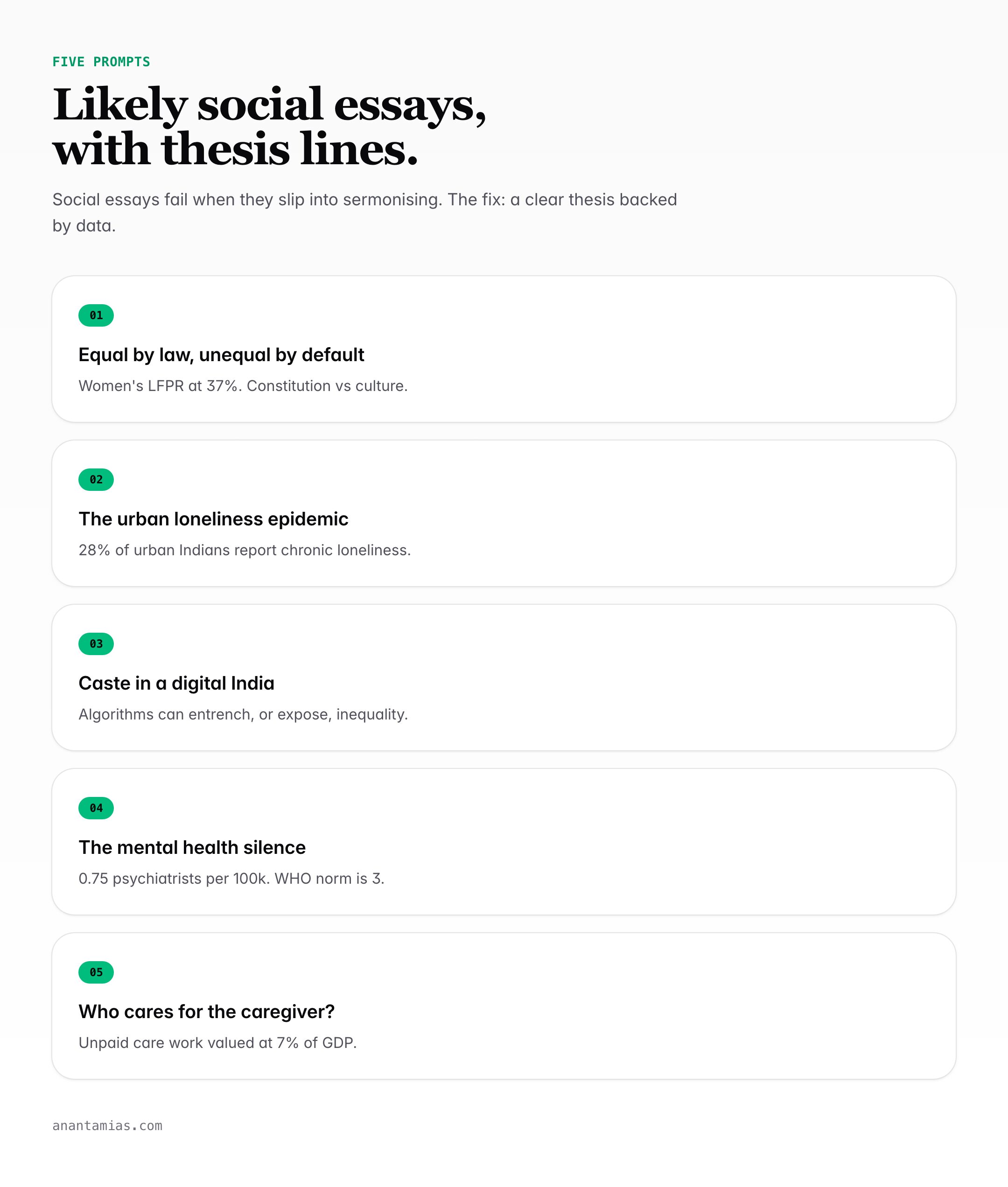
1. Caste persists because economics has not replaced it
- Ambedkar’s ‘Annihilation of Caste’
- Inter-caste marriage data (NFHS-5: ~11%)
- SC/ST Act enforcement
- Caste and metropolitan housing
2. The girl child
- Sex ratio at birth (NFHS-5: 929)
- Beti Bachao Beti Padhao 10 years
- Missing women — Amartya Sen
- Education access and secondary dropout
3. Ageing India
- LASI data
- Nuclear family collapse
- Pension coverage gap
- Dementia and caregiver economy
4. Urban loneliness
- Migration and kinship rupture
- Mental health survey — NIMHANS
- Gated communities as social walls
- Third places (Oldenburg)
5. Marriage as institution
- Same-sex marriage verdict 2023
- Live-in relationships and Supreme Court
- Divorce data trend
- Arranged marriage digital shift
6. Disability
- RPWD Act 2016 review
- Accessibility audit gap
- Inclusive education — Sarva Shiksha
- Paralympic mainstreaming
7. Mental health
- Mental Healthcare Act 2017
- Tele-MANAS coverage
- Suicide rate — NCRB
- Stigma and community response
8. Village-city dichotomy
- Rurban Mission
- Reverse migration post-COVID
- Agrarian distress — Nagaraj report
- Smart city vs aspirational district
9. Youth and aspiration
- Craig Jeffrey’s ‘Timepass’
- Coaching centre suicides (Kota)
- Employment gap in aspirational India
- Social media self-worth
10. Religion and secularism
- Constituent Assembly debates
- Sabarimala, Shah Bano arcs
- Communal harmony in lived India
- Nehru–Gandhi–Ambedkar lineage
3. Data Anchors
| Indicator | Value | Source |
|---|---|---|
| Maternal Mortality | 97 per 100k | SRS 2018–20 |
| Total Fertility Rate | 2.0 | NFHS-5 |
| Open defecation | 19% | NFHS-5 |
| Female literacy | 70.3% | NFHS-5 |
| Crimes against women | 4.45 lakh | NCRB 2022 |
| Child labour | 10.1 mn | Census 2011 |
4. Quotes to Anchor
I measure the progress of a community by the degree of progress which women have achieved.
— B.R. Ambedkar
You may call me anything, I shall not mind. But I am a woman first.
— Mahadevi Varma
The mark of a civilised society is how it treats its weakest.
— Mahatma Gandhi
5. Essay Arc Template
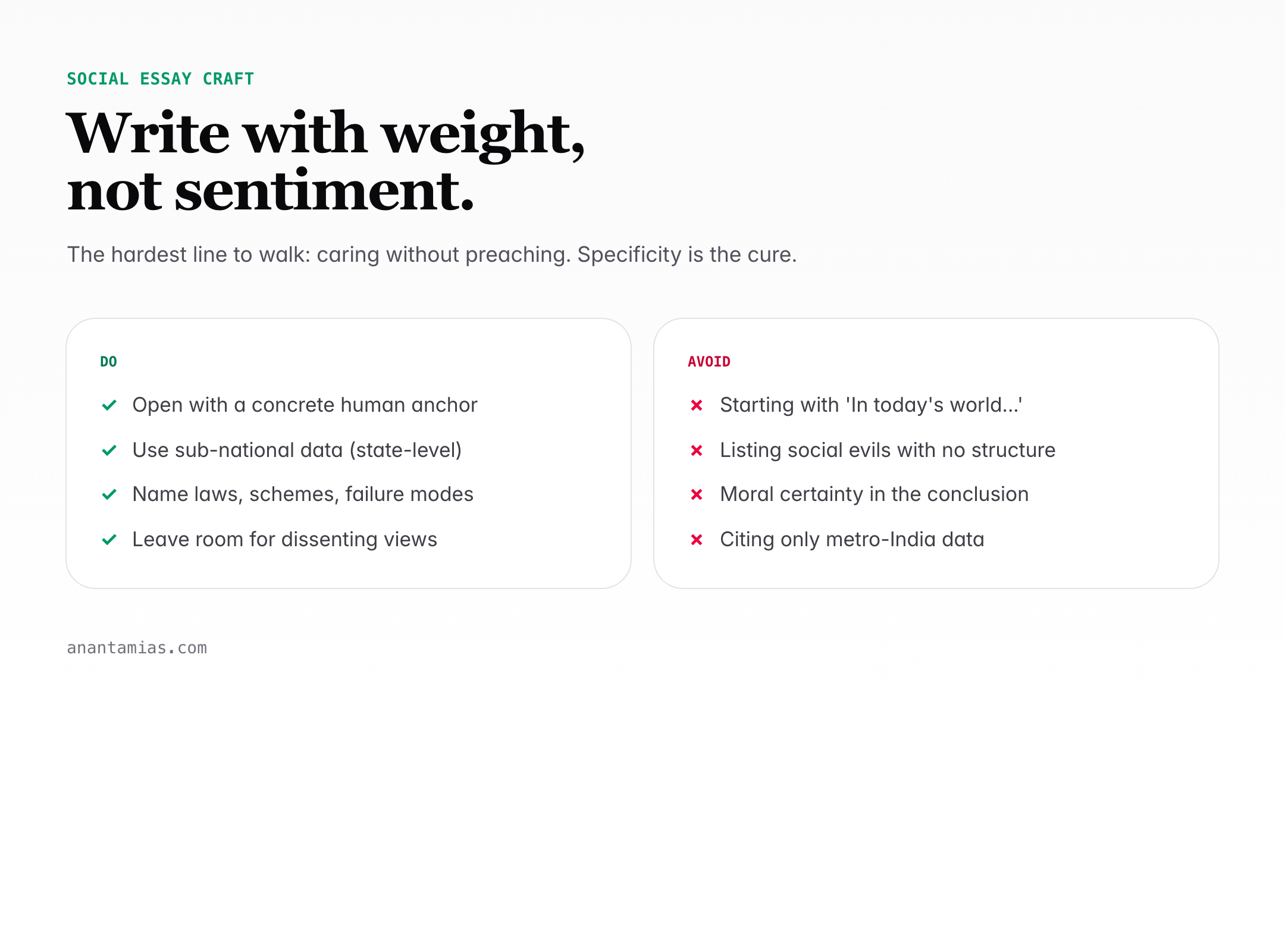
- Hook: a story — a Dalit scholar, a widow in Varanasi, a nurse in Nagaland
- Frame: the social question in philosophical terms
- Data spine: three hard numbers
- Policy audit: what exists, what fails
- Counter-voices: perspectives from affected communities
- Way forward: institutional + cultural + individual
- Conclusion: return to the opening story, resolved
6. What to Avoid
- Victim narratives without agency
- Savarna or urban gaze without acknowledgement
- Generic ‘awareness’ as a solution
- Moral lecturing
7. Reading List
- Everybody Loves a Good Drought — P. Sainath
- Ants among Elephants — Sujatha Gidla
- The Argumentative Indian — Amartya Sen
- Why I am a Hindu — Shashi Tharoor
- Seeing Like a Feminist — Nivedita Menon
Frequently Asked Questions
How do I avoid sounding preachy?
Start with a story, end with a story. Keep policy in the middle. Let the reader feel, not be lectured.
Can I criticise government schemes?
Yes, with evidence. Criticism without data is polemic.
Which writers should I read for social texture?
Sainath, Gidla, Arundhati Roy (non-fiction), Nivedita Menon, Ashis Nandy.
How personal should a social essay get?
One anecdote is enough. The essay is about society seen, not self displayed.