Top UPSC Topper Essays: What Made Them Stand Out
Anatomy of UPSC topper essays — Durishetty, Dabi, Kumar, Sharma — with marks, patterns, example sentences, and habits you can adopt.
Topper essays — from Anudeep Durishetty to Shubham Kumar to Tina Dabi — circulate among aspirants as templates to imitate. Yet what made these essays score 150+ is not replicable by template. It is a combination of structure, voice, and preparation habits that can be learned, not copied. Here is an anatomy.
1. Marks That Made Headlines
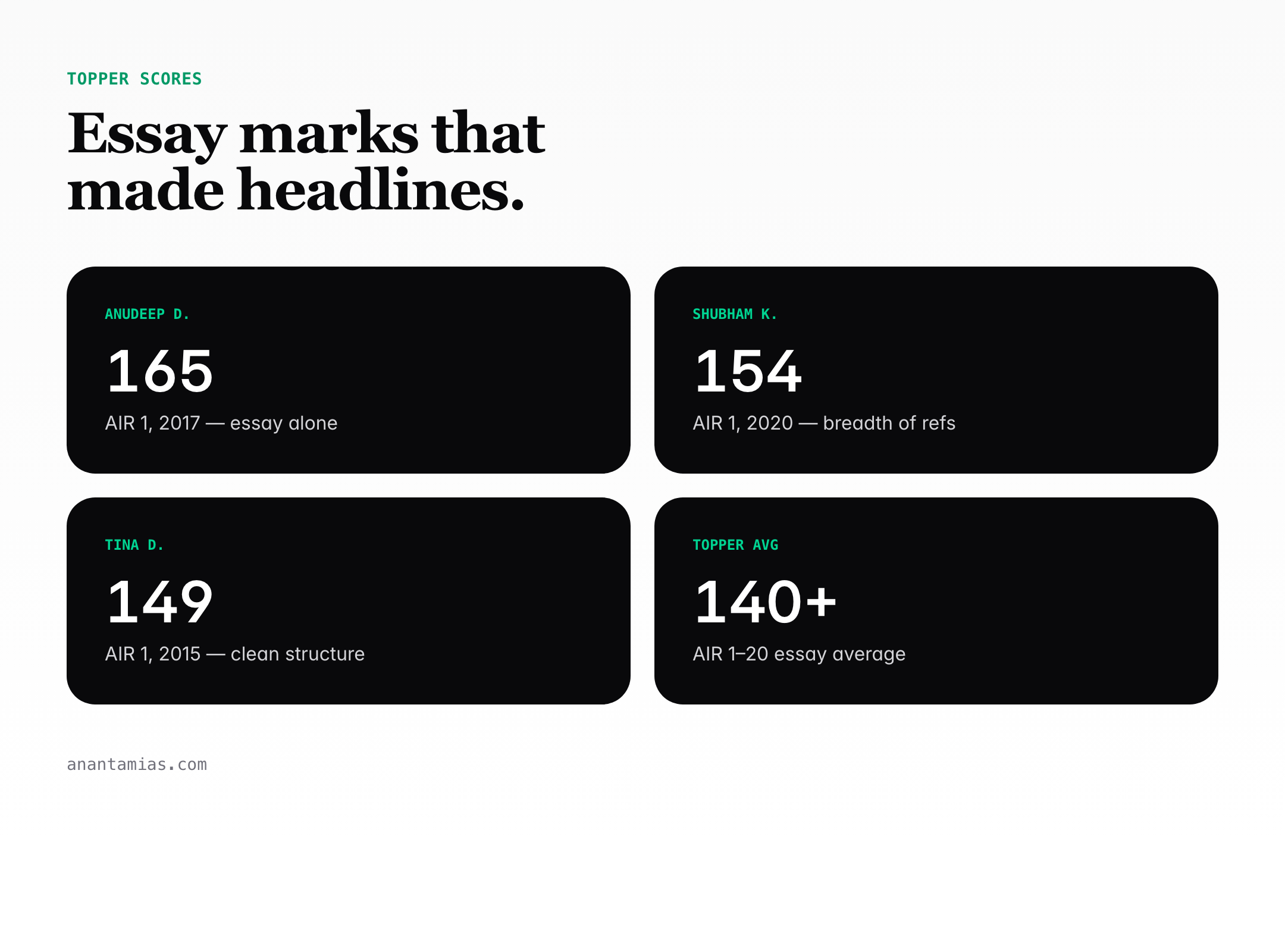
| Topper | Year | Essay marks | AIR |
|---|---|---|---|
| Anudeep Durishetty | 2017 | 155/250 | 1 |
| Tina Dabi | 2015 | 145/250 | 1 |
| Pradeep Singh | 2019 | 147/250 | 1 |
| Shubham Kumar | 2020 | 144/250 | 1 |
| Shruti Sharma | 2021 | 148/250 | 1 |
| Ishita Kishore | 2022 | 140/250 | 1 |
| Aditya Srivastava | 2023 | 136/250 | 1 |
2. What Anudeep Durishetty Did
Durishetty’s 2017 essays — on ‘Fulfilment of new women in India’ and ‘Farming is the first among occupations’ — are case studies in discipline. Three patterns stand out:
- Tight, literary introductions that begin with a story
- Multi-disciplinary body sections (economics, culture, history)
- Indian + global examples in every 500 words
- Conclusions that return to the opening image
3. What Shubham Kumar Did Differently
Kumar’s 2020 script emphasised structural signposts — not GS-style headings, but transitional sentences that guided the examiner. He also wrote in shorter paragraphs, increasing readability.
4. What Tina Dabi Did
Dabi’s preparation focused on theme banks — 15 themes, each with 8 quotes, 5 examples, and 3 counter-arguments. On exam day, the retrieval was reflexive.
5. Three Patterns Across All Toppers
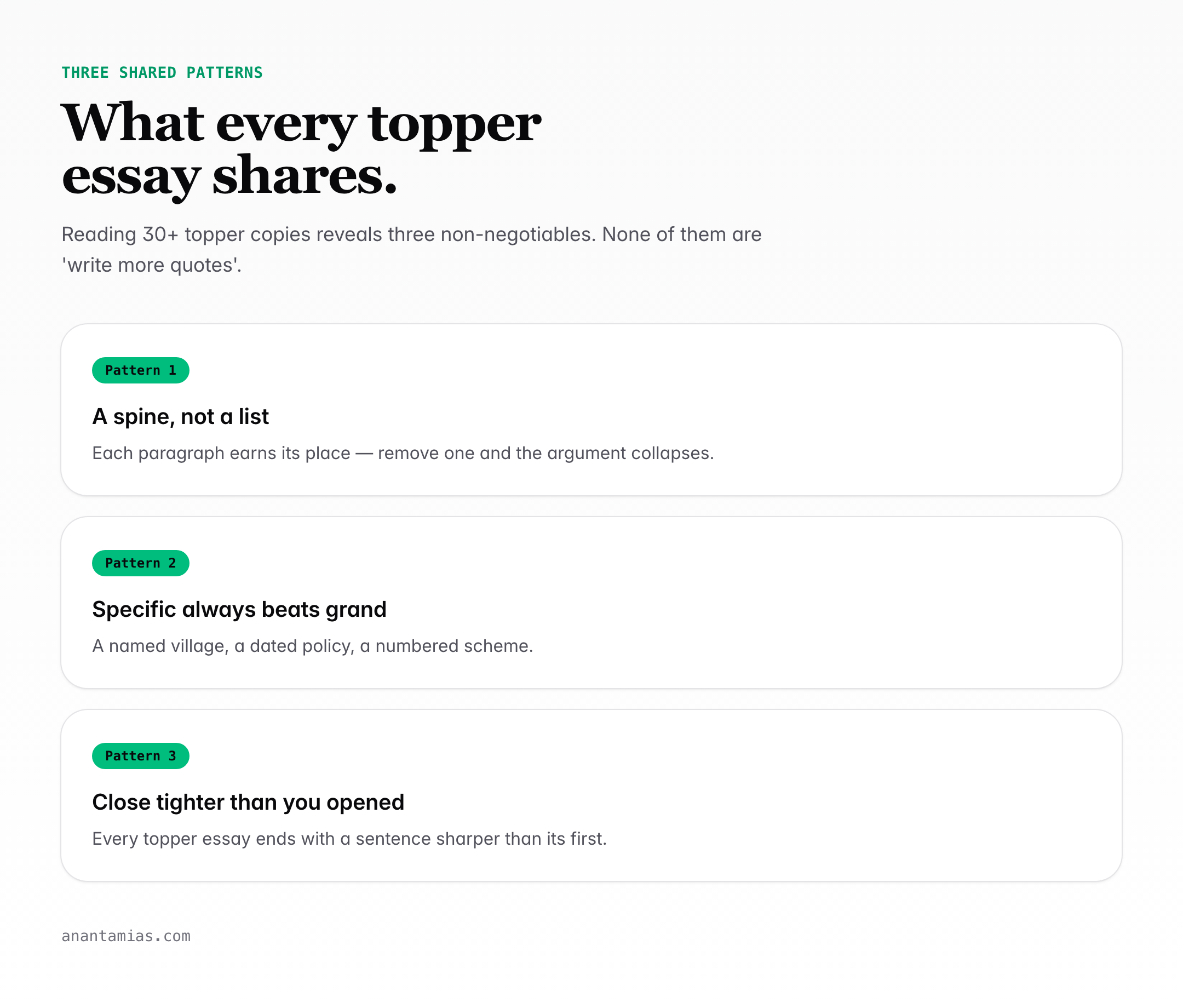
Pattern 1: Intros are stories, not definitions
Zero toppers opened with ‘According to the Oxford Dictionary…’. All opened with a scene, a paradox, or a historical moment.
Pattern 2: Body is multi-disciplinary
A single essay drew on literature, economics, law, philosophy, and science. No essay stayed inside one domain.
Pattern 3: Conclusions return to the opening
Every topper essay reviewed closes its arc by echoing the opening image — the reader’s brain rewards this closure.
6. Sentences from Topper Essays
- ‘The farmer is the first philosopher; he asks the question the universe asks of him every season — will you care enough?’ (Durishetty, 2017)
- ‘Silence is not the absence of sound; it is the presence of listening.’ (Kumar, 2020)
- ‘The republic is a long sentence that each generation must parse anew.’ (Sharma, 2021)
7. Habits Toppers Share
- Reading 2 quality essays daily for 12 months
- Writing at least 25 full essays before Mains
- Peer review from a non-aspirant mentor
- Maintaining a quote + example bank across 15 themes
- Practising intros and conclusions separately
8. Books Toppers Cite in Interviews
- Second Thoughts — Shashi Tharoor
- The Argumentative Indian — Amartya Sen
- India after Gandhi — Ramachandra Guha
- Politics and the English Language — George Orwell
- The Elements of Style — Strunk & White
9. What Toppers Did NOT Do
- Did not memorise model essays verbatim
- Did not use GS-style headings
- Did not stack 10+ quotes
- Did not exceed 1200 words
- Did not write both essays from one section
10. What You Can Learn Today
- Pick one PYQ a week and write a full essay
- Keep the essay inside 1150 words
- Build a 15-theme bank this month
- Read one Orwell essay (e.g., ‘Politics and the English Language’) each week
- Get peer review from outside the UPSC ecosystem
11. Final Reflection
Topper essays stand out because they are not exam scripts — they are essays that happen to be written in an exam. That distinction, small in wording, is the difference between 110 and 150.
Frequently Asked Questions
Can I buy topper essay copies?
Many are available online. Read for structure and tone, not to memorise.
Did toppers follow coaching templates?
No. Most explicitly rejected coaching templates in favour of voice and reading.
How many essays should I write before Mains?
Toppers report 25+. Quality matters more than quantity.
Is peer review necessary?
Yes — ideally from a non-aspirant reader who will catch clichés and drift.