Urbanisation in India: Trends, Drivers and Challenges (UPSC Geography)
India crossed 31% urban in 2011 and is heading toward 40% by 2030, with the number of census towns nearly tripling in a single decade. Here is the full picture — how the census defines an urban place, why growth is top-heavy in big cities, what pushes and pulls people in, and why governance is the real challenge — explained for UPSC GS1.
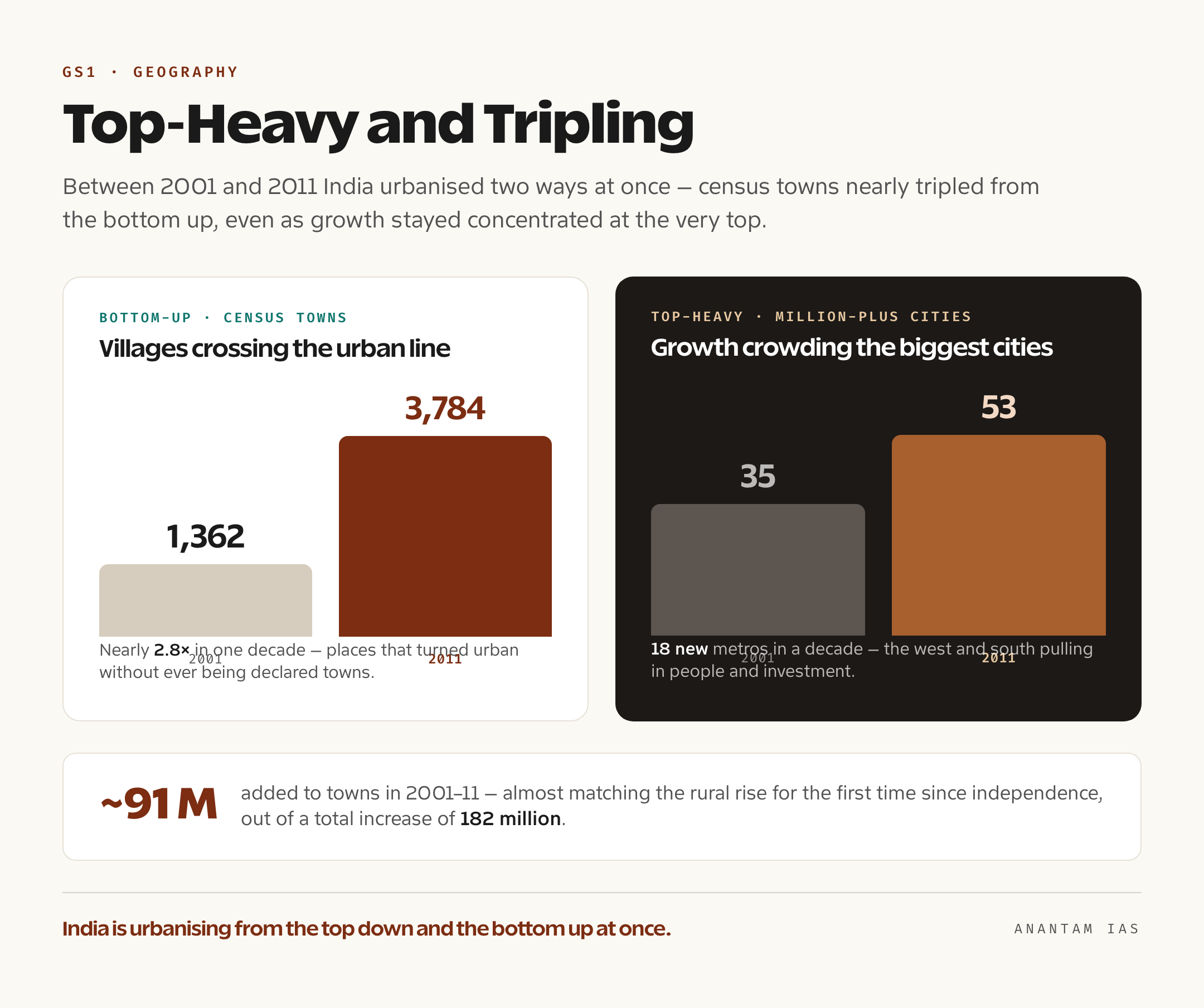
For the first time since independence, the 2011 Census recorded something quietly historic: across the previous decade, the number of people India added to its towns and cities almost matched the number it added to its villages — roughly 91 million each, out of a total rise of 182 million. A country that had always grown chiefly in the countryside had reached a tipping point. The urban share of the population crossed 31 per cent, and the number of places the census counts as towns jumped by more than 2,700 in ten years. India was still a rural nation by headcount, but the centre of gravity had started to move.
And that shift is the whole subject of urbanisation — the process by which a rising proportion of a population comes to live in towns and cities, and the way those settlements grow, spread and change. For an aspirant, this is one of the densest crossover topics in the syllabus: it sits in human geography, in the sociology of Indian society, in the economics of structural change, and in the governance debate over who actually runs a city. It rewards a candidate who can get the definitions exactly right, fix a few sharp numbers in memory, and explain why India’s urban growth has taken the peculiar, top-heavy shape it has.
How India Defines and Counts an Urban Place
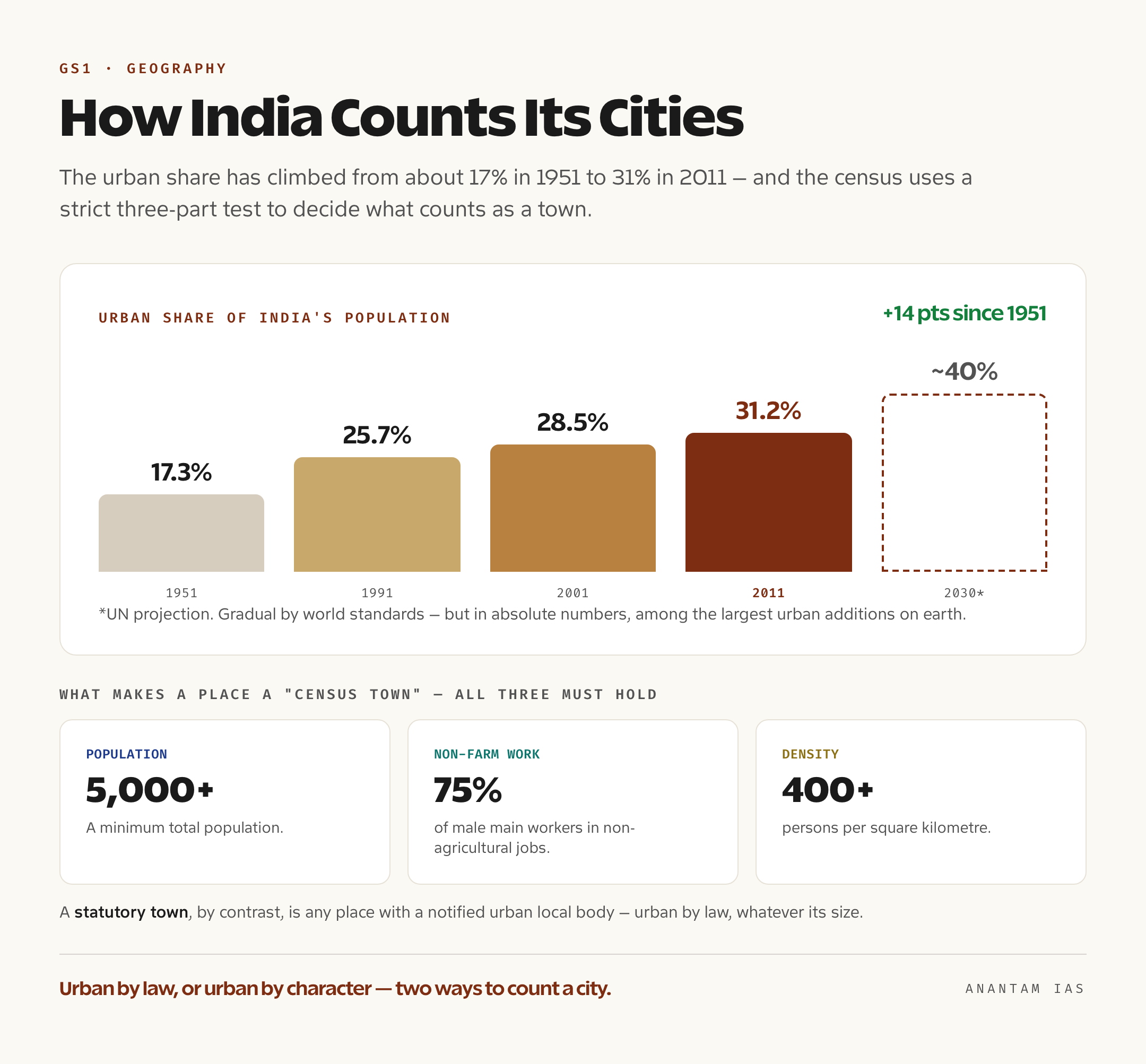
Start with the deceptively hard question: what is a town? In India the answer is set by the census, and it draws the urban line in two different ways. The first kind of urban settlement is the statutory town — any place that has a notified urban local body, such as a municipal corporation, a municipality, a cantonment board or a notified town area committee, regardless of how big or small it is. If the state government has declared it a municipal area, it is urban by law. As the 2011 Census recorded, there were 4,041 such statutory towns.
The second kind is the more interesting one. A census town is a place that has not been given an urban local body but has nevertheless taken on urban characteristics, and the census uses a three-part test to identify it: a minimum population of 5,000; at least 75 per cent of the male main working population engaged in non-agricultural work; and a population density of at least 400 persons per square kilometre. A settlement that meets all three is counted as urban even though, on paper, it is still governed as a village panchayat. This matters enormously, because it means a large slice of urban India is administratively rural — running on village institutions while living an urban life.
Above the level of the single town sit two larger units worth knowing. An urban agglomeration, or UA, is a continuous urban spread made up of a core town together with its physically contiguous outgrowths — railway colonies, university campuses, port areas — or two or more towns that have grown into one another; the 2011 Census identified 475 such agglomerations. And a metropolitan city, or million-plus city, is any urban agglomeration or town with a population above one million. These categories are the vocabulary of the whole topic. Get them precise, and the rest of the analysis has something solid to stand on.
The Level and Trend: Rising, But Top-Heavy
Now the numbers that show where India sits and where it is heading. The level of urbanisation has climbed steadily but slowly — from about 17.3 per cent of the population in 1951, to 25.7 per cent in 1991, to 28.5 per cent in 2001, and to 31.16 per cent in 2011. The United Nations projects that India will be around 40 per cent urban by 2030 and will cross the halfway mark only sometime after the middle of the century. By global standards this is gradual: India is urbanising later and more slowly than China did, even though, in absolute numbers, it is adding more city-dwellers than almost any country on earth.
But the headline percentage hides the more revealing pattern, and this is the heart of the topic. Indian urbanisation is top-heavy — it has concentrated, over time, in the largest cities and the most developed regions. The number of million-plus cities rose from 35 in 2001 to 53 in 2011, and these big agglomerations have absorbed a disproportionate share of urban growth. A handful of mega-cities — Delhi, Mumbai, Kolkata, Bengaluru, Chennai, Hyderabad — and the more industrialised states of the west and south have pulled in people and investment, while large parts of the populous Hindi-belt states stay stubbornly rural. So India’s urbanisation is lopsided across both the size hierarchy of cities and the map.
There is a second, quieter trend running underneath the metropolitan story, and it surprised many demographers. Between 2001 and 2011 the number of census towns exploded — from 1,362 to 3,784, nearly tripling in a single decade. These are villages that crossed the urban threshold without anyone formally declaring them towns: places where farming gave way to small manufacturing, trade and services as the dominant work. This “in-situ” or bottom-up urbanisation — the countryside turning urban where it stands, rather than people migrating to existing cities — accounted for a remarkable share of the decade’s urban growth. It tells you that India is urbanising not only by people moving up the city hierarchy but also by the rural base itself slowly transforming. Researchers at the Observer Research Foundation and others have argued that even this understates the truth, because India’s restrictive census definition leaves many genuinely urban places counted as villages.
What Drives Urbanisation in India
So why are people and places turning urban at all? The classic framework is the push-pull model of migration, and it works well for India. The “push” factors drive people out of the countryside: shrinking and fragmented landholdings, low and uncertain farm incomes, rural underemployment, indebtedness, and the periodic shocks of drought and crop failure. When agriculture cannot absorb a growing workforce, the village stops being able to hold its young. The “pull” factors draw them toward the city: the prospect of regular wages, jobs in construction, manufacturing and services, better schools and hospitals, and the simple density of opportunity that a city offers. Most of India’s rural-to-urban migration is, at bottom, a search for work.
Behind the individual decision sits a deeper economic engine — the structural transformation of the economy. As a country develops, the share of output and employment shifts from agriculture toward industry and, increasingly in India’s case, toward services. Cities are where that non-farm economy concentrates, because firms and workers gain from being close to one another — what economists call agglomeration economies. India’s services-led growth has made this especially visible: the IT and back-office boom built Bengaluru, Hyderabad and Gurugram into urban magnets in a generation. So urbanisation is not a side-effect of growth; it is one of its main forms. A diversifying economy and a growing urban population are two faces of the same process.
Three other drivers round out the picture. Natural increase within cities — more births than deaths among people already urban — still contributes a large part of urban growth, often more than migration in any given decade. The reclassification of villages into census towns, as we saw, adds settlements without anyone moving at all. And the physical expansion of city boundaries, which sweeps surrounding villages into a municipal area, converts rural people into urban ones with the stroke of an administrative pen. Real urbanisation in India is a blend of all four — migration, natural increase, reclassification and boundary expansion — and a strong answer names them rather than treating migration as the only cause.
The Challenges: When Cities Grow Faster Than They Are Governed
Here is the uncomfortable truth about Indian urbanisation: the country is urbanising faster than it is building the capacity to manage it. The most visible symptom is the slum — the informal, often unauthorised settlements where a large share of urban Indians live without secure tenure, piped water or proper sanitation. In cities like Mumbai, a substantial part of the population lives in slums on a tiny fraction of the land. The shortfall in affordable housing runs into many millions of units, and the gap is filled not by planning but by informality, with the urban poor squeezed into whatever space the market and the state leave unclaimed.
Infrastructure strains in every direction. Water supply is intermittent in most Indian cities, sanitation and sewage treatment lag far behind population growth, and solid-waste management is a chronic failure. Traffic congestion and air pollution have made several Indian cities among the most polluted in the world. And the same paved-over, drainage-starved growth that produces those problems also produces urban flooding — the now-routine paralysis of cities like Mumbai, Chennai and Bengaluru when heavy rain meets concretised floodplains, encroached lakes and choked storm drains. These are not separate crises; they are the symptoms of growth that has outpaced the systems meant to absorb it.
But the deepest problem is governance, and this is where examiners look for analysis rather than a list of woes. The 74th Constitutional Amendment of 1992 was meant to fix it by giving cities elected, empowered urban local bodies — municipal corporations and municipalities — and by setting up Ward Committees, State Finance Commissions and Metropolitan Planning Committees. Three decades on, the promise is only half-kept. Most urban local bodies remain starved of funds, of functions and of functionaries — the “three Fs” that should have been devolved to them. Real power over land, water, policing and planning often sits with state-level parastatal agencies rather than the elected mayor, and the largest cities are governed by a confusing tangle of overlapping bodies with no single accountable authority. A city that no one is fully in charge of is a city that cannot plan, and that is the structural reason behind so much of India’s visible urban distress.
The Policy Response: Schemes and the Way Forward
The government’s answer has been a string of urban missions, and an aspirant should know the main ones. The Smart Cities Mission, launched in 2015, set out to develop 100 selected cities with technology-led, area-based redevelopment and city-wide solutions — integrated command-and-control centres, smarter utilities, public spaces. Running alongside it, the Atal Mission for Rejuvenation and Urban Transformation, or AMRUT, focused on the basics that smart-city glamour can skip: water supply, sewerage, drainage and green spaces. AMRUT 2.0, launched on 1 October 2021 with an outlay of nearly ₹3 lakh crore and running through 2025-26, widened the ambition to universal water-tap and sewerage coverage across thousands of towns. The Pradhan Mantri Awas Yojana (Urban) has driven affordable-housing construction, and the Swachh Bharat Mission (Urban) tackled sanitation and waste.
These missions have built real assets, but they share a common weakness, and naming it is the mark of a balanced answer. They are largely project-driven and centrally sponsored — they pour money into infrastructure without fixing the underlying problem of weak, under-empowered urban local bodies. A new command centre or sewage plant does not, by itself, create a municipality that can run, maintain and pay for it. So the genuine way forward is less about more schemes and more about deeper reform: real fiscal and functional devolution to cities under the spirit of the 74th Amendment, professional municipal cadres, buoyant own-revenue sources like property tax, integrated metropolitan-level planning that matches the scale of real urban regions, and recognition that India’s vast peri-urban fringe and its thousands of small census towns need governance and investment too — not just the marquee metros.
Because the larger point is that urbanisation is not a problem to be resisted; it is the engine of India’s future growth. Cities already generate well over half of national output on a small fraction of the land, and the share is rising. The question is not whether India will urbanise — it will, decisively, over the coming decades — but whether it will do so in planned, liveable, productive cities or in sprawling, under-served ones. Getting that right is among the most consequential development challenges the country faces.
For Your Mains Answer
This is a high-value topic for GS Paper 1, which covers the salient features of the world’s physical geography, the distribution of resources, and — directly here — urbanisation, its problems and remedies, as well as the related social-geography themes of population and settlement. It also feeds GS Paper 2 on devolution and local government (the 74th Amendment) and GS Paper 3 on infrastructure, planned urban development and the economy. The skill examiners reward is exactly the one this article uses: nail the definitions, anchor the trend in a few precise figures, and then pivot quickly from describing problems to analysing the governance failure beneath them.
How to Build the Answer
Move in a clean chain: define urbanisation and how India counts a town (statutory versus census town, with the three-part test) → state the level and the trend, stressing that it is top-heavy and that census towns nearly tripled → explain the drivers using the push-pull model plus the three other sources of urban growth → set out the challenges, leading with slums and infrastructure but landing on governance → finish with the schemes and an honest verdict on why they fall short. That arc — define, measure, explain, diagnose, prescribe — fits almost any urbanisation question.
Common Mistakes to Avoid
Don’t treat urbanisation as just rural-to-urban migration; natural increase, reclassification and boundary expansion all matter, and migration is often not the largest source. Don’t confuse a statutory town with a census town — the difference (legal status versus economic characteristics) is itself examinable. Don’t list urban problems without explaining the governance root cause; the marks are in the 74th-Amendment analysis. And don’t frame urbanisation as purely a burden — it is also the main driver of economic growth, and a balanced answer says so.
A Compact Answer Spine
Urbanisation = rising share living in towns + how settlements grow → census defines urban via statutory towns (4,041) and census towns (5,000 pop, 75% non-farm male workers, 400/sq km; 3,784 in 2011, up from 1,362) → level 31.16% (2011), heading to ~40% by 2030, but top-heavy: 53 million-plus cities, growth concentrated in big cities and developed regions → drivers: push-pull migration + natural increase + reclassification + boundary expansion, all rooted in structural transformation → challenges: slums, housing shortage, water-sanitation-waste, urban flooding, and weak ULBs → 74th Amendment under-implemented (three Fs not devolved) → schemes: Smart Cities, AMRUT 2.0, PMAY-U, SBM-U → verdict: fix governance, not just build projects.
Diagram or Flowchart Idea
Draw a simple two-part visual: a rising line or bar showing the urban share climbing from 17% (1951) to 31% (2011) to ~40% (2030), beside a four-box flow of the drivers — migration, natural increase, reclassification, boundary expansion — all feeding into “urban growth.” A clean sketch like this signals command of both the trend and its causes in a single glance.
A Balanced-Conclusion Line
A line that lands the marks: “India’s challenge is not that it is urbanising, but that its cities are growing faster than they are being governed — and the remedy lies less in new schemes than in finally honouring the 74th Amendment by giving cities the funds, functions and functionaries to plan their own future.”
How to Use Data Without Cramming
You need only four anchors, not a spreadsheet: 31.16 per cent (urban share in 2011), ~40 per cent (projected by 2030), the census-town leap from 1,362 to 3,784, and 53 million-plus cities. Drop those into the right sentences and the answer reads as authoritative. Attribute them plainly — “as the 2011 Census recorded” — rather than scattering numbers without a source.
FAQ
What is the difference between a statutory town and a census town? A statutory town is any place that has a notified urban local body — a municipal corporation, municipality, cantonment board and so on — so it is urban by law regardless of size. A census town has no such urban local body but meets three demographic tests: a population of at least 5,000, at least 75 per cent of male main workers in non-agricultural work, and a density of at least 400 persons per square kilometre. The key distinction is legal status versus economic and demographic character — a census town lives an urban life but is still administered as a village.
What is India’s level of urbanisation, and is it rising fast? As per the 2011 Census, 31.16 per cent of Indians lived in urban areas, up from 28.5 per cent in 2001. The United Nations projects this will reach about 40 per cent by 2030. By international standards the pace is gradual — slower than China’s — but in absolute terms India is adding among the largest numbers of city-dwellers in the world, and the urban share is rising steadily.
Why is Indian urbanisation called “top-heavy”? Because urban growth has concentrated in the largest cities and the most developed regions rather than spreading evenly. The number of million-plus metropolitan cities rose from 35 in 2001 to 53 in 2011, and the big agglomerations of the west and south have absorbed a disproportionate share of population and investment, while much of the rural Hindi belt remains lightly urbanised.
What is the 74th Constitutional Amendment and why does it matter for cities? The 74th Amendment of 1992 gave constitutional status to urban local bodies, mandating elected municipalities, Ward Committees, State Finance Commissions and Metropolitan Planning Committees. It was meant to make cities self-governing. In practice it remains only partly implemented — most municipalities still lack adequate funds, functions and functionaries — which is the structural reason behind much of India’s urban governance crisis.
Practice Questions
Prelims MCQs
- As per the Census of India 2011, which three criteria together define a “census town”?
(a) Population of 5,000, 75 per cent of male main workers in non-agricultural activities, and density of at least 400 persons per sq km
(b) Population of 10,000, a notified municipality, and density of 1,000 persons per sq km
(c) Population of 5,000 and the existence of a municipal corporation
(d) Population of 20,000 and contiguity with another town
Answer: (a) A census town must meet all three demographic tests; if it had a notified urban local body it would instead be a statutory town. - Which of the following is a “statutory town” rather than a census town?
(a) A village that has crossed 5,000 in population with mostly non-farm work
(b) A settlement administered by a municipal corporation or municipality
(c) Any urban agglomeration with over one million people
(d) A railway colony attached to a city
Answer: (b) A statutory town is defined by having a notified urban local body, irrespective of its size or demographic profile. - According to the 2011 Census, what was India’s level of urbanisation?
(a) 25.7 per cent
(b) 28.5 per cent
(c) 31.16 per cent
(d) 40 per cent
Answer: (c) The urban share was 31.16 per cent in 2011, up from 28.5 per cent in 2001; about 40 per cent is the UN’s projection for 2030. - The sharp near-tripling of census towns between 2001 and 2011 (from 1,362 to 3,784) is best explained by which phenomenon?
(a) Large-scale migration to existing metropolitan cities
(b) In-situ urbanisation, where rural settlements take on urban characteristics without being formally declared towns
(c) The merger of states
(d) A change in the definition of a metropolitan city
Answer: (b) Census towns reflect bottom-up, in-situ urbanisation — villages crossing the urban threshold while still governed as panchayats. - With reference to urban growth in India, which of the following is/are sources of an increase in the urban population? 1. Rural-to-urban migration 2. Natural increase within cities 3. Reclassification of villages as census towns 4. Expansion of municipal boundaries. Select the correct answer:
(a) 1 and 2 only
(b) 1, 2 and 3 only
(c) 1, 3 and 4 only
(d) 1, 2, 3 and 4
Answer: (d) All four contribute to urban growth; migration is often not even the largest single source in a given decade.
Mains Practice Questions
- “Indian urbanisation is top-heavy and concentrated in large cities and developed regions.” Examine the trends and pattern of urbanisation in India in the light of this statement. (15 marks, 250 words)
- Distinguish between a statutory town and a census town. How has the rapid growth of census towns reshaped our understanding of urbanisation in India? (10 marks, 150 words)
- Discuss the principal drivers of urbanisation in India. To what extent is rural-to-urban migration responsible for urban growth compared with other factors? (15 marks, 250 words)
- “India’s cities are growing faster than they are being governed.” Critically analyse the challenges of urban India, with special reference to the implementation of the 74th Constitutional Amendment. (15 marks, 250 words)
- Evaluate the major urban missions launched in India, including the Smart Cities Mission and AMRUT. Do they address the structural weaknesses of urban governance, or merely its symptoms? (15 marks, 250 words)