Chief Ministers of Uttar Pradesh: Complete List, Tenure and Party
Every Chief Minister of Uttar Pradesh since the United Provinces was renamed in 1950, with exact term dates, parties, all nine President's Rule spells and the records worth knowing.
Yogi Adityanath is the Chief Minister of Uttar Pradesh. He has held the office since 19 March 2017 and was sworn in for a second consecutive term on 25 March 2022, which makes him the longest-serving Chief Minister in the state’s history and the first to hold the office for two full consecutive terms.
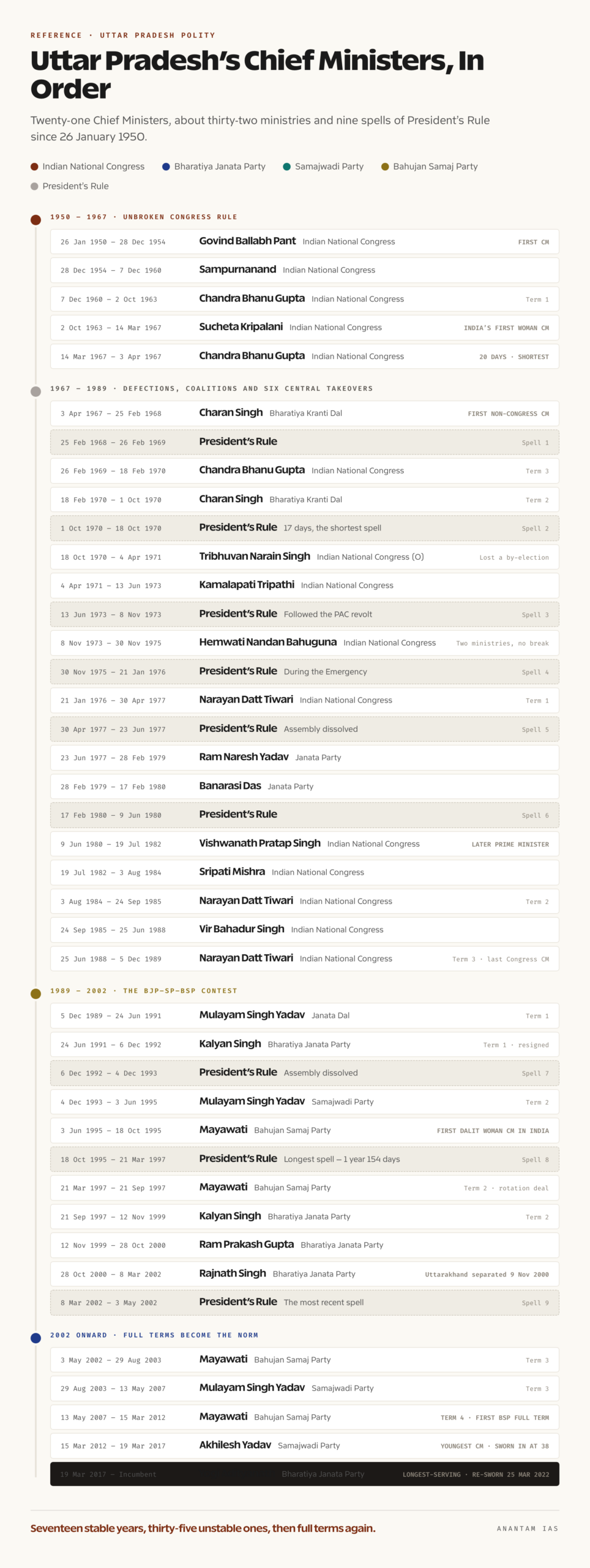
Twenty-one people have been Chief Minister of Uttar Pradesh since 26 January 1950. Because several of them returned to office repeatedly — Mayawati four times, Mulayam Singh Yadav, Chandra Bhanu Gupta and Narayan Datt Tiwari three times each — those twenty-one individuals account for roughly thirty-two separate ministries. The state has also spent nine spells under President’s Rule, more than almost any other, adding up to about four years and eight months of direct central administration.
How the Office Works in Uttar Pradesh
The office rests on Article 164 of the Constitution. The Governor appoints the Chief Minister, appoints the other ministers on the Chief Minister’s advice, and the Council of Ministers answers collectively to the Legislative Assembly.
The Governor picks whoever can demonstrate majority support. After that, the ministry survives on the confidence of the House, and the Chief Minister’s term runs with the life of the Assembly, normally five years. Uttar Pradesh’s record shows how theoretical that five-year figure can be: between 1967 and 2002 only a handful of governments reached the end of a full assembly cycle.
Uttar Pradesh is one of the few states with a bicameral legislature. The Legislative Assembly has 403 elected seats and the Legislative Council has 100. A Chief Minister may sit in either chamber, which matters in practice — Mayawati, Akhilesh Yadav and Yogi Adityanath all entered office through the Council rather than the Assembly, and Yogi Adityanath only became an MLA, from Gorakhpur Urban, in 2022. Anyone appointed while a member of neither House has six months to get elected to one.
The state also holds the record for the sheer scale of what the office manages: an electorate larger than most countries, and 80 Lok Sabha seats, which is why national parties treat control of Lucknow as a strategic asset rather than a state-level prize.
Complete List of Chief Ministers of Uttar Pradesh
This list begins on 26 January 1950, and that starting point needs explaining. Before that date the territory was the United Provinces, a province under the Government of India Act, 1935, headed by a Premier — the Nawab of Chhatari briefly in 1937, then Govind Ballabh Pant from 1937 to 1939 and again from 1946. When the Constitution came into force, the province was renamed Uttar Pradesh and the office of Premier became the office of Chief Minister. Pant carried straight on across that change, which is why he appears as both the last Premier of the United Provinces and the first Chief Minister of Uttar Pradesh. Standard listings number from 1950 because that is when the modern constitutional office begins.
The state’s boundaries changed once during this period: on 9 November 2000, the hill districts were separated to form Uttarakhand, then named Uttaranchal. Rajnath Singh was Chief Minister when that happened, and every entry from that date covers the smaller Uttar Pradesh. Numbers in brackets mark a return by someone already counted.
| # | Name | Term Start | Term End | Party | Notes |
|---|---|---|---|---|---|
| 1 | Govind Ballabh Pant | 26 January 1950 | 28 December 1954 | Indian National Congress | First Chief Minister; had been Premier of the United Provinces; left to become Union Home Minister |
| 2 | Sampurnanand | 28 December 1954 | 7 December 1960 | Indian National Congress | Later Governor of Rajasthan |
| 3 | Chandra Bhanu Gupta | 7 December 1960 | 2 October 1963 | Indian National Congress | First term; stepped down under the Kamaraj Plan |
| 4 | Sucheta Kripalani | 2 October 1963 | 14 March 1967 | Indian National Congress | India’s first woman Chief Minister |
| (3) | Chandra Bhanu Gupta | 14 March 1967 | 3 April 1967 | Indian National Congress | 20 days; shortest tenure in the state’s history |
| 5 | Charan Singh | 3 April 1967 | 25 February 1968 | Bharatiya Kranti Dal | First non-Congress Chief Minister of the state |
| — | President’s Rule | 25 February 1968 | 26 February 1969 | — | First spell |
| (3) | Chandra Bhanu Gupta | 26 February 1969 | 18 February 1970 | Indian National Congress | Third term |
| (5) | Charan Singh | 18 February 1970 | 1 October 1970 | Bharatiya Kranti Dal | Second term |
| — | President’s Rule | 1 October 1970 | 18 October 1970 | — | Second spell; 17 days, the shortest |
| 6 | Tribhuvan Narain Singh | 18 October 1970 | 4 April 1971 | Indian National Congress (O) | Resigned after losing a by-election |
| 7 | Kamalapati Tripathi | 4 April 1971 | 13 June 1973 | Indian National Congress | |
| — | President’s Rule | 13 June 1973 | 8 November 1973 | — | Third spell; followed the PAC revolt |
| 8 | Hemwati Nandan Bahuguna | 8 November 1973 | 30 November 1975 | Indian National Congress | Served across two ministries with no break in office |
| — | President’s Rule | 30 November 1975 | 21 January 1976 | — | Fourth spell; during the Emergency |
| 9 | Narayan Datt Tiwari | 21 January 1976 | 30 April 1977 | Indian National Congress | First term |
| — | President’s Rule | 30 April 1977 | 23 June 1977 | — | Fifth spell; Assembly dissolved |
| 10 | Ram Naresh Yadav | 23 June 1977 | 28 February 1979 | Janata Party | |
| 11 | Banarasi Das | 28 February 1979 | 17 February 1980 | Janata Party | |
| — | President’s Rule | 17 February 1980 | 9 June 1980 | — | Sixth spell |
| 12 | Vishwanath Pratap Singh | 9 June 1980 | 19 July 1982 | Indian National Congress | Later Prime Minister of India |
| 13 | Sripati Mishra | 19 July 1982 | 3 August 1984 | Indian National Congress | |
| (9) | Narayan Datt Tiwari | 3 August 1984 | 24 September 1985 | Indian National Congress | Second term |
| 14 | Vir Bahadur Singh | 24 September 1985 | 25 June 1988 | Indian National Congress | |
| (9) | Narayan Datt Tiwari | 25 June 1988 | 5 December 1989 | Indian National Congress | Third term; later first Chief Minister of Uttarakhand |
| 15 | Mulayam Singh Yadav | 5 December 1989 | 24 June 1991 | Janata Dal | First term |
| 16 | Kalyan Singh | 24 June 1991 | 6 December 1992 | Bharatiya Janata Party | First term; resigned on 6 December 1992 |
| — | President’s Rule | 6 December 1992 | 4 December 1993 | — | Seventh spell; Assembly dissolved |
| (15) | Mulayam Singh Yadav | 4 December 1993 | 3 June 1995 | Samajwadi Party | Second term |
| 17 | Mayawati | 3 June 1995 | 18 October 1995 | Bahujan Samaj Party | First Dalit woman Chief Minister in India |
| — | President’s Rule | 18 October 1995 | 21 March 1997 | — | Eighth spell; the longest, 1 year 154 days |
| (17) | Mayawati | 21 March 1997 | 21 September 1997 | Bahujan Samaj Party | Second term, under a rotation arrangement |
| (16) | Kalyan Singh | 21 September 1997 | 12 November 1999 | Bharatiya Janata Party | Second term |
| 18 | Ram Prakash Gupta | 12 November 1999 | 28 October 2000 | Bharatiya Janata Party | |
| 19 | Rajnath Singh | 28 October 2000 | 8 March 2002 | Bharatiya Janata Party | Uttarakhand separated on 9 November 2000 |
| — | President’s Rule | 8 March 2002 | 3 May 2002 | — | Ninth spell; the most recent |
| (17) | Mayawati | 3 May 2002 | 29 August 2003 | Bahujan Samaj Party | Third term |
| (15) | Mulayam Singh Yadav | 29 August 2003 | 13 May 2007 | Samajwadi Party | Third term |
| (17) | Mayawati | 13 May 2007 | 15 March 2012 | Bahujan Samaj Party | Fourth term; first BSP government to complete five years |
| 20 | Akhilesh Yadav | 15 March 2012 | 19 March 2017 | Samajwadi Party | Youngest Chief Minister of the state |
| 21 | Yogi Adityanath | 19 March 2017 | Incumbent | Bharatiya Janata Party | Re-sworn 25 March 2022; longest-serving in the state’s history |
What the table shows is a state that spent its first seventeen years under uninterrupted Congress rule, then thirty-five years of near-permanent instability, and then a return to stable single-party terms from 2007 onward. Every government since Mayawati’s 2007-12 term has run its full five years, which had happened only twice in the previous four decades.
Note one counting quirk that trips people up. Hemwati Nandan Bahuguna’s tenure is sometimes shown as two entries, because his ministry was reconstituted in March 1974; he was not out of office in between. Similar splits appear for Chief Ministers re-sworn after an election without leaving office. That is why the “total number of terms” for Uttar Pradesh is quoted variously as anything from thirty-two to thirty-five, while the number of individuals — twenty-one — is not in dispute.
Longest-Serving and Most Notable Chief Ministers of Uttar Pradesh
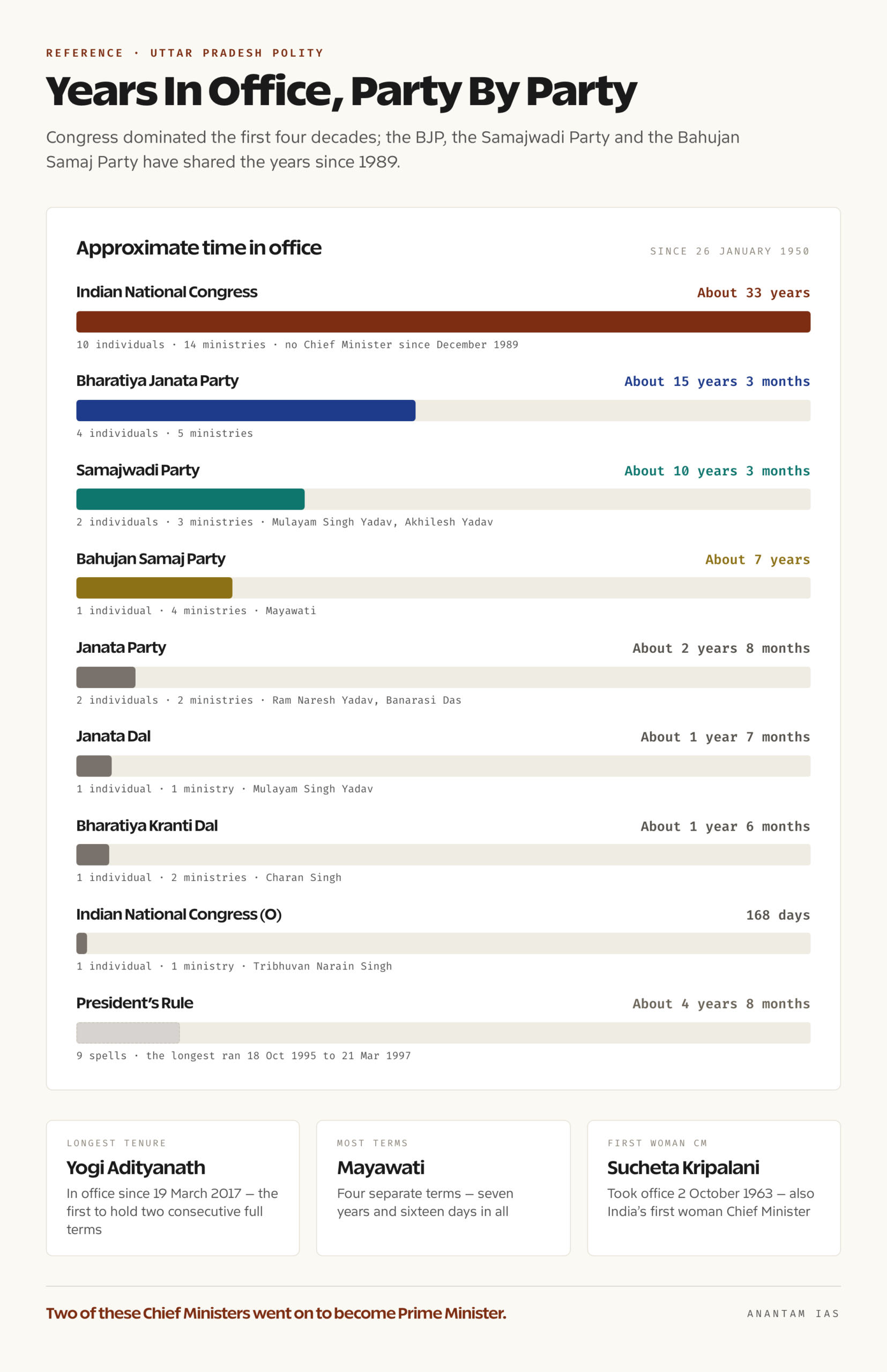
Yogi Adityanath is the longest-serving Chief Minister in the state’s history, past nine years and four months as of July 2026. He is the first person to hold the office through two consecutive full terms, and only the second, after Mayawati in 2007-12, to complete even one.
Mayawati is second by total time in office with seven years and sixteen days, spread across four separate terms — the most times anyone has been sworn in as Chief Minister of Uttar Pradesh. Her first term in 1995 made her the first Dalit woman to lead any Indian state. Three of her four terms were short, coalition-dependent arrangements; the fourth, from 2007 to 2012, was a single-party majority government that ran its full five years.
Mulayam Singh Yadav follows with six years and 274 days across three terms, under two different party labels: Janata Dal in 1989 and the Samajwadi Party, which he founded in 1992, thereafter. He later served as Union Defence Minister.
Govind Ballabh Pant is the founding figure. He led the United Provinces as Premier and then became the first Chief Minister of Uttar Pradesh on 26 January 1950, serving until December 1954, when he moved to Delhi as Union Home Minister. He was awarded the Bharat Ratna in 1957.
Sucheta Kripalani is the single most quoted name on this list. She took office on 2 October 1963 and became India’s first woman Chief Minister, holding the post until March 1967. A Constituent Assembly member and a veteran of the freedom movement, she took charge at a difficult moment — the 1965 conflict and a serious food shortage both fell inside her tenure. You can read more about her life and career in the profile at Sucheta Kripalani.
Charan Singh broke the Congress monopoly in April 1967 as the state’s first non-Congress Chief Minister, after leaving the party to form the Bharatiya Kranti Dal. He went on to become Prime Minister of India in 1979. Vishwanath Pratap Singh, Chief Minister from 1980 to 1982, also became Prime Minister, in 1989 — making Uttar Pradesh the only state to have sent two of its former Chief Ministers to that office.
How Power Has Shifted: Party Trends in Uttar Pradesh
Uttar Pradesh has moved through four distinct political eras: Congress dominance to 1989, a fragmented decade of Janata-family and coalition governments, the three-way BJP-SP-BSP contest of the 1990s and 2000s, and BJP consolidation since 2017.
| Party | Individuals | Ministries | Approximate time in office |
|---|---|---|---|
| Indian National Congress | 10 | 14 | About 33 years |
| Bharatiya Janata Party | 4 | 5 | About 15 years 3 months |
| Samajwadi Party | 2 | 3 | About 10 years 3 months |
| Bahujan Samaj Party | 1 (Mayawati) | 4 | About 7 years |
| Janata Party | 2 | 2 | About 2 years 8 months |
| Bharatiya Kranti Dal | 1 (Charan Singh) | 2 | About 1 year 6 months |
| Janata Dal | 1 (Mulayam Singh Yadav) | 1 | About 1 year 7 months |
| Indian National Congress (O) | 1 (Tribhuvan Narain Singh) | 1 | 168 days |
| President’s Rule | — | 9 spells | About 4 years 8 months |
Congress held the office without a break from 1950 to 1967 and returned repeatedly until 1989 — but it has not supplied a Chief Minister since Narayan Datt Tiwari left office in December 1989, a gap of more than thirty-six years in the country’s largest state. The Mandal and Ayodhya politics of 1989-92 restructured the field around the BJP, the Samajwadi Party and the Bahujan Samaj Party, and Congress never recovered its place in it.
The 1990s were the most unstable stretch: between 1989 and 2002 the state saw ten changes of government and three spells of President’s Rule, including one lasting seventeen months. Stability returned with the 2007 election, and each of the four assemblies since has produced a government that lasted its full term.
Records and Quick Facts About Uttar Pradesh’s Chief Ministers
- Shortest tenure: Chandra Bhanu Gupta’s second term, 14 March to 3 April 1967 — 20 days.
- Longest tenure: Yogi Adityanath, in office since 19 March 2017 and past nine years.
- Most terms: Mayawati, four. Mulayam Singh Yadav, Chandra Bhanu Gupta and Narayan Datt Tiwari each served three.
- First woman Chief Minister: Sucheta Kripalani, 1963 — also the first woman to head any state government in India.
- Youngest Chief Minister: Akhilesh Yadav, sworn in at 38 in March 2012.
- First non-Congress Chief Minister: Charan Singh, April 1967.
- President’s Rule: nine spells, the longest running 18 October 1995 to 21 March 1997 and the shortest just 17 days in October 1970. The most recent ended on 3 May 2002.
- Chief Ministers who became Prime Minister: Charan Singh and Vishwanath Pratap Singh.
- Territorial change: Uttarakhand was separated on 9 November 2000, during Rajnath Singh’s tenure. Narayan Datt Tiwari, a three-time Chief Minister of Uttar Pradesh, later became Chief Minister of Uttarakhand as well.
FAQ
Who is the current Chief Minister of Uttar Pradesh? Yogi Adityanath of the Bharatiya Janata Party. He took office on 19 March 2017 and was sworn in for a second consecutive term on 25 March 2022 after the BJP won the 2022 assembly election.
Who was the first Chief Minister of Uttar Pradesh? Govind Ballabh Pant of the Indian National Congress. He was Premier of the United Provinces and continued in office as Chief Minister when the province was renamed Uttar Pradesh on 26 January 1950. He served until December 1954.
Who was the first woman Chief Minister of Uttar Pradesh? Sucheta Kripalani, who took office on 2 October 1963 and served until 14 March 1967. She was also India’s first woman Chief Minister of any state.
How many Chief Ministers has Uttar Pradesh had? Twenty-one individuals since 1950. Counting each ministry separately gives about thirty-two, because Mayawati held office four times, and Mulayam Singh Yadav, Chandra Bhanu Gupta and Narayan Datt Tiwari three times each.
How is the Chief Minister of Uttar Pradesh appointed? Under Article 164, the Governor appoints the person who can command a majority in the 403-member Legislative Assembly. The ministry stays in office while it holds the confidence of the House, and a Chief Minister who is not already a member of either the Assembly or the 100-member Legislative Council must be elected to one within six months.
Practice Questions
Practice MCQs
- India’s first woman Chief Minister took office in which state? (a) Tamil Nadu (b) Uttar Pradesh (c) Odisha (d) Punjab — Answer: (b) Sucheta Kripalani became Chief Minister of Uttar Pradesh on 2 October 1963, the first woman to head any state government in India.
- Which of these was the first non-Congress Chief Minister of Uttar Pradesh? (a) Ram Naresh Yadav (b) Tribhuvan Narain Singh (c) Charan Singh (d) Kalyan Singh — Answer: (c) Charan Singh took office on 3 April 1967 leading the Bharatiya Kranti Dal, which he had formed after leaving Congress.
- Uttarakhand was separated from Uttar Pradesh on which date? (a) 1 November 2000 (b) 9 November 2000 (c) 15 November 2000 (d) 26 January 2001 — Answer: (b) The hill districts became the state of Uttaranchal, later renamed Uttarakhand, on 9 November 2000.
- Who has been sworn in as Chief Minister of Uttar Pradesh the most times? (a) Mulayam Singh Yadav (b) Narayan Datt Tiwari (c) Kalyan Singh (d) Mayawati — Answer: (d) Mayawati served four separate terms — 1995, 1997, 2002-03 and 2007-12.
- Which two former Chief Ministers of Uttar Pradesh went on to become Prime Minister of India? (a) Charan Singh and Vishwanath Pratap Singh (b) Govind Ballabh Pant and Charan Singh (c) Vishwanath Pratap Singh and Chandra Shekhar (d) Charan Singh and Kamalapati Tripathi — Answer: (a) Charan Singh became Prime Minister in 1979 and Vishwanath Pratap Singh in 1989.