Whittlesey’s Agricultural Regions: Five Criteria, Thirteen Types
Whittlesey's classification of world agricultural regions: the five criteria he applied, the thirteen types they produce, which of them occur in India, and why the scheme has no box for the modern intensive smallholding.
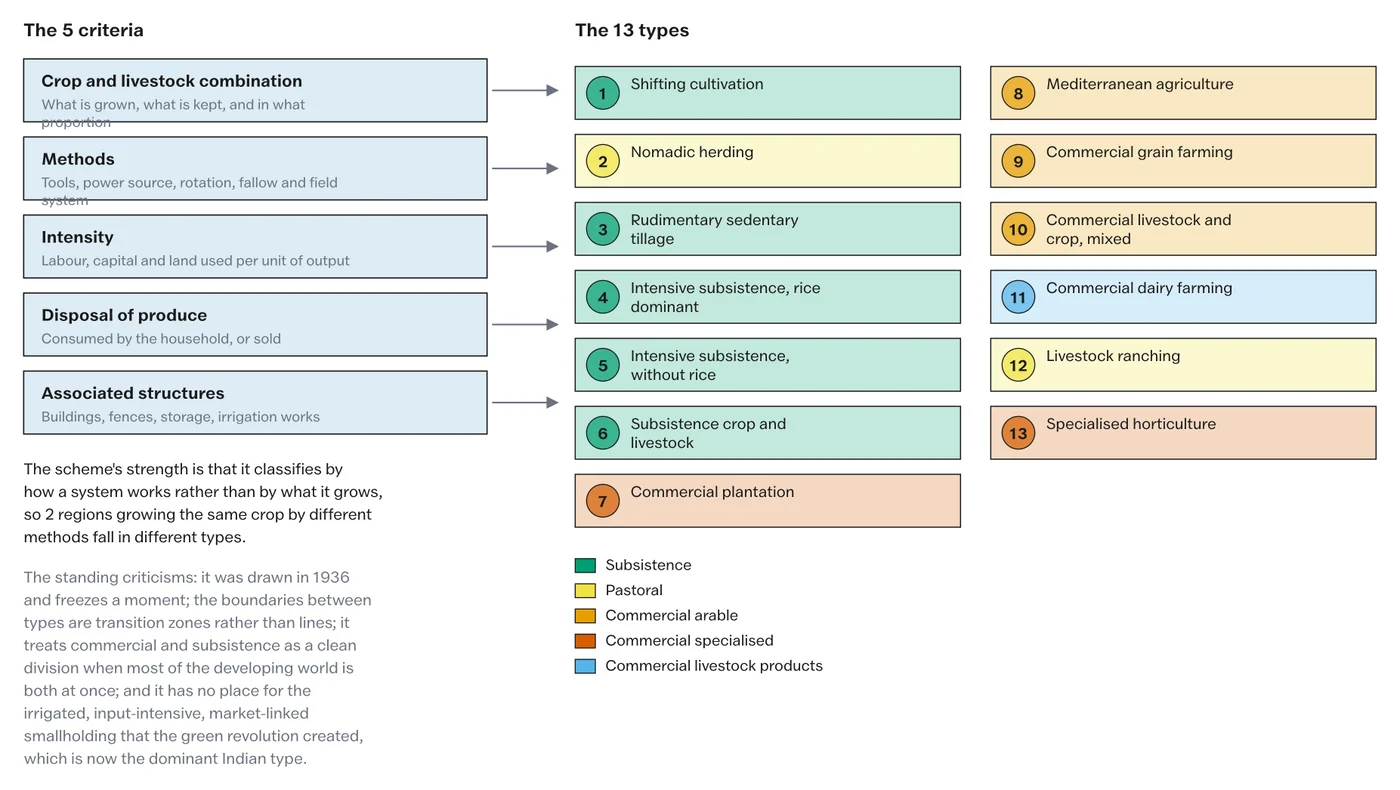
Whittlesey’s agricultural regions remain the standard classification of world farming systems nearly a century after Derwent Whittlesey published them in 1936, and the reason is a single methodological choice. He classified farming by how a system works rather than by what it grows. Two regions producing the same crop by different methods fall into different types, and that is what makes the scheme analytical rather than descriptive.
The scheme gives five criteria and thirteen types. Knowing the criteria matters more than reciting the types, because the criteria are what let you place a system the list does not name.
The Five Criteria
Whittlesey applied five tests to every farming system he examined.
- The crop and livestock combination. What is grown, what is kept, and in what proportion to each other.
- The methods used. Tools, power source, rotation, fallow practice and field system.
- The intensity of use. How much labour, capital and land go into a unit of output.
- The disposal of produce. Whether it is consumed by the household or sold, which is the subsistence-commercial divide.
- The associated structures. Buildings, fences, storage, irrigation works and the rest of the fixed capital on the land.
The fifth criterion is the one usually forgotten and the most distinctively geographical, because farm buildings and field boundaries are the visible landscape evidence of a farming system, and they persist long after the system that built them has changed.
The Thirteen Types
| # | Type | Where it dominates |
|---|---|---|
| 1 | Shifting cultivation | Humid tropics: Amazon, Congo, South-East Asia, north-eastern India |
| 2 | Nomadic herding | Arid and sub-arid belts and the tundra |
| 3 | Rudimentary sedentary tillage | Tropical margins where shifting cultivation has settled |
| 4 | Intensive subsistence, rice dominant | Monsoon Asia’s deltas and river plains |
| 5 | Intensive subsistence, without rice | Drier parts of monsoon Asia; wheat, millets and pulses |
| 6 | Subsistence crop and livestock farming | Parts of Africa, Latin America and interior Asia |
| 7 | Commercial plantation | Tropical colonies: tea, rubber, coffee, cocoa, sugar |
| 8 | Mediterranean agriculture | The 5 Mediterranean-climate regions |
| 9 | Commercial grain farming | Interior temperate grasslands: Prairies, Steppes, Pampas |
| 10 | Commercial livestock and crop, mixed | Western and central Europe, eastern North America |
| 11 | Commercial dairy farming | Cool humid regions near urban markets |
| 12 | Livestock ranching | Semi-arid grasslands of the Americas, Australia, southern Africa |
| 13 | Specialised horticulture | Near large urban markets and in favoured climates |
The Four Divisions Worth Holding
Thirteen types are hard to remember as a list and easy to remember as four groups, and the groups are what the criteria produce.
- Subsistence types 1, 3, 4, 5 and 6, where produce is consumed by the household. Intensity varies enormously within this group: shifting cultivation is land-extensive and labour-light, while intensive subsistence rice is the most labour-intensive farming on earth.
- Pastoral types 2 and 12, distinguished by mobility and by disposal. Nomadic herding is subsistence and mobile; ranching is commercial and sedentary on fixed holdings.
- Commercial arable types 8, 9 and 10, where crops are grown for sale, generally at low labour intensity and high capital intensity.
- Commercial specialised types 7, 11 and 13, each tied to a particular market or climate and each with heavy fixed capital in processing or transport.
Where India Sits, and Why It Is Awkward
India contains at least five of the thirteen types, which is itself a useful observation about the country’s agricultural diversity.
- Intensive subsistence with rice dominant across the eastern plains, the coastal deltas and the north-east.
- Intensive subsistence without rice through the drier north-west and the Deccan interior, on wheat, jowar, bajra and pulses.
- Shifting cultivation, called jhum, in the north-eastern hill states, with cycles now shortened well below what soil recovery requires.
- Commercial plantation in Assam and the Nilgiris for tea, Kerala and Karnataka for rubber, coffee and spices.
- Nomadic and transhumant herding among the Gujjar, Bakarwal, Gaddi and Rabari communities.
The awkwardness is that the scheme’s central division, between subsistence and commercial, no longer describes Indian agriculture well. The irrigated, input-intensive, market-linked smallholding that the green revolution created is neither. A Punjab wheat and rice farm uses purchased seed, fertiliser and power, sells the bulk of its output to a procurement agency at a support price, and is worked largely by household and hired labour on under 4 hectares. Whittlesey has no box for it, and saying so is a stronger observation than forcing it into type 5.
The Standing Criticisms
- It freezes a moment. Drawn in 1936, it captures the world before mechanisation, the green revolution and global agribusiness reshaped it.
- The boundaries between types are transition zones rather than lines, and mapping them as lines overstates their sharpness.
- The subsistence-commercial division is too clean. Most of the developing world is partly both, often on the same holding in the same season.
- It has no place for the modern intensive smallholding, which is now the dominant type across South and East Asia.
- It is silent on tenure and institutions. Who owns the land, on what terms, and with what access to credit, shapes farming at least as much as climate does.
The scheme’s strength and its weakness are the same thing: it classifies by observable practice, so it survives changes in crop but not changes in the economy around the farm.
How the Scheme Compares with the Alternatives
| Scheme | Basis | Strength | Weakness |
|---|---|---|---|
| Whittlesey (1936) | Practice: combination, method, intensity, disposal, structures | Explains how a system works; globally applicable | Dated; no box for the modern intensive smallholding |
| Von Thünen (1826) | Distance from market and transport cost | Explains the spatial arrangement around a market | Assumes an isolated state and one market |
| Agro-climatic zoning | Rainfall, temperature, soil, topography | Directly usable for planning inputs | Physical only; ignores institutions and markets |
| Agro-ecological regions | Soil, physiography, bioclimate, length of growing period | Ecologically grounded and finer-grained | Descriptive rather than explanatory of practice |
The comparison is the answer to most questions on agricultural regionalisation. Whittlesey explains practice, Von Thünen explains location, and the two Indian schemes explain physical potential. None of them explains all three, and the useful position is that a regionalisation should be chosen for the question being asked.
Practice Questions
Prelims
1. Which of the following is NOT one of Whittlesey’s criteria?
- (a) Intensity of land, labour and capital use
- (b) Disposal of produce
- (c) Distance from the nearest market
- (d) Associated farm structures
Answer: (c)
2. Intensive subsistence agriculture with rice dominant is characteristic of
- (a) the temperate grasslands
- (b) the deltas and river plains of monsoon Asia
- (c) the Mediterranean basin
- (d) the semi-arid Americas
Answer: (b)
3. Livestock ranching differs from nomadic herding chiefly in that ranching is
- (a) practised in humid regions
- (b) commercial and sedentary on fixed holdings
- (c) labour intensive
- (d) confined to the tropics
Answer: (b)
4. Whittlesey published his classification of agricultural regions in
- (a) 1826
- (b) 1936
- (c) 1955
- (d) 1966
Answer: (b)
5. The Whittlesey type that fits Punjab’s irrigated wheat and rice farming least awkwardly is
- (a) commercial grain farming
- (b) intensive subsistence without rice
- (c) mixed crop and livestock farming
- (d) none of these fits well
Answer: (d)
Mains
- State Whittlesey’s criteria for delimiting agricultural regions and explain why the fifth is distinctively geographical. (10 marks)
- Identify the Whittlesey types found in India and map their broad distribution. (15 marks)
- “Whittlesey classifies by practice rather than by produce.” Explain this distinction and its consequences for the resulting regions. (15 marks)
- Examine the relevance of Whittlesey’s typology to Indian agriculture after the green revolution. (20 marks)
- Compare Whittlesey’s typology with India’s agro-climatic zoning as bases for agricultural planning. (20 marks)