Adam Smith’s Theory of Moral Sentiments: Sympathy and the Impartial Spectator (UPSC Ethics — GS IV)
Adam Smith is remembered for the invisible hand and forgotten for the book he cared about more. Its central device — an impartial spectator inside the head — is the most usable dilemma test any thinker in the syllabus has produced.
Adam Smith published The Theory of Moral Sentiments in 1759, seventeen years before The Wealth of Nations. He revised it six times across his life, the last revision in the year he died, and he thought of it as the more important book. Almost nobody reads it, which is why the standard summary of Smith — that self-interest, left alone, produces public benefit — misses the moral psychology he actually built.
His question is not why markets work. It is how creatures as self-preferring as human beings ever manage to judge themselves. The answer he constructs, an imagined observer installed inside the mind, turns out to be the single most practical device any thinker in the ethics syllabus has left behind, because it can be applied to a file in about thirty seconds.
Sympathy: Not Kindness, but Imaginative Exchange of Places
Smith opens with an observation and a mechanism. The observation is that people are moved by the fortunes of others even when nothing is at stake for themselves. The mechanism he calls sympathy, and the word does not mean pity or compassion in his usage. It means the imaginative act of changing places — reconstructing in your own mind what you would feel in another person’s situation, and then comparing that reconstruction with what they actually appear to feel.
Two consequences follow, and both are more interesting than the word “sympathy” suggests.
First, sympathy is a standard of judgement, not a warm feeling. When the reconstruction matches the other person’s response, we approve of it — their grief is proportionate, their anger justified. When it does not match, we disapprove, and we do so even where the person is suffering. Excessive grief and disproportionate rage are judged harshly precisely because the spectator cannot go along with them.
Second, sympathy runs in both directions. Knowing that others are reconstructing our feelings, we moderate them so they can be shared. Smith’s account of self-command — restraint of one’s own passions to a pitch that an observer can enter into — comes from this, and it is the ancestor of what modern administrative language calls composure under scrutiny.
This is a development of the sentimentalist tradition Smith inherited from his friend, whose position on the relation between reason and feeling is set out in David Hume’s account of moral sentiment. Smith’s departure is that he makes the spectator, rather than the agent’s own feeling of approval, the seat of moral judgement.
The Impartial Spectator
The device that carries the whole theory arrives when Smith turns the mechanism on the self. We cannot examine our own conduct while inside it. So we do something ingenious: we split, imagining ourselves observed by a person who knows the situation fully, is not implicated in it, and has no stake in the outcome. Smith calls this figure the impartial spectator — elsewhere “the man within the breast”, “the great judge and arbiter” of conduct.
Conscience, on this account, is not a divine implant or a rational deduction. It is a socially learned faculty that has been internalised: we begin by judging others, learn that others judge us, and end by constructing an idealised judge who evaluates us from outside.
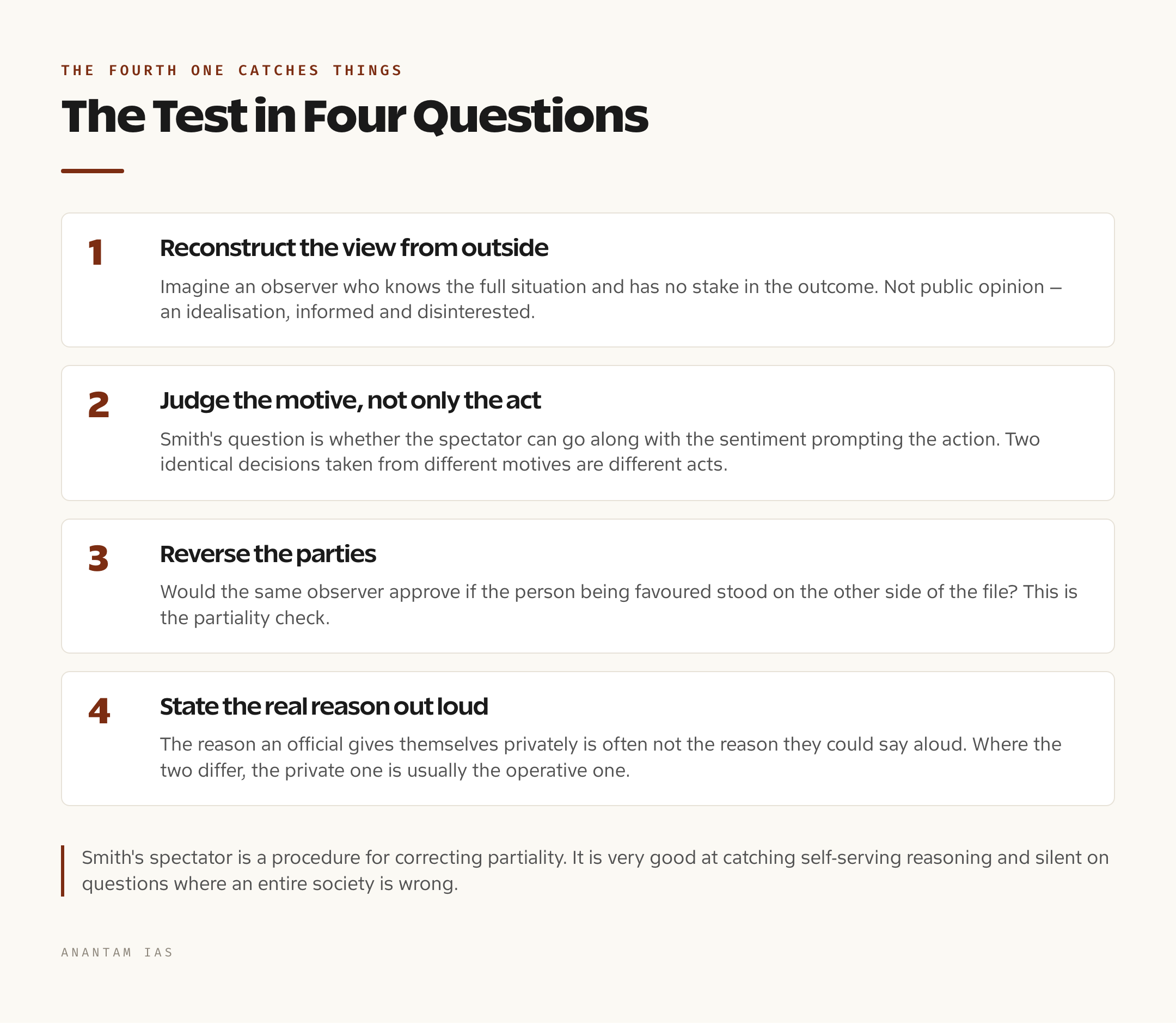
What makes this valuable rather than merely elegant is that it works as a test. Applied to a decision, it asks four things in sequence: What would a fully informed observer with no interest in this matter see? Would that observer go along with my motive, as distinct from my action? Would they approve if the parties were reversed — if the person I am favouring were on the other side? And can I state my actual reason to that observer without embarrassment?
That last question is the one that does the work, because the reason an official gives themselves in private is often not the reason they could state aloud. The test is close in spirit to the publicity requirements in modern administrative ethics and to the reasoning-record standard set out in the framework for resolving ethical dilemmas, and it is considerably faster to apply than either a utilitarian calculation or a Kantian universalisation.
Praise and Praiseworthiness
Smith draws a distinction that is worth more to an aspirant than most of the framework: the difference between wanting praise and wanting to be praiseworthy.
The desire for praise is the desire for the actual applause of actual people. The desire for praiseworthiness is the desire to be the kind of person who deserves applause, whether or not any arrives. The two usually point the same way, which is why they are easy to confuse — and they come apart exactly when it matters.
Smith’s examples of the divergence are the two cases every administrator eventually meets. A person praised for something they did not do takes no real satisfaction in it if they are honest, because the praise is not theirs. A person condemned for a decision they know was right can hold the position, because the impartial spectator inside still approves. Smith says the second person appeals from the judgement of the actual world to the judgement of the ideal observer, and that this appeal is what makes moral independence possible at all.
He is also clear that the vanity route is the common one. The “vain man” prefers being thought virtuous to being virtuous, and public life offers unlimited opportunity for that preference. This is why Smith belongs in the same argument as integrity as a civil-service value: integrity is precisely the condition in which what you would be praised for and what you actually do have stopped diverging.
The Corruption of Moral Sentiments
The most quotable passage for contemporary use is Smith’s account of a systematic bias in ordinary moral judgement. He observes that people admire wealth and rank and are disposed to look away from the faults of the powerful, while neglecting or despising poverty. He calls this the corruption of our moral sentiments and treats it as the great and most universal cause of moral failure — not the occasional villain, but the everyday deference of the many to the successful.
For a paper concerned with probity, that is a diagnosis rather than a lament. It explains why the same file moves faster for a well-connected applicant without anyone taking a bribe; why regulatory bodies drift toward the industry they supervise; why the social cost of refusing a powerful person feels larger than the cost of refusing a poor one, even when the law is identical. Smith locates the failure in a bias in the spectator, which is a more useful place to look than individual wickedness, and it connects directly to the concentration-of-influence problem in corporate governance and business ethics.
He also anticipates the objection to his own theory here. If moral standards come from what spectators approve, and spectators are systematically biased toward the rich, then the standard is corrupted at source. Smith’s answer is that the impartial spectator is an idealisation — informed and disinterested — not a poll of actual opinion, and that moral progress consists in the gap between the two.
Prudence, Justice, Beneficence
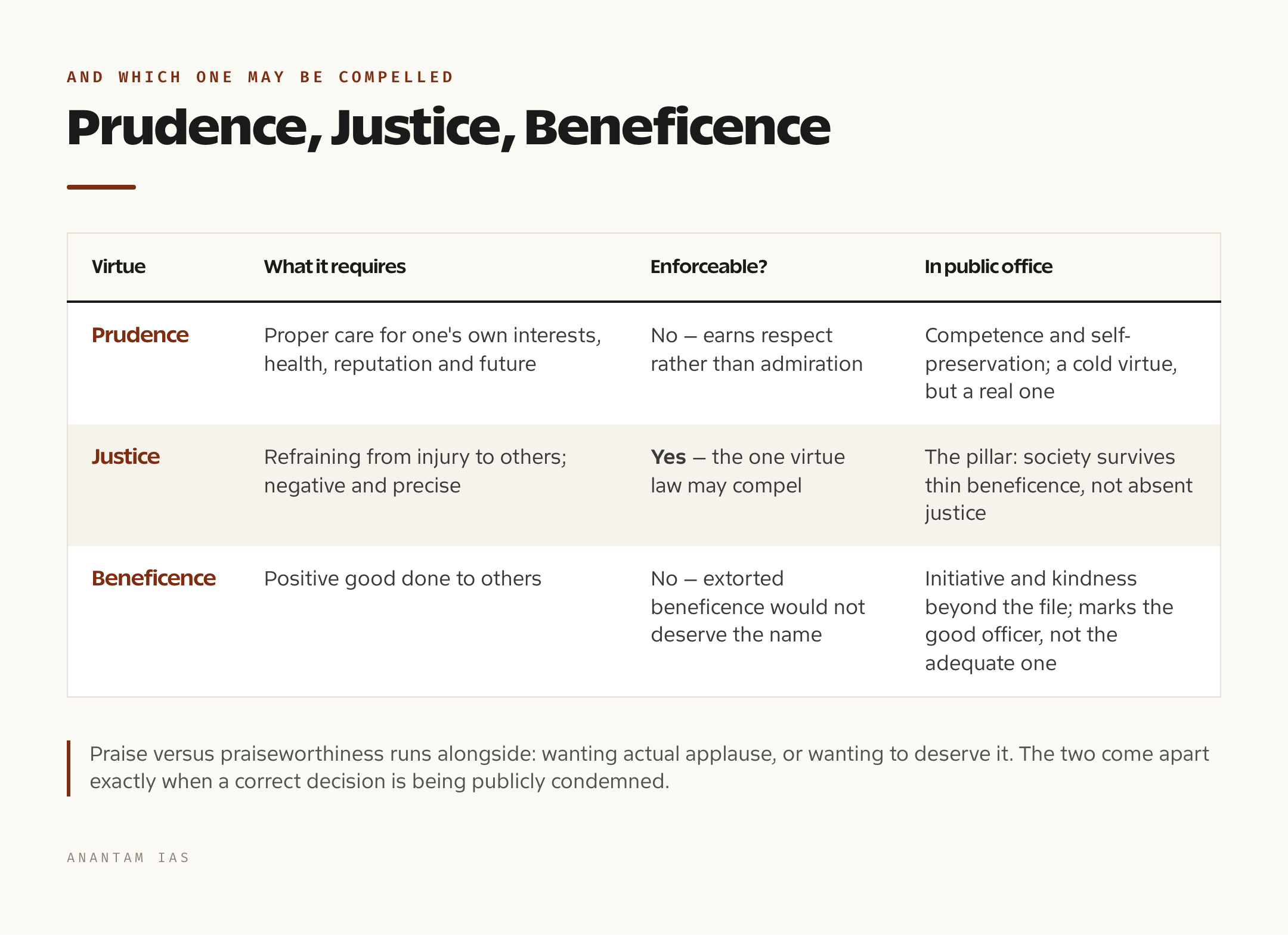
Smith’s virtues sort into three, and the sorting matters because he attaches different enforcement to each.
Prudence is proper care for one’s own interests, health, reputation and future. Smith treats it as a genuine virtue rather than a concession, though a cold one that earns respect rather than admiration.
Justice is refraining from injury to others. It is negative, precise, and the only one of the three that may be enforced by law. Smith’s image is that justice is the pillar holding up the building, and society can survive without much beneficence but not without justice.
Beneficence is positive good done to others. It is the most admirable and the least enforceable — extorted beneficence, Smith says, would not deserve the name.
That hierarchy maps onto public administration with almost no adjustment. An official may be compelled to do no injury and to follow the law; kindness, initiative and going beyond the file cannot be compelled and are the marks of the good officer rather than the adequate one.
The So-Called Adam Smith Problem
Nineteenth-century commentators asked how the author of a book about sympathy could also be the author of a book about self-interest, and named it das Adam Smith Problem. Contemporary scholarship largely treats it as a misreading, and the resolution is worth carrying into an answer.
The Wealth of Nations does not claim people are only self-interested. It claims that in the specific domain of market exchange, appealing to a butcher’s interest is a more reliable way to get dinner than appealing to his benevolence — a point about the design of institutions, not about human nature. Smith is scathing elsewhere about merchants combining against the public, about employers conspiring on wages, and about the businessman’s interest in restricting competition.
Both books also depend on the same background: markets work inside a framework of justice, and commercial society is only tolerable because sympathy, propriety and the spectator regulate conduct that the law cannot reach. Read together, Smith is closer to an argument that a market economy requires a moral culture than to an argument that it replaces one. That is the version worth deploying in any answer connecting ethics to economic policy, and it sits beside the other Western thinkers surveyed in Western moral philosophy.
Where It Fails
Three limitations should be stated rather than glossed.
The spectator is culturally furnished. An idealised observer in eighteenth-century Britain could contemplate slavery and colonial rule without much discomfort. If conscience is a socialised faculty, it inherits the blindness of the society that formed it, and calling the spectator “impartial” does not exempt it. This is the standard objection, and Smith’s own concept of corrupted sentiments concedes most of it.
It provides no content. Like other agent-centred frameworks, including virtue ethics, it tells you how to check a judgement rather than what the right answer is. A well-socialised official with a defective moral community will pass the test comfortably.
Approval is not correctness. Smith moves from what a spectator would approve to what is right, which is exactly the inference Hume’s own is-ought problem warns against. The most defensible reading is that the spectator is a procedure for correcting partiality — very good at catching self-serving reasoning, silent on questions where the whole society is wrong.
Used with those limits, it remains the fastest self-check in the syllabus: before signing, ask what a fully informed person with nothing to gain would make of your reason, and whether you would be willing to say it out loud.
FAQ
What does Adam Smith mean by sympathy? Not pity, but the imaginative act of changing places with another person to reconstruct what they feel, and then judging whether their response is proportionate to the situation.
Who is the impartial spectator? An imagined observer who knows the situation fully and has no stake in it, whose approval or disapproval we use to judge our own conduct. Smith also calls this figure the man within the breast, and treats it as the origin of conscience.
What is the difference between praise and praiseworthiness? Praise is the actual approval of actual people; praiseworthiness is deserving approval whether or not it comes. Smith argues that the ability to appeal from the first to the second is what makes moral independence under criticism possible.
What is the corruption of moral sentiments? Smith’s name for the ordinary human disposition to admire wealth and rank and to neglect the poor, which he treated as the most universal cause of corrupted moral judgement.
Is The Theory of Moral Sentiments inconsistent with The Wealth of Nations? Most current scholarship says no. The later book argues that market exchange works through mutual interest, not that human beings are only self-interested, and it assumes a framework of justice and social propriety that the earlier book supplies.
How is the impartial spectator different from Kant’s universalisability test? Kant asks whether the principle of your action could be willed as a universal law by any rational being. Smith asks whether a fully informed, disinterested observer would go along with your motive. Kant’s test is rational and abstract; Smith’s is imaginative and situational.
Practice Questions
Prelims MCQs
- In Adam Smith’s moral theory, “sympathy” refers to: (a) Compassion for those who suffer (b) The imaginative act of changing places with another to judge the propriety of their feeling (c) The natural benevolence that restrains self-interest in markets (d) Agreement with another person’s moral opinions — Answer: (b) Smith uses it as a mechanism of judgement, which is why disproportionate grief or anger is disapproved of even though the person is suffering.
- The “impartial spectator” in Smith’s account is best described as: (a) A magistrate who adjudicates disputes between citizens (b) Public opinion as expressed by the majority (c) An imagined, fully informed and disinterested observer whose approval we use to judge ourselves (d) The divine judge of human conduct — Answer: (c) Smith treats conscience as an internalised idealised observer rather than as revelation or pure reason, and insists it is an idealisation rather than a poll of actual opinion.
- Which of Smith’s three virtues did he hold may legitimately be enforced by law? (a) Prudence (b) Justice (c) Beneficence (d) Self-command — Answer: (b) justice, as refraining from injury, is negative and precise; Smith held that extorted beneficence would not deserve the name.
- Smith’s phrase “the corruption of our moral sentiments” refers to: (a) The decline of religious authority in commercial society (b) The disposition to admire the wealthy and powerful and neglect the poor (c) The tendency of markets to reward vice (d) The influence of passion on reason in moral judgement — Answer: (b) he treated this everyday deference, rather than exceptional wickedness, as the most universal cause of corrupted judgement.
- The Theory of Moral Sentiments was first published in: (a) 1740 (b) 1759 (c) 1776 (d) 1790 — Answer: (b) seventeen years before The Wealth of Nations; Smith continued revising it until the year of his death in 1790.
Mains Practice Questions
- “The impartial spectator is a procedure for correcting partiality, not a source of moral content.” Examine this claim with reference to administrative decision-making. (150 words)
- Explain Smith’s distinction between the love of praise and the love of praiseworthiness, and discuss its relevance for an officer facing public criticism for a correct decision. (250 words)
- Smith held that the disposition to admire wealth and rank corrupts moral judgement. Analyse this insight in the context of regulatory capture and preferential treatment in public offices. (250 words)
- Is there a contradiction between Adam Smith’s moral philosophy and his economics? Substantiate your answer. (150 words)
- Compare the impartial spectator with the Kantian test of universalisability as tools for resolving a conflict of interest. Which is more usable in practice, and why? (250 words)