Adi Karmyogi Programme (Abhiyan): Tribal Change Leaders, Three-Tier Cadre and the Janjatiya Gaurav Varsh Architecture
Adi Karmyogi Programme explained: Ministry of Tribal Affairs initiative for 20 lakh tribal change leaders, three-tier Karmayogi-Sahyogi-Saathi structure, Adi Sewa Kendra, Village Vision 2030, links with PM-JANMAN, Dharti Aaba and Mission Karmayogi.
The Indian state has tried many vocabularies for tribal welfare. The earliest was protective: the Fifth and Sixth Schedules, the Tribes Advisory Council, and the Forest Rights Act. The next was developmental: the Tribal Sub-Plan, the integrated tribal development projects, and the Eklavya Model Residential Schools. The newest is a vocabulary of governance and capacity. The Adi Karmyogi Programme, launched on 19 August 2025 by the Ministry of Tribal Affairs, sits firmly in this last frame. It treats the chronic gap between tribal villages and welfare schemes as a problem of human resources, training, and the missing last mile.
The programme builds on the Janjatiya Gaurav Varsh celebrations and shares a design vocabulary with Mission Karmayogi, the National Programme for Civil Services Capacity Building. The ambition is to create 20 lakh tribal change leaders across one lakh tribal-dominated villages, organised into three tiers. A village-level cadre of community elders and self-help group women anchors the programme at the bottom. A middle tier of professionals and youth carries technical support. A top tier of government officers shifts from rule-based to role-based governance. The motto, Sewa, Sankalp, Samarpan, signals an attitudinal change as much as a structural one.
This guide walks through the design of the programme, its three-tier cadre, the four components built around the Adi Sewa Kendra, the student chapters at IITs, IIMs and AIIMS, the venture capital fund, and the strategic links with PM-JANMAN, Dharti Aaba and Mission Karmayogi.
Quick Facts on the Adi Karmyogi Programme
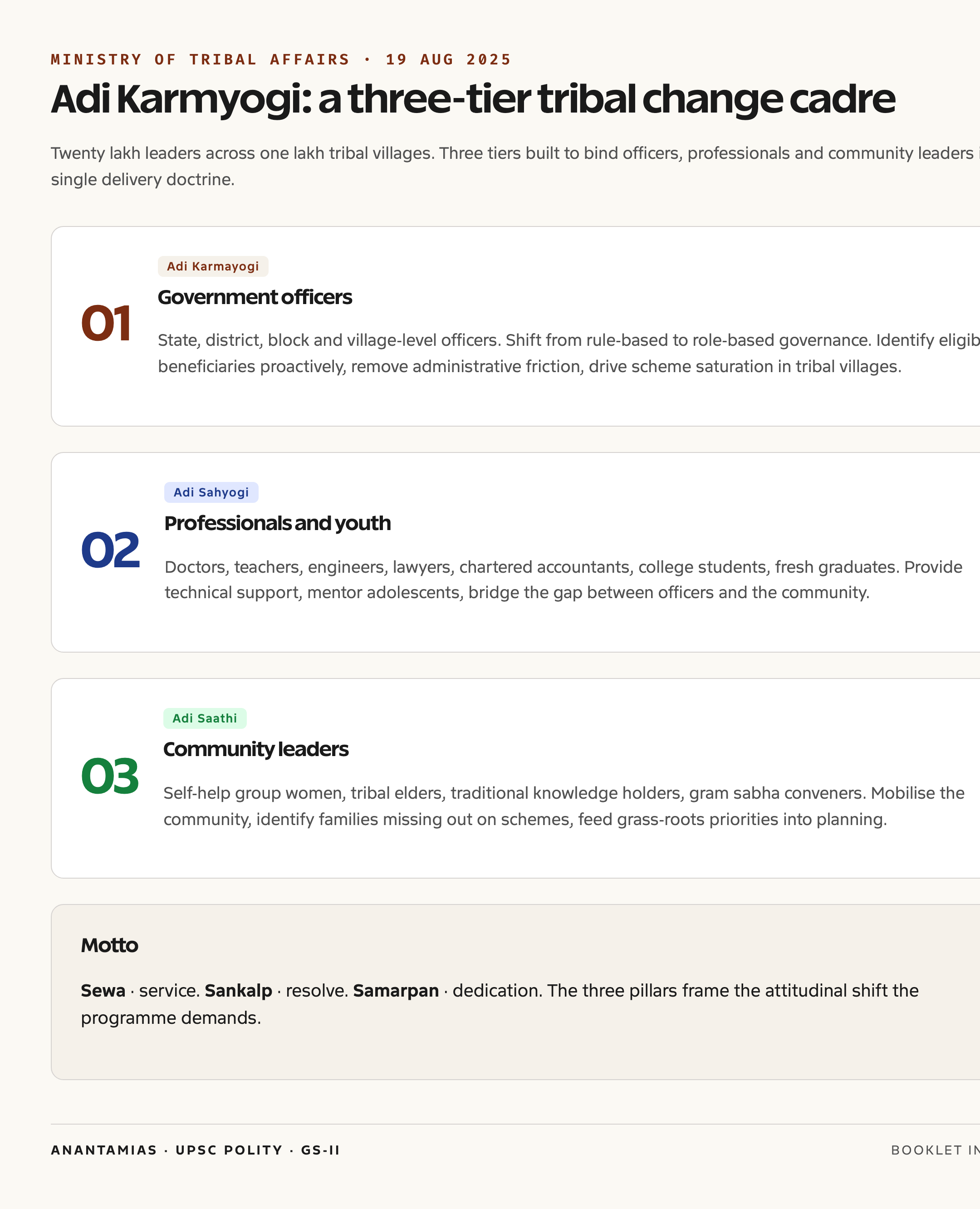
The Adi Karmyogi Programme was launched on 19 August 2025 by the Ministry of Tribal Affairs. The programme is part of the Janjatiya Gaurav Varsh celebrations marking 150 years since Bhagwan Birsa Munda‘s birth anniversary. The target is 20 lakh tribal change leaders, also called Adi Karmayogis, across one lakh tribal-dominated villages. The motto rests on three pillars: Sewa, Sankalp and Samarpan. The cadre is organised in three tiers: Adi Karmayogi (government officers), Adi Sahyogi (professionals and youth), and Adi Saathi (community leaders and SHG women). The operational components include the Adi Sewa Kendra single-window service centre in every tribal village, Adi Sewa Samay fortnightly community sittings, Village Vision 2030 bottom-up planning, and Governance Process Labs. Student chapters have been launched in IITs, IIMs, AIIMS and NITs, supported by a Rs 50 crore venture capital fund for tribal-led startups. The programme acts as the human-resource arm of PM-JANMAN, Dharti Aaba Janjatiya Gram Utkarsh Abhiyan, and Mission Karmayogi.
What the Adi Karmyogi Programme Is
The programme is a governance reform delivered through people rather than through new schemes. Most tribal welfare schemes already exist, run by the Ministry of Tribal Affairs, the Ministry of Rural Development, the Ministry of Agriculture, and others. The chronic gap is one of saturation: many eligible families do not receive the benefit either because they do not know about it or because the local machinery cannot deliver it. Adi Karmyogi aims to close this gap by training a cadre at three different proximity levels and building a single-window service centre in every tribal village.
The programme is administratively unusual because it spans three levels of capacity: the official, the technical professional, and the community member. Mission Karmayogi works only with civil servants. Self-help group programmes work only with women’s groups. Adi Karmyogi binds the three groups together in a shared operational doctrine. The shared doctrine is what the programme calls “role-based governance”, a phrase that signals that an officer’s job is to facilitate outcomes rather than enforce rules.
Background and Historical Context
The Indian tribal welfare architecture rests on three constitutional and policy pillars. The first is the Fifth and Sixth Schedule of the Constitution, which gives special administrative status to Scheduled Areas and tribal areas in the north-east. The second is the Tribal Sub-Plan, introduced in the Fifth Five-Year Plan, which earmarked Plan funds for the tribal population in proportion to their share. The third is a series of legislative protections, including the Provisions of the Panchayats (Extension to Scheduled Areas) Act, 1996, the Forest Rights Act, 2006, and the various land-alienation prohibitions in state law.
Despite this architecture, the development gap persists. National Family Health Survey rounds and other surveys have repeatedly shown that Scheduled Tribes lag behind the general population on most human development indicators. The persistent gap reflects geographic remoteness, poor connectivity, weak public service penetration, and a history of mistrust between tribal communities and the formal state apparatus.
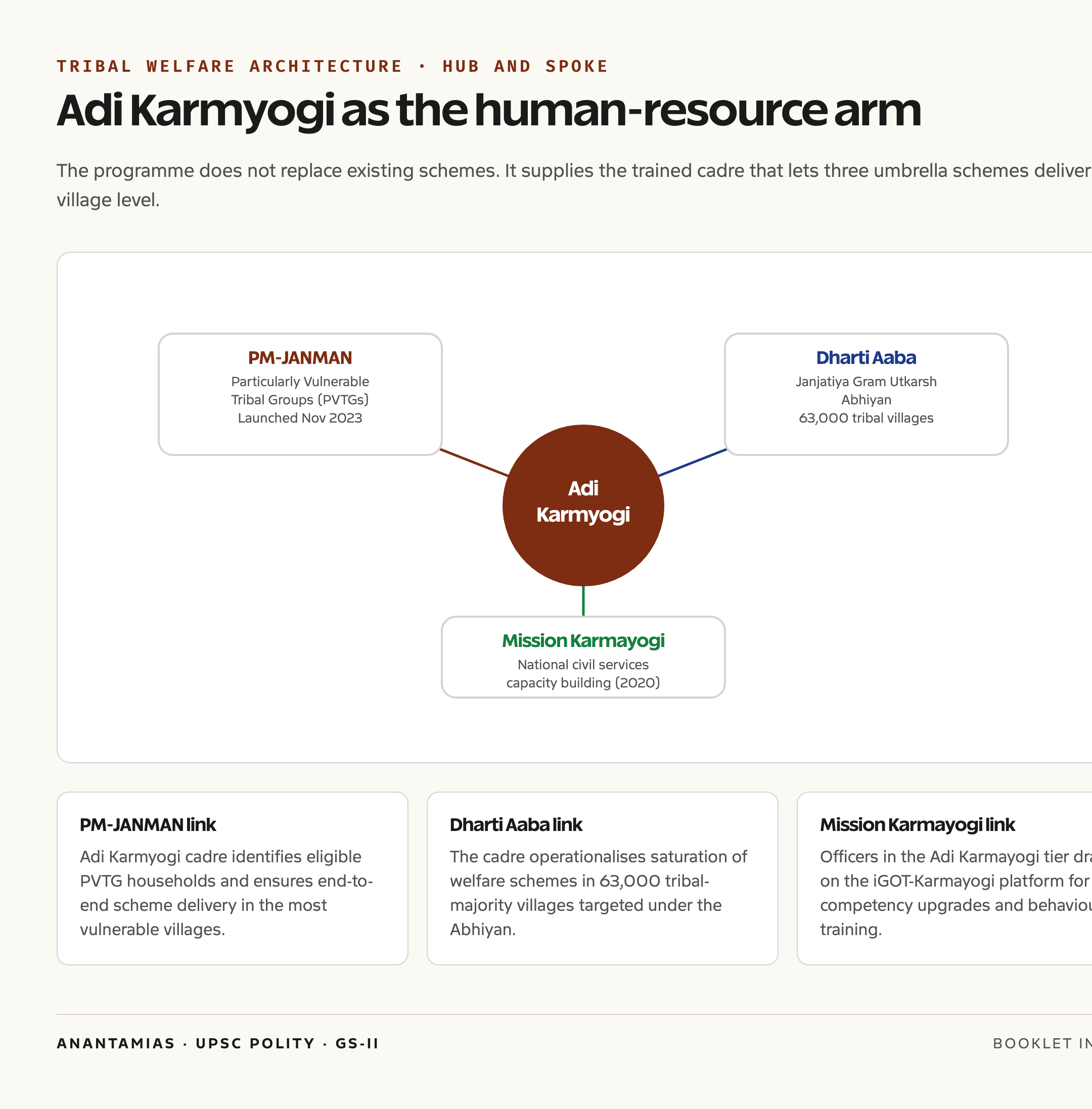
The 2019-2024 period saw a shift toward saturation-mode delivery. The Aspirational Districts Programme picked districts on a composite development index, and tribal-majority districts featured heavily in the list. The PM-JANMAN scheme, launched in November 2023, focused on Particularly Vulnerable Tribal Groups (PVTGs). The Dharti Aaba Janjatiya Gram Utkarsh Abhiyan, announced in the Union Budget 2024-25, targets saturation of welfare schemes in 63,000 tribal-majority villages. Adi Karmyogi is the human-resource layer that ties these scheme-level interventions together.
The Three-Tier Cadre: Karmayogi, Sahyogi, Saathi
The cadre design is the heart of the programme. The Adi Karmayogi tier comprises government officers at the state, district, block and village levels. These are the people responsible for implementing welfare schemes in their administrative jurisdiction. The training module asks them to move from “rule-based” to “role-based” governance, which translates into facilitating outcomes, identifying eligible beneficiaries proactively, and removing the administrative friction that often stops a scheme from reaching the family.
The Adi Sahyogi tier comprises professionals and youth. The professional category includes doctors, teachers, engineers, lawyers, and chartered accountants who have a technical skill that the village needs. The youth category includes college students, fresh graduates, and young volunteers. Their role is to provide technical support, mentor adolescents and young adults in tribal villages, and act as a bridge between the official tier and the community.
The Adi Saathi tier comprises community leaders. This includes self-help group women, tribal elders, traditional knowledge holders, and gram sabha conveners. Their role is to mobilise the community for participation in the gram sabha, identify families that are missing out on schemes, and feed back the community’s priorities into the planning process. This is the tier that gives the programme its grass-roots traction.
The three tiers do not work in isolation. Each Adi Sewa Kendra, the village-level service centre, brings the three tiers together once a fortnight in the Adi Sewa Samay session, where issues are raised and resolved with all three present.
Why the Programme Matters
The programme matters for three reasons. The first is its scale. Twenty lakh trained leaders across one lakh tribal villages is a major capacity-building exercise. If even a fraction of the cadre stays active for five years, the cumulative effect on scheme delivery, gram sabha quality and grievance resolution will be substantial.
The second is its governance philosophy. The shift from “rule-based” to “role-based” governance is more than a slogan. It signals an effort to professionalise tribal-area administration, which has historically been treated as a hardship posting and a low-priority placement. Pairing officers with professional volunteers and community leaders builds a shared accountability framework that does not rest on the officer alone.
The third is its integration with the broader tribal-issues-india policy architecture. The programme reinforces saturation-mode delivery, a planning logic that has emerged across the Aspirational Districts Programme, the PM Awas Yojana, and the Jal Jeevan Mission. The cadre helps the saturation logic work in practice by ensuring that no eligible family is missed.
Detailed Analysis: The Four Operational Components
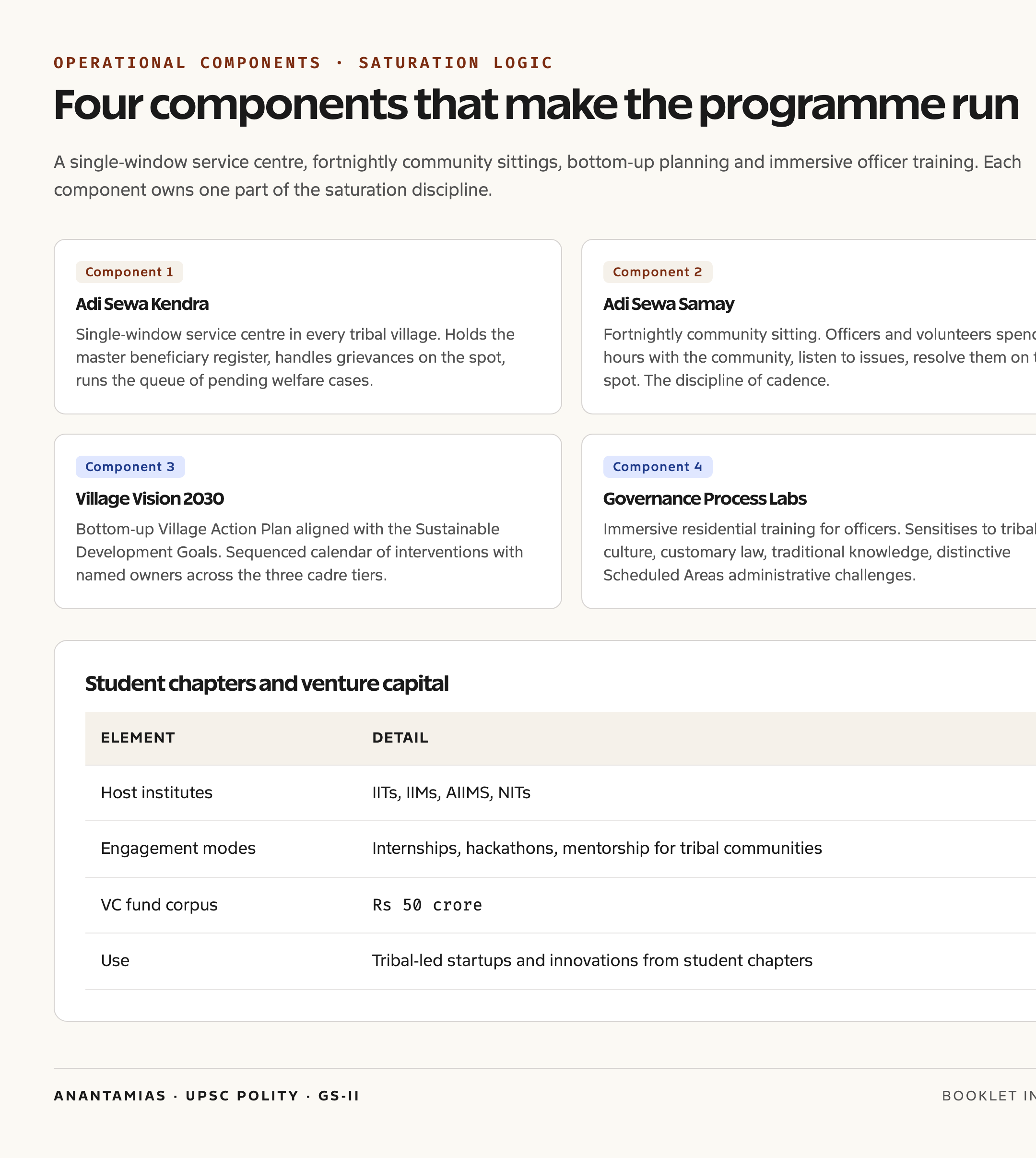
The Adi Sewa Kendra is the village-level service centre. It is meant to function as a single-window for all welfare schemes available to a tribal household. The Kendra holds the village’s master beneficiary register, maintains a queue of pending cases, and provides on-the-spot grievance redressal for issues like ration card linkage, scholarship payments, and pension disbursement. The Kendra is run by an Adi Saathi at the day-to-day level, with regular visits from Adi Sahyogi volunteers and Adi Karmayogi officers.
The Adi Sewa Samay is a fortnightly community sitting. The format borrows from the Jansunwai tradition. Government officers and volunteers spend one to two hours sitting with the community, listening to issues, and resolving them on the spot where possible. The Samay is held at the Adi Sewa Kendra and is open to all village residents, not just scheme beneficiaries. The discipline of the fortnightly cadence is the programme’s main accountability check.
The Village Vision 2030 is a bottom-up planning exercise. Each village prepares its own Village Action Plan aligned with the United Nations Sustainable Development Goals, framed in the local context and mapped against available central, state and tribal-area schemes. The Plan is not a wishlist; it is a sequenced calendar of interventions with named owners at the three tiers. The 2030 horizon gives the planning a medium-term frame that is longer than annual schemes but shorter than the perspective plans of the past.
The Governance Process Labs are immersive training modules for officers. The Labs are conducted in residential settings, often at training institutes like the Indira Gandhi National Tribal University or the Lal Bahadur Shastri National Academy of Administration. The curriculum sensitises officers to tribal culture, customary law, traditional knowledge systems, and the distinctive administrative challenges of Scheduled Areas. The Labs are also open to senior Adi Sahyogi volunteers in select cohorts.
Comparative Frame: Other Cadre-Building Programmes
A comparative scan helps locate Adi Karmyogi in the broader cadre-building space. Mission Karmayogi, launched in September 2020, is the closest cousin. It is a national programme for civil services capacity building, anchored on the iGOT-Karmayogi digital platform. Mission Karmayogi works with serving civil servants only and uses behavioural and competency frameworks to upgrade administrative skills. Adi Karmyogi extends the Mission’s logic to a much broader cadre that includes non-officers, and its competency framework is built around tribal-area service delivery.
The National Rural Livelihoods Mission has built one of the largest cadres of community resource persons in the country, drawn from self-help groups. The cadre delivers livelihood interventions, financial literacy, and gender-responsive programmes. Adi Karmyogi’s Adi Saathi tier draws on the NRLM template and integrates with the SHG network in tribal areas.
The Aspirational Districts Programme runs on a saturation logic with district-level real-time dashboards. It does not have a dedicated cadre but works through the existing administrative apparatus with sharper monitoring. Adi Karmyogi adds the cadre layer to the saturation logic and takes the discipline down to the village level, where the Aspirational Districts Programme operates at the district level.
Challenges and Open Questions
Three challenges deserve attention. The first is the volunteer attrition problem. Twenty lakh leaders is a large number, and the cadre will work only if a substantial share of the cadre stays active over multiple years. Volunteer attrition is the recurring problem in cadre-building programmes. Stipend support, recognition incentives and a clear progression path will determine whether the programme sustains its scale.
The second is the integration with state and district administration. The Ministry of Tribal Affairs is a Union ministry, but most welfare schemes are delivered through state line departments. The Adi Karmyogi cadre needs the active partnership of state secretariats, district collectors, and block development officers. Partnership friction is a known risk and the early implementation period will reveal how much the programme depends on individual state buy-in.
The third is the equity question. The student chapters in IITs, IIMs and AIIMS, and the Rs 50 crore venture capital fund, can either feed back into tribal communities or be diverted into more conventional startups that happen to have a tribal label. A clear set of grant-making norms and a transparent shortlisting process will determine whether this layer of the programme delivers tribal-led innovation or merely tribal-themed innovation.
Prelims Pointers
The Adi Karmyogi Programme was launched on 19 August 2025 by the Ministry of Tribal Affairs. The target is 20 lakh tribal change leaders across one lakh tribal-dominated villages. The motto rests on Sewa, Sankalp and Samarpan. The three-tier cadre comprises Adi Karmayogi (officers), Adi Sahyogi (professionals and youth), and Adi Saathi (community leaders). Adi Sewa Kendra is the village-level single-window service centre. Adi Sewa Samay is the fortnightly community sitting. Village Vision 2030 is the bottom-up planning exercise. Student chapters have been launched in IITs, IIMs, AIIMS and NITs with a Rs 50 crore venture capital fund. The programme is the human-resource arm of PM-JANMAN, Dharti Aaba Janjatiya Gram Utkarsh Abhiyan, and Mission Karmayogi. The programme is part of the Janjatiya Gaurav Varsh celebrations.
Mains Practice Questions
A typical question is: “The Adi Karmyogi Programme uses a three-tier cadre to bridge the gap between welfare schemes and tribal villages. Critically examine its design and the operational challenges in delivering 20 lakh trained leaders across one lakh villages.” A second question links the programme to broader inclusive growth in india goals: “Saturation-mode delivery has emerged as the dominant logic of the Indian welfare state. Discuss the role of cadre-building programmes like Adi Karmyogi in achieving inclusive growth in tribal areas.” A third option focuses on the federal structure: “Adi Karmyogi is a Union ministry programme delivered through state line departments. Examine the federal coordination challenges and propose institutional mechanisms to address them.”
Way Forward
Three priorities will determine the long-term success of the programme. The first is the publication of an annual State of Adi Karmyogi report with disaggregated data on cadre activity, scheme saturation, and Adi Sewa Kendra performance. Public data is the cleanest accountability tool. The second is the creation of a state-Centre coordination cell that resolves implementation friction with named officers and clear escalation paths. The third is a clear evaluation design at the village level that compares scheme saturation in Adi Karmyogi villages with similar non-programme villages, using a difference-in-differences design that the Ministry of Statistics and Programme Implementation can validate.
The success of Adi Karmyogi will eventually be judged by the Adi Saathi at the bottom. If a self-help group woman in a Particularly Vulnerable Tribal Group village can walk into her Adi Sewa Kendra, raise a missing scheme entitlement, and walk out with a date for resolution, the programme will have done its job. The architecture is sound. The execution is now a matter of disciplined implementation and honest measurement.
Frequently Asked Questions
What is the Adi Karmyogi Programme?
The Adi Karmyogi Programme, launched on 19 August 2025 by the Ministry of Tribal Affairs, is a tribal governance and capacity-building initiative aimed at creating 20 lakh tribal change leaders across one lakh tribal-dominated villages. The programme has a three-tier cadre, four operational components, and links to PM-JANMAN, Dharti Aaba Janjatiya Gram Utkarsh Abhiyan, and Mission Karmayogi.
Who are Adi Karmayogi, Adi Sahyogi and Adi Saathi?
Adi Karmayogi are government officers at the state, district, block and village levels who shift from rule-based to role-based governance. Adi Sahyogi are professionals (doctors, teachers, engineers) and youth who provide technical support and mentorship. Adi Saathi are community leaders, including self-help group women, tribal elders, and gram sabha conveners, who mobilise the community.
What is the Adi Sewa Kendra?
The Adi Sewa Kendra is the village-level single-window service centre to be set up in every tribal-dominated village. It maintains the master beneficiary register, handles grievance redressal on the spot, and serves as the operational hub for all three tiers of the cadre. The Kendra is the principal anchor for scheme saturation in the village.
How does Adi Karmyogi differ from Mission Karmayogi?
Mission Karmayogi is a capacity-building programme exclusively for civil servants, anchored on the iGOT-Karmayogi digital platform. Adi Karmyogi extends the same governance philosophy to a much wider cadre that includes professional volunteers, youth, and community leaders. The two programmes share design principles but operate on different scales and target groups.
What is Village Vision 2030?
Village Vision 2030 is a bottom-up planning exercise in which every tribal village prepares its own Village Action Plan aligned with the Sustainable Development Goals. The Plan is sequenced over the medium term, names owners at the three cadre tiers, and maps interventions to available central, state, and tribal-area schemes.
What is the connection between Adi Karmyogi and PM-JANMAN?
PM-JANMAN is the central scheme launched in November 2023 to deliver welfare and infrastructure to Particularly Vulnerable Tribal Groups (PVTGs). Adi Karmyogi acts as the human-resource arm for PM-JANMAN by providing the trained cadre that identifies eligible PVTG households, delivers the schemes, and tracks progress at the village level.
Who funds the Rs 50 crore venture capital fund for tribal-led startups?
The Rs 50 crore venture capital fund is anchored by the Ministry of Tribal Affairs and operates in partnership with the Adi Karmayogi Student Chapters at IITs, IIMs, AIIMS and NITs. The fund supports tribal-led startups, hackathon winners and innovations that emerge from the student chapters’ engagement with tribal communities.
Is the Adi Karmyogi Programme a Centrally Sponsored Scheme?
The programme is a central-sector initiative of the Ministry of Tribal Affairs, with state coordination through the state Tribal Development Departments. It is not a Centrally Sponsored Scheme in the traditional sense. The cadre, the Adi Sewa Kendra setup, and the training are funded by the Centre, while implementation cooperation is sought from states.
How does the programme relate to the Janjatiya Gaurav Varsh?
The programme was launched within the Janjatiya Gaurav Varsh celebrations marking 150 years since the birth of Bhagwan Birsa Munda. The Janjatiya Gaurav Varsh provides the larger thematic and political frame for the programme, signalling a continuity with the Janjatiya Gaurav Diwas that the Government of India has observed since 2021.
What are the main challenges in implementing the programme?
Three challenges stand out. Volunteer attrition over multiple years can erode the cadre size. Federal coordination with state line departments and district administrations is essential and requires sustained partnership. The equity question around the student chapters and the venture capital fund needs careful grant-making norms to ensure tribal-led rather than tribal-themed innovation. Implementation discipline and transparent measurement will determine the long-term outcomes.