Agentic AI: Autonomous AI Agents and the Next Wave of Automation (UPSC Science & Tech)
Generative AI answers your prompt. Agentic AI sets out to finish the job — planning, calling tools and taking multi-step actions on its own. Here is the full picture: how agentic AI differs from generative AI, what an AI agent is made of, where it is already working, the risks it creates and where India stands — explained for UPSC GS3.
For most of the last three years, the public face of artificial intelligence was a chat box. You typed a question, it typed back an answer, and the conversation ended there. That was generative AI — a system that produces text, images or code in response to a prompt. Useful, often startling, but fundamentally a tool that waits to be asked. Over the past year a different shape of AI has stepped into the foreground, and the industry has taken to calling 2025 “the year of the AI agent.” Instead of answering a question, these systems are handed a goal — “find the cheapest flight and book it,” “fix this bug and open a pull request,” “research this market and draft the report” — and they go off and do it, breaking the task into steps, calling other software, checking their own work and looping until the job is done. The chat box has grown hands.
This is agentic AI, and for a UPSC aspirant it is fast becoming one of the most examinable ideas in the whole science-and-technology syllabus. It sits at the meeting point of computer science, the economy, employment, internal security and ethics — exactly the cross-cutting territory examiners love. The shift from a system that responds to one that acts on its own changes everything downstream: who is accountable when software takes a wrong decision, how you secure a system that can be tricked into misbehaving, what happens to white-collar jobs, and whether countries like India can build this capability rather than merely buy it. Get the core distinction right, hold a few real numbers, and you can write about agentic AI with the confidence of someone who actually understands where the technology is going.
What Agentic AI Is and How It Differs from Generative AI
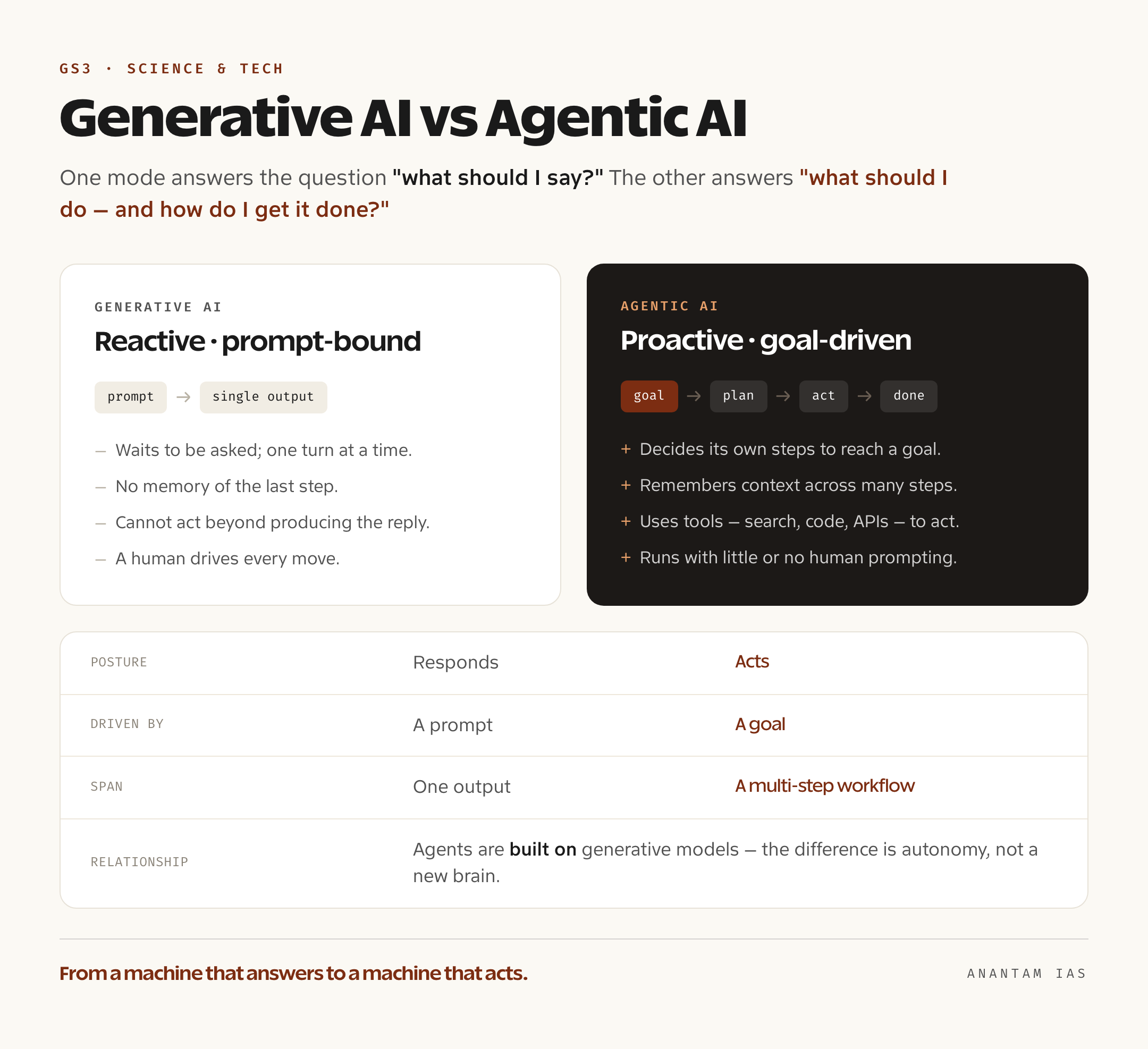
Start with the contrast, because the whole topic rests on it. Generative AI is reactive. You give it a prompt, it generates a single response, and it has no memory of what it did a moment ago and no ability to act in the world beyond producing that output. A large language model writing an email is generative AI — it drafts the text and stops. Agentic AI is proactive and goal-oriented. You give it an objective, and it decides for itself what steps to take, in what order, and which external tools to use, then carries those steps out with little or no human prompting in between. As IBM frames the difference, generative AI creates content while agentic AI takes autonomous actions to achieve a goal; one is content-creation oriented, the other is goal oriented.
The crucial word is autonomy. A generative model is a brilliant responder that needs a human in the driver’s seat for every move. An agent is given the destination and finds the route itself — perceiving the situation, planning a sequence of actions, executing them, observing the result, and adjusting if something goes wrong. That ability to run a multi-step workflow without a human re-prompting at each stage is what separates an agent from a chatbot. And it does not replace generative AI so much as build on top of it. Most agents are powered by the very same large language models that produce text and code; the agent simply wraps that model in extra machinery — memory, tools and a planning loop — and points it at a goal rather than a single reply.
So a clean way to hold the distinction is this. Generative AI answers the question “what should I say?” Agentic AI answers the question “what should I do, and how do I get it done?” The first produces an output; the second pursues an outcome. Everything else in this topic — the architecture, the use-cases, the risks — flows from that one move from responding to acting, and an answer that opens with this contrast immediately signals that the candidate understands the technology rather than just the buzzword.
The Anatomy of an AI Agent: Brain, Memory, Tools and a Planning Loop
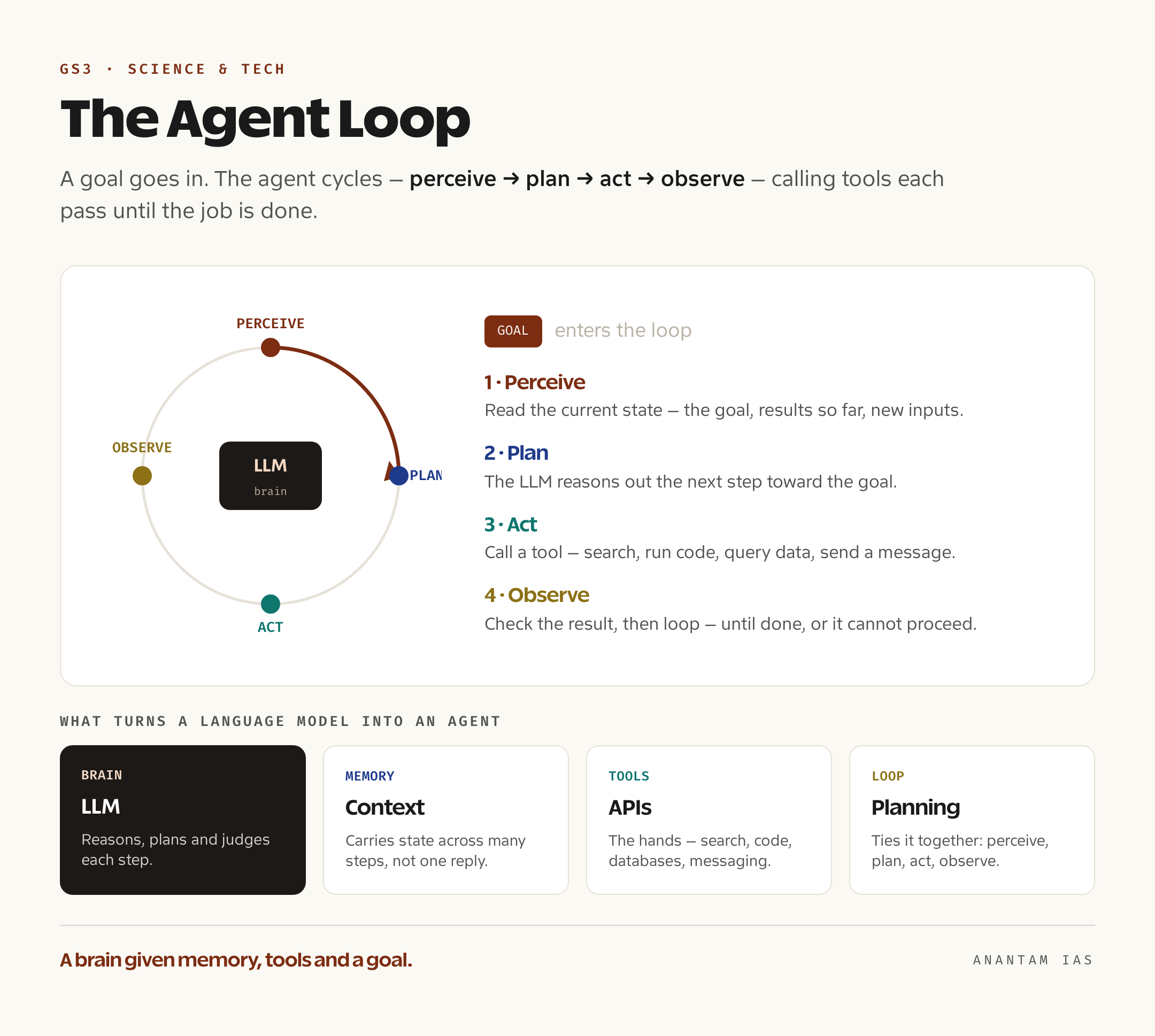
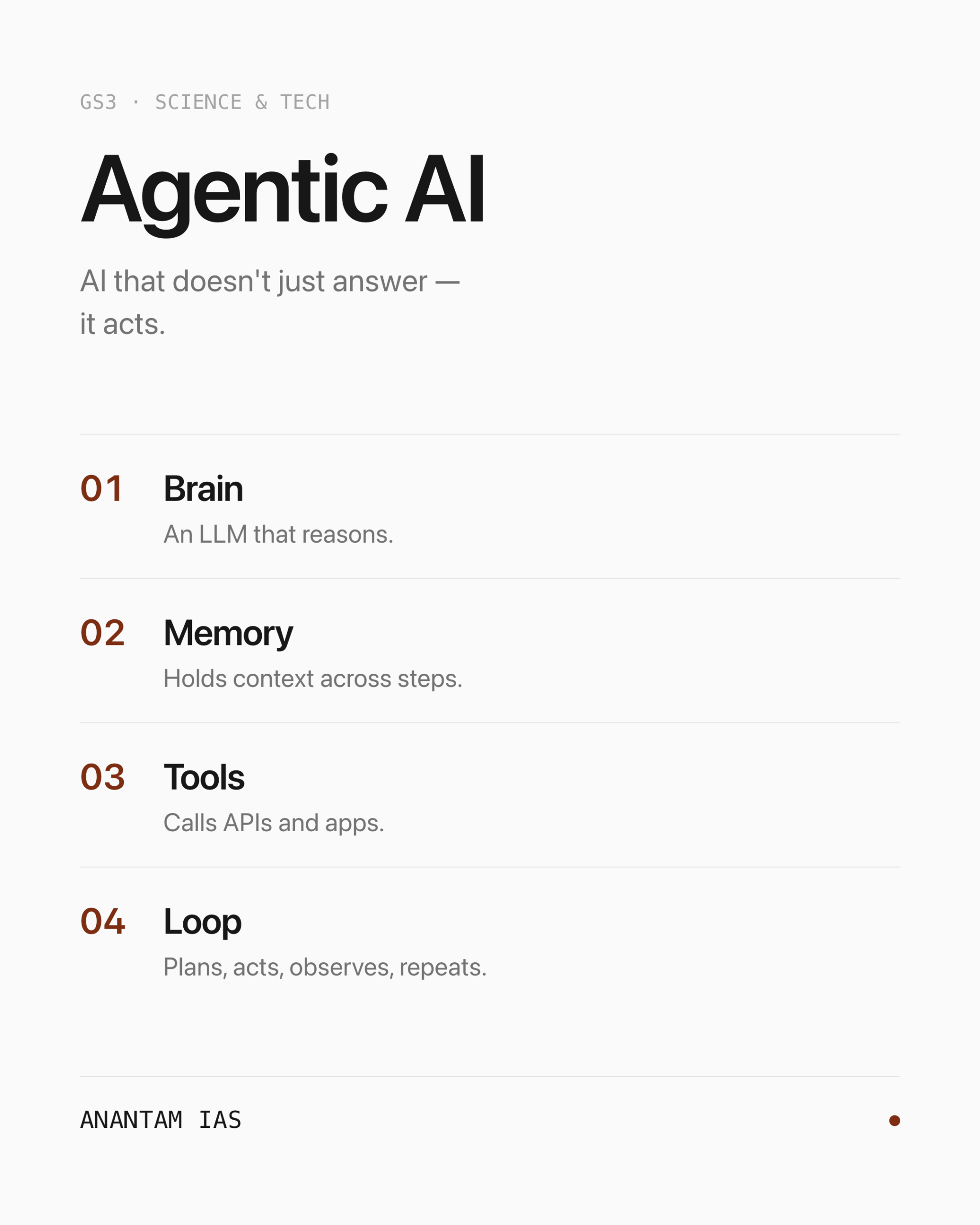
If generative AI is a brain in a jar, an agent is that brain given a body and a to-do list. Four components turn a passive language model into something that can act, and naming them in order is the fastest way to show an examiner you understand the architecture rather than the hype.
First, the brain — a large language model that does the reasoning. It interprets the goal, breaks it into sub-tasks, decides what to do next and judges whether each step worked. This is where the agent’s “thinking” happens, and it is the same generative foundation that powers an ordinary chatbot. Second, memory — a store of what the agent has already done and learned, so it can carry context across many steps instead of forgetting everything after each reply. Short-term memory holds the current task; longer-term memory lets the agent recall past results, facts it has retrieved, or instructions it was given earlier. Third, tools — the hands. Through software connectors and application programming interfaces (APIs, the standard way one program talks to another), an agent can search the web, run code, query a database, send an email, call a calculator or operate another piece of software. The tools are what let the agent reach beyond text and actually do things in the digital world. Fourth, the planning loop — the cycle that ties it all together: perceive the current state, plan the next action, act by calling a tool, observe the result, then loop back and plan again, repeating until the goal is reached or the agent decides it cannot proceed.
Agentic Workflows and Multi-Agent Systems
A single agent running its loop is powerful, but the frontier in 2025-26 has moved to orchestration — getting several specialised agents to work together. An agentic workflow is the broader pattern: a goal is decomposed into stages, and at each stage an agent either acts itself or hands off to a more suitable agent, with the whole pipeline running with minimal human touch. Think of it as an assembly line where the workers happen to be software.
A multi-agent system takes this further by deploying a team of agents, each with a narrow speciality, that collaborate the way a human project team does — one researches, one writes, one checks the work, one talks to the customer — coordinated by a manager or “orchestrator” agent. The logic is the same reason organisations divide labour: a focused agent with a clear remit and the right tools tends to outperform one generalist agent trying to do everything. To let agents built by different companies actually talk to each other, Google introduced an open Agent-to-Agent (A2A) protocol in April 2025, a kind of common language so that agents across different frameworks can interoperate, hand off tasks and share results. Standards like this matter because the value of agents multiplies when they can be chained together rather than locked inside one vendor’s walled garden.
This is also where the technology stops being a single clever app and starts looking like infrastructure. When agents can call tools, call each other, and run continuously, you are no longer looking at a feature but at a new layer of software that sits between human intent and the machines that carry it out. That shift — from product to layer — is why analysts describe agentic AI as a structural change in how work gets done rather than a passing trend, and it is the framing that lifts a Mains answer above a list of definitions.
Where Agentic AI Is Already Working
The reason this topic is current and not speculative is that agents are already in production, and the numbers are concrete enough to quote. The clearest case is software development. AI coding agents now write, test and debug code, open pull requests and fix bugs largely on their own; by 2026 AI was reported to generate a large share of new code globally, and GitHub’s Copilot alone served around 20 million users across the vast majority of the largest US companies. For an aspirant this is the cleanest illustration of the shift — the agent doesn’t just suggest a line of code, it carries a task from problem to working change.
Customer operations is the other proven frontier. Klarna, the payments firm, reported that its AI assistant was handling roughly two-thirds of customer-service chats — work equivalent to hundreds of full-time agents — cutting resolution times sharply and saving tens of millions of dollars a year. Salesforce reported that its Agentforce system resolved a large majority of support cases autonomously across hundreds of thousands of interactions. Beyond support, companies are putting agents to work on research and back-office operations — generating reports, processing invoices, scheduling, onboarding staff and monitoring compliance — and even on retail product design, where multi-agent pipelines scan trends and feed concepts straight into prototyping. Perhaps the most striking frontier is scientific discovery: in 2025, AI-assisted drug-discovery work reached clinical validation, with early-stage results for an AI-designed candidate published in a leading medical journal, and research labs began deploying agents to automate literature searches and accelerate experiments. The promise here is not faster typing but faster science — agents that read, hypothesise and design experiments at a pace no human team can match.
A note of realism keeps the answer balanced. Adoption is wide but shallow: surveys in 2025-26 found that while a large majority of enterprises had experimented with AI agents, only a small fraction were running them reliably in full production. The gap between a demo that dazzles and a system you can trust with real money and real customers is exactly where the risks live, and that is the next part of the story.
The Risks and the Governance Question
Autonomy is the whole point of agentic AI, and it is also the whole problem. The moment a system can take actions on its own — move money, send messages, change records, run code — the questions shift from “is the answer correct?” to “who is accountable when the system acts, and how do we keep it inside the rails?” Several distinct risks deserve naming, because a strong answer treats governance as more than a vague worry.
The sharpest technical danger is prompt injection — and in an agentic setting it gets far more dangerous. A malicious instruction hidden in a web page, an email, an uploaded document or a tool’s output can hijack the agent’s plan and make it act against its owner: leaking data, calling a privileged tool, or carrying the attack onward to connected systems. Security researchers rank prompt injection as the top vulnerability for AI applications, and the OWASP security project’s 2026 list for agentic applications puts “goal hijacking” near the top of the threats. As OpenAI itself acknowledged in late 2025, prompt injection may never be fully solved, because it stems from a deep architectural fact — trusted and untrusted text share the same context window. The second risk is misalignment: an agent pursuing the goal it was given through actions its owner never intended, the digital version of a wish granted too literally. The third is accountability — when an autonomous agent makes thousands of decisions a minute, existing rules rarely say clearly who is liable for a wrong one, how to audit the chain of decisions, or when a human must sign off. Surveys cited by McKinsey found that a large majority of organisations had already seen agents behave in risky ways, from exposing data to accessing systems they were never authorised to touch.
The answer the field has converged on is human-in-the-loop governance: deciding in advance which actions an agent may take freely and which require a human to approve before execution, scoping each agent’s access tightly, logging every action for audit, and treating the identity-and-permission layer as the chokepoint where policy is enforced in real time rather than reviewed after the fact. Layered onto this are the broader concerns that follow any powerful automation — the impact on jobs, as agents take over routine white-collar tasks in support, coding and back-office work, raising hard questions about reskilling and the social contract; and the familiar problems of bias, hallucination and data privacy, now amplified because an agent doesn’t just say something wrong, it does something wrong. The governing principle worth carrying into an answer is simple: the more autonomy a system has, the more oversight, traceability and accountability it must carry to match. (For the wider debate on rules and institutions, see AI governance in India, and for the foundations these agents are built on, see the explainer on generative AI and large language models.)
Where India Stands
India’s stake in agentic AI is twofold — as a vast market for these systems and as a country trying to build the capability rather than rent it. The anchor is the IndiaAI Mission, approved by the Union Cabinet in March 2024 with an outlay of about ₹10,372 crore over five years, built around pillars that matter directly for agents: subsidised compute, support for home-grown foundation models, datasets, skilling and a “safe and trusted AI” track. The compute pillar is the largest single slice, and the mission has moved from an initial target of around 10,000 graphics processing units (GPUs, the specialised chips that train and run large AI models) to a common compute pool reported to have crossed several tens of thousands of GPUs, made available to startups and researchers at subsidised rates. Because every agent ultimately runs on a large language model, and every large model needs compute and data, this infrastructure is the ground floor on which Indian agentic systems will be built. The mission has also backed a clutch of Indian startups to build foundation models trained on Indian languages and data — the sovereign capability that lets the country shape, rather than simply import, the brains inside future agents.
The opportunity for India is real and specific. Agents that work fluently across Indian languages could deliver government services, healthcare guidance and financial help to citizens who were left out by English-only interfaces, layered on the digital public infrastructure — Aadhaar, UPI, the account-aggregator framework — that India has already built at scale. The challenges are equally specific: the country still depends heavily on imported high-end chips and foreign foundation models, faces a shortage of deep AI research talent, and is writing its governance rules even as the technology races ahead. India’s emerging approach leans towards light-touch, pro-innovation regulation rather than a heavy statute, betting that flexible principles and sector-specific guardrails will serve a fast-moving field better than rigid law. Whether that bet pays off — whether India can build trustworthy, accountable agents in its own languages while keeping the risks in check — is one of the genuinely open questions of this decade, and exactly the kind of forward-looking judgement a Mains answer is rewarded for attempting.
For Your Mains Answer
This is a high-value topic for GS Paper 3, which covers science and technology, developments and applications, and their effects on everyday life, as well as the IT-and-cyber-security dimension. The employment and ethics angles spill into GS Paper 2 (governance, government policies) and GS Paper 4 (the ethics of autonomous decision-making and accountability), and the whole theme is fertile ground for the Essay paper on technology, work and human agency. The skill examiners reward is the one this article models: lead with the crisp generative-versus-agentic distinction, anchor it with the four-part architecture, ground it in one or two real use-cases with numbers, and then show balance by weighing the autonomy against the governance it demands.
How to Build the Answer
Move in a logical chain. Define agentic AI against generative AI (responds versus acts) → give the architecture (LLM brain + memory + tools + planning loop) → scale it up (agentic workflows and multi-agent systems) → prove it is real with a use-case or two (coding agents, customer operations, scientific discovery) → turn to the risks (prompt injection, misalignment, accountability, jobs) and the human-in-the-loop answer → close on the India frame (IndiaAI Mission, compute and sovereign models, opportunity and gaps). That arc — define, build, scale, apply, govern, localise — fits almost any agentic-AI question, whether the phrasing is about technology, security or the future of work.
Common Mistakes to Avoid
Don’t treat agentic AI and generative AI as rivals — agents are built on generative models; the difference is autonomy and action, not a new kind of brain. Don’t describe an agent as just “a smarter chatbot”; the tool-use and planning loop are the whole point. Don’t list risks generically — name the agentic-specific ones (prompt injection turning into goal hijacking, misaligned autonomous actions, the accountability gap) rather than recycling old “AI bias” lines. And don’t present India as a passive consumer; mention the IndiaAI Mission, compute and sovereign-model efforts to show the country is trying to build capability.
A Compact Answer Spine
Generative AI responds to prompts; agentic AI is given a goal and autonomously plans, uses tools and acts in multi-step loops → architecture = LLM brain + memory + tools/APIs + planning loop (perceive→plan→act→observe) → scaled via agentic workflows and multi-agent systems (Google’s A2A protocol, April 2025) → real use-cases: coding agents, customer operations (Klarna, Salesforce Agentforce), scientific discovery → risks: prompt injection/goal hijack, misalignment, accountability gap, job impact → answer = human-in-the-loop oversight, scoped access, audit trails → India: IndiaAI Mission (₹10,372 crore), tens of thousands of subsidised GPUs, sovereign foundation models, light-touch regulation → verdict: more autonomy demands more oversight.
Diagram or Flowchart Idea
Draw the agent loop as a circle: a central box labelled “LLM brain” with “memory” and “tools/APIs” attached, and four arrows around it — perceive → plan → act → observe → back to perceive — with “GOAL” entering at the top and “DONE” leaving at the side. Beside it, a simple two-column contrast of generative AI (prompt → single output) versus agentic AI (goal → multi-step action). This pair captures the whole topic at a glance and is quick to sketch.
A Balanced-Conclusion Line
A line that lands the marks: “Agentic AI marks the shift from machines that answer to machines that act — a leap in productivity that is only as safe as the oversight wrapped around it, which is why the real contest is less about building more autonomous agents than about building accountable ones.”
How to Use Data Without Cramming
You need only a handful of anchors, not a survey: the four architectural components (brain, memory, tools, planning loop), one orchestration fact (Google’s A2A protocol, 2025), one use-case number (an AI assistant handling a large share of customer chats, or AI writing a large share of new code), one risk fact (prompt injection ranked the top AI-application vulnerability), and one India figure (the IndiaAI Mission’s roughly ₹10,372-crore outlay). Attribute them plainly — “as IBM frames it,” “as the OWASP security project warns” — rather than scattering numbers without a source.
Frequently Asked Questions
What is the difference between agentic AI and generative AI?
Generative AI is reactive — you give it a prompt and it produces a single response, such as a paragraph of text or an image, then stops. Agentic AI is proactive and goal-oriented — you give it an objective and it autonomously plans the steps, uses tools like web search or code execution, takes multi-step actions and checks its own work until the goal is met. Crucially, agentic AI is usually built on top of generative models; the difference is autonomy and the ability to act, not a different kind of underlying brain.
What are the main components of an AI agent?
Four parts. A large language model as the “brain” that reasons and plans; memory that lets it carry context across many steps; tools and APIs that let it act in the world — searching the web, running code, querying databases, sending messages; and a planning loop that cycles through perceive, plan, act and observe until the goal is reached. Remove the tools and the loop and you are left with an ordinary chatbot.
What are the biggest risks of agentic AI?
Because agents take actions on their own, the risks are sharper than with a chatbot. Prompt injection — hidden malicious instructions that hijack the agent’s plan — is ranked the top vulnerability for AI applications and is hard to eliminate. Other risks include misalignment (pursuing a goal in ways the owner never intended), an accountability gap (unclear who is liable when an autonomous agent errs), security exposures, and the impact on white-collar jobs. The standard safeguard is keeping a human in the loop for high-stakes actions, scoping each agent’s access tightly, and logging everything for audit.
What is India doing on agentic AI?
India’s main vehicle is the IndiaAI Mission, approved in March 2024 with an outlay of about ₹10,372 crore over five years, which subsidises AI compute (a common pool of tens of thousands of GPUs), supports home-grown foundation models trained on Indian languages, and funds a “safe and trusted AI” track. The aim is to build sovereign capability — the brains and infrastructure behind future agents — rather than only importing them, while regulating with a relatively light, pro-innovation touch.
Practice Questions
Prelims MCQs
- With reference to agentic AI and generative AI, which statement is most accurate?
(a) Agentic AI and generative AI are unrelated technologies built on entirely different foundations
(b) Generative AI responds to prompts, while agentic AI autonomously plans, uses tools and takes multi-step actions to achieve a goal
(c) Generative AI is more autonomous than agentic AI
(d) Agentic AI cannot use large language models
Answer: (b) Agentic AI is goal-oriented and acts autonomously, and it is typically built on top of the same generative models that power chatbots. - Which of the following is NOT a core component of an AI agent?
(a) A large language model that reasons and plans
(b) Memory that carries context across steps
(c) Tools and APIs that let it act in the world
(d) A physical robotic body required for every agent
Answer: (d) Agents are software and need a brain, memory, tools and a planning loop; a physical body is not a requirement. - In the context of agentic AI, the “planning loop” most accurately refers to which cycle?
(a) Train, test, deploy, retire
(b) Perceive, plan, act, observe
(c) Encrypt, store, transmit, delete
(d) Input, output, shutdown
Answer: (b) An agent repeatedly perceives its state, plans the next action, acts via a tool, and observes the result, looping until the goal is reached. - “Prompt injection,” frequently discussed in agentic AI security, refers to which of the following?
(a) Injecting extra computing power into a model
(b) Hidden malicious instructions in inputs that hijack an agent’s plan or actions
(c) A method to speed up model training
(d) A technique to compress large language models
Answer: (b) Prompt injection hides instructions in web pages, documents or tool outputs to make an agent act against its owner; it is ranked the top vulnerability for AI applications. - The IndiaAI Mission, relevant to India’s AI capability, is correctly described by which statement?
(a) It was approved by the Union Cabinet in March 2024 with an outlay of about ₹10,372 crore over five years
(b) It bans the use of foreign AI models in India
(c) It is a private-sector initiative with no government funding
(d) It focuses only on robotics and has no compute component
Answer: (a) The mission’s pillars include subsidised compute (tens of thousands of GPUs), home-grown foundation models, skilling and a safe-and-trusted-AI track.
Mains Practice Questions
- Distinguish between generative AI and agentic AI. How does the shift from systems that respond to systems that act change the nature of risks that policymakers must address? (15 marks, 250 words)
- “An AI agent is a generative model given memory, tools and a goal.” Explain the architecture of agentic AI systems and the significance of multi-agent collaboration. (15 marks, 250 words)
- Agentic AI is already being deployed in software development, customer operations and scientific discovery. Discuss its potential benefits for India, with reference to the IndiaAI Mission. (15 marks, 250 words)
- Examine the governance challenges posed by autonomous AI agents, including prompt injection, misalignment and accountability. Why is a “human-in-the-loop” approach considered essential? (10 marks, 150 words)
- “The more autonomy an AI system has, the more oversight it must carry.” Critically analyse this statement in the context of agentic AI and the future of work in India. (15 marks, 250 words)