
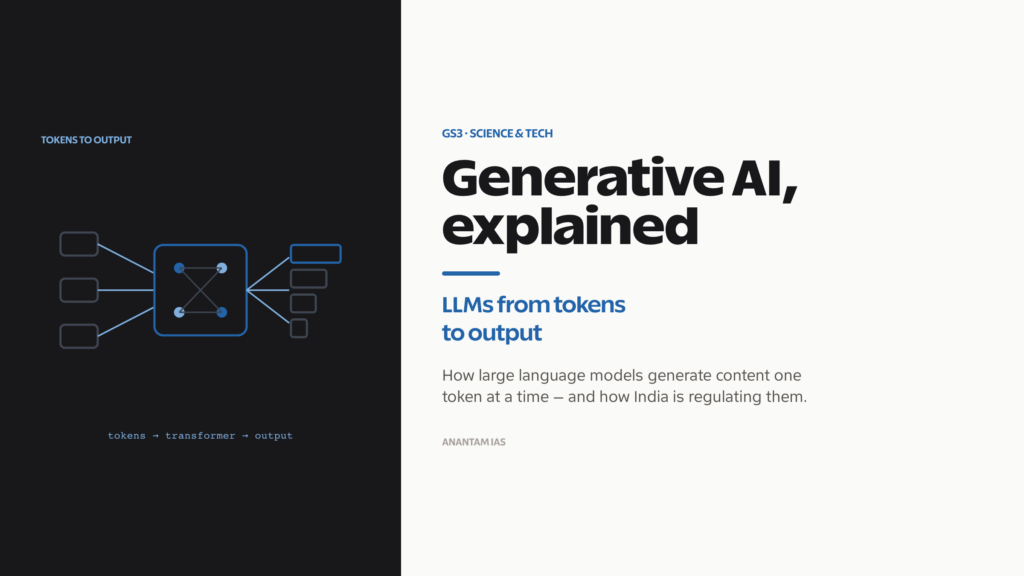
Generative AI is the branch of artificial intelligence that creates new content rather than classifying or predicting from existing content. Give it a few words of input, and it will hand back paragraphs of text, a photograph, a song, a video clip, or a working block of computer code. Every one of those outputs is generated probabilistically, one token at a time, from a model that has read most of what humans have written or recorded online.
The shift from analytical AI to generative AI is the largest change in computer science since the smartphone. Two technologies made it possible. The transformer, a neural-network architecture invented at Google in 2017, taught machines to handle sequences without losing context. The foundation model, a single model trained on internet-scale data and then fine-tuned for many tasks, made deployment economical. Together they produced ChatGPT, Gemini, Claude, Copilot, and the rest of the systems that crossed into mainstream use after late 2022.
For UPSC GS-III, generative AI is now a recurring theme in questions on emerging technology, employment, ethics, and national security. India has launched an AI mission to build sovereign compute and is drafting rules under the Digital India Act. This guide explains what generative AI is, how the major systems compare, what they are good and bad at, and how India is regulating them.
Quick Facts on Generative AI
Generative AI refers to AI systems that create new content such as text, images, audio, video, or code by learning patterns from large datasets. Most modern generative AI is built on a class of neural networks called transformers, introduced in the 2017 paper Attention Is All You Need.
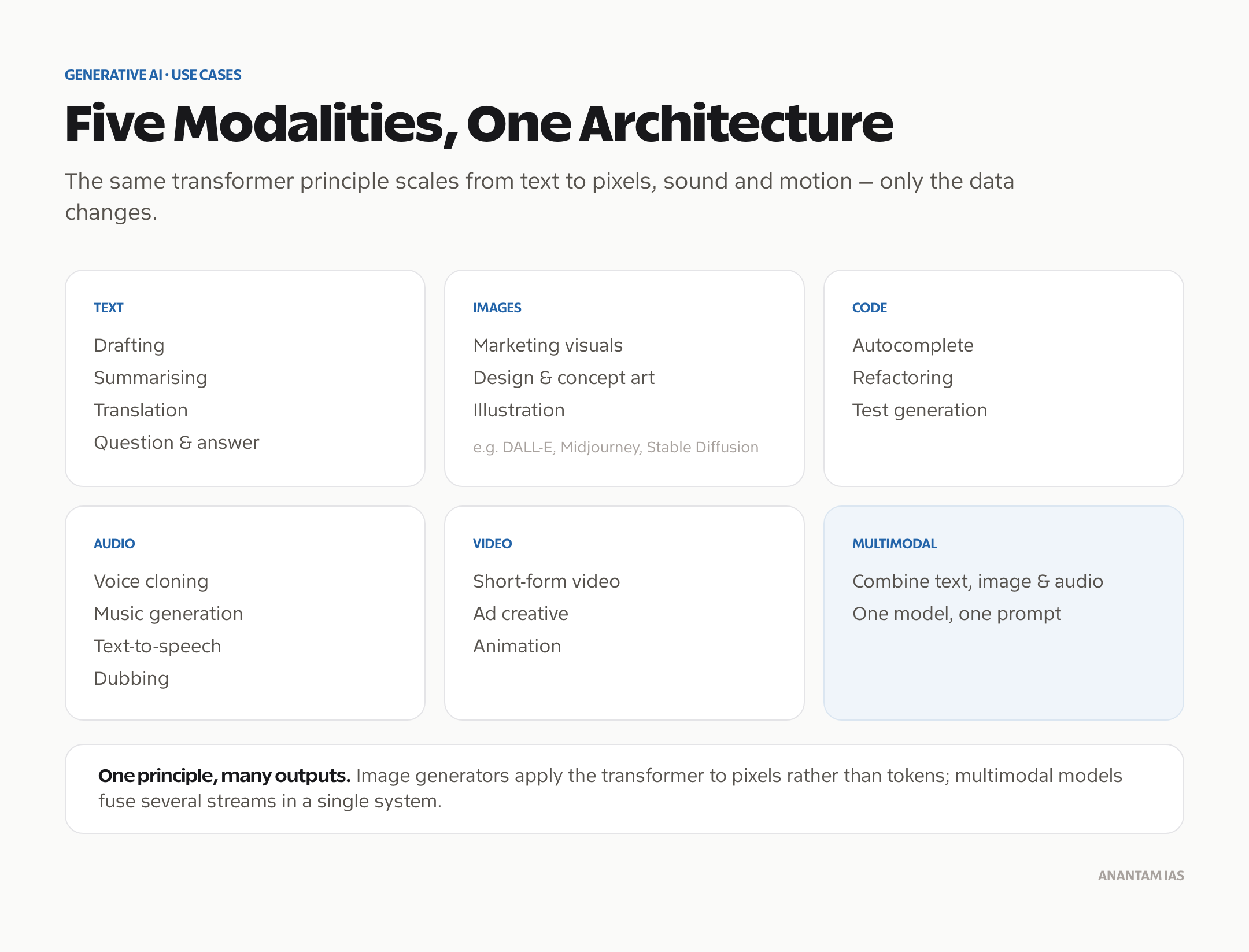
A large language model, abbreviated LLM, is a transformer-based generative AI specialised for text. It is trained on hundreds of billions of words and stores its knowledge as billions of numerical parameters. ChatGPT, Google Gemini, Anthropic Claude, Meta Llama, xAI Grok, and Mistral are all LLMs. Image generators such as DALL-E, Midjourney, and Stable Diffusion use the same transformer principle on pixels rather than tokens. Multimodal models combine text, image, audio, and video in one system.
The economics are extreme. Training a frontier LLM costs hundreds of millions of dollars and requires tens of thousands of high-end graphics processors, GPUs, mostly NVIDIA. The compute and energy requirements are why generative AI policy now overlaps with semiconductor policy and energy policy.
How a Large Language Model Works
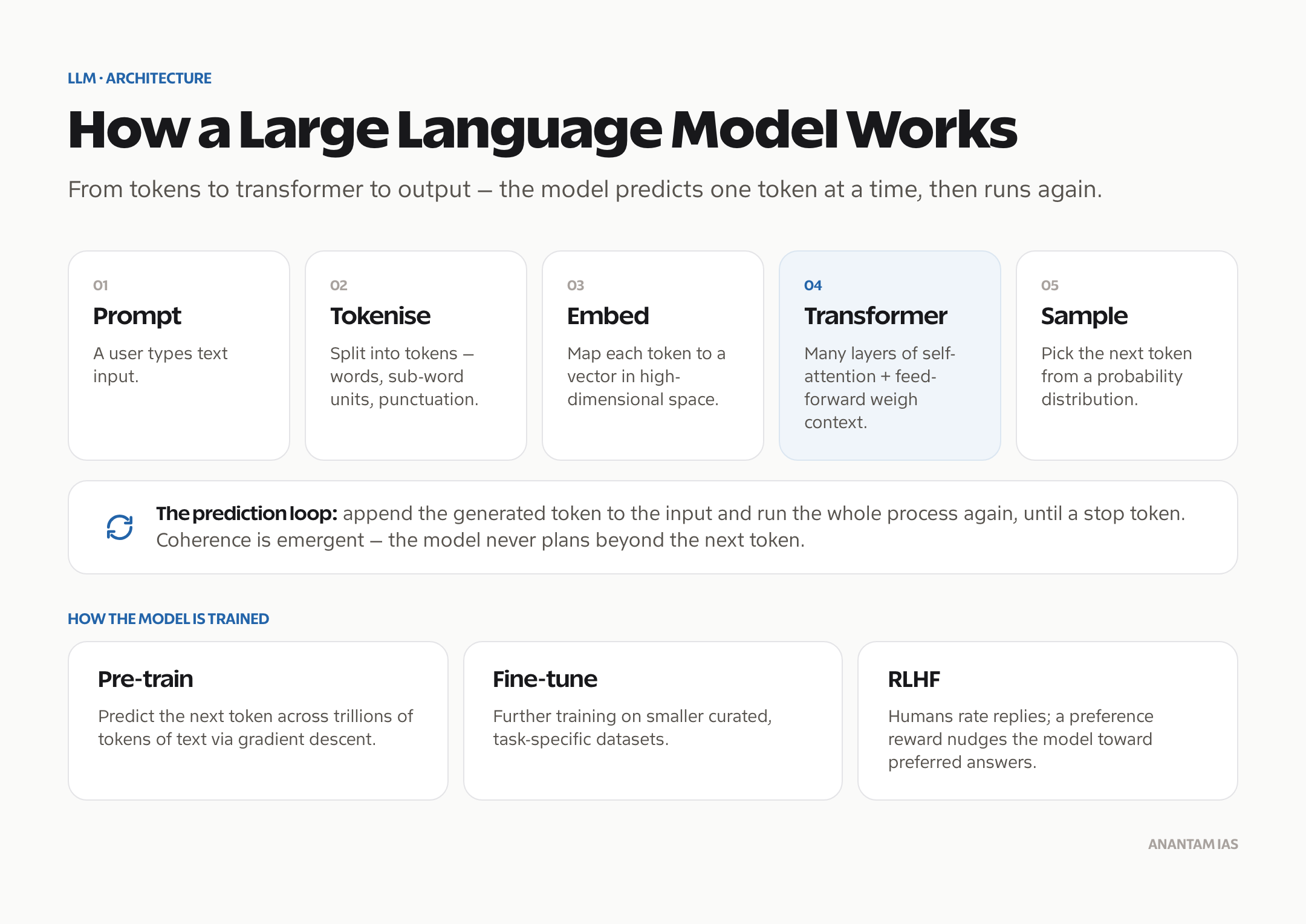
The simplest way to understand an LLM is to follow what happens when a user types a prompt. The text is broken into tokens, which can be whole words, parts of words, or punctuation. Each token is mapped to a numerical vector, an embedding, that captures its meaning in a high-dimensional space.
The vectors flow through a stack of transformer layers. Each layer applies an attention mechanism that lets every token in the input pay attention to every other token, weighted by relevance. This is what gives the model its grasp of context. The same word can mean different things in different sentences, and attention is how the model figures out which meaning applies.
After the transformer stack, the model produces a probability distribution over its entire vocabulary for the next token. It samples one token, appends it to the input, and runs the whole process again. The model never plans more than one token ahead. Coherence over a paragraph is an emergent property of the prediction loop, not the result of any explicit planning.
Training is where the heavy lifting happens. The model is shown trillions of tokens of text and asked to predict the next token at each position. It adjusts its parameters by gradient descent until its predictions match the training data. This pre-training stage is followed by fine-tuning on smaller curated datasets and reinforcement learning from human feedback, RLHF, where humans rate responses and the model is nudged toward the kinds of replies humans prefer.
The number of parameters has grown by orders of magnitude. GPT-2 in 2019 had 1.5 billion parameters. GPT-3 in 2020 had 175 billion. The most capable 2025 frontier models have well over a trillion parameters and are often mixtures of experts, where only a fraction of the parameters fire on any given query.
Major Generative AI Systems and Their Owners
The generative-AI market in 2026 is dominated by a small number of companies, mostly in the United States. Knowing the major systems and who owns them is now part of the prelims-level current-affairs vocabulary.
| System or Tool | Owner | Type |
|---|---|---|
| ChatGPT | OpenAI, USA | General-purpose conversational LLM |
| Google Gemini | Google or Alphabet, USA | Multimodal LLM with deep search integration |
| Claude | Anthropic, USA | Conversational LLM with safety focus |
| GitHub Copilot | Microsoft and GitHub, USA | AI coding assistant built on OpenAI models |
| Grok | xAI, USA | Conversational LLM linked to X, formerly Twitter |
| DALL-E | OpenAI, USA | Image generation from text prompts |
| Llama | Meta, USA | Open-weights LLM family |
| Mistral | Mistral AI, France | Open-weights LLM family |
| BharatGPT | CoRover, India | Indic-language conversational AI |
| Krutrim | Krutrim Si Designs, India | Multilingual Indian LLM |
The Indian entrants are early but real. BharatGPT and Krutrim are building Indic-first models that handle the country’s official languages natively rather than translating from English. The IndiaAI Mission, approved by the Union Cabinet in March 2024, will fund domestic foundation models and provide subsidised compute through the IndiaAI Compute Capacity programme.
What Generative AI Can and Cannot Do
The systems are remarkably good at tasks that involve summarising, drafting, translating, paraphrasing, and pattern matching across text. They can write a draft brief, summarise a 30-page report, translate between major languages, generate marketing copy, and produce passable first drafts of computer code. They can also generate convincing photographs, illustrations, short videos, and synthetic voices that are very hard for an untrained ear to spot as fake.
They are unreliable on tasks that require precise factual accuracy, structured arithmetic, or up-to-the-minute information. LLMs hallucinate, that is, they generate confident text that is factually wrong, because they are sampling from a probability distribution rather than retrieving from a verified database. Their training data has a cut-off date, and they have no built-in way to know what is true.
They are also bad at long-horizon planning. An LLM can write a paragraph that describes a multi-step plan, but the actual reasoning behind the plan is usually shallow. This is why LLM-driven agents, systems that act in the world rather than just talk, still need careful scaffolding and monitoring.
The most under-appreciated weakness is bias. Models trained on internet text inherit the prejudices and demographic skews of that text. They underperform on low-resource languages, including most Indian languages, and they reflect the cultural assumptions of the English-language web. Mitigating these biases is now a research field of its own.
Generative AI and Indian Languages
India’s linguistic diversity is the bottleneck for generative AI in the country. Frontier models are still trained mostly on English data, with smaller volumes of Hindi, Bengali, and Tamil. Most Indian languages are low-resource, meaning the model has seen far less text in them than in English, and the quality drops accordingly.
Bhashini, the National Language Translation Mission run by the Ministry of Electronics and IT, is trying to fix this. It has built corpora and translation models for 22 scheduled languages and offers them as APIs to government departments and startups. AI4Bharat, an IIT Madras research group, has released open-weights Indic LLMs and benchmark datasets that frontier developers can incorporate.
The economic stakes are real. If Indic-language generative AI is built only by foreign frontier labs, India will pay foreign companies for every query its citizens make in Hindi or Tamil. If domestic developers can fine-tune open-weights models on Indic data, the economics flip. This is one of the reasons the IndiaAI Mission is investing in domestic compute.
Generative AI in the Job Market
Every wave of automation has shifted the boundary between what machines do and what humans do. Generative AI is shifting that boundary inside white-collar work for the first time. The tasks most exposed are the ones that involve drafting, summarising, translating, basic coding, and template-driven analysis.
The early evidence from the United States and Europe is that adoption raises productivity for most knowledge workers but compresses the wage premium for entry-level roles, where the marginal task is most easily automated. Customer-support agents, paralegals, junior copywriters, junior coders, and back-office analysts are seeing the largest changes.
For India, the impact cuts both ways. The IT services industry has historically employed hundreds of thousands of engineers in tasks that an LLM can now do faster. At the same time, India’s BPO and KPO base means the country is uniquely well placed to redeploy that workforce into AI-augmented roles, provided training keeps pace. The Skill India programme has begun integrating generative-AI modules into its courses, but the scale needs to grow several fold.
Ethics, Bias, and Misinformation
Generative AI raises three broad ethical concerns. The first is misinformation, where models can produce convincing fake text, fake images, and fake voices on demand. Deepfake political videos, synthetic fraud calls that mimic a relative’s voice, and AI-generated misinformation on social media are now routine.
The second is bias, where models inherit and amplify stereotypes from their training data. Studies of major LLMs have found that they apply different defaults to gendered roles, caste-coded names, and minority languages, sometimes in ways that would be illegal under equal-opportunity rules in many jurisdictions.
The third is intellectual property, where models trained on copyrighted text or images can reproduce styles and sometimes verbatim passages of their training data. Lawsuits in the United States, the United Kingdom, and India are now testing the boundaries of fair use for AI training data. The 2024 amendments to India’s Patents Rules and the ongoing draft Digital India Act both touch on this question.
India’s Regulatory Approach
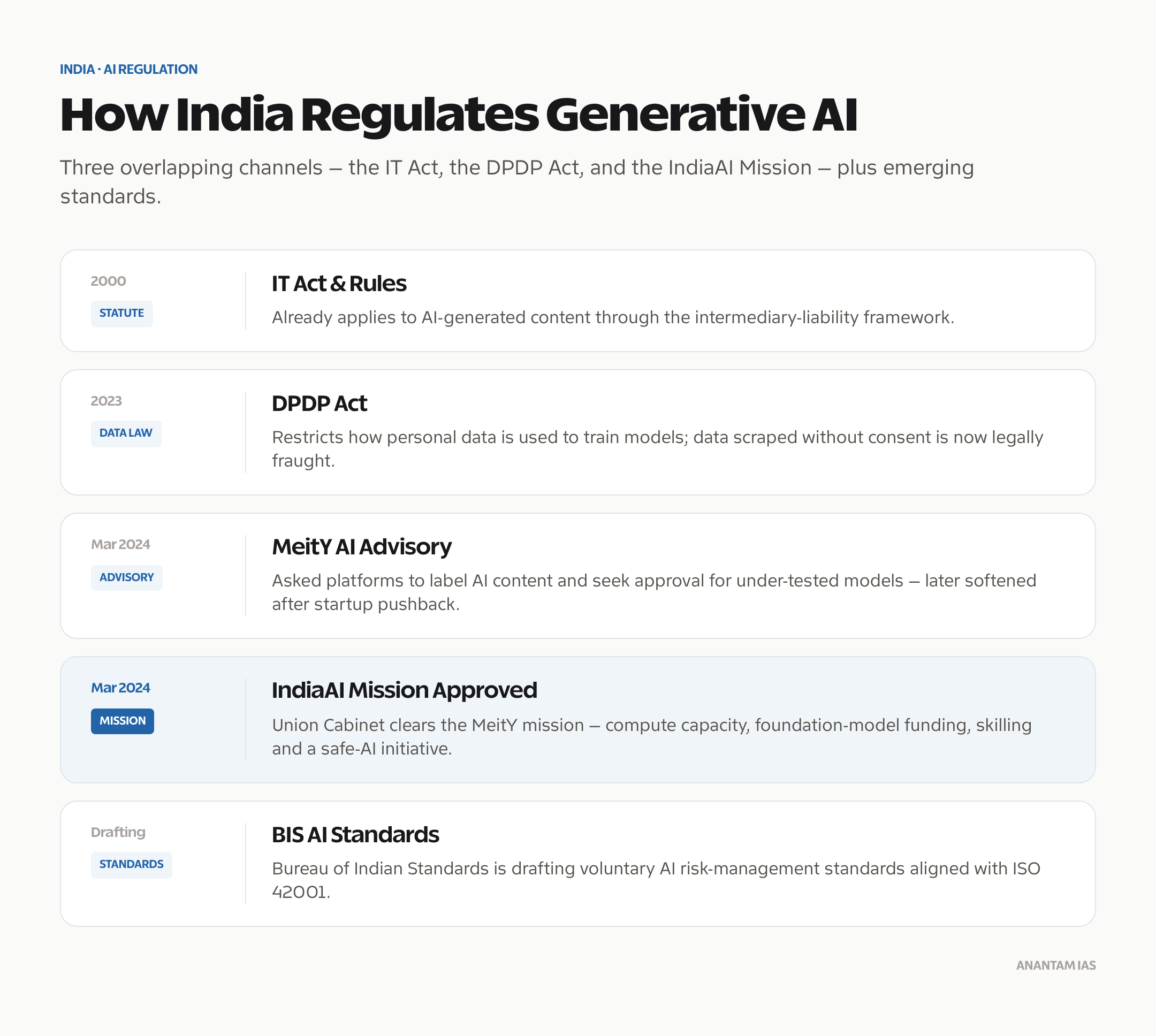
India is regulating generative AI through three overlapping channels. The first is the IT Act, 2000 and its rules, which already apply to AI-generated content under the intermediary-liability framework. The Ministry of Electronics and IT issued an advisory in March 2024 asking platforms to label AI-generated content and seek government approval for under-tested generative models. The advisory was later softened after pushback from startups.
The second is the Digital Personal Data Protection Act, 2023, which restricts how personal data can be used to train AI models. Personal data scraped without consent for training is now legally fraught.
The third is the IndiaAI Mission, which sits inside MeitY and combines compute capacity, foundation-model funding, application development, future-skills training, and a safe-AI initiative. The mission is the carrot. The DPDP Act and the IT Rules are the sticks. Together they form the closest thing India has to a generative-AI policy.
The Bureau of Indian Standards is also drafting voluntary standards for AI risk management aligned with the ISO 42001 international standard.
Why Generative AI Matters for UPSC GS-III
GS-III tests candidates on awareness of emerging technology and its socio-economic impact. Generative AI now appears in prelims-style factual questions, who owns ChatGPT, what is a transformer, what is RLHF, and in mains questions about employment, ethics, and India’s regulatory posture.
The cleanest UPSC framing of generative AI is as a general-purpose technology, like electricity or the internet, that requires policy in three layers, infrastructure, application, and risk. Infrastructure means compute, energy, and data. Application means productivity, public services, and language equity. Risk means misinformation, bias, copyright, and security. Linking generative AI to a public service such as health, education, or grievance redressal makes a strong mains answer.
Frequently Asked Questions
What is generative AI?
Generative AI is artificial intelligence that creates new content, including text, images, audio, video, and code, by learning statistical patterns from large datasets. Most modern generative AI is built on transformer-based neural networks trained on internet-scale data.
What is the difference between generative AI and a large language model?
Generative AI is the broad category. A large language model, LLM, is a generative AI specialised for text. ChatGPT, Gemini, and Claude are LLMs. DALL-E and Midjourney are also generative AI but operate on images, not text. Multimodal systems combine both.
Who owns ChatGPT, Gemini, and Claude?
ChatGPT and DALL-E are owned by OpenAI in the United States. Gemini is owned by Google or Alphabet. Claude is owned by Anthropic. GitHub Copilot is owned by Microsoft and GitHub and uses OpenAI models. Grok is owned by xAI, the company linked to Elon Musk.
What is the IndiaAI Mission?
The IndiaAI Mission is a Union government programme approved in March 2024 with an outlay of around Rs 10,300 crore over five years. It funds domestic compute capacity, foundation-model development, application building, future-skills training, and a safe-AI initiative under the Ministry of Electronics and IT.
Are large language models always factually correct?
No. LLMs sample from a probability distribution and routinely produce confident but factually wrong text, a behaviour called hallucination. Treating LLM output as a reference source without verification is unsafe. They are best used as drafting and summarising assistants, with a human in the loop for fact checking.
How is generative AI being regulated in India?
India regulates generative AI through the IT Act, 2000 and its rules, the Digital Personal Data Protection Act, 2023, and the IndiaAI Mission inside MeitY. Specific advisories on labelling AI-generated content and government approval for under-tested models have been issued and revised. A comprehensive Digital India Act is in draft.
Tell Google you want more of this.
Add Anantam IAS as a preferred sourceOne tap, and this site shows up more often in your own Top Stories, AI Overviews and AI Mode. Remove it any time.