The Agni Missile Family: India’s Ballistic Missile Backbone Explained
A complete UPSC GS-III explainer on India's Agni missile family. Covers Agni-1 through Agni-5 and Agni-Prime, ranges, propulsion, MIRV capability, the canisterised launch system, and how the family fits into India's nuclear doctrine and credible minimum deterrent.
The Agni family is the spine of India’s land-based nuclear deterrent. The name comes from the Sanskrit word for fire, and the family covers everything from short-range battlefield missiles to intercontinental systems that can reach across the Pacific. Every Agni is built by the Defence Research and Development Organisation, DRDO, and operated by the Strategic Forces Command, the tri-service body that manages India’s nuclear weapons.
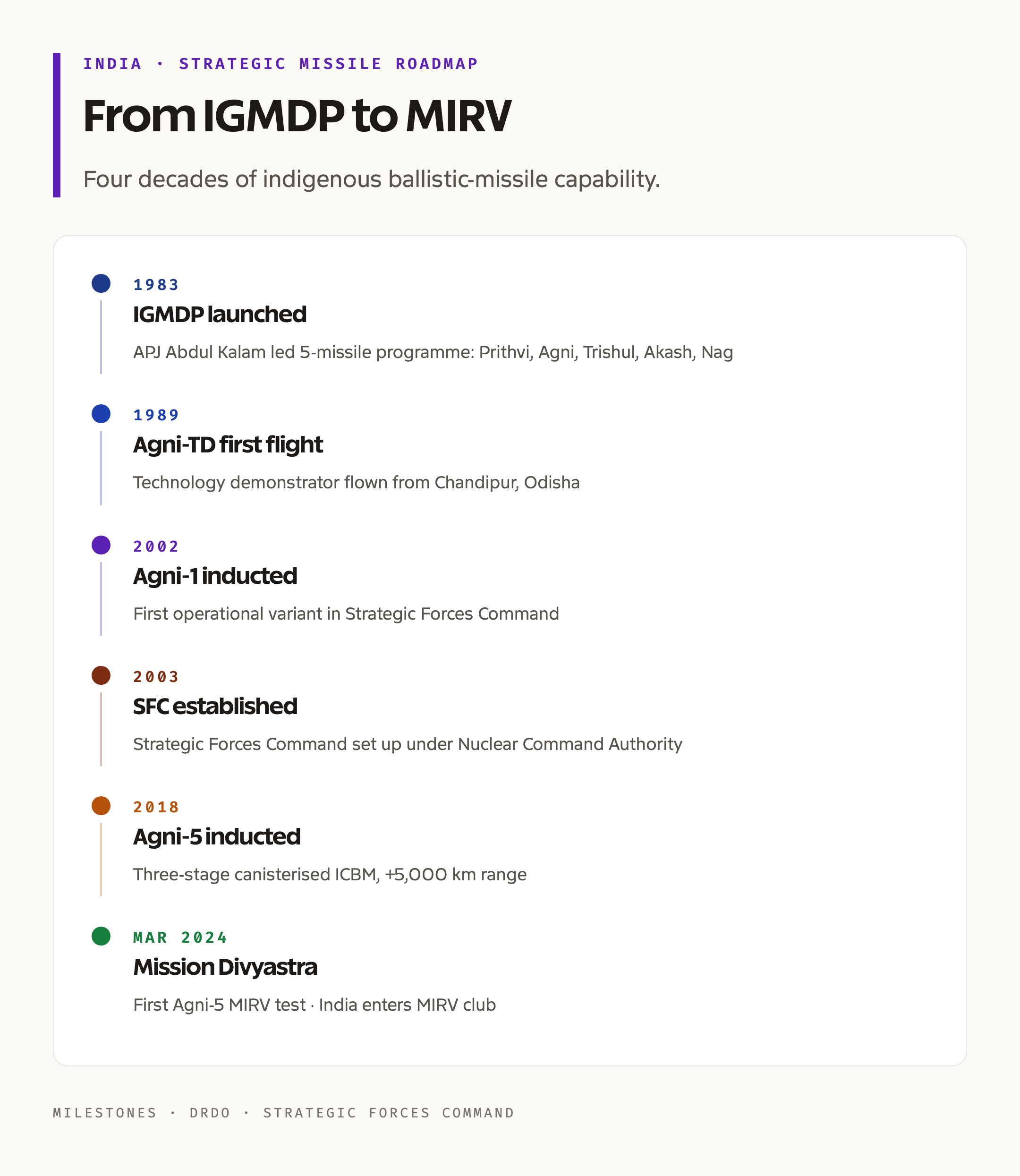
The family has been built up incrementally over four decades. The earliest Agni was a technology demonstrator flown in 1989 under the Integrated Guided Missile Development Programme. The latest variant, Agni-5, was inducted in 2025 with a multiple independently targetable re-entry vehicle, MIRV, capability that takes India into a small club of countries with that technology. Agni-Prime, the newest addition, replaces the older short and medium-range variants with a single canisterised, road-mobile, two-stage solid-propellant design.
For UPSC GS-III, the Agni family touches on defence technology, strategic affairs, the no-first-use nuclear doctrine, and the science behind solid-propellant rocketry. This guide walks through every variant, the underlying technology, the operational role, and the place of the family in India‘s credible minimum deterrent.
Quick Facts on the Agni Family
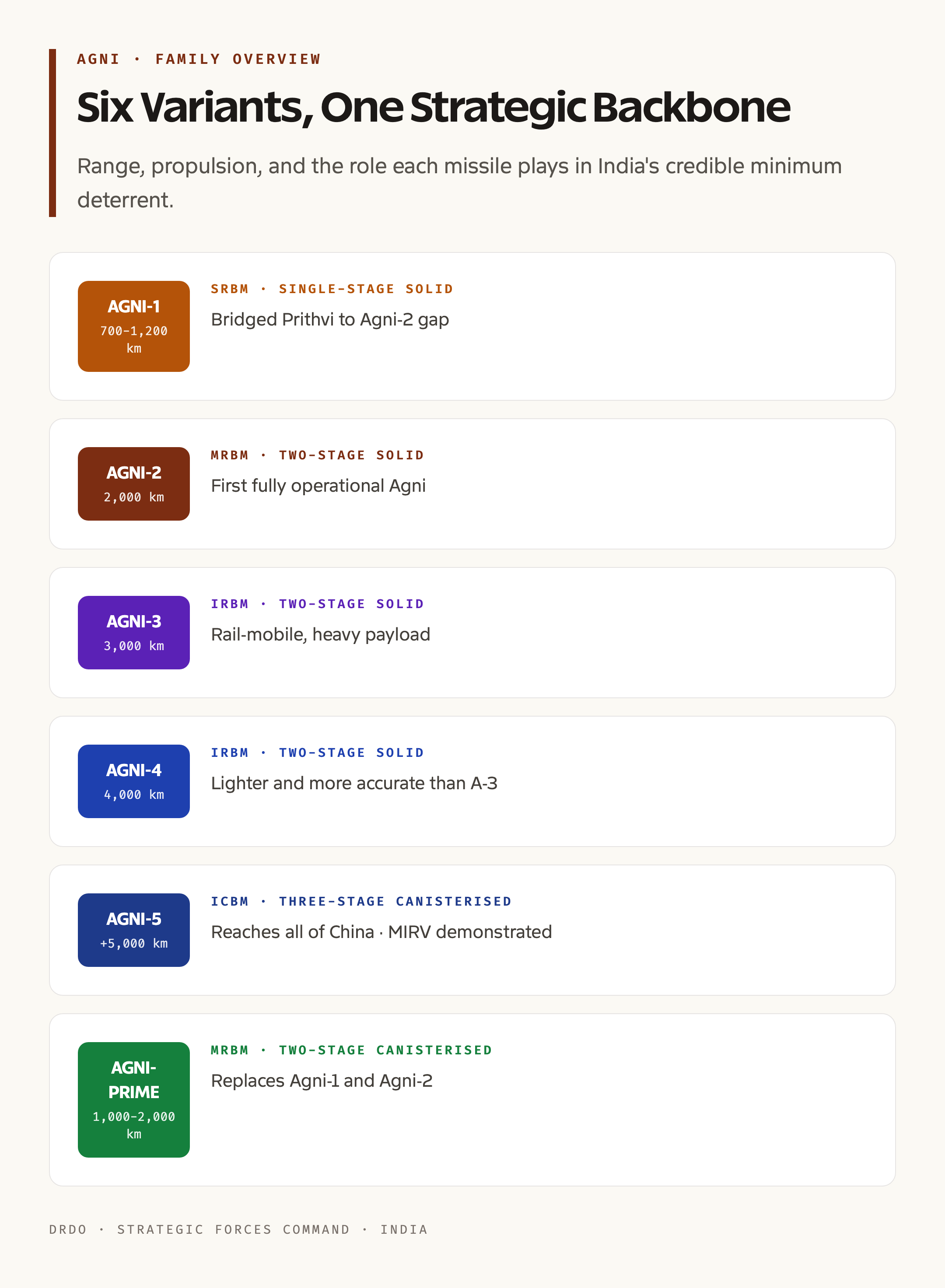
The Agni family is a series of medium and long-range surface-to-surface ballistic missiles developed by DRDO. The first flight test of an Agni technology demonstrator took place in May 1989 from Chandipur, Odisha. Agni-1 was the first inducted variant, in 2002.
The family today spans Agni-1, Agni-2, Agni-3, Agni-4, Agni-5, Agni-Prime, and the under-development Agni-6. Ranges run from about 700 kilometres at the shortest end to over 5,000 kilometres at the longest. All operational variants are nuclear-capable, although the missile itself can be paired with conventional warheads as well.
The Strategic Forces Command, set up in 2003 under the Nuclear Command Authority, owns and operates Agni systems. Production of the missiles, particularly the Agni-Prime canisterised version, has been gradually shifted from DRDO labs to Bharat Dynamics Limited in Hyderabad to support faster induction.
How a Ballistic Missile Works
A ballistic missile follows an unpowered trajectory after its rocket motors burn out, much like a thrown stone but on a continental scale. The flight has three phases. The boost phase, when rocket motors fire and the missile climbs out of the atmosphere. The midcourse phase, when the warhead coasts on a long ballistic arc through space. The terminal phase, when the warhead re-enters the atmosphere and falls towards the target.
Range is set by the burnout velocity at the end of the boost phase. Higher velocity gives a longer arc and a longer range. Multi-stage missiles drop empty rocket motors as they climb, which lets the upper stages reach higher velocities than a single-stage missile of the same total mass.
Solid propellants combine fuel and oxidiser into a rubbery composite that burns at a controlled rate when ignited. They store stably for years, which makes them ideal for missiles that need to be ready to launch on short notice. Liquid propellants give higher performance per kilogram of fuel but need to be loaded just before launch and are unstable in storage. Every operational Agni today uses solid propellant.
Accuracy is measured by circular error probable, CEP, the radius within which half the warheads will land. Modern Agnis use a combination of inertial navigation, ring-laser gyros, and satellite navigation aids to push CEP under 100 metres at intercontinental ranges. Manoeuvrable re-entry vehicles, MaRVs, and MIRVs add further sophistication to terminal performance.
The Agni Variants Compared
The simplest way to remember the family is by range and mission. Each variant fills a specific operational gap.
| Missile | Range | Classification | Stages | Key Feature |
|---|---|---|---|---|
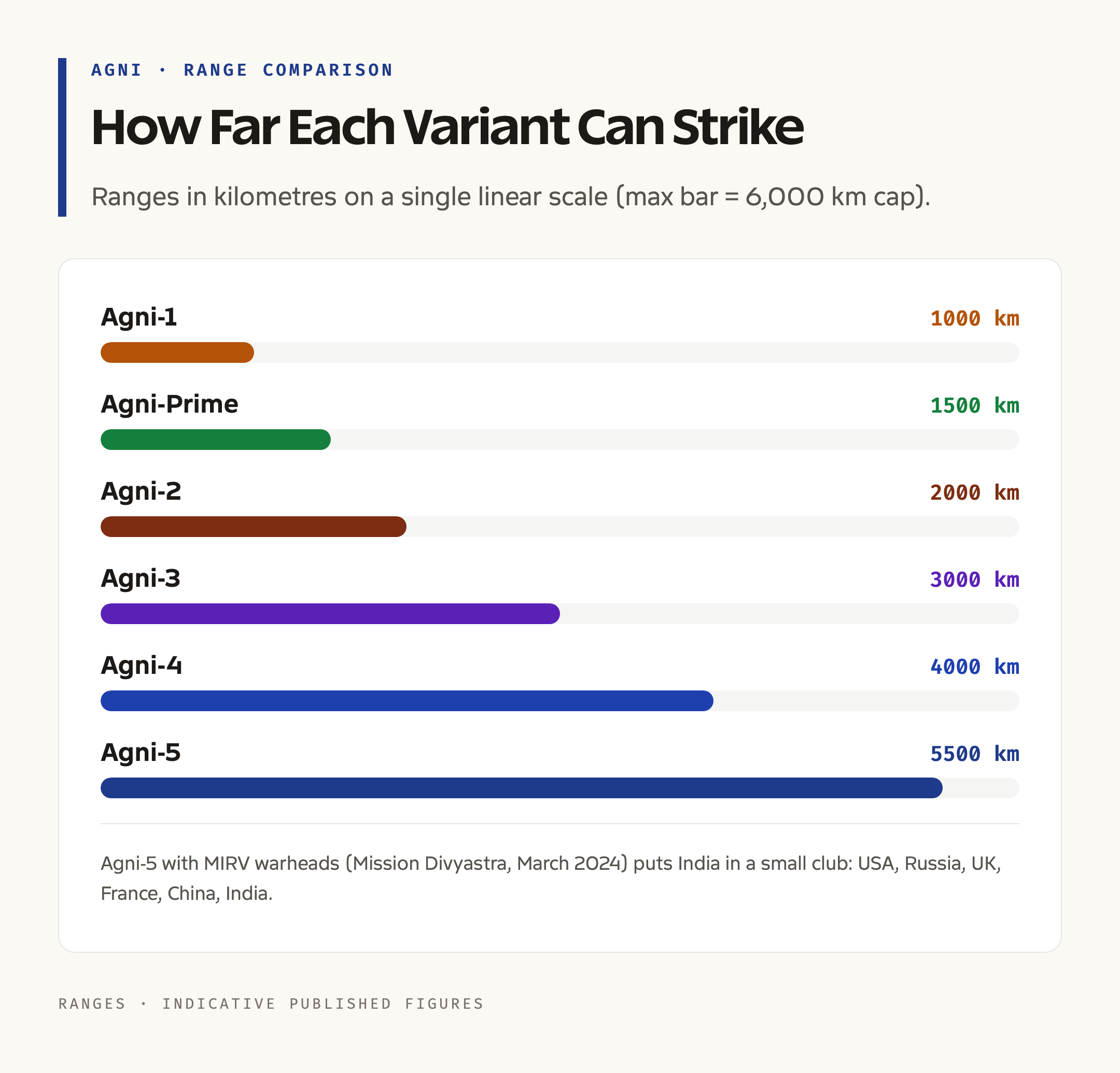
| Agni-1 | 700 to 1,200 km | SRBM | Single-stage solid | Bridged the gap between Prithvi and Agni-2 |
| Agni-2 | 2,000 km | MRBM | Two-stage solid | First fully operational Agni |
| Agni-3 | 3,000 km | IRBM | Two-stage solid | Rail mobile, heavy payload |
| Agni-4 | 4,000 km | IRBM | Two-stage solid | Lighter and more accurate than Agni-3 |
| Agni-5 | over 5,000 km | ICBM | Three-stage solid, canisterised | Reaches all of China, MIRV capable |
| Agni-Prime | 1,000 to 2,000 km | New-gen MRBM | Two-stage solid, canisterised | Replaces Agni-1 and Agni-2 |
| Agni-6 | 8,000 to 12,000 km projected | ICBM | Under development | Designed for MIRV from the outset |
Agni-1 was developed quickly in the early 2000s to fill a strategic gap between the short-range Prithvi and the longer-range Agni-2. It is single-stage solid-propellant and is now being phased out as Agni-Prime replaces it.
Agni-2 was the first Agni to enter regular service. Its two-stage solid-propellant design and 2,000-kilometre reach made it the workhorse of the early 2000s deterrent.
Agni-3 added intermediate range and a heavier payload, with a rail-mobile launcher option. Agni-4 followed with a lighter, more accurate, more reliable version of the same range class, using composite materials extensively.
Agni-5 is the breakthrough system. Three solid stages, a fully canisterised design, road-mobile launchers, and a published range of over 5,000 kilometres. Mission Divyastra in March 2024 successfully tested an Agni-5 with multiple independently targetable re-entry vehicles, demonstrating MIRV capability for the first time. Each MIRV warhead can hit a separate target, drastically expanding the missile’s deterrent value.
Agni-Prime is the youngest variant. It is shorter than the older Agnis but carries a similar payload, and its canister-launch system means the missile is sealed at the factory and can be transported, stored, and launched without further preparation. Agni-Prime is designed to replace Agni-1 and Agni-2 in the inventory.
Agni-6 is reported to be under development with a projected range of 8,000 to 12,000 kilometres and MIRV capability designed in from the start. It has not been flight-tested in public.
Canisterisation and Why It Matters
A canister-launched missile is sealed inside a hermetically protected tube at the factory, transported to the field still inside the tube, and launched directly from it. Sea moisture, dust, temperature swings, and rough handling never touch the missile. This dramatically improves storage life and reaction time, and it lets a launcher carry the missile into the field without the elaborate ground preparations older missiles needed.
Agni-5 and Agni-Prime are both canisterised. The canisterised design is what gives Agni-Prime its road-mobile flexibility and what gives Agni-5 the ability to launch from a Tatra-based transporter erector launcher with little warning. The Strategic Forces Command sees canisterisation as a survivability multiplier. A road-mobile canisterised missile is much harder for an adversary to track and destroy in a first strike than a fixed silo missile.
Canisterisation also reduces the time between political decision and missile launch from hours to minutes. This is operationally significant under India’s no-first-use nuclear doctrine, where the deterrent must be able to survive a first strike and respond credibly.
MIRV and Mission Divyastra
A MIRV is a single missile that releases several warheads, each of which can be steered to a separate target. The bus carrying the warheads, the post-boost vehicle, makes small adjustments to its trajectory between releases, sending each warhead onto its own re-entry path.
The strategic logic is simple. A single-warhead missile can be defeated by a single interceptor. A six-warhead MIRV missile would require at least six interceptors, plus extras for the decoys that usually accompany the warheads. MIRVs make ballistic-missile defence orders of magnitude harder.
Mission Divyastra, conducted on March 11, 2024, was India’s first successful flight test of an Agni-5 with MIRV warheads. The Prime Minister announced the success on the same day. With this test, India joined the United States, Russia, the United Kingdom, France, and China as the only countries with operational MIRV capability.
The MIRV test was politically as well as technologically important. It signalled that India’s nuclear deterrent could absorb a first strike and still deliver enough warheads to make any adversary’s first-strike calculation unattractive.
Where the Agni Fits in Indian Doctrine
India’s nuclear doctrine, last updated in 2003, rests on credible minimum deterrence and no first use. Credible minimum means India’s nuclear forces must be sufficient to inflict unacceptable damage in a retaliatory strike, but no larger than that. No first use means India will not use nuclear weapons unless attacked by them.
The Agni family is the land leg of the resulting nuclear triad. The other two legs are submarine-launched ballistic missiles, currently the K-15 and K-4 carried by Arihant-class submarines, and air-launched delivery, currently the Mirage 2000 and Su-30 MKI carrying nuclear-capable cruise missiles.
The family is sized to cover every adversary at every range. Agni-1 and Agni-Prime cover the short and medium range against Pakistan. Agni-3 and Agni-4 cover the intermediate range, which is most of China. Agni-5 covers the entire Chinese landmass, including Beijing, and reaches into the western Pacific. Agni-6, when inducted, will give India intercontinental reach.
The doctrine’s credibility rests on the survivability and reliability of these missiles. Canisterisation, road mobility, and MIRV capability together make a credible second-strike posture. The Strategic Forces Command operates the systems under the Nuclear Command Authority, with the Prime Minister at its apex.
Industry, Production, and Self-Reliance
DRDO designs the Agni systems through its Advanced Systems Laboratory, ASL, in Hyderabad and the Defence Research and Development Laboratory, DRDL. Production is shared with Bharat Dynamics Limited and a network of private-sector partners. The propulsion stages are largely indigenous, using composite solid propellants developed in India.
The Agni programme is a flagship for the Atmanirbhar Bharat in defence agenda. The MIRV bus, the inertial navigation, the carbon-composite re-entry vehicle, and the canister system are all Indian-designed. Some specialised electronics and materials still come from overseas, but the strategic core of the missile is sovereign.
Production capacity has scaled with demand. Agni-Prime is being inducted at a faster rate than older variants because of its modular design and the canister-launch system, which simplifies deployment.
Why the Agni Family Matters for UPSC GS-III
GS-III asks candidates to engage with defence technology, strategic affairs, and India’s place in the global order. The Agni family is the cleanest example of India’s indigenous strategic capability. Prelims questions cluster around ranges, classifications, and key tests. Mains questions tend to ask about doctrine, deterrence, and the implications of MIRV.
The strongest answers connect three layers. The technology layer, what each missile does and how. The doctrinal layer, why India needs that capability and how it fits with no-first-use. The strategic layer, how the family shapes India’s relationship with Pakistan, China, and the wider internal security and external-security architecture. Linking the Agni programme to the older IGMDP shows the long arc of India’s missile capability.
Frequently Asked Questions
What is the range of Agni-5?
Agni-5 has a published range of over 5,000 kilometres, which makes it an intercontinental ballistic missile by the most common technical definition. Some external estimates put the actual range higher, possibly above 7,000 kilometres. With MIRV warheads demonstrated in Mission Divyastra in March 2024, it can strike multiple targets across all of China and well into the western Pacific.
What is the difference between Agni-Prime and Agni-1?
Agni-Prime is a new-generation two-stage solid-propellant canisterised missile with a range of 1,000 to 2,000 kilometres. It replaces the older single-stage Agni-1, which has a range of 700 to 1,200 kilometres. Agni-Prime is lighter, more accurate, and can be road-mobile and launched from sealed canisters, giving it much faster reaction time.
Who operates the Agni missiles?
The Agni missiles are operated by the Strategic Forces Command, SFC, a tri-service command set up in 2003. The SFC reports to the Nuclear Command Authority, which has the Prime Minister as its political head and the National Security Adviser as a key adviser.
Is Agni-5 nuclear-capable?
Yes. Every operational Agni variant is nuclear-capable. The missile itself can carry conventional warheads as well, but the strategic role of the family is nuclear deterrence under India’s credible minimum doctrine.
What is MIRV and which Agni has it?
MIRV stands for multiple independently targetable re-entry vehicle. A MIRV missile carries several warheads on a single missile, and each warhead is steered to a separate target. Agni-5 demonstrated MIRV capability for the first time during Mission Divyastra on March 11, 2024.
What is the Agni-6?
Agni-6 is a reported next-generation ICBM under development by DRDO with a projected range of 8,000 to 12,000 kilometres and MIRV capability designed in from the start. It has not been flight-tested in public and details remain classified.