Ahilyabai Holkar: The Philosopher-Queen of Indore Who Rebuilt India’s Temples
Ahilyabai Holkar (1725-1795) ruled the Holkar kingdom from Maheshwar for 28 years, rebuilt Kashi Vishwanath and Somnath, and earned the title Punyashloka. UPSC notes on her statesmanship, temple revival, and legacy.
Ahilyabai Holkar ruled the Holkar kingdom from Maheshwar on the Narmada for twenty-eight years between 1767 and 1795. She inherited the throne by accident — her father-in-law Malhar Rao Holkar had outlived his only son and his only grandson — and she held it through the deftest application of Maratha statecraft in the late eighteenth century. She paid her own troops. She refused subsidies from Pune. She managed her court without a regent. She corresponded directly with the Peshwa, with the Nizam, with the British Resident at Indore, and with priests at every major teertha in the subcontinent.
She also did something no other ruler of her era attempted at scale. She funded the reconstruction of Hindu temples destroyed during the medieval period across the entire geographic range of India — Kashi Vishwanath at Varanasi, Somnath in Gujarat, Vishnupad at Gaya, Mahakaleshwar at Ujjain, and roughly a hundred more. The British administrator John Malcolm, hardly a sentimental witness, called her reign “perhaps the purest and most prosperous administration ever known to Hindustan.”
This article reads Ahilyabai Holkar with a UPSC History lens. It traces her early life at Chondi, her marriage into the Holkar house, the chain of family deaths that put her on the throne, her administrative philosophy, the temple-building programme, and the modern revival of her memory.
Quick Facts
- Born: May 31, 1725, at Chondi village, Ahmednagar district, present-day Maharashtra
- Father: Mankoji Shinde, patil of Chondi
- Mother: Sushila Shinde
- Husband: Khanderao Holkar, son of Malhar Rao Holkar
- Marriage: 1733, at age 8
- Son: Male Rao Holkar, died 1767
- Daughter: Muktabai
- Father-in-law: Subedar Malhar Rao Holkar
- Husband’s death: 1754, Battle of Kumher (Bharatpur)
- Father-in-law’s death: May 20, 1766
- Son’s death: April 5, 1767
- Coronation: December 11, 1767
- Capital: Maheshwar (moved from Indore in 1767)
- Reign: 1767-1795 (28 years)
- Title: Punyashloka Ahilyabai
- Death: August 13, 1795, at Maheshwar
- Modern recognition: Tercentenary (300 years) of her birth marked in 2025
Early Life at Chondi
Ahilyabai was born in 1725 in Chondi, a small village in Ahmednagar district, to a Dhangar family. Her father Mankoji Shinde was the patil, the village headman. He taught her to read and write at a time when literacy among non-Brahmin girls in rural Maharashtra was rare.
The defining moment of her childhood was an accident. Around 1733, the Maratha general Malhar Rao Holkar, then in his early forties and rising fast in the Peshwa’s service, passed through Chondi. He saw the eight-year-old Ahilya feeding the poor at a roadside temple. Different versions of the story exist — some place the meeting at a temple at Choundi, others at a public alms-giving — but the outcome is documented. Malhar Rao asked for the girl’s hand for his only son Khanderao. The marriage took place the same year.
Ahilyabai grew up at the Holkar court in Indore. She was educated alongside the family’s male children, learned administration from Malhar Rao directly, and was treated by him less as a daughter-in-law and more as a successor in training.
The Chain of Deaths That Made Her Queen
The Holkar succession is a study in tragedy and competence. Three deaths in thirteen years cleared the path for Ahilyabai’s rule.
1754. Khanderao Holkar, her husband, was killed by enemy fire while inspecting siege works at the Battle of Kumher, near Bharatpur. He was thirty-one. Ahilyabai was twenty-nine. By custom she should have committed sati. Malhar Rao Holkar physically intervened and forbade it. He told her — the recorded line is from contemporary Marathi chronicles — that the Holkar state needed her more than the funeral pyre did.
1766. Malhar Rao Holkar himself died on May 20, 1766, in his sixties. He had ruled Indore for three decades and was one of the architects of Maratha power in central India. The throne passed to Ahilyabai’s son Male Rao Holkar with her as regent.
1767. Male Rao Holkar died on April 5, 1767, less than a year after his accession. He had been mentally unwell for years and died young and childless.
The Holkar house was now without a male heir. The Peshwa Madhavrao I in Pune was urged by Holkar rivals — chiefly Raghunath Rao Peshwa and the Holkar courtier Gangadhar Yashwant — to send a regent and effectively annex the state. Ahilyabai pre-empted them. She wrote directly to the Peshwa, offered to lead the army in person if necessary, and asked for formal recognition as ruler. She also raised her own force of about 500 cavalry under her command. On December 11, 1767, she was formally enthroned at Indore. She was forty-two.
Capital at Maheshwar
One of Ahilyabai’s first decisions was to move the seat of government from Indore to Maheshwar, an ancient town on the north bank of the Narmada, about ninety kilometres south-west of Indore. Maheshwar had three advantages. It was sacred — the Mandhata island and the Omkareshwar Jyotirlinga lay further upstream — which gave the new capital religious legitimacy. It was on the Narmada, which gave it riverine trade. And it was outside the immediate orbit of Maratha court intrigue at Indore.
At Maheshwar she built a fort palace on the river, a complex of temples on the ghats, and a textile manufactory whose hand-woven Maheshwari saris are still produced in the same town today by weavers descended from the workers she settled.
Administration: The Holkar Model
Ahilyabai’s administration is the part of her record that UPSC most often tests. Several features stand out.
Personal hearing of cases
She held a daily darbar at Maheshwar at which any subject could present a petition. She heard cases personally, often into the evening, and recorded her judgements in writing. A surviving collection of her daftars runs to thousands of entries.
Refusal of subsidiary alliance
Unlike many Maratha houses after the Third Battle of Panipat in 1761, the Holkars under Ahilyabai did not slide into financial dependence on the Peshwa or, later, the British. She kept the Holkar treasury solvent, paid her own army, and did not accept subsidies that would compromise her independence.
Separation of personal and state finance
She maintained a sharp distinction between the Holkar state treasury and her private religious endowment fund. The temples and dharamshalas she built across India were funded from her khaas purse, not from state revenue. This is partly why her successors did not inherit fiscal stress from the building programme.
Standing army under her command
She maintained a corps of about 500 cavalry under her direct command, ready to deploy. In 1767-68, faced with a possible invasion by Raghoba Peshwa, she led negotiations personally and was prepared to take the field. Raghoba withdrew.
Tukoji Holkar as army chief
She appointed Tukoji Holkar, a distant Holkar cousin, as the head of the Holkar military and entrusted him with campaigns against Mughal remnants, Rajput chiefs, and later British encroachment. The division of labour — Ahilyabai for civil administration, Tukoji for the field army — held for the entire twenty-eight-year reign.
The Temple Reconstruction Programme
Ahilyabai’s most visible legacy is the temple reconstruction programme. Between roughly 1770 and her death in 1795, she funded the rebuilding or restoration of temples destroyed during the medieval Indo-Islamic centuries across the entire Indian subcontinent.
A partial list, drawn from inscriptions and Holkar daftar records, includes:
- Kashi Vishwanath, Varanasi — present temple structure financed by Ahilyabai in 1780
- Somnath, Gujarat — adjoining temple rebuilt circa 1783 (the main current Somnath is the 1951 reconstruction)
- Vishnupad, Gaya — present structure 1787
- Mahakaleshwar, Ujjain — major restoration
- Omkareshwar, on the Narmada — restoration and ghats
- Trimbakeshwar, Nashik — repairs
- Grishneshwar, near Ellora — full reconstruction
- Rameshwaram — well and pilgrimage rest-house
- Badrinath — dharamshala and ghats
- Kedarnath — dharamshala
- Jagannath Puri — dharamshala
- Dwarka — temple repairs
She also financed ghats on the Ganga at Varanasi, Hardwar, Prayag, and on the Godavari at Nashik, and built or repaired water wells (baolis), rest-houses (dharamshalas), and feeding centres (annachhatra) on every major pilgrimage route between Setubandha Rameshwaram and Badrinath. The geographic reach is itself a statement — she was treating the subcontinent as a single sacred space at a moment when its political fragmentation was at its peak.
The title Punyashloka — “she of holy verse” — was conferred by orthodox sources during her lifetime and is the title by which traditional Hindu institutions still address her.
Foreign Affairs and the British
In the last decade of her reign, Ahilyabai had to manage the rapidly growing British presence in central India. She conducted correspondence in her own name with Warren Hastings and later with the Governor-General’s representatives. The British residency at Indore was established only after her death; during her reign she refused to accept a resident.
Her position towards the Company was clear-eyed. She believed the Marathas could not defeat the British in pitched battle, given the disparity in artillery and supply, but that they could be held off through diplomacy, terrain, and the avoidance of provocation. She advised Mahadji Scindia of Gwalior in this direction in the 1780s, though Scindia took the opposite view.
Death and Succession
Ahilyabai Holkar died at Maheshwar on August 13, 1795, aged seventy. Her death was followed within months by that of Tukoji Holkar, and the Holkar state then entered a period of internecine struggle that ended with the rise of Yashwantrao Holkar. The Holkars eventually accepted a subsidiary alliance with the British in 1818 after the Third Anglo-Maratha War.
Why Ahilyabai Matters for UPSC
For UPSC History, Ahilyabai Holkar appears in three places.
Maratha Confederacy
She is one of the four pillars of the post-Panipat Maratha system, alongside the Peshwa at Pune, Mahadji Scindia at Gwalior, and the Bhonsle at Nagpur. The four-corner structure of the late Maratha state is incomplete without her.
Religion and society in late eighteenth-century India
Her temple programme is the single largest non-state-coordinated religious infrastructure investment between the late Mughal period and the modern era. It is the key Indian comparison case when essay questions ask about cultural revival, soft power, or the public sphere before colonialism.
Women in governance
She belongs in the same line as Rani Velu Nachiyar and Kittur Rani Chennamma as a queen who governed in her own name. Unlike Rani Laxmibai or Begum Hazrat Mahal, her record is administrative rather than military, and that is what makes her useful in a different kind of essay — on statecraft, on welfare, on continuity of governance across gender.
The line from Ahilyabai to twentieth-century women administrators like Sucheta Kripalani is not biological. It is institutional, and it runs through the idea that public office is fully compatible with female authority.
Modern Revival
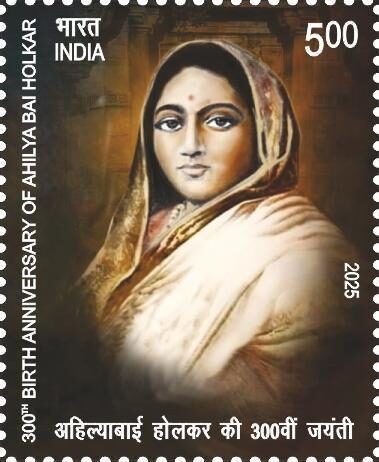
Ahilyabai’s tercentenary fell in 2025. The Government of India released a commemorative coin and stamp series. A biographical film, Ahilyabai, went into production the same year. The Government of Madhya Pradesh announced restoration of the Maheshwar fort and the Rajwada at Indore.
For three centuries the Holkar state has been dissolved, but the temples Ahilyabai paid for are still active places of worship from Rameshwaram to Badrinath. Few rulers in Indian history can claim a longer functional footprint.
Frequently Asked Questions
Why is Ahilyabai Holkar called Punyashloka?
Punyashloka literally means u0022she whose mention is sacred.u0022 The title was conferred during her lifetime by orthodox Hindu institutions in recognition of her temple reconstruction programme across India, her personal piety, and her practice of feeding pilgrims at her own expense. It is the formal honorific by which traditional sources still refer to her.
Was Ahilyabai prevented from committing sati?
Yes. Her husband Khanderao Holkar died in the Battle of Kumher in 1754. Custom required her to commit sati on his pyre. Her father-in-law Malhar Rao Holkar physically intervened and forbade it, telling her that the state needed her alive. The episode is documented in contemporary Marathi chronicles and is one reason Ahilyabai is invoked in modern debates on social reform.
Did Ahilyabai actually fight battles?
She commanded a personal cavalry corps of about 500 troops and was prepared to lead it in 1767-68 against Raghoba Peshwa, who eventually withdrew without battle. Her primary military role was commander-in-chief in the strategic and logistical sense; the field commands were delegated to Tukoji Holkar. She is therefore better classed as a ruling queen with military capacity rather than a battlefield commander like Rani Laxmibai.
Which temples did Ahilyabai rebuild?
The major ones include Kashi Vishwanath at Varanasi (1780), Somnath in Gujarat (c. 1783), Vishnupad at Gaya (1787), Mahakaleshwar at Ujjain, Omkareshwar, Grishneshwar near Ellora, and many more. She also funded ghats at Varanasi, Hardwar, Prayag, and Nashik, and dharamshalas at Rameshwaram, Badrinath, Kedarnath, Puri, and Dwarka. The total number runs into the hundreds.
Where was the Holkar capital under Ahilyabai?
She moved the capital from Indore to Maheshwar on the Narmada in 1767, soon after her coronation. Maheshwar remained the seat of government for the rest of her reign. Indore returned to capital status under her successors.
What is Maheshwari sari?
Maheshwari is a handloom sari tradition that traces its origin directly to Ahilyabai Holkar. She invited weavers from Mandav, Surat, and Burhanpur to settle at Maheshwar in the 1770s and established a textile manufactory under royal patronage. The Maheshwari sari, with its distinctive Narmada-wave borders, is a GI-registered product today and is still woven in Maheshwar.
How did the Holkar state behave towards the British?
Under Ahilyabai, the Holkar state refused to accept a British resident at Indore and conducted independent diplomacy. She privately judged that pitched battle against Company forces was inadvisable but believed avoidance and diplomacy could preserve sovereignty. The Holkars eventually entered a subsidiary alliance only after the Third Anglo-Maratha War of 1818, more than two decades after her death.
What is Ahilyabai’s relevance for UPSC Ethics (GS-IV)?
GS-IV case material on her draws on three threads: her daily personal hearing of citizen grievances as a model of accessible governance; her separation of personal and state finance as a model of financial integrity; and her refusal of sati combined with her continuation in office as an early Indian case of public duty overriding social custom.