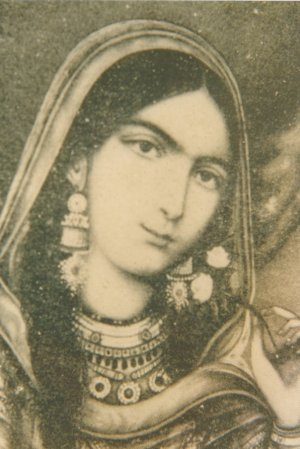
Begum Hazrat Mahal was the only woman in the 1857 revolt to formally proclaim a ruler, govern a province for nearly a year, and refuse a British amnesty offered in the Queen’s name. She was not born to royalty. She entered the Awadh court at Lucknow as a pari, a court dancer, was elevated to the harem, married the king Wajid Ali Shah, and bore him a son, Birjis Qadr. When the king was deported to Calcutta after the British annexation of Awadh in February 1856, the begum chose to stay in Lucknow with her son. When the revolt broke out in May 1857, she put the eleven-year-old Birjis Qadr on the Awadh throne and effectively ruled Awadh in his name through the rest of 1857 and into 1858.
She is the second name, after Rani Laxmibai, in any honest list of the named leaders of 1857. She is also the one who outlived the revolt and the only one who refused, in writing and in public, the Queen’s Proclamation of 1858.
This article reads Begum Hazrat Mahal with a UPSC History lens. It traces her uncertain origins, her place in the Lucknow court, the annexation of Awadh, the 1857 rising, the year of her regency, the retreat to Nepal, her formal refusal of British amnesty, and her death at Kathmandu in 1879.
Quick Facts
- Birth name: Muhammadi Khanum (also recorded as Iftikhar-un-Nisa)
- Court name: Mahak Pari (in the parikhana), later Hazrat Mahal
- Born: Around 1820, at Faizabad
- Origin: Sold into the Awadh royal household as a young girl
- Husband: Wajid Ali Shah, last Nawab of Awadh (r. 1847-1856)
- Son: Birjis Qadr, born 1845
- Annexation of Awadh: February 7, 1856 by Lord Dalhousie
- Wajid Ali Shah deported: March 13, 1856 to Calcutta
- Birjis Qadr proclaimed Nawab: July 5, 1857 at Lucknow
- Capital under regency: Lucknow, then Faizabad after British recapture
- Crossed into Nepal: Spring 1859, with about 5,000 followers
- Refusal of amnesty: December 1858
- Died: April 7, 1879, at Kathmandu
- Burial: Jama Masjid grounds, Kathmandu
Origins: From Faizabad to the Parikhana
The early life of Begum Hazrat Mahal is, by the standards of nineteenth-century royal biography, almost entirely undocumented. She was born around 1820 in Faizabad, the older capital of the Awadh state, to a family whose name does not survive in the archive. She was sold as a young girl, possibly because the family could not maintain her, and entered the Awadh royal household first as an attendant and then as a member of the parikhana, the court dance establishment maintained by Wajid Ali Shah’s predecessors and by Wajid Ali Shah himself.
The parikhana was not a brothel. It was a closed institution of trained female performers — singers, dancers, instrumentalists — who lived under royal protection and whose elite practitioners were eligible for promotion to the harem proper. Hazrat Mahal — her court name at this stage was Mahak Pari — moved up through this system and entered the harem of Wajid Ali Shah as a mutah wife, a temporary religious marriage form recognised in Shia jurisprudence. The marriage was later regularised.
She bore Wajid Ali Shah a son, Birjis Qadr, in 1845. With the birth she received the title Hazrat Mahal, “Her Highness of the Palace,” which placed her among the senior begums of the household.
The Annexation of Awadh, 1856
Awadh was the last major Indian state to be annexed before 1857. Its annexation is the single most important political grievance behind the revolt in the upper Doab.
The legal pretext was misgovernment. British political officers had been writing dossiers on Awadh’s administration for decades. In February 1856 Lord Dalhousie used these dossiers to issue a unilateral proclamation. Awadh’s ruler Wajid Ali Shah refused to sign a treaty surrendering sovereignty. On February 7, 1856, Awadh was annexed by the Company. Wajid Ali Shah was deported on March 13, 1856, first to Calcutta, eventually to Garden Reach in Metiabruz, where he lived out his life as a pensioner of the Company.
The decision split the Awadh royal household. Wajid Ali Shah’s senior begum, Janab-i-Aliyah Malika Kishwar, left for England via Calcutta to petition Queen Victoria directly. She died in Paris in 1858 without securing reversal. Begum Hazrat Mahal took the opposite decision. She stayed in Lucknow with the young Birjis Qadr. That single decision — to remain on Indian soil with the only male heir of Awadh — is the hinge of her entire later career.
The Revolt of 1857 in Awadh
The 1857 revolt reached Awadh through the Bengal Army sepoys, but it took root because the Awadh peasantry, the dispossessed taluqdars, and the urban service classes of Lucknow all had concrete grievances against the British annexation of 1856.
Lucknow itself rose at the end of May 1857. Sir Henry Lawrence, the Chief Commissioner, withdrew with British civilians and a garrison into the Residency, where the famous siege of Lucknow began on June 30, 1857. The Awadh countryside fell to the rebels within weeks.
On July 5, 1857, in a public ceremony at the Bara Imambara, Begum Hazrat Mahal had her eleven-year-old son Birjis Qadr proclaimed Nawab of Awadh. The choice was constitutionally sharp. The Awadh throne had not been claimed by the British, who had abolished it; the begum’s claim that it still existed and that Birjis Qadr was its legitimate occupant was, in formal Islamic legal terms, a strong one.
She then took the title of regent, set up a four-member regency council, and effectively ran Awadh out of the Chhatar Manzil palace in Lucknow. She managed correspondence with rebel leaders elsewhere — Nana Sahib at Bithur, Tantia Tope, Bakht Khan in Delhi — and with the surviving Mughal court of Bahadur Shah Zafar, which formally recognised Birjis Qadr’s accession.
The Reconquest of Lucknow, 1858
Sir Colin Campbell relieved the Lucknow Residency on November 17, 1857, evacuated the British survivors, but did not yet hold the city. The full British reconquest of Lucknow took place in March 1858. Campbell brought up some 30,000 troops, supported by Jung Bahadur Rana’s 9,000 Gurkhas from Nepal, and entered Lucknow on March 14, 1858.
Begum Hazrat Mahal did not surrender. She retreated to Faizabad, then to Bondi in the northern Awadh terai, and continued to coordinate guerrilla operations through the summer and autumn of 1858. British political officers including Sir James Outram tried repeatedly to negotiate her surrender on generous terms. She refused every offer.
The Queen’s Proclamation and Hazrat Mahal’s Reply
On November 1, 1858, Queen Victoria issued the proclamation that transferred sovereignty of British India from the East India Company to the Crown and offered general amnesty to all who had taken up arms, provided they had not killed British subjects.
Begum Hazrat Mahal issued a counter-proclamation in December 1858 — drafted, signed, and circulated in Awadh in Persian and Urdu. It is a remarkable document. It went through the Queen’s text point by point. It rejected the claim that the Crown was a fairer master than the Company. It catalogued the broken treaties of the previous half-century. It argued that the British had no legitimate claim to Awadh because Awadh had never been conquered, only annexed by fraudulent legal device. It rejected the amnesty.
The proclamation is preserved in British political archives and is one of the few extended written political statements by an Indian woman ruler in the nineteenth century.
Exile in Nepal
In the spring of 1859, with British forces closing in across the terai, Begum Hazrat Mahal crossed the border into Nepal with Birjis Qadr and a party of about 5,000 followers — soldiers, courtiers, household, and other rebel leaders including Nana Sahib’s nephew Rao Sahib for a time. Jung Bahadur Rana, the Nepali prime minister, was a British ally but refused to extradite her. Instead he allowed her sanctuary at Kathmandu, on the condition that she abandon any further political activity from Nepali soil.
She accepted. She lived in Kathmandu for the next twenty years on a small Nepali pension and on the proceeds of her remaining jewellery. Birjis Qadr eventually returned to Calcutta in 1887 under a pardon issued after his mother’s death.
She refused, until the end, to apply for the British amnesty.
Begum Hazrat Mahal died at Kathmandu on April 7, 1879, aged about fifty-nine. She was buried in the grounds of the Jama Masjid in central Kathmandu. The grave is still preserved and is maintained by the Indian Embassy as a heritage site. A commemorative postage stamp was issued by India Post in 1984. The Hazratganj area of central Lucknow takes its name from her.
Why Begum Hazrat Mahal Matters for UPSC
For UPSC History she sits at three intersections.
The annexation of Awadh and the causes of 1857
The annexation of Awadh in 1856 is the single most important political cause of the 1857 revolt. Begum Hazrat Mahal is the human face of that cause and the only annexed-state ruler who actually led an armed counter-claim.
Women in the revolt
She is one of three named woman commanders of 1857, alongside Rani Laxmibai of Jhansi and the much less documented Begum of Bhopal who chose neutrality. Her case is the longest-running and the only one that ends in voluntary exile rather than death in battle.
Continuity with earlier women resisters
The line from Rani Velu Nachiyar and Kittur Rani Chennamma through Rani Laxmibai to Begum Hazrat Mahal forms a coherent eighty-year arc of Indian queens leading armed resistance against the Company. The republican lineage of women in Indian public life — that runs to figures like Sucheta Kripalani — eventually inherits this prestige in modified form.
Birjis Qadr’s Later Life
The son Begum Hazrat Mahal protected for two decades had a difficult later life. Birjis Qadr returned to India from Nepal in 1887, was recognised as a pensioner of the British Indian government, and lived in Calcutta. In 1893 he was poisoned at a family banquet — by relatives disputing the Awadh inheritance, in the standard historical reconstruction — and died with his wife and son. The Awadh royal line effectively ended with him. Wajid Ali Shah’s other line, through his senior begum, became the Pataudis through later marriages.
Comparative Frame
| Leader | Base | Year of leadership | Final outcome |
|---|---|---|---|
| Rani Laxmibai | Jhansi | 1857-58 | Killed at Gwalior |
| Begum Hazrat Mahal | Lucknow | 1857-58 | Exile in Nepal |
| Tantia Tope | Bundelkhand | 1857-59 | Executed at Shivpuri |
| Nana Sahib | Bithur | 1857-58 | Disappeared in Nepal |
| Bahadur Shah Zafar | Delhi | 1857 | Exile in Rangoon |
Of these five, Begum Hazrat Mahal is the only one who issued a formal written rejection of the post-revolt British settlement. That is a small thing in military terms and a very large thing in political ones.
Frequently Asked Questions
Who was Begum Hazrat Mahal before she married Wajid Ali Shah?
She was born around 1820 in Faizabad with the name Muhammadi Khanum and was sold as a child into the Awadh royal household. She entered the parikhana, the court dance establishment, with the name Mahak Pari, and rose through it to enter Wajid Ali Shah’s harem. She received the title Hazrat Mahal after she bore him a son, Birjis Qadr, in 1845.
Why did Begum Hazrat Mahal stay in Lucknow when Wajid Ali Shah was deported?
When the British annexed Awadh in February 1856 and deported Wajid Ali Shah in March 1856, the royal household split. The senior begum left for England to petition Queen Victoria. Hazrat Mahal chose to remain in Lucknow with her son Birjis Qadr, the only male heir physically present in Awadh. This decision is what made her the rallying point for the 1857 rising in Lucknow.
When was Birjis Qadr proclaimed Nawab?
On July 5, 1857, at the Bara Imambara in Lucknow, with Begum Hazrat Mahal acting as regent. He was eleven years old. The proclamation was formally recognised by the Mughal court of Bahadur Shah Zafar at Delhi.
How long did Begum Hazrat Mahal hold Lucknow?
She and her regency council effectively administered Lucknow and most of Awadh from July 1857 to the British reconquest of Lucknow in March 1858. She then retreated north and continued resistance from the Awadh terai through the rest of 1858, with intermittent battlefield engagements.
Did she really refuse the Queen’s Proclamation of 1858?
Yes. She issued a written counter-proclamation in December 1858, in Persian and Urdu, that rejected Queen Victoria’s amnesty offer point by point. The document is preserved in British political archives and is one of the longest political statements by an Indian woman ruler of the nineteenth century.
Where is Begum Hazrat Mahal buried?
In the grounds of the Jama Masjid in central Kathmandu, Nepal, where she died in exile on April 7, 1879. The grave is preserved and maintained as a heritage site with cooperation between the Indian Embassy and Nepali authorities.
What happened to her son Birjis Qadr?
He lived in Kathmandu in exile until 1887, when he returned to Calcutta under a British pardon. He was poisoned in 1893 in a family inheritance dispute and died along with his wife and son. The direct Awadh royal line effectively ended with him.
Is the Hazratganj area of Lucknow named after her?
Yes. Hazratganj, the main commercial area of central Lucknow today, was developed in 1827 by Nawab Nasiruddin Haidar and significantly reworked by Wajid Ali Shah. The name u0022Hazratganju0022 — u0022the market of Her Highnessu0022 — is associated with Begum Hazrat Mahal in popular memory, though the original naming pre-dates her by several decades. The contemporary association is now firmly established and is part of the city’s cultural memory.
Tell Google you want more of this.
Add Anantam IAS as a preferred sourceOne tap, and this site shows up more often in your own Top Stories, AI Overviews and AI Mode. Remove it any time.