Air (Prevention and Control of Pollution) Act, 1981: Provisions, Powers, UPSC
The Air Act, 1981 is India's central air pollution law, born of the 1972 Stockholm Conference. Full UPSC guide on objectives, powers of CPCB and SPCBs, the 1987 noise amendment, NCAP linkage, penalties, and challenges.
The Air (Prevention and Control of Pollution) Act, 1981 is the central piece of legislation that governs air pollution in India. It is one of the older umbrella environmental laws, predating the broader Environment (Protection) Act of 1986, and it sits in a small family of statutes that translate India’s commitment at the 1972 Stockholm Conference on the Human Environment into domestic regulatory architecture. The Air Act of 1981 followed the Water (Prevention and Control of Pollution) Act of 1974, the Wildlife (Protection) Act of 1972, and was followed by the Environment (Protection) Act of 1986. Together, these four statutes form the backbone of pre-1990 Indian environmental governance.
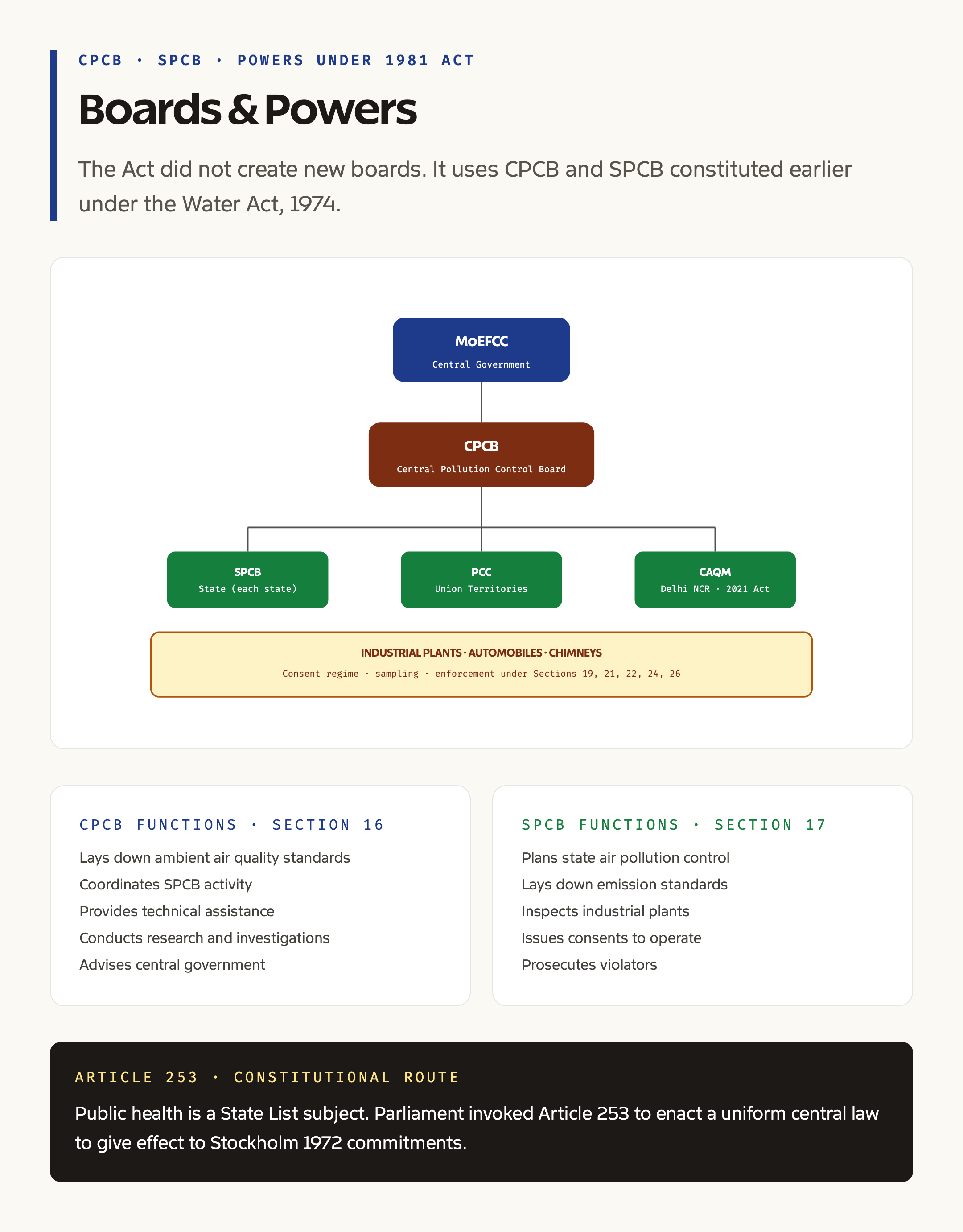
The Act was born out of a specific constitutional moment. After Stockholm, the central government invoked Article 253 of the Constitution, which permits Parliament to legislate on a state subject for the purpose of giving effect to international agreements, to enact a uniform air pollution law applicable across the country. Without that route, “public health” being a State List subject would have made central legislation problematic. The same Article 253 route had been used for the Water Act 1974, and the design of the two statutes is closely parallel. Both rely on the Pollution Control Boards as their administrative spine, both create a permit-based regulatory regime, and both rely on civil and criminal penalties for enforcement.
For UPSC, the Air Act is a frequent prelims candidate (year, objectives, the 1987 amendment, the role of CPCB and SPCBs) and a recurring mains topic (effectiveness of the framework, NCAP linkage, penalties and reform). This guide walks through the structure, key provisions, institutional architecture, amendments, comparative frame, challenges, and the way forward.
Quick Facts
- Year of enactment: 1981; came into force on 16 May 1981
- Constitutional basis: Article 253 (international agreements), used to legislate on a State subject
- International trigger: United Nations Conference on the Human Environment, Stockholm, 1972
- Objective: Prevention, control, and abatement of air pollution
- Administering ministry: Ministry of Environment, Forest and Climate Change
- Implementing institutions: Central Pollution Control Board (CPCB) at the central level; State Pollution Control Boards (SPCB) at the state level
- Pre-existing institutions used: The Act did not create new boards; it utilised the CPCB and SPCBs created under the Water Act, 1974
- Definition of “air pollutant”: Any solid, liquid, or gaseous substance present in the atmosphere in such concentration as may be or tend to be injurious to human beings or other living creatures, plants, property, or the environment
- Major amendment: 1987, expanded the definition of air pollutant to include noise
- Penalty regime: Originally criminal; substantially changed by the Jan Vishwas (Amendment of Provisions) Act, 2023, which replaced certain offences with monetary penalties
- Air Pollution Control Area: State Government can declare any area as such
- Consent regime: No industrial plant in such an area can operate without previous consent of the SPCB
What Is the Air Act, 1981
The Air Act establishes a permit-based regime for the emission of air pollutants from industrial plants and certain mobile sources. It rests on three operational pillars. The first is the declaration of Air Pollution Control Areas by the State Government, on the advice of the State Pollution Control Board, where the regulatory regime applies in full. The second is the consent mechanism, under which any industry seeking to operate in a control area must obtain prior consent from the SPCB, with consent typically subject to compliance conditions on emissions, monitoring, and reporting. The third is the inspection, sampling, and enforcement powers of the SPCB and CPCB, which extend to entry, sampling of emissions, demand for records, and prosecution.
The Act divides authority between the central level (CPCB) and the state level (SPCBs and Pollution Control Committees in Union Territories). The CPCB sets ambient air quality standards, lays down emission standards for specific industries in coordination with the Ministry, conducts research, coordinates SPCB activity, and serves as the apex technical body. The SPCB inspects and licenses industries, issues consents, monitors compliance, prosecutes violators, and sets state-specific control measures within the central framework.
Background and Historical Context
The Stockholm Conference of June 1972 was the first major United Nations conference dedicated to environmental issues. India’s then Prime Minister, Indira Gandhi, addressed the conference with the famous formulation that poverty and environmental degradation are linked, an observation that shaped much of the subsequent debate on sustainable development. The conference produced the Stockholm Declaration with 26 principles, including the now-classic Principle 1, which links the right to a life of dignity with the right to an adequate environment.
Key Provisions
The Act is structured into six chapters and just under 55 sections. The substantive parts are:
Section 16: Functions of the Central Board. The CPCB is given the function of improving the quality of air, advising the central government on air pollution issues, coordinating SPCB activity, providing technical assistance, conducting investigations and research, and laying down standards for the quality of air.
Section 17: Functions of the State Board. The SPCB plans comprehensive air pollution control programmes for the state, advises the state government, collects information on air pollution, lays down standards for emission of air pollutants from automobiles, industrial plants, and any other sources, inspects industrial plants, and issues consents.
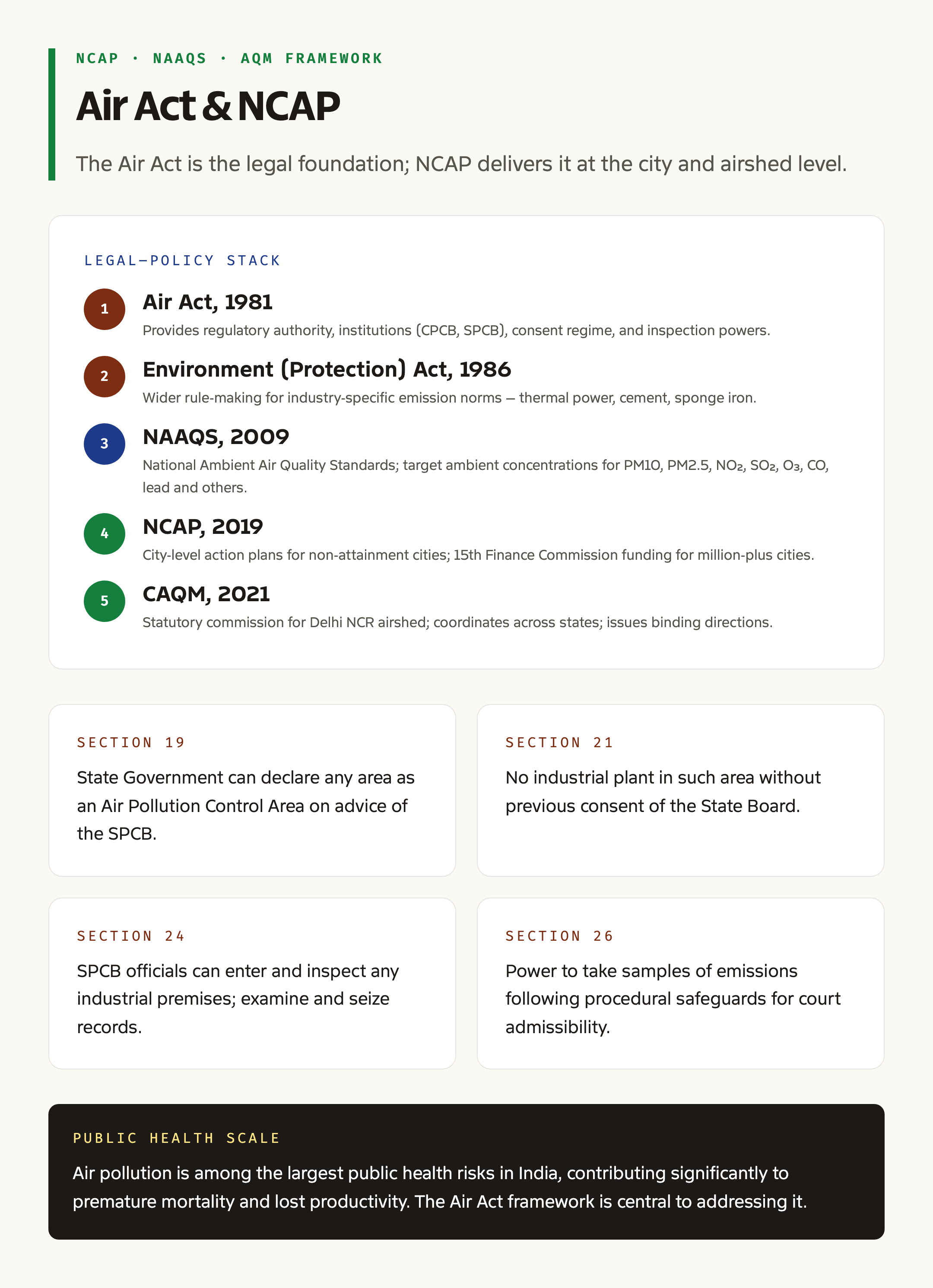
Section 19: Power to declare Air Pollution Control Areas. The State Government, after consultation with the State Board, may declare any area in the state as an Air Pollution Control Area for the purposes of the Act. Within such an area, the regulatory regime applies in full.
Section 21: Restrictions on use of certain industrial plants. No person can establish or operate any industrial plant in an air pollution control area without the previous consent of the State Board. The consent is granted with conditions on emissions, control equipment, and monitoring.
Section 22: Persons carrying on industry not to allow emission of air pollutants in excess of standards laid down by State Board.
Section 23: Furnishing of information to State Board and other agencies in case of accidental or unintentional emission.
Section 24: Power of entry and inspection of any industrial premises by SPCB officials, including entry, examination, and seizure of any documents or materials related to the offence.
Section 25: Power to obtain information.
Section 26: Power to take samples of air or emission and the procedure to be followed in connection therewith. The procedural safeguards (notice to the occupier, sealed sample, opportunity to be present) are similar to those in the Water Act and are intended to make samples admissible in court.
Sections 37 to 39: Penalties for various offences, originally up to seven years’ imprisonment for repeated offences and continuing failures, with fines on a daily basis. The 2023 Jan Vishwas Act changed several of these to monetary penalties for non-compliance with closure or denial of services.
Section 31: Appeal to the Appellate Authority constituted by the State Government.
Section 53: Power of the central government to make rules; the Air (Prevention and Control of Pollution) Rules, 1982 are framed under this provision.
The 1987 Amendment: Bringing Noise In
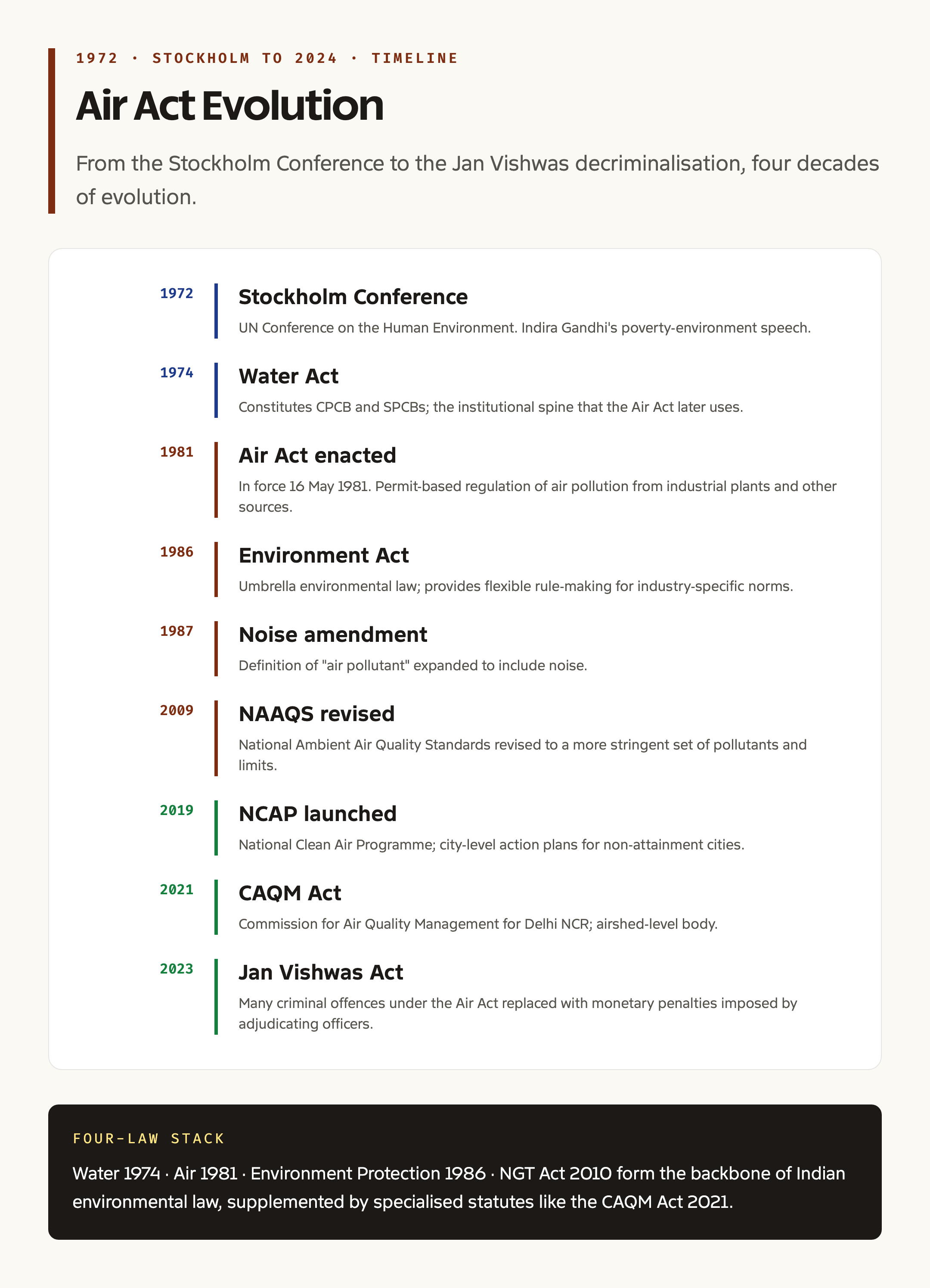
The original 1981 Act did not address noise pollution. The 1987 amendment changed this by widening the definition of “air pollutant” to include noise. This single change brought industrial noise, vehicular noise, and certain ambient noise concerns within the umbrella of the Air Act. The Noise Pollution (Regulation and Control) Rules, 2000 were subsequently framed under the broader Environment (Protection) Act, 1986, which now carries the bulk of operational noise rule-making, but the conceptual base remains the 1987 amendment.
Why It Matters
The Act matters because air pollution is one of the largest public health crises in India. The Global Burden of Disease studies have consistently identified air pollution as a leading risk factor for premature mortality, with estimates of more than a million deaths a year in India attributable to ambient and household air pollution combined. The economic cost in lost productivity, healthcare expenditure, and crop yield reduction runs into significant fractions of GDP. The Air Act is the legal framework through which this crisis is addressed at the regulatory level.
Beyond public health, the Act matters because it created a federal regulatory architecture that has since carried the weight of much subsequent environmental governance. The CPCB and SPCBs are the bodies that monitor ambient air quality across over 800 manual and continuous stations, that license industries under the Air Act and the Water Act, and that participate in environmental clearance processes under the Environment (Protection) Act. They are also the agencies that lead implementation of the National Clean Air Programme, launched in 2019.
The Act also matters in litigation. Air quality cases, including the long-running matter on Delhi NCR pollution before the Supreme Court, the National Green Tribunal cases on stubble burning, and the line of cases on industrial emissions in Vapi, Korba, Singrauli, and elsewhere, have all rested in part on the Air Act framework, often combined with the Environment (Protection) Act and the National Green Tribunal Act.
Detailed Analysis: Linkage with NCAP and Wider Framework
The National Clean Air Programme (NCAP), launched by the Ministry of Environment in 2019, is the policy programme through which the Air Act framework is operationalised at the city and airshed level. NCAP set initial targets for reduction in particulate matter (PM10 and PM2.5) concentrations across non-attainment cities, was subsequently strengthened, and now drives air quality action plans across over 130 cities.
The legal-policy stack works as follows. The Air Act provides the regulatory authority, the institutions (CPCB, SPCB), the consent regime for industries, and the inspection and enforcement powers. The Environment (Protection) Act, 1986 provides the wider rule-making power, under which industry-specific emission norms (for thermal power, cement, sponge iron, etc.) are notified. The National Ambient Air Quality Standards (NAAQS), revised in 2009, set the target ambient concentrations. NCAP provides the city-level action plans, the funding through the 15th Finance Commission grants for cities with populations above one million, and the monitoring and reporting framework. The Commission for Air Quality Management for Delhi NCR and Adjoining Areas, created by a 2021 statute, adds an airshed-level coordinating body for the most polluted region.
The Air Act is therefore the legal foundation, but the operational delivery of clean air is distributed across multiple statutes and agencies.
Comparative Frame
| Indian Pollution Law | Year | Subject | Key Institutions |
|---|---|---|---|
| Water (Prevention and Control of Pollution) Act | 1974 | Water pollution | CPCB, SPCB |
| Air (Prevention and Control of Pollution) Act | 1981 | Air pollution, noise (after 1987) | CPCB, SPCB |
| Environment (Protection) Act | 1986 | Umbrella environmental law | MoEFCC, CPCB |
| National Green Tribunal Act | 2010 | Environmental adjudication | NGT |
| Commission for Air Quality Management Act | 2021 | Delhi NCR airshed governance | CAQM |
The Air Act sits within this stack as the dedicated air quality statute, while the Environment (Protection) Act provides the more flexible rule-making instrument used for most current emission standards.
Penalties and the 2023 Jan Vishwas Amendment
The original Air Act carried criminal penalties for non-compliance, with imprisonment up to seven years and continuing daily fines. In practice, enforcement was uneven, prosecutions were slow, and the criminal route deterred regulators from acting against smaller offenders. The Jan Vishwas (Amendment of Provisions) Act, 2023, decriminalised many of these offences and replaced them with monetary penalties imposed by an adjudicating officer, with appeals to the National Green Tribunal. The reform aims to make enforcement faster and more proportionate while preserving criminal penalties for the most serious violations and for repeated, wilful non-compliance.
Challenges
Several challenges constrain the Act’s effectiveness. The first is institutional capacity. Many SPCBs are understaffed and underfunded, with vacancies in technical positions and limited monitoring infrastructure. The second is enforcement. Despite extensive consent requirements, monitoring of compliance lags behind the issuance of consents, and prosecution of violators has historically been slow. The third is the gap between source control and ambient outcomes: even rigorous control of large industrial sources leaves the airshed subject to vehicular emissions, biomass burning, road dust, and construction dust that need different policy instruments. The fourth is the airshed problem. Pollution does not respect district or state boundaries, and the existing Air Act framework was designed for plant-by-plant control, not for airshed-level governance. The Commission for Air Quality Management for Delhi NCR is one response; replicating that model for other airsheds remains a debate. The fifth is the data and transparency challenge: while the National Air Quality Index has improved public access to ambient data, source apportionment studies, emission inventories, and enforcement records remain uneven across states.
Prelims Pointers
- The Air Act, 1981 was enacted to give effect to the decisions taken at the Stockholm Conference, 1972, using Article 253 of the Constitution
- The Act came into force on 16 May 1981
- The 1987 amendment expanded the definition of air pollutant to include noise
- The Act did not create new boards; it used the CPCB and SPCBs already constituted under the Water Act, 1974
- The State Government, on the advice of the SPCB, can declare any area as an Air Pollution Control Area under Section 19
- No industrial plant can operate in such an area without the previous consent of the State Board (Section 21)
- SPCB officials can enter and inspect any industrial premises under Section 24
- The Act forms part of the legal foundation for the National Clean Air Programme launched in 2019
- The Jan Vishwas (Amendment of Provisions) Act, 2023 replaced many criminal offences with monetary penalties
- The Commission for Air Quality Management for Delhi NCR and Adjoining Areas was constituted by a 2021 statute, supplementing the Air Act framework
Mains Practice Questions
- The Air (Prevention and Control of Pollution) Act, 1981 is the foundational air pollution statute in India. Discuss its structure, the role of the Pollution Control Boards, and the linkage with the National Clean Air Programme. How effective has the framework been in addressing India’s air quality crisis?
- India’s air pollution problem is fundamentally an airshed problem, but the regulatory framework is largely a plant-by-plant framework. Examine the case for reforming the Air Act to enable airshed-level governance, drawing on the experience of the Commission for Air Quality Management for Delhi NCR.
- The Jan Vishwas (Amendment of Provisions) Act, 2023 decriminalised several offences under the Air Act, 1981. Evaluate the case for decriminalisation of environmental offences and the safeguards required to prevent dilution of compliance.
Way Forward
A balanced reform agenda for the Air Act has several strands. The institutional capacity of the SPCBs needs sustained investment, including continuous emission monitoring systems mandated for high-pollution industries, improved laboratory and analytical capacity, and adequate technical staffing. Airshed-level governance, beyond Delhi NCR, can be extended to other heavily polluted regions through similar statutory commissions or through formal interstate compacts under the Air Act. Source apportionment studies need to be made standard for non-attainment cities, with public dashboards that show contributions from industry, transport, biomass, and dust. The Air Quality Index needs to be backed by graded response action plans tied to actionable measures, as has been done in Delhi NCR. The penalty regime, post-Jan Vishwas, needs careful monitoring to ensure that monetary penalties deter rather than become a routine cost of business. The link with NCAP funding, with the 15th Finance Commission grants and Smart City programmes, can be strengthened so that air quality investments are integrated with urban transport, waste, and energy policy.
Frequently Asked Questions
What is the Air Act, 1981?
The Air (Prevention and Control of Pollution) Act, 1981 is the central Indian legislation for the prevention, control, and abatement of air pollution. It establishes a permit-based regime administered by the Central Pollution Control Board and State Pollution Control Boards.
Why was the Air Act enacted using Article 253?
Public health is a State List subject. To enact a uniform central law on air pollution, Parliament invoked Article 253 of the Constitution, which permits central legislation on State subjects to give effect to international agreements. The trigger was the Stockholm Conference of 1972.
Did the Air Act create the CPCB and SPCBs?
No. The CPCB and SPCBs were created earlier under the Water (Prevention and Control of Pollution) Act, 1974. The Air Act simply extended their mandate to cover air pollution as well.
What does the 1987 amendment do?
The 1987 amendment expanded the definition of u0022air pollutantu0022 to include noise, bringing noise pollution within the regulatory scope of the Air Act for the first time.
What is an Air Pollution Control Area?
An Air Pollution Control Area is any area declared as such by the State Government, on the advice of the State Pollution Control Board, under Section 19 of the Act. Within such an area, no industrial plant can be established or operated without the previous consent of the State Board.
What powers do SPCB officials have under the Act?
SPCB officials can enter and inspect industrial premises, examine and seize records, demand information, take samples of emissions following the prescribed procedure, and prosecute violators. The powers are similar to those under the Water Act, 1974.
How is the Air Act linked to the National Clean Air Programme?
The Air Act provides the legal authority, the regulatory institutions, and the consent regime for industries. NCAP, launched in 2019, provides the city-level action plans, monitoring framework, and funding to operationalise air quality improvement under the Air Act and related statutes.
What changed with the Jan Vishwas Act, 2023?
The Jan Vishwas (Amendment of Provisions) Act, 2023 decriminalised several offences under the Air Act and replaced criminal penalties with monetary penalties imposed by an adjudicating officer, with appeals to the National Green Tribunal. The most serious violations remain criminally prosecutable.
Is the Air Act applicable across the whole of India?
The Act extends to the whole of India and applies to such areas as the State Government, on the advice of the SPCB, declares as Air Pollution Control Areas. The Commission for Air Quality Management for Delhi NCR adds an airshed-level body for the National Capital Region.
How does the Air Act interact with the Environment (Protection) Act, 1986?
The Air Act is the dedicated air pollution statute. The Environment (Protection) Act, 1986 is a wider umbrella law that provides flexible rule-making power. Most current industry-specific emission norms are notified under the Environment (Protection) Act, while the Air Act provides the regulatory institutions and the basic consent regime.