Aircraft Carriers of India: INS Vikrant, Vikramaditya, and the Case for a Third Carrier
A complete UPSC GS-III explainer on India's aircraft carriers. Covers INS Vikrant (IAC-1), INS Vikramaditya, the retired INS Viraat, the STOBAR vs CATOBAR debate, the proposed INS Vishal, and what carrier capability means for India's two-ocean naval strategy.
The aircraft carrier is the most visible expression of a nation’s naval ambition. A carrier announces, in a way that no submarine or destroyer can, that a state intends to project power beyond its coastline. India has operated aircraft carriers continuously since 1961, longer than any non-Western navy except the United States, and is one of only a small handful of countries that currently builds them. The two carriers in service today, INS Vikramaditya and the indigenous INS Vikrant, sit at the centre of India’s two-ocean naval strategy and are the subject of an ongoing debate about whether a third carrier is essential or a luxury that the navy cannot afford.
A modern aircraft carrier is not simply a ship that carries planes. It is a floating airbase with a self-contained command, control, surveillance, and logistics ecosystem. A typical carrier hosts a wing of fighter aircraft, helicopters, and increasingly unmanned aircraft. It operates inside a carrier strike group that includes destroyers, frigates, and a nuclear submarine for protection, plus replenishment ships for fuel, food, and ordnance. The carrier is the focal point. Everything else exists to keep it safe and to extend its reach.
For UPSC purposes, the topic sits at the intersection of defence technology, maritime strategy, indigenous shipbuilding, and the larger debate about how India should spend its defence budget. The article walks through the three carriers India has operated, the technical differences between launch systems, the case for and against a third carrier, and how India’s carrier programme compares with regional peers.
Quick Facts on Indian Aircraft Carriers
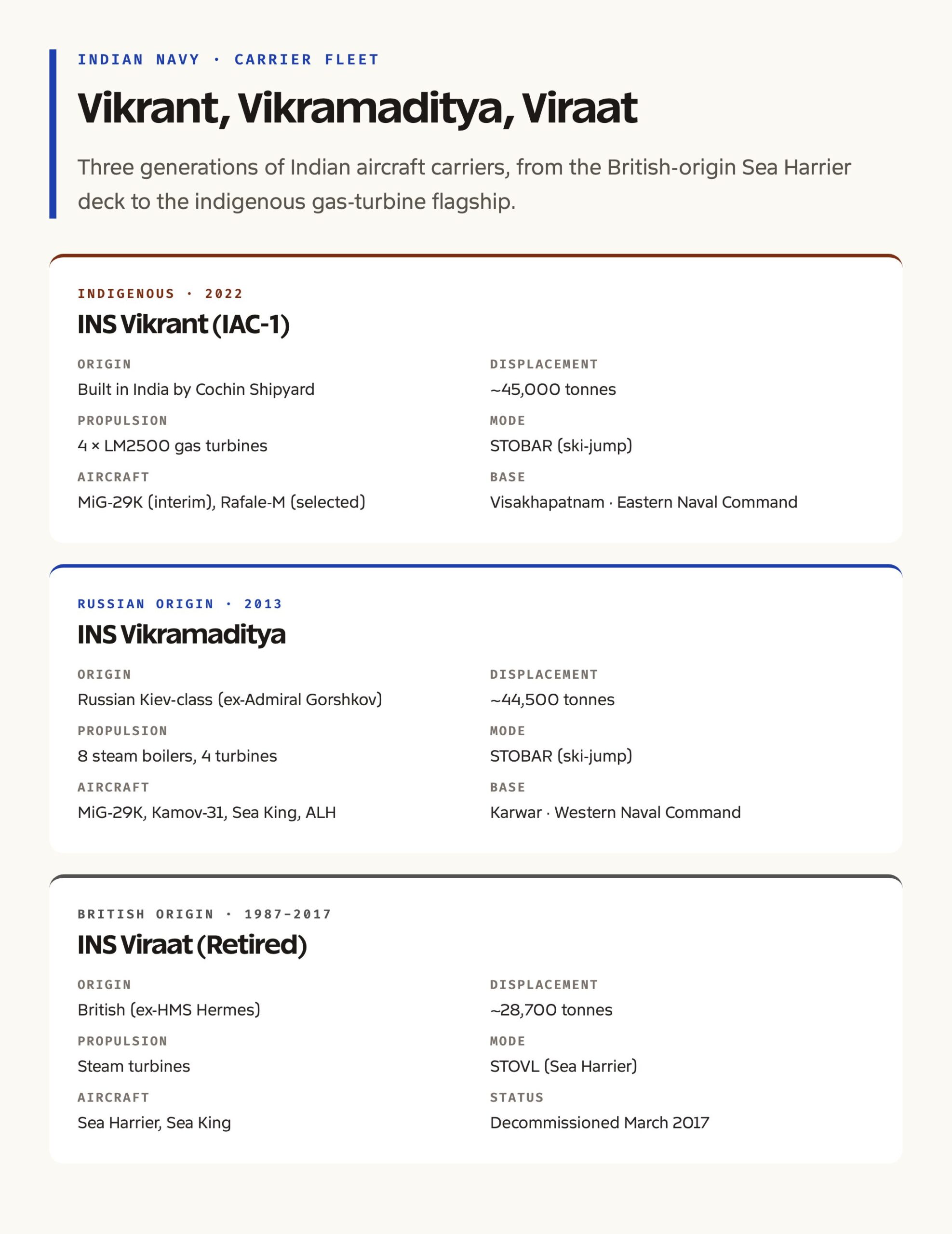
India’s first aircraft carrier was INS Vikrant, originally HMS Hercules of the British Royal Navy, transferred to India and commissioned in 1961. It served through the 1971 Bangladesh Liberation War, where its aircraft attacked targets along the East Pakistan coast, and was decommissioned in 1997. The second was INS Viraat, originally HMS Hermes, transferred in 1987 and decommissioned in 2017. The third was INS Vikramaditya, a modified Russian Kiev-class carrier originally named Admiral Gorshkov, commissioned in 2013 after extensive refit.
The fourth and current flagship is the new INS Vikrant, also called Indigenous Aircraft Carrier-1 or IAC-1, the first aircraft carrier ever built in India. It was constructed by Cochin Shipyard Limited and commissioned in September 2022. A fifth, the proposed INS Vishal or IAC-2, is under consideration but has not yet received final approval. The navy has consistently asked for a three-carrier force, with two operationally available at any given time.
What an Aircraft Carrier Actually Does
A carrier converts a navy from a defensive force into an expeditionary one. Without carriers, sea-going aircraft must operate from land bases, which limits their range to a few hundred kilometres from the coastline. With a carrier, a navy can place a fighter wing in any ocean of the world and keep it there for weeks. The carrier turns the sea itself into a runway.
Background and Historical Context
India’s interest in carriers dates to the late 1950s, when the navy began planning for sea control in the Bay of Bengal and the Arabian Sea. The first INS Vikrant was acquired from the United Kingdom and refitted for tropical operations. It carried Sea Hawk fighters and Alize anti-submarine aircraft. During the 1971 war, it operated in the Bay of Bengal and provided crucial air cover and strike support for the eastern theatre.
INS Viraat joined the fleet in 1987 after a similar refit of HMS Hermes. It carried Sea Harriers, capable of vertical and short take-off and landing, abbreviated VSTOL. Viraat was the workhorse carrier of the Indian Navy for three decades, taking part in operations including the 1989 deployment in support of the IPKF in Sri Lanka and Operation Parakram in 2001-02. By the time it was decommissioned in 2017, it was one of the longest-serving carriers in the world.
The transition to a modern carrier came with INS Vikramaditya, acquired from Russia under a 2004 contract. The ship had originally been laid down as Admiral Gorshkov, a Soviet Kiev-class hybrid carrier-cruiser. The deal was for a modified version, with the cruiser missile launchers removed and a full-length flight deck with a ski-jump ramp added. The refit, by the Sevmash shipyard in northern Russia, ran years over schedule and almost three times over budget, but the ship was finally commissioned in November 2013.
The indigenous programme began in earnest in 2009, when the keel of IAC-1 was laid at Cochin Shipyard. The ship was designed by the Indian Navy’s Directorate of Naval Design, with most of the steel sourced from Indian mills, and the bulk of the weapon and electronic systems integrated domestically. After more than a decade of design, build, and sea trials, the ship was commissioned as INS Vikrant in September 2022.
Key Features: INS Vikrant and INS Vikramaditya
The current two carriers share a similar mission profile but differ in design philosophy.
INS Vikramaditya is a modified Russian Kiev-class hull, with a displacement of about 44,500 tonnes, twenty-two decks, and a flight deck with a fourteen-degree ski-jump ramp at the bow. It is powered by eight steam boilers driving four steam turbines for a top speed of around thirty knots. The air wing centres on the MiG-29K multirole fighter, with Kamov-31 airborne early-warning helicopters, Sea King anti-submarine helicopters, Chetak utility helicopters, and the indigenous Advanced Light Helicopter, abbreviated ALH. Vikramaditya is based at Karwar on the west coast and operates with the Western Naval Command.
INS Vikrant, the new indigenous carrier, has a displacement of about 45,000 tonnes, thirteen decks above the waterline, and a flight deck with a fourteen-degree ski-jump. It is powered by four LM2500 gas turbines, a US-origin engine type also used by several allied navies, giving it a top speed of about twenty-eight knots. The ship has a high degree of automation, which keeps the crew complement smaller than Vikramaditya despite the similar displacement. The interim air wing is built around the MiG-29K. The Indian Navy has selected the Rafale-Marine, abbreviated Rafale-M, from France as the long-term carrier-borne fighter, with deliveries scheduled for the late 2020s. The MH-60R Seahawk anti-submarine helicopter is also being inducted. INS Vikrant is based at Visakhapatnam on the east coast, under the Eastern Naval Command.
Why Carriers Matter for India
The Indian Navy’s strategic doctrine assigns carriers a central role for three reasons.
The first is the two-ocean reality. India faces two distinct theatres, the Arabian Sea and the Bay of Bengal, separated by a long coastline that includes the southern peninsula and the Andaman and Nicobar archipelago. Land-based fighters cannot cover both theatres simultaneously without forward basing, which is politically and logistically constrained. Two carriers give the navy the ability to keep a credible air capability in either ocean as needed.
The second is sea-lane security. Indian Ocean shipping carries a large share of global energy trade, and Indian economic security depends on freedom of navigation through the Strait of Hormuz, the Bab al-Mandab, and the Strait of Malacca. Carriers extend the navy’s reach into these chokepoints in a way that smaller ships cannot.
The third is the strategic balance with regional rivals. The Chinese People’s Liberation Army Navy has expanded rapidly, with Liaoning, Shandong, and Fujian as its first three carriers. Pakistan has no carrier capability. India’s continued operation of two carriers, with the option of a third, sustains a clear regional advantage that aligns with broader internal security and external defence priorities.
Detailed Analysis: STOBAR Versus CATOBAR Versus STOVL
The three operational modes for carrier aircraft are the technical heart of the topic.
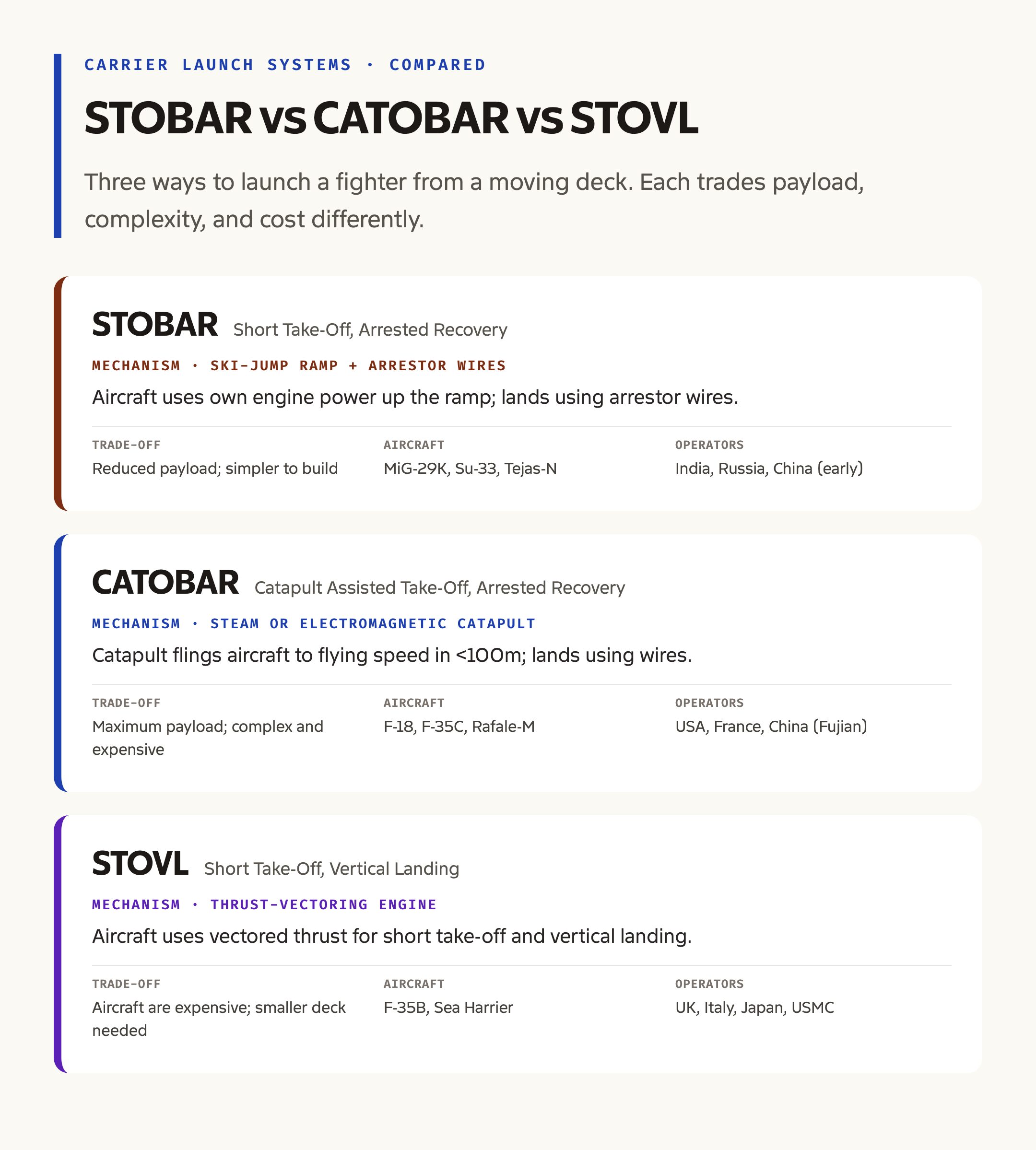
| Feature | STOBAR | CATOBAR | STOVL |
|---|---|---|---|
| Take-off | Ski-jump ramp; aircraft uses own engine power | Steam or electromagnetic catapult flings aircraft | Vertical or short take-off using engine vector |
| Recovery | Arrestor wires | Arrestor wires | Vertical landing |
| Maximum payload | Reduced (engine must lift aircraft) | Maximum payload possible | Most reduced |
| Aircraft examples | MiG-29K, Su-33, Tejas-N | F-18 Super Hornet, F-35C, Rafale-M | F-35B, Sea Harrier, Yak-38 |
| Used by | India, Russia, China (early carriers) | US, France | UK, Italy, Japan, US Marine Corps |
| Complexity | Simpler, cheaper | Complex, expensive | Aircraft are expensive |
STOBAR stands for Short Take-Off But Arrested Recovery. The aircraft uses its own engine thrust to run up the ski-jump ramp, which gives it an upward angle on take-off. It lands using arrestor wires. Both Indian carriers are STOBAR. The advantage is simplicity and lower cost. The disadvantage is that the aircraft cannot take off at maximum fuel and weapon load, because it has to lift itself off the deck without external help.
CATOBAR stands for Catapult Assisted Take-Off But Arrested Recovery. A steam or electromagnetic catapult, embedded in the deck, accelerates the aircraft to flying speed in less than a hundred metres. The aircraft can then take off with full fuel and full weapons load. CATOBAR is used by the United States and France. The latest electromagnetic version, abbreviated EMALS, is on the new US Gerald R. Ford-class and the Chinese Fujian. The cost and complexity are significant, but the operational advantage is decisive.
STOVL stands for Short Take-Off and Vertical Landing. The aircraft uses thrust-vectoring to take off in a short distance and land vertically. The Sea Harrier, used on Viraat, was a STOVL aircraft. The current generation is the F-35B, used by the United Kingdom, Italy, Japan, and the US Marine Corps.
INS Vishal and the Third-Carrier Debate
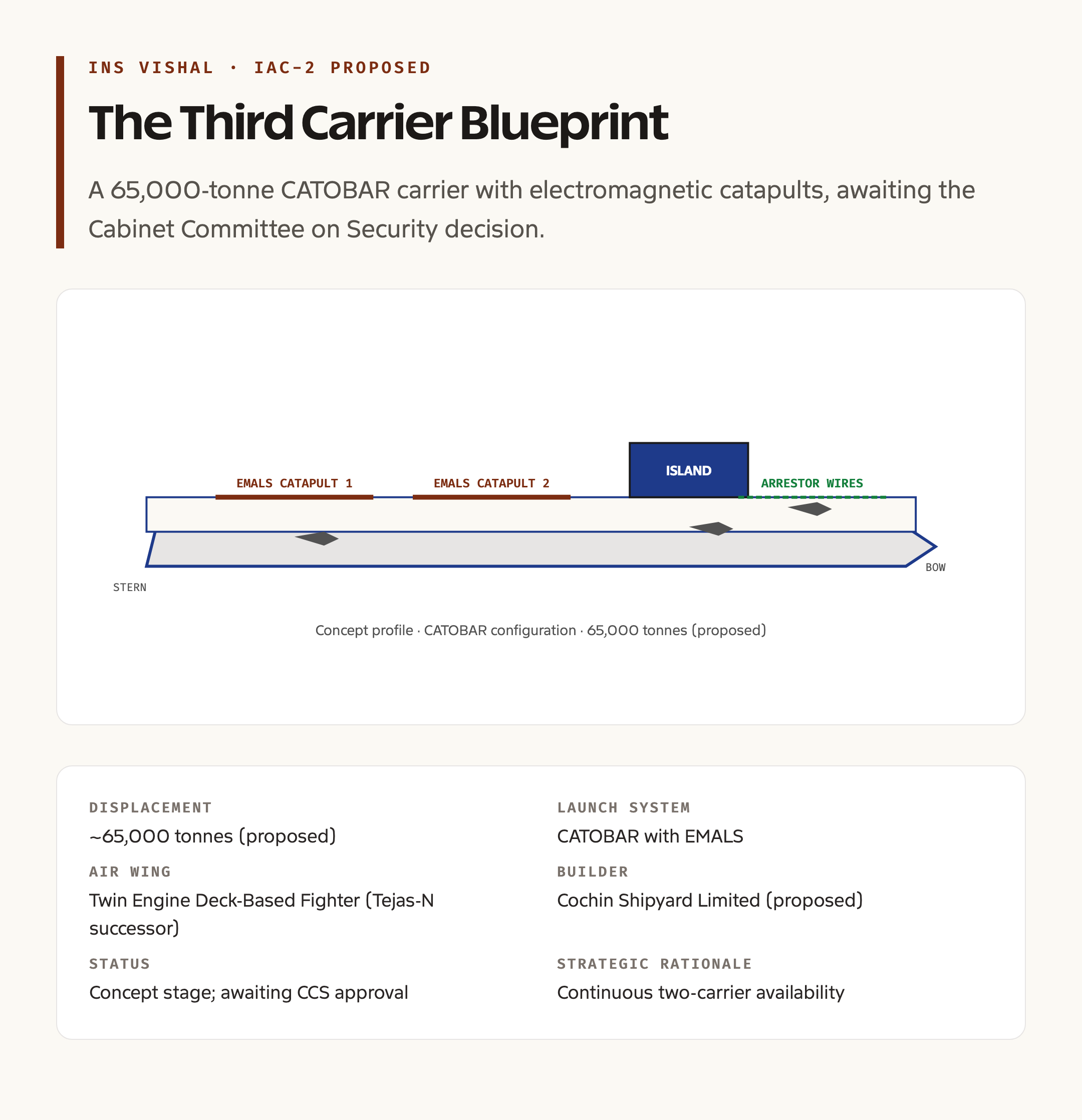
The proposed third carrier, INS Vishal or Indigenous Aircraft Carrier-2, has been on the drawing board since the early 2010s. The current concept is a 65,000-tonne carrier with CATOBAR launch, possibly with electromagnetic catapults, a higher sortie rate, and the ability to operate heavier aircraft including airborne early-warning aircraft of the fixed-wing type.
The case for INS Vishal has three strands. The first is operational. With only two carriers, one is always in deep maintenance for parts of the year, leaving only one available for actual deployment. A three-carrier force gives the navy a continuous two-carrier availability. The second is technological. Building a CATOBAR carrier domestically, including the catapult system, would push Indian shipbuilding into the top tier of the world. The third is strategic. As the Chinese carrier fleet grows and the Indian Ocean becomes more contested, India’s force posture needs to keep pace.
The case against is largely budgetary. A new carrier and its full strike group, including aircraft, escorts, and support vessels, can cost upwards of three billion US dollars over the build cycle, with operating costs adding more. Critics argue that the same money spent on submarines, anti-ship missiles, and shore-based aviation would deliver greater capability per rupee, particularly given the vulnerability of carriers to modern long-range anti-ship weapons.
The decision has not been finalized. The navy has continued to advocate for INS Vishal. The political and budgetary call lies with the Cabinet Committee on Security.
Comparative Snapshot: India and Regional Carrier Operators
The Indian Ocean and the wider Asia-Pacific are dotted with carriers and carrier-like ships. China operates Liaoning, Shandong, and Fujian, with the third using EMALS catapults. Japan has converted its Izumo-class destroyers to operate F-35B fighters in a STOVL role, effectively giving it light carrier capability without calling them carriers. South Korea is building light carriers. The United Kingdom operates two Queen Elizabeth-class STOVL carriers. The United States operates eleven nuclear-powered Nimitz and Ford-class carriers, the largest fleet by far.
India sits in a distinct position. It is the only navy in the region operating a STOBAR carrier built indigenously. Its maintenance and operational experience is deeper than that of any non-Western navy except the Russian, and it has a clear path to a CATOBAR carrier in the next decade if the political decision is made.
Challenges in the Indian Carrier Programme
The first challenge is the carrier-borne fighter. The MiG-29K has been an interim solution and is now ageing. The Rafale-M has been selected, but full induction will take years. The naval variant of the indigenous Tejas, abbreviated Tejas-N or TEDBF (Twin Engine Deck-Based Fighter), is in development but is still some years from service. The carriers cannot reach their full potential without a robust modern fighter fleet.
The second challenge is the protection of the carrier itself. Modern long-range anti-ship missiles, including hypersonic glide vehicles, increase the risk to surface ships. Carrier strike groups need stronger air-defence escorts and more capable submarine cover.
The third challenge is the maintenance and refit cycle. With only two carriers, scheduled maintenance creates predictable gaps in availability. A third carrier would solve this, but only if budgetary support is forthcoming.
The fourth challenge is the aircraft carrier ecosystem of supporting infrastructure: berthing, dry docks, ammunition depots, and dedicated air stations. Each carrier requires substantial fixed shore infrastructure that has to be built and maintained.
Prelims Pointers
- INS Vikrant, the original, was India’s first aircraft carrier, commissioned in 1961, served in the 1971 war, and decommissioned in 1997.
- INS Viraat, the second carrier, served from 1987 to 2017.
- INS Vikramaditya is a modified Russian Kiev-class carrier, formerly Admiral Gorshkov, commissioned in November 2013.
- The new INS Vikrant is the first aircraft carrier built in India, by Cochin Shipyard Limited, commissioned in September 2022.
- Both Indian carriers in service today use the STOBAR configuration with a ski-jump ramp.
- INS Vikramaditya has a displacement of about 44,500 tonnes; INS Vikrant about 45,000 tonnes.
- INS Vikrant is powered by four LM2500 gas turbines.
- The MiG-29K is the current carrier-borne fighter; the Rafale-M has been selected as the long-term replacement.
- The proposed third carrier, INS Vishal or IAC-2, is conceived as a CATOBAR carrier of around 65,000 tonnes.
- The Chinese carrier Fujian uses electromagnetic catapults of the EMALS type.
Mains Practice Questions
- Examine the strategic role of aircraft carriers in India’s two-ocean naval doctrine. Discuss the case for and against the construction of a third indigenous carrier.
- Compare the STOBAR, CATOBAR, and STOVL configurations of aircraft carriers and assess the trade-offs each presents. Which configuration is most appropriate for the proposed Indigenous Aircraft Carrier-2?
- The commissioning of the indigenous INS Vikrant in 2022 was a major milestone for Indian shipbuilding. Discuss the technological, strategic, and economic implications of this achievement.
Way Forward
The next phase of India’s carrier programme requires four things. First, a final decision on INS Vishal, with an early indication of whether the third carrier will use CATOBAR or remain on STOBAR. Without this decision, the long lead time for catapult development and aircraft selection cannot be compressed. Second, sustained funding for the Twin Engine Deck-Based Fighter, the indigenous successor to the MiG-29K, so that the carrier wing of the 2030s is built around a platform under Indian control. Third, expansion of the carrier strike group escort force, with more destroyers under Project 15B and the future Project 18, plus stronger conventional and nuclear-powered submarine elements. Fourth, infrastructure on the Andaman and Nicobar islands and the Lakshadweep group, including forward-mooring and replenishment facilities, to extend the operational reach of the carriers across the entire Indian Ocean. The carrier is one element in a larger naval system. India’s choices over the next decade will determine whether that system stays comfortably ahead of regional competitors or has to play catch-up.
Frequently Asked Questions
How many aircraft carriers does India have?
India currently operates two aircraft carriers: INS Vikramaditya, commissioned in 2013, and the new INS Vikrant, commissioned in 2022. A third carrier, INS Vishal or IAC-2, has been proposed but has not yet been approved.
Who built INS Vikrant, the new indigenous carrier?
The new INS Vikrant was built by Cochin Shipyard Limited in Kochi, Kerala. It was designed by the Indian Navy’s Directorate of Naval Design. It is the first aircraft carrier ever built in India and was commissioned in September 2022.
What is the difference between STOBAR and CATOBAR?
STOBAR stands for Short Take-Off But Arrested Recovery. The aircraft uses a ski-jump ramp at the bow of the carrier and its own engine power to take off, and lands using arrestor wires. CATOBAR stands for Catapult Assisted Take-Off But Arrested Recovery. A steam or electromagnetic catapult accelerates the aircraft to flying speed, allowing take-off with full fuel and weapons load. CATOBAR is more capable but more complex and expensive.
Which fighter aircraft operate from Indian carriers?
The current carrier-borne fighter is the MiG-29K, of Russian origin. The Indian Navy has selected the Rafale-M, of French origin, as the long-term replacement, with deliveries planned in the second half of the 2020s. The indigenous Twin Engine Deck-Based Fighter is in development for service in the 2030s.
What was INS Viraat?
INS Viraat was an aircraft carrier of the Indian Navy, originally HMS Hermes of the British Royal Navy. It was transferred to India in 1987 and operated until 2017. It carried Sea Harrier STOVL fighters and was the workhorse Indian carrier for three decades.
What is INS Vikramaditya?
INS Vikramaditya is the Russian-origin aircraft carrier of the Indian Navy, originally laid down as Admiral Gorshkov in the Soviet Union. It was modified for Indian service with a full-length flight deck and ski-jump ramp, and was commissioned in November 2013. Its displacement is about 44,500 tonnes.
What is INS Vishal?
INS Vishal, or Indigenous Aircraft Carrier-2, is the proposed third Indian carrier. The current concept is a 65,000-tonne carrier with CATOBAR launch, possibly with electromagnetic catapults. It has not yet been formally approved and is awaiting a decision by the Cabinet Committee on Security.
Why does India need aircraft carriers?
India needs aircraft carriers because it has a two-ocean responsibility, covering both the Arabian Sea and the Bay of Bengal. Land-based fighters cannot cover both theatres simultaneously. Carriers also extend the navy’s reach across the Indian Ocean for sea-lane security, and they are essential for sustaining the regional balance with the growing Chinese carrier fleet.
What is a carrier strike group?
A carrier strike group is the formation in which a carrier operates. It includes the carrier itself, destroyers and frigates for air defence and surface combat, a nuclear-powered or conventional submarine for sub-surface protection, and replenishment ships for fuel and stores. The carrier is the focal point and the rest exist to protect it and extend its reach.
How does the Indian carrier fleet compare with China?
The Chinese People’s Liberation Army Navy operates three carriers: Liaoning and Shandong, both STOBAR with ski-jump ramps similar to the Indian configuration, and Fujian, the latest, which uses electromagnetic catapults of the CATOBAR type. China operates one more carrier than India and is racing ahead in catapult technology, although Indian operational experience and shipbuilding capability remain significant.