Almatti Dam and Krishna River: Height Dispute, Reservoir, Inter-State Issues
Almatti Dam and Krishna River explained for UPSC: location, reservoir, height increase dispute, Krishna Water Tribunal awards, types of dams, and Telangana-Karnataka conflict.
The Almatti Dam sits on the Krishna river in northern Karnataka and quietly carries some of India’s most contentious water politics on its earthen shoulders. Built primarily for irrigation in the parched Bijapur and Bagalkot districts, it stores water for the Upper Krishna Project, generates hydropower at the foot of its spillway, and now stands at the centre of a fresh round of disputes between Karnataka and Telangana over how high its gates can be raised.
Karnataka wants to raise the Full Reservoir Level so it can use the Krishna allocation that the second tribunal awarded. Telangana argues that any increase in storage at Almatti will reduce the water that flows downstream to its own projects, and it has invoked the Inter-State River Water Disputes Act to push back. The dispute also pulls in Andhra Pradesh and the Krishna River Management Board.
This guide explains what the Almatti Dam actually is, how the Krishna river basin is shared, what the tribunal awards and pending Supreme Court challenges say, and where the dam sits in the broader catalogue of Indian dam types and water governance debates.
Quick Facts: Almatti Dam and Krishna River
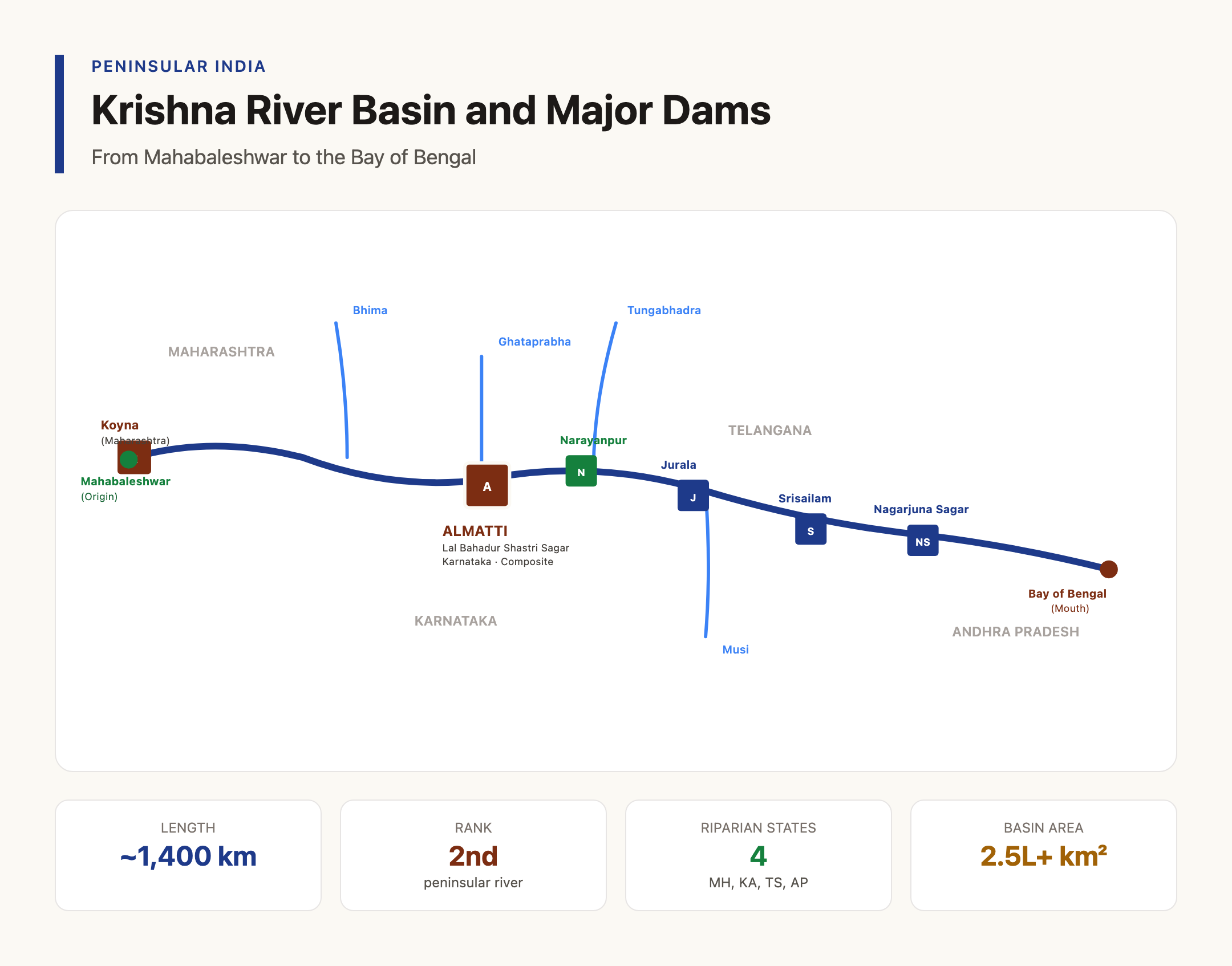
- Location: Almatti, Bijapur district, north Karnataka, on the Krishna river
- Type of dam: Composite, with an earthen embankment and a gravity concrete spillway
- Reservoir name: Lal Bahadur Shastri Reservoir
- Primary purpose: Irrigation under the Upper Krishna Project, with hydropower as a secondary objective
- Power station: Almatti Dam Power Station at the foot of the dam
- Project umbrella: Upper Krishna Project, one of the largest irrigation projects in Karnataka
- Tribunal: Krishna Water Disputes Tribunal-II, also called the Brijesh Kumar Tribunal, award notified in 2010 with subsequent legal challenges
- Riparian states of the Krishna basin: Maharashtra, Karnataka, Telangana, and Andhra Pradesh
- River length: Krishna is the second-longest peninsular river, flowing roughly 1,400 kilometres
- Origin and mouth: Rises near Mahabaleshwar in the Western Ghats, drains into the Bay of Bengal at Hamasaladeevi, Andhra Pradesh
What the Almatti Dam Is
The Almatti Dam is a multipurpose structure on the Krishna river built as the keystone of the Upper Krishna Project, a phased irrigation programme that aims to bring water to large parts of the drought-prone districts of north Karnataka. Construction was completed in 2005, although different stages of project canals continued to come online for years afterwards.
Structurally, Almatti is best described as a composite dam. The main body is an earthen embankment that uses compacted earth and rock as the primary water-retaining material. The spillway section, where flood waters are released through gated openings, is a concrete gravity structure. This composite design is common for long, low-lying valleys where a single concrete gravity dam would be uneconomic.
The reservoir is named Lal Bahadur Shastri Sagar after India’s second prime minister. It feeds canals on both banks and supports a dam-toe hydroelectric power station with multiple Kaplan turbine units. Through the year, the reservoir level varies between dead storage and Full Reservoir Level depending on inflows and downstream demand.
Background and Historical Context
The Krishna river basin has been allocated and re-allocated more times than almost any other Indian river system. The Krishna Water Disputes Tribunal-I, set up under the Inter-State River Water Disputes Act, 1956, gave its award in 1973, and that award froze the inter-state shares of Maharashtra, Karnataka, and what was then undivided Andhra Pradesh. Karnataka received about 700 thousand million cubic feet of dependable yield, and the Upper Krishna Project was designed around that share.
Construction of Almatti began in the 1960s and stretched across decades, repeatedly slowed by funding constraints, design revisions, and litigation. When work resumed in earnest in the 1990s, downstream Andhra Pradesh approached the Supreme Court arguing that the proposed Full Reservoir Level of 524.256 metres would exceed Karnataka’s tribunal allocation. The Supreme Court issued interim orders limiting the height pending tribunal review.
The Krishna Water Disputes Tribunal-II, headed by Justice Brijesh Kumar, was constituted in 2004. It delivered its main award in 2010 and gave a further explanatory order in 2013. The tribunal allowed Karnataka additional water from surplus flows, which in principle permits Almatti’s height to be raised to 524.256 metres, increasing the gross storage from approximately 130 thousand million cubic feet to higher levels. The notification of the tribunal award has been delayed by litigation.
Andhra Pradesh was bifurcated in 2014, and Telangana inherited the Krishna allocations that previously belonged to combined Andhra. Telangana has since argued that Karnataka’s plan to raise Almatti will affect its own backwater submergence at Jurala and downstream supply to Nagarjuna Sagar and Srisailam, both of which are Telangana’s lifelines.
Key Specifications and Project Details
The dam’s gross storage at the present FRL is in the range of 123 to 130 thousand million cubic feet, and a height increase to 524.256 metres would push gross storage above 200 thousand million cubic feet, although live storage and the operation rule curves matter more than the headline figure for downstream flow. The Almatti Power Station is in the range of a few hundred megawatts of installed capacity using low-head Kaplan units.
The Upper Krishna Project is divided into stages I, II, and III. Stage I and II canals serve large parts of Bijapur, Bagalkot, Yadgir, Raichur, Koppal, and Gulbarga districts. Stage III, contingent on the height increase, would extend irrigation to additional drought-prone tracts in north Karnataka. Hydropower from the dam-toe station feeds the Karnataka grid, although the project is fundamentally an irrigation scheme, not a power scheme.
Why Almatti Matters: Water, Federalism, Politics
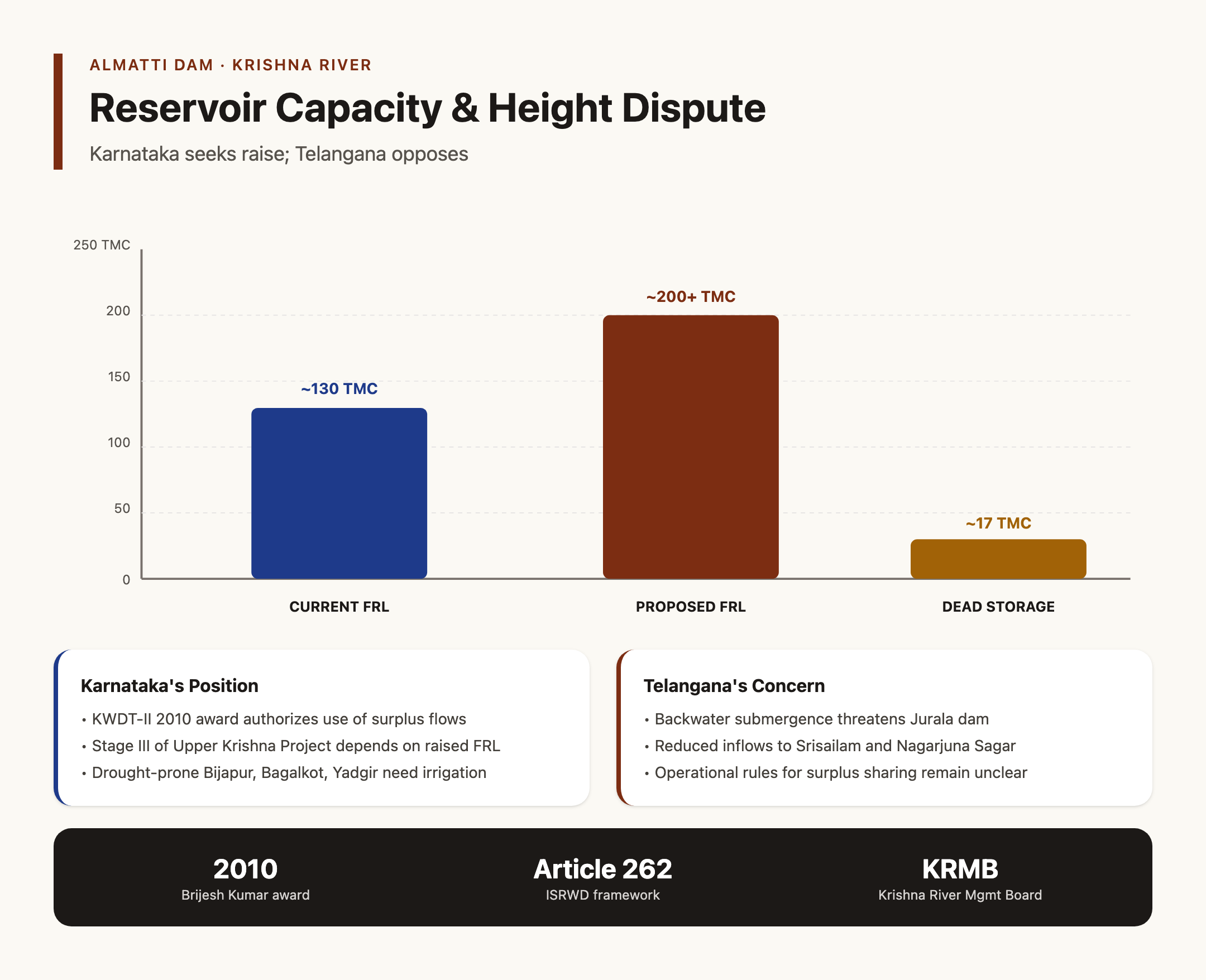
Almatti is a textbook case of how upstream and downstream incentives diverge in a peninsular Indian basin. Karnataka, the upper riparian, seeks to maximize storage so it can use its tribunal allocation in lean years. Telangana, the middle-lower riparian, fears that storage upstream will reduce dependable flow to its own reservoirs. Andhra Pradesh, the lowest riparian, has a stake in the residual flow to the delta. The dispute is genuinely about hydrology and not just politics, because Krishna is a deficit basin in most years, with utilization already exceeding the basin’s average yield in dry sequences.
For UPSC mains, Almatti is also a way into the larger architecture of Indian water federalism. It sits inside the framework of Article 262, the Inter-State River Water Disputes Act, 1956, the River Boards Act, 1956, and the Krishna and Godavari River Management Boards constituted under the Andhra Pradesh Reorganisation Act, 2014. Inter-state water disputes are kept out of ordinary judicial review, but the Supreme Court has retained jurisdiction over questions of constitutional interpretation, which is why disputes still reach the Court even after tribunal awards.
Detailed Analysis: The Krishna Basin and the Height Dispute
The Krishna river rises near Mahabaleshwar in the Western Ghats and flows roughly east through Maharashtra, Karnataka, Telangana, and Andhra Pradesh before emptying into the Bay of Bengal. Its main tributaries include the Bhima, the Tungabhadra, the Ghataprabha, the Malaprabha, the Musi, the Koyna, and the Dudhganga. The basin covers more than 250,000 square kilometres and supports cropping systems ranging from sugarcane and paddy in irrigated tracts to dryland millets in the rainfed zones.
The argument over Almatti’s FRL turns on three issues. First, dependable yield, which is the volume of water that can be expected at a given probability of exceedance. Second, surplus flow, which is the water available in good monsoon years above the dependable yield. Third, project-specific allocations, which are the volumes assigned to each state’s named projects under the tribunal awards.
Karnataka’s case is that the second tribunal authorized additional storage to allow it to use surplus flow water. Telangana’s counter is that submergence at the higher FRL will affect its Jurala dam and that operational rules are unclear about how surplus flows would be released downstream in dry sequences. Until the tribunal award is finally notified and operational rules are framed, the Almatti gates remain at the interim FRL set by the Supreme Court. Periodic political flashpoints, especially in monsoon and post-monsoon months, keep the dispute in headlines.
Comparative Perspective: Types of Dams in India
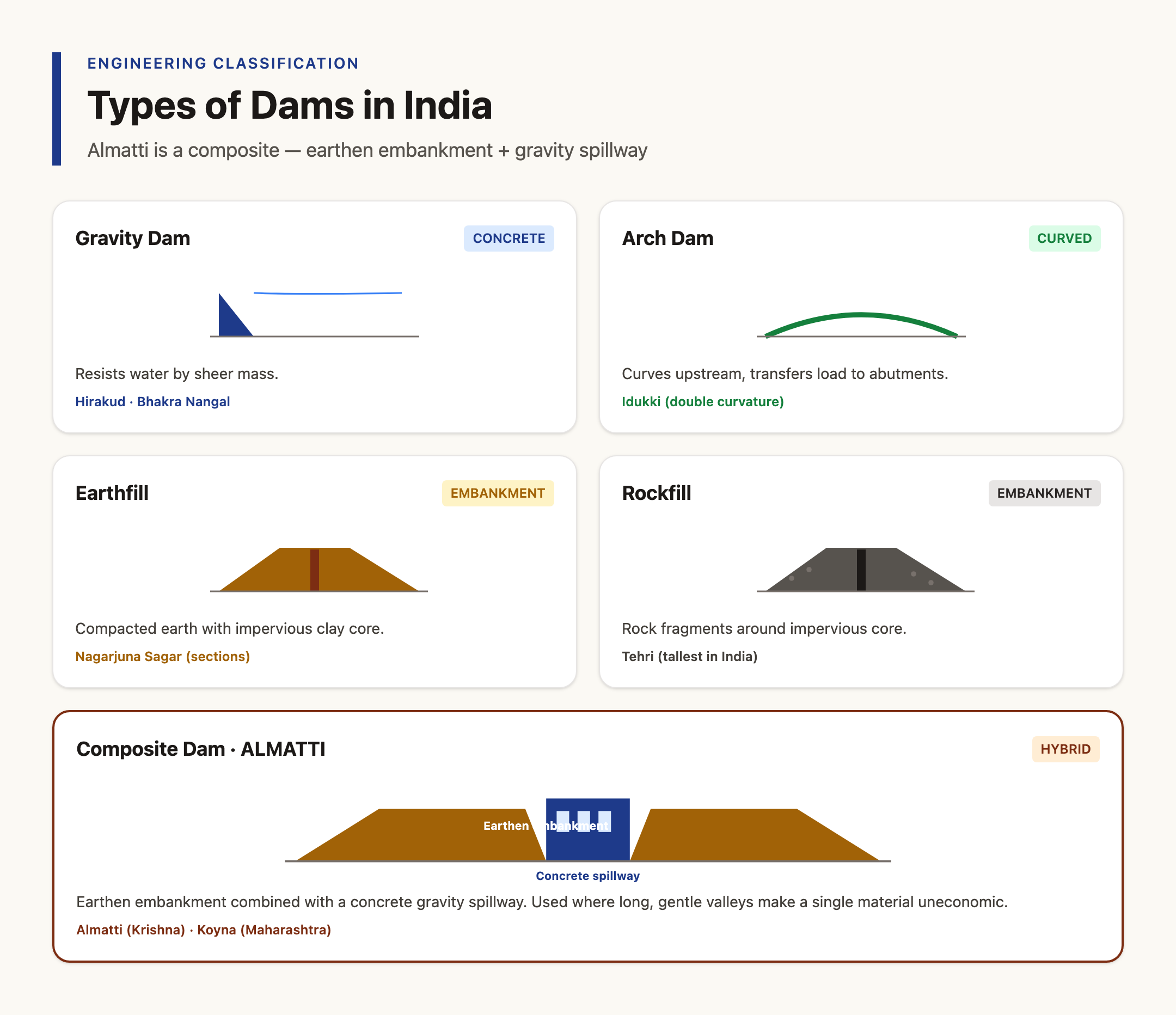
| Type of Dam | Construction Feature | Indian Examples |
|---|---|---|
| Gravity Dam | Massive concrete or masonry, resists water by its own weight | Hirakud (Odisha), Bhakra Nangal (HP/Punjab) |
| Arch Dam | Curved upstream, transfers load to abutments | Idukki (Kerala) |
| Earthfill Embankment | Compacted earth with impervious clay core | Nagarjuna Sagar earthen sections (AP/Telangana) |
| Rockfill Embankment | Rock fragments with central impervious core | Tehri (Uttarakhand) |
| Composite Dam | Combination of concrete and earth or rock | Almatti (Karnataka), Koyna (Maharashtra) |
Almatti’s composite design fits the long, gentle valley of the Krishna at its location. A pure concrete gravity dam across that span would be hugely expensive, while a pure earth dam could not safely pass extreme floods.
Major Indian Dams at a Glance
| Dam | River | State | Significance |
|---|---|---|---|
| Tehri | Bhagirathi | Uttarakhand | Tallest dam in India |
| Hirakud | Mahanadi | Odisha | One of the longest dams in India |
| Bhakra Nangal | Sutlej | HP and Punjab | Among the world’s highest straight gravity dams |
| Indira Sagar | Narmada | Madhya Pradesh | Largest reservoir capacity in India |
| Sardar Sarovar | Narmada | Gujarat | Major multi-state irrigation project |
| Nagarjuna Sagar | Krishna | Telangana and Andhra Pradesh | Among the largest masonry dams in the world |
| Idukki | Periyar | Kerala | Iconic double-curvature arch dam |
| Govind Ballabh Pant Sagar | Rihand | Uttar Pradesh | Largest artificial lake in India |
| Kallanai | Kaveri | Tamil Nadu | One of the oldest functional dams in the world, built by Karikalan Chola |
| Farakka | Ganga | West Bengal | Barrage to improve Hooghly navigability |
Challenges Facing Almatti and Krishna Basin Management
The basin faces several long-term pressures that the height dispute does not solve and may even sharpen. Water-intensive cropping in the upper and middle basin, especially sugarcane in Maharashtra and Karnataka, locks in heavy demand even in deficit years. Reservoir sedimentation steadily reduces the live storage of every major dam in the basin, including Almatti. Climate variability makes the dependable yield itself a moving target, since the assumed long-term flow series may overstate future water availability.
Operational rules between Almatti, Narayanpur, Jurala, Srisailam, and Nagarjuna Sagar need to be modernized for real-time inter-state coordination, ideally under the Krishna River Management Board. Submergence and rehabilitation issues, especially for villages around Bagalkot, remain partially unresolved, and the LARR Act, 2013, sets a higher rehabilitation standard than was applied to earlier project phases. Environmental flow requirements for the lower Krishna delta are largely informal, although delta fisheries and Sundarbans-like estuarine ecosystems depend on residual freshwater inflow.
Prelims Pointers on Almatti and Krishna
- Almatti is on the Krishna river in Bijapur district of north Karnataka.
- Reservoir name is Lal Bahadur Shastri Sagar.
- The dam is a composite of an earthen embankment with a concrete gravity spillway.
- Primary purpose is irrigation under the Upper Krishna Project, with hydropower as secondary.
- Krishna river riparian states are Maharashtra, Karnataka, Telangana, and Andhra Pradesh.
- The Krishna Water Disputes Tribunal-II is also known as the Brijesh Kumar Tribunal.
- Inter-state river water disputes are governed by Article 262 of the Constitution and the Inter-State River Water Disputes Act, 1956.
- Krishna river rises near Mahabaleshwar in the Western Ghats and drains into the Bay of Bengal.
- Tehri Dam is the tallest dam in India.
- Kallanai on the Kaveri is the oldest functional dam in India, built by the Chola king Karikalan in the second century CE.
Mains Practice Questions
- (GS-II) Examine the constitutional and statutory framework for resolution of inter-state river water disputes in India, with reference to the Krishna basin.
- (GS-III) Discuss the multipurpose character of the Almatti Dam and the inter-state issues that have arisen around its proposed height increase.
- (GS-III) Climate variability and population pressure are reshaping water demand in the Krishna basin. Suggest a basin-level governance reform framework that can manage this stress.
- (GS-II) Compare the Krishna and Cauvery river water disputes. What lessons do they offer for the design of inter-state river water tribunals?
Way Forward
A workable path on Almatti requires three converging moves. First, finalize and notify the Krishna Water Disputes Tribunal-II award along with binding operational rules that govern how surplus flows are shared and released in real time. Second, empower the Krishna River Management Board with telemetry-based gauging at all major reservoirs and a transparent dashboard so that all riparian states see the same data. Third, treat Almatti’s height as one variable in a basin-wide optimization rather than a stand-alone trophy, by linking it to crop water budgeting, micro-irrigation incentives, environmental flow rules, and basin-level demand management.
For broader basin governance, replication of the Cauvery Water Management Authority model, with statutory teeth and political insulation, would help. Climate adaptation studies should be commissioned to update the dependable yield estimates that all the tribunal awards rest on. Rehabilitation and resettlement for affected villages must comply fully with the LARR Act, 2013. Environmental flow norms for the lower Krishna delta need to be codified, drawing on the Brisbane Declaration framework and Indian inter-disciplinary studies.
Frequently Asked Questions
Where is the Almatti Dam located?
The Almatti Dam is located on the Krishna river at Almatti in Bijapur district of northern Karnataka. It is the keystone structure of the Upper Krishna Project, which serves drought-prone districts of north Karnataka.
What kind of dam is the Almatti Dam?
Almatti is a composite dam. The main body is an earthen embankment built of compacted earth and rock, while the spillway section that releases floodwaters is a concrete gravity structure. This combination is common in long, gentle valleys.
What is the Lal Bahadur Shastri Reservoir?
It is the official name of the Almatti reservoir, named after India’s second prime minister Lal Bahadur Shastri. The reservoir feeds canals of the Upper Krishna Project and powers a dam-toe hydroelectric station.
What is the Almatti Dam height dispute about?
Karnataka has long sought to raise Almatti’s Full Reservoir Level to use additional water awarded by the Krishna Water Disputes Tribunal-II. Telangana argues that the increase will affect its own projects downstream, especially submergence at Jurala and inflow at Nagarjuna Sagar and Srisailam, and that the operational rules for sharing surplus flows are unclear.
Which states share the Krishna river basin?
Maharashtra, Karnataka, Telangana, and Andhra Pradesh share the Krishna basin. After the bifurcation of Andhra Pradesh in 2014, Telangana inherited a share of the original Andhra allocation, and the Krishna River Management Board was constituted to manage the basin under the Andhra Pradesh Reorganisation Act.
What is the Krishna Water Disputes Tribunal-II?
The Krishna Water Disputes Tribunal-II, also known as the Brijesh Kumar Tribunal, was set up in 2004 under the Inter-State River Water Disputes Act, 1956. It delivered its main award in 2010 and a further order in 2013, allocating shares to Maharashtra, Karnataka, and Andhra Pradesh.
Where does the Krishna river originate and end?
The Krishna river rises near Mahabaleshwar in the Western Ghats of Maharashtra and flows generally eastward through Karnataka, Telangana, and Andhra Pradesh before draining into the Bay of Bengal at Hamasaladeevi in Andhra Pradesh.
What is the difference between an earthen, gravity, and arch dam?
An earthen dam uses compacted earth or rock with an impervious core to retain water. A gravity dam uses the sheer mass of concrete or masonry to resist water pressure by its own weight. An arch dam is curved upstream and transfers water pressure laterally to its abutments, allowing a thinner, lighter structure but requiring strong rock walls.
Which is the tallest dam in India?
Tehri Dam on the Bhagirathi river in Uttarakhand is the tallest dam in India, with a height of around 260 metres. It is a rockfill embankment dam and is part of a larger hydroelectric and irrigation complex.
Why are inter-state water disputes kept out of regular court jurisdiction?
Article 262 of the Constitution permits Parliament to bar the jurisdiction of the Supreme Court and other courts on inter-state river water disputes, and the Inter-State River Water Disputes Act, 1956, gives effect to this. The intent is to provide a specialized adjudicatory mechanism through tribunals. The Supreme Court still hears constitutional questions and ensures procedural fairness, which is why dispute litigation continues even after tribunal awards.