The Cauvery Water Dispute is the long-running inter-state conflict over the sharing of the Cauvery river‘s waters among Karnataka, Tamil Nadu, Kerala and the Union Territory of Puducherry. The disagreement is more than a century and a half old. It began with a colonial-era agreement in 1892, was carried forward in revised form in 1924, became a constitutional issue after the reorganisation of states in 1956, was referred to a tribunal in 1990, received a final tribunal award in 2007, was decisively reshaped by the Supreme Court in 2018, and is now administered by the Cauvery Water Management Authority.
Each one of those steps matters for UPSC. The Cauvery Water Dispute is the standard worked example for inter-state water disputes in India and the single most heavily examined case under the Inter-State River Water Disputes Act of 1956. It is also one of the few water disputes that has reached and been decided by the Supreme Court.
This article walks through the river basin’s geography, the colonial-era agreements, the post-Independence breakdown, the tribunal years from 1990 to 2007, the 2018 Supreme Court verdict, the establishment of the Cauvery Water Management Authority, the issues that remain unresolved, and the conclusions UPSC tends to draw from this case for the wider problem of interstate river water disputes in India.
Quick Facts: Cauvery Water Dispute
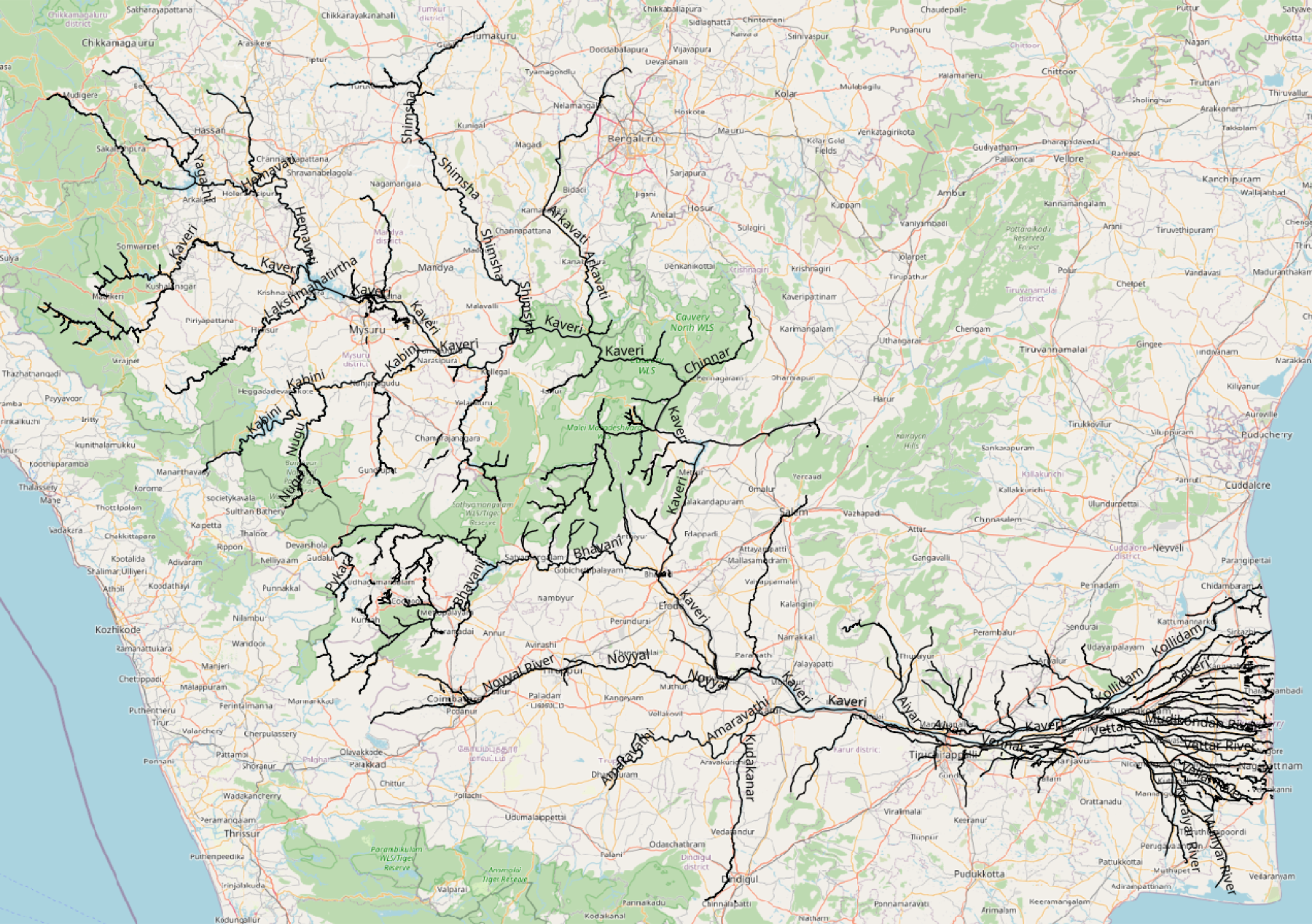
The hard numbers and dates of the dispute are worth memorising as a block.
- Parties: Karnataka, Tamil Nadu, Kerala, Puducherry
- River: Cauvery (Kaveri), about 800 km long
- Origin: Talakaveri in the Brahmagiri hills, Kodagu district, Karnataka
- Mouth: Bay of Bengal at Poompuhar, Tamil Nadu (with delta near Thanjavur)
- Total basin yield (per 2007 award): 740 TMC (thousand million cubic feet) in a normal year
- First written agreement: 1892, between the Madras Presidency and the princely state of Mysore
- Revised agreement: 1924, fifty-year arrangement
- Tribunal formed: 2 June 1990
- Tribunal interim order: June 1991
- Tribunal final award: 5 February 2007
- Supreme Court verdict: 16 February 2018
- Cauvery Water Management Authority (CWMA) formed: 1 June 2018
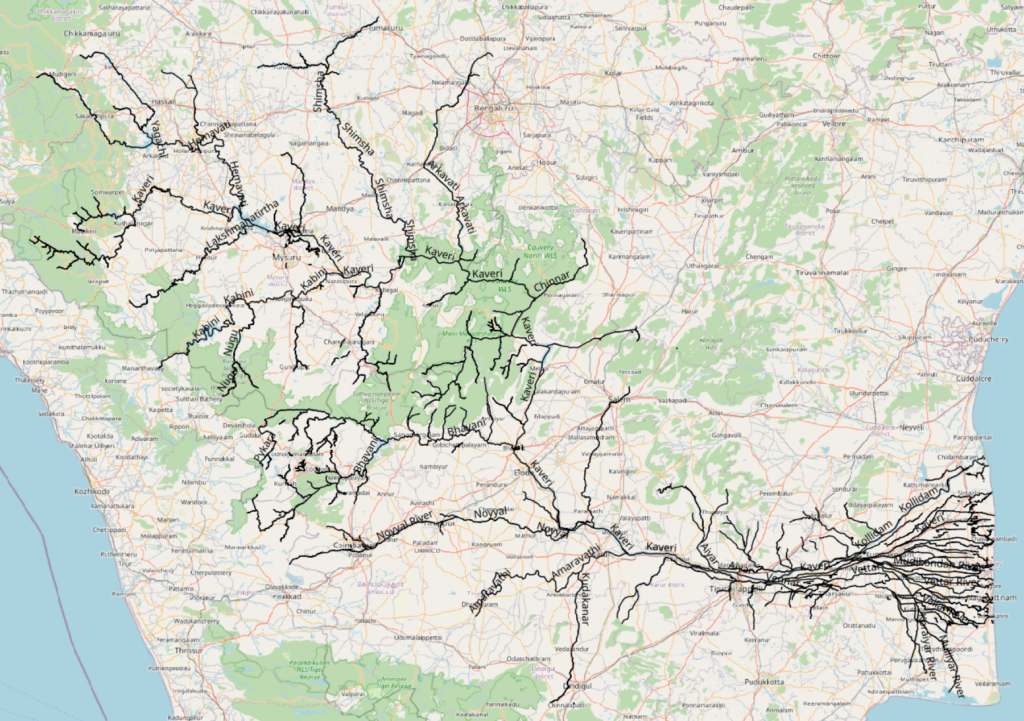
The Cauvery basin covers an area of about 81,000 sq km across the four states. Most of the basin lies in Karnataka and Tamil Nadu, with smaller shares in Kerala and Puducherry.
The Cauvery Basin and Its Hydrology
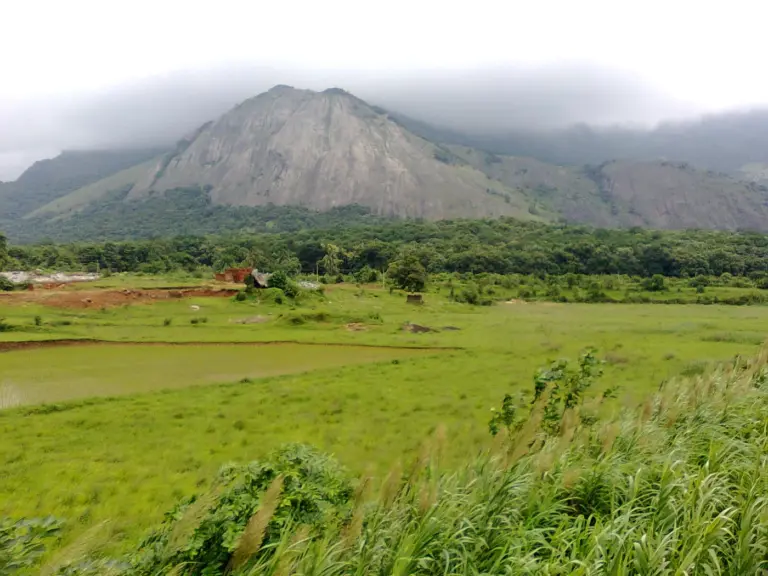
The Cauvery rises at Talakaveri in the Brahmagiri hills of the Western Ghats in Kodagu district of Karnataka. It flows generally east-southeast across the Mysore plateau, descends through the Eastern Ghats into the Tamil Nadu plain, and forms a large delta in Thanjavur district before emptying into the Bay of Bengal.
The river receives water from the southwest monsoon (June to September) on its upper catchment in Karnataka and Kerala, and from the northeast monsoon (October to December) on its lower catchment in Tamil Nadu. This split monsoon regime is at the heart of the dispute. Karnataka’s water comes first, when its monsoon is full, but Tamil Nadu’s standing kharif crop in the delta is planted in June and needs water before its own monsoon arrives in October. Tamil Nadu therefore demands releases from Karnataka in the lean months, especially July to September.
Major dams and reservoirs in the basin include:
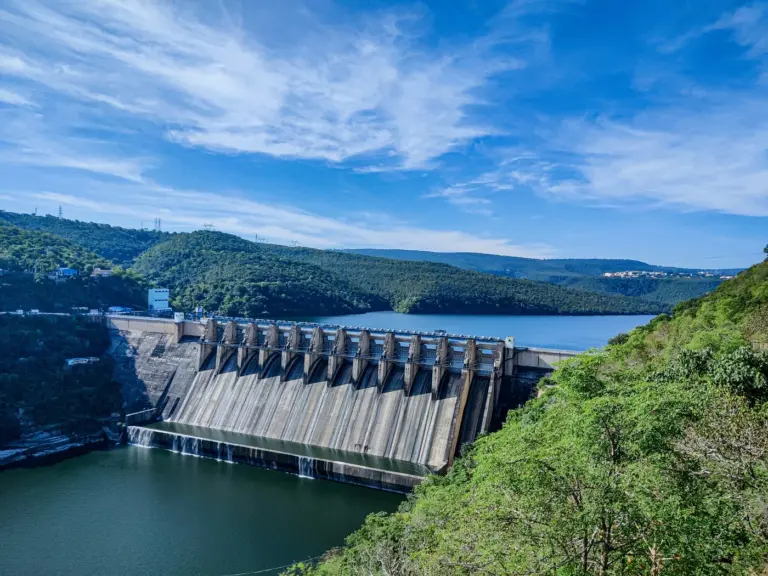
- Krishna Raja Sagara (KRS) and Hemavati in Karnataka
- Kabini and Harangi in Karnataka
- Mettur (Stanley Reservoir) in Tamil Nadu
- Banasura Sagar in Kerala
The dispute revolves heavily around how much water Karnataka must release through Mettur for the Tamil Nadu delta, particularly in dry years. The Mettur dam is the choke point: it is downstream of all Karnataka reservoirs and upstream of the entire Tamil Nadu delta. See the Krishnarajasagara Dam entry for the upstream context.
Colonial-Era Agreements: 1892 and 1924
The earliest formal agreement on Cauvery waters was signed in 1892 between the Madras Presidency (then under direct British rule) and the princely state of Mysore. The agreement required Mysore to obtain Madras’s prior consent before constructing any new irrigation project on the Cauvery that would materially affect the supply to Madras.
The 1924 agreement was a more detailed fifty-year arrangement. It was signed against the backdrop of Mysore’s plan to build the Krishna Raja Sagara dam (which was completed in 1932) and Madras’s demand for guarantees on its share of water for the Cauvery delta. The 1924 agreement set out specific dam heights, irrigation areas and water-sharing principles, and was to remain in force for fifty years until 1974.
The two agreements were colonial-era arrangements between a British presidency and a princely state. After Independence and the reorganisation of states in 1956, the parties changed. Madras Presidency became Madras State (renamed Tamil Nadu in 1969). Mysore State (renamed Karnataka in 1973) inherited Mysore’s claim and added the Coorg (Kodagu) headwaters area. Kerala emerged as a riparian state with a small share of the basin. Puducherry, the former French enclave on the Cauvery delta, also became a stakeholder.
Karnataka has consistently argued that the colonial-era agreements were inequitable because they were imposed on a princely state by the colonial power and gave Madras a disproportionate share. Tamil Nadu has consistently argued that the agreements were valid and continue to bind the successor states.
Breakdown and Demand for a Tribunal
The 1924 agreement lapsed on its fiftieth anniversary in 1974. Karnataka took the position that the agreement was no longer in force and went ahead with new irrigation projects in its part of the basin. Tamil Nadu protested. From 1970 onwards Tamil Nadu had been asking the Supreme Court and the Centre to refer the dispute to a tribunal under the Inter-State River Water Disputes Act of 1956.
The Centre referred the dispute to a tribunal only in 1990. The Cauvery Water Disputes Tribunal (CWDT) was constituted on 2 June 1990, chaired by Justice Chittatosh Mookerjee, with two other members.
The tribunal began hearings in 1990 and continued for sixteen years. In June 1991 it passed an interim order directing Karnataka to release 205 TMC of water annually to Tamil Nadu and not to increase its area of irrigation beyond 11.2 lakh acres. The interim order was extremely controversial in Karnataka, which protested and which saw widespread civil unrest, including the Cauvery riots in December 1991 with serious incidents in Bengaluru.
The 2007 Tribunal Final Award
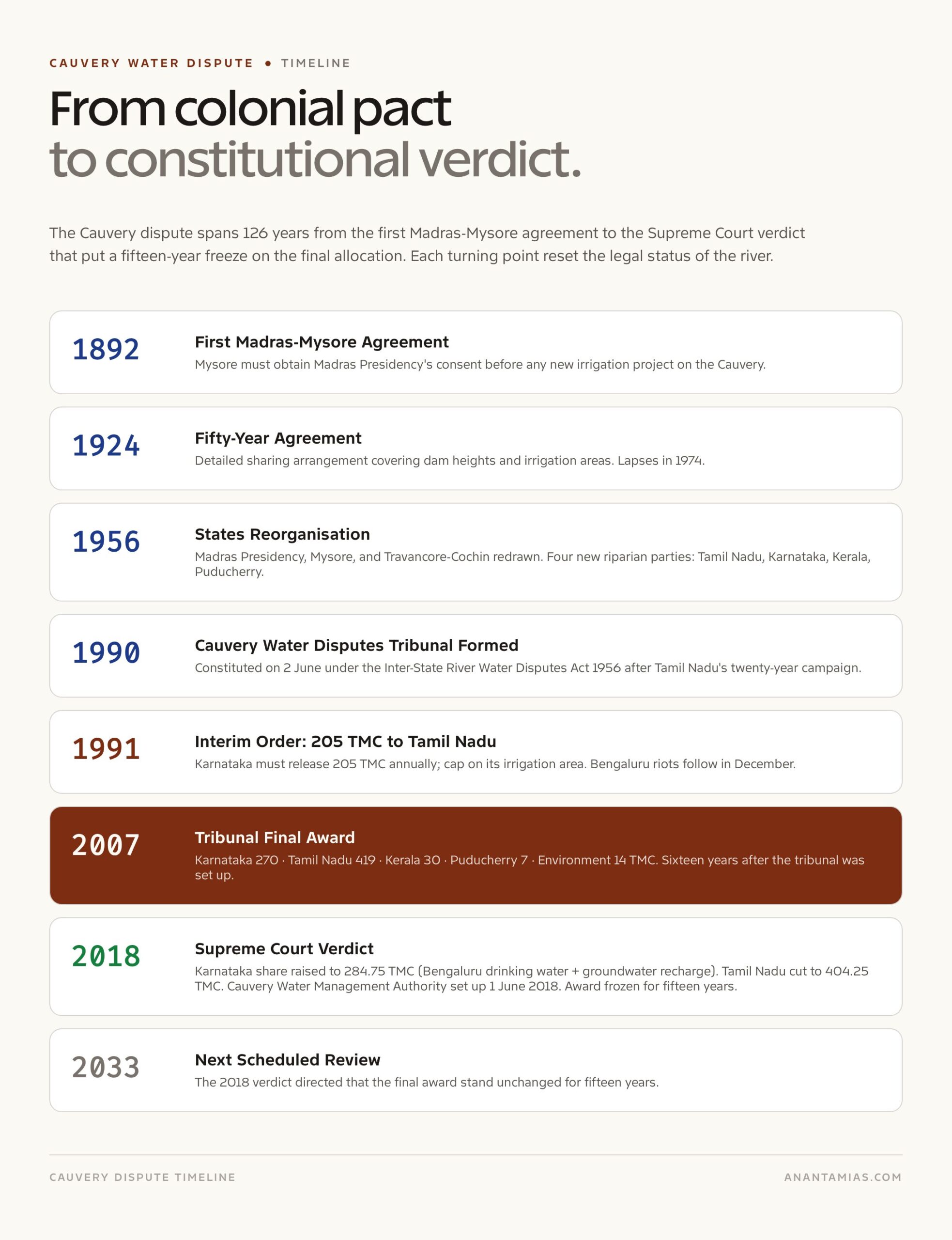
After sixteen years of hearings the tribunal delivered its final award on 5 February 2007. The award allocated the total dependable annual flow of 740 TMC as follows (in a normal year):
- Karnataka: 270 TMC
- Tamil Nadu: 419 TMC
- Kerala: 30 TMC
- Puducherry: 7 TMC
- Reserved for environmental flow and inevitable loss: 14 TMC
The tribunal also fixed the monthly release schedule that Karnataka had to follow at Biligundlu, the inter-state border point on the Cauvery, to deliver Tamil Nadu’s share. The schedule front-loaded releases to the south-west monsoon months when Karnataka’s reservoirs would be filling, which Karnataka contested on the ground that it gave Tamil Nadu disproportionate access to its own monsoon inflow.
Both Karnataka and Tamil Nadu filed Special Leave Petitions in the Supreme Court against the 2007 award. The petitions and the implementation of the award were both pending when the Supreme Court took the matter up for final determination, more than a decade later.
The 2018 Supreme Court Verdict
On 16 February 2018 the Supreme Court delivered its verdict on the appeals against the tribunal award. The bench was headed by then Chief Justice Dipak Misra.
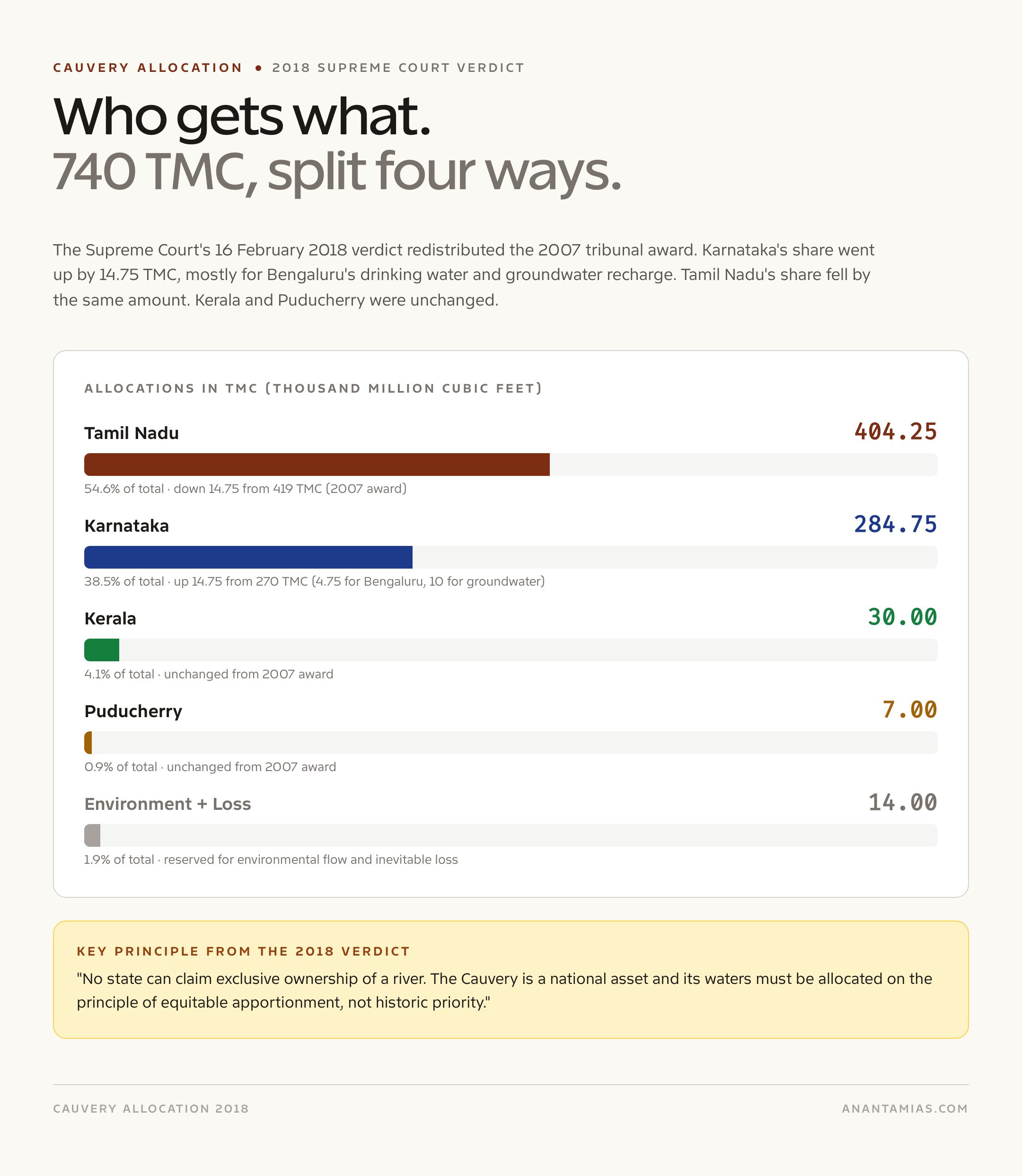
The Court redistributed the water shares, increasing Karnataka’s share at the expense of Tamil Nadu while keeping Kerala’s and Puducherry’s allocations unchanged.
The revised allocations were:
- Karnataka: 284.75 TMC (up from 270 TMC, an increase of 14.75 TMC)
- Tamil Nadu: 404.25 TMC (down from 419 TMC, a decrease of 14.75 TMC)
- Kerala: 30 TMC (unchanged)
- Puducherry: 7 TMC (unchanged)
The Supreme Court justified the reallocation on three main grounds:
First, the Court held that the city of Bengaluru, which depends on the Cauvery for its drinking water, had grown rapidly since the tribunal’s award and needed an additional allocation. The Court allowed Karnataka 4.75 TMC for Bengaluru’s drinking water in addition to its existing share.
Second, the Court allowed Karnataka 10 TMC for groundwater recharge, on the ground that the tribunal had not adequately accounted for the role of groundwater in the basin.
Third, the Court declared that no state could claim exclusive ownership of a river. The Cauvery, the Court said, was a national asset and its waters had to be allocated on the principle of equitable apportionment rather than historic priority.
The Court also directed that the final award would stand unchanged for the next fifteen years, after which it would be revisited. That fifteen-year horizon brings the next review to 2033.
The Cauvery Water Management Authority
The Supreme Court in its 2018 verdict directed the central government to set up the institutional machinery to implement the award. The Centre constituted the Cauvery Water Management Authority (CWMA) on 1 June 2018 and the Cauvery Water Regulation Committee (CWRC) three weeks later.
The CWMA is a nine-member body. It includes a chairperson (an officer of the rank of secretary to the Government of India), two members representing the central government, and one representative from each of the four party states and Union Territories (Karnataka, Tamil Nadu, Kerala, Puducherry).
The CWMA’s mandate is:
- To secure the implementation of the 2018 Supreme Court order and the underlying 2007 tribunal award
- To regulate the daily, monthly and annual water releases from Karnataka to Tamil Nadu at Biligundlu
- To monitor reservoir storage in the basin
- To recommend appropriate steps when there is a deficit or surplus in any year
- To inform the Centre and the states of any breaches
The CWRC is the technical committee that works under the CWMA and meets more frequently to monitor day-to-day releases.
The CWMA model has been studied as a possible template for other water disputes. The Inter-State River Water Disputes (Amendment) Act 2019 proposed a similar standing tribunal with implementing authorities for other disputes.
Why the Dispute Persists Despite the Verdict
Even after the 2018 verdict and the creation of the CWMA, the Cauvery dispute is not finally settled. Several issues continue to generate friction.
Drought years remain a problem. The award specifies releases for a normal year (740 TMC of total flow). In drought years the actual flow is much less. The Court did not specify a clear formula for distress sharing, and every dry year produces a fresh round of demands and counter-demands.
Karnataka’s expanding urban demand is rising rapidly. Bengaluru’s population has grown sharply since 2018 and its draw on Cauvery water is much higher than the 4.75 TMC allowed. New satellite cities like Mysuru and Mandya have their own claims.
Tamil Nadu’s delta cropping pattern is unchanged. The Cauvery delta in Thanjavur, Tiruvarur and Nagapattinam still grows two paddy crops a year, which is among the most water-intensive cropping patterns possible. Suggestions to shift to less water-intensive crops have not gained political support.
Mekedatu project remains contested. Karnataka has proposed a multi-purpose reservoir at Mekedatu on the Cauvery to supply drinking water to Bengaluru and generate hydropower. Tamil Nadu has objected on the ground that it would impound water that should flow to its delta. The case is pending in the Supreme Court.
Groundwater is uncounted. Both states pump heavily from the Cauvery groundwater system, but the 2018 verdict only addressed surface flows.
The Cauvery Dispute in Constitutional Law
The Cauvery case has had a significant effect on constitutional and water law in India. Several principles have been established or strengthened through it.
Article 262 of the Constitution provides that Parliament may by law provide for the adjudication of disputes relating to inter-state river waters, and may bar the jurisdiction of the Supreme Court. The Inter-State River Water Disputes Act of 1956 was enacted under this article. The Cauvery dispute tested the workings of this Act over more than three decades and led to its amendment in 2002 and 2019.
The 2018 verdict established that a state cannot claim exclusive ownership of river waters and that allocation must be based on equitable apportionment. The Court drew on the Helsinki Rules (1966) and the UN Convention on the Law of Non-Navigational Uses of International Watercourses (1997), though India is not a party to the latter.
The decision also confirmed that the Supreme Court has the jurisdiction to hear appeals against tribunal awards under Article 136 of the Constitution (Special Leave Petitions), notwithstanding the bar in Article 262. This had been contested for decades.
What UPSC Asks About the Cauvery Dispute
Past UPSC prelims and mains questions on this topic have focused on these specific points.
The Cauvery Water Disputes Tribunal was constituted in 1990 under the Inter-State River Water Disputes Act of 1956. It gave its interim order in 1991 (205 TMC to Tamil Nadu) and its final award in 2007. The 2018 Supreme Court verdict increased Karnataka’s share to 284.75 TMC and reduced Tamil Nadu’s to 404.25 TMC. The Cauvery Water Management Authority was set up on 1 June 2018 to implement the award.
For comparison with another major peninsular water dispute see our note on the Mahanadi River Water Dispute, which has followed a similar trajectory but with a much shorter tribunal process.
Frequently Asked Questions
What is the Cauvery Water Dispute?
The Cauvery Water Dispute is the long-running inter-state conflict over the sharing of Cauvery river waters among Karnataka, Tamil Nadu, Kerala and Puducherry. It began with a colonial-era agreement in 1892, was reshaped by a tribunal between 1990 and 2007, and was decided by the Supreme Court in 2018.
Who are the parties to the Cauvery Water Dispute?
The four parties are Karnataka and Tamil Nadu (the two main contesting states), Kerala (the small upstream state) and the Union Territory of Puducherry (which has a delta enclave at Karaikal). The basin lies in all four.
What was the 2007 Cauvery Tribunal award?
The Cauvery Water Disputes Tribunal’s final award of 5 February 2007 allocated the 740 TMC of dependable annual flow as follows: Karnataka 270 TMC, Tamil Nadu 419 TMC, Kerala 30 TMC, Puducherry 7 TMC, and 14 TMC reserved for environmental flow and inevitable losses.
What did the 2018 Supreme Court verdict change?
The 2018 Supreme Court verdict redistributed the shares: Karnataka’s share increased from 270 to 284.75 TMC (mainly for Bengaluru drinking water and groundwater recharge) and Tamil Nadu’s share decreased from 419 to 404.25 TMC. Kerala’s 30 TMC and Puducherry’s 7 TMC were unchanged. The Court also declared that no state can claim exclusive ownership of a river.
What is the Cauvery Water Management Authority?
The Cauvery Water Management Authority (CWMA) is the implementing body for the 2018 Supreme Court verdict and the 2007 tribunal award. It was set up on 1 June 2018 and includes representatives of the central government and all four party states/UTs. It regulates the daily and monthly releases from Karnataka to Tamil Nadu at Biligundlu, the inter-state border point.
Under which constitutional article is the Cauvery dispute adjudicated?
Article 262 of the Constitution allows Parliament to provide by law for the adjudication of inter-state river water disputes. The Inter-State River Water Disputes Act of 1956 was enacted under this article, and the Cauvery dispute was referred to a tribunal under it in 1990.
Why does the Cauvery dispute keep recurring even after the 2018 verdict?
The dispute keeps recurring because the verdict does not provide a clear formula for distress sharing in drought years, Bengaluru’s drinking water demand has grown sharply since 2018, the Mekedatu project remains contested between Karnataka and Tamil Nadu, and the cropping pattern in the Cauvery delta continues to demand large volumes of water. The next formal review of the award is due in 2033.
Tell Google you want more of this.
Add Anantam IAS as a preferred sourceOne tap, and this site shows up more often in your own Top Stories, AI Overviews and AI Mode. Remove it any time.