Andrew Heywood Political Theory: How to Read It for PSIR
Use Political Theory: An Introduction selectively for PSIR. Identify the edition and authors, then apply freedom, equality and justice to a worked case.
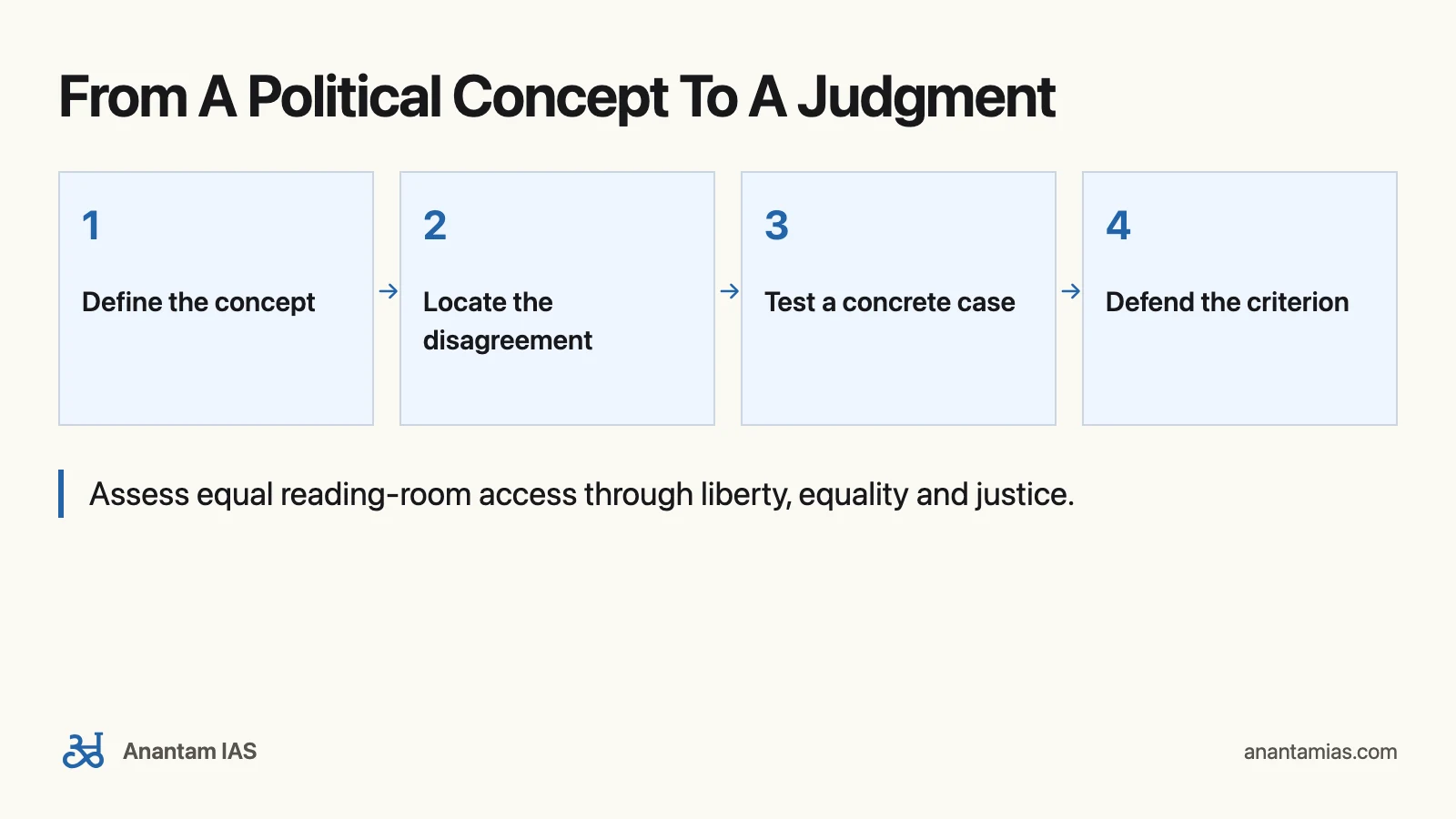
Andrew Heywood Political Theory can help with PSIR when you use it to clarify a political problem. Reading every page in order is a slow way to discover that your notes still treat freedom, equality and justice as interchangeable words. Choose a concept, identify the disagreement and test it against a concrete case.
I recommend Political Theory: An Introduction for focused conceptual reading. Keep an older usable copy if it explains the ideas you need. Buy another edition only after comparing its contents with a specific gap in your notes. It belongs alongside sources for the rest of PSIR, including Indian political thought and international relations.
Choose The Correct Title
Political Theory: An Introduction is distinct from Heywood’s Politics and Political Ideologies. A recommendation for one title doesn’t establish the coverage of another.
- Bloomsbury’s fifth edition credits Andrew Heywood and Clayton Chin. Chin’s contribution should not disappear when the book is described simply as “Heywood.”
- The publisher’s fifth-edition record dates that edition to 2023. The India Amazon record has a later publication date; a market publication date isn’t automatically a new edition number.
- The verified India listing for Political Theory credits both Heywood and Chin. Check its edition statement against the title page before purchasing.
- An older fourth-edition copy can have different chapter organization. The topic labels below are tied to the fifth-edition contents, so owners of another edition should use their index.
If your present notes already explain a concept accurately, buying a second Heywood title for the same concept needs a clear reason. The PSIR booklist is the place for choosing the wider set of sources.
Map Concepts To Study Tasks
The fifth edition organizes political thinking around problems. Use that structure to turn a syllabus term into a disagreement you can explain.
| Concept to study | Fifth-edition area | Output you should create |
|---|---|---|
| Authority and legitimacy | The problem of power | Explain when power has an accepted right to rule |
| State and sovereignty | The problem of the state | Separate the state from a particular government |
| Justice | The problem of law | Identify the standard being used to judge a rule |
| Freedom and rights | The problem of citizenship | Compare a protected choice with the ability to exercise it |
| Equality and welfare | The problem of equality | State what is being equalized and why |
| Democracy | The problem of democracy | Compare representation with the common good |
This is a selective reading map. It doesn’t claim that every PSIR thinker, text or syllabus topic receives enough treatment for your preparation. Use the official syllabus and your own contents page to record what’s still missing.
Compare Freedom, Equality And Justice
These concepts ask related but different questions. Freedom concerns being free to act and govern one’s life. Equality concerns how people are treated or how advantages are distributed. Justice asks whether an arrangement can be defended as fair or right.
Original practice example, not a UPSC question: “Can a public reading room have equal entry rules and still leave students with unequal opportunities to use it?”
Assume a hypothetical reading room has free admission and the same opening hours for everyone. One student lives nearby. Another must travel from far away and provide care at home. We have no data about any real library or group.
Work through the case before choosing a position:
- Formal equality: Both students face the same entry rule. That establishes equal treatment on this rule, but says little about their travel or time constraints.
- Freedom from interference: Neither student is prohibited from entering. This is one aspect of negative liberty, the absence of external interference. The distant student’s difficulty shouldn’t automatically be called a legal ban.
- Effective opportunity: Travel and care responsibilities may limit actual use. This is a question about the conditions of exercising a choice. Don’t treat every practical obstacle as a complete definition of positive liberty; positive liberty also concerns self-direction and agency.
- Justice: Decide which allocation principle should guide a response. Equal entry, assistance based on need and a fair distribution of public resources are different grounds that need an argument.
- Policy tradeoff: Longer hours might help some users but require staffing resources. Travel support might target a barrier but needs a defensible eligibility rule. The case gives reasons to examine proposals, not proof that either proposal will work.
Now put the distinction into a compact answer plan:
| Answer stage | Original sentence or task |
|---|---|
| Opening distinction | Equal rules establish one kind of equality; usable opportunity depends on further conditions |
| Liberty paragraph | State what interference is absent and what practical constraints remain |
| Equality paragraph | Name the relevant object: entry, usable time or resources |
| Justice paragraph | Defend the allocation principle before recommending assistance |
| Evaluation | Explain costs, eligibility and whose barrier the measure actually addresses |
| Final judgment | Common admission rules are useful, but their effects need to be examined alongside unequal circumstances |
The weak move is writing “equality means the same, justice means different.” The stronger move is naming the criterion and defending it. Different treatment can be justified by a relevant need, but difference by itself doesn’t establish justice.
For a fuller distinction between liberty concepts, Stanford’s discussion of positive and negative liberty is a useful follow-up.
Make A Concept Comparison Sheet
A good sheet keeps disagreement visible. When you locate a thinker in your book, record their argument accurately before adding another view.
- Concept: Write a plain definition and one boundary. For example, equal legal permission doesn’t establish equal material resources.
- Position: Record what a named thinker claims and the reason supporting it.
- Objection: Challenge that reason, its assumption or its consequence. Avoid a generic line saying the view is “impractical.”
- Application: Use an original example, then mark the facts that would be needed for a real-world conclusion.
- Answer use: Write one paragraph where the comparison directly addresses the question’s demand.
Think of the sheet as a set of labeled drawers. A quotation belongs in the drawer for the claim it supports; dropping it anywhere because it sounds impressive makes retrieval harder. The analogy concerns organization, not a promise that political disagreements have tidy final answers.
Set A Flexible Reading Routine
One concept comparison is a sensible session target. Pages per day will depend on the edition and how difficult the argument is for you.
- Start with 15 minutes of reading: Identify one claim and the question it answers.
- Spend 10 minutes comparing: Add a competing position and the actual point of disagreement.
- Use 10 minutes for application: Test both positions against a small original case.
- Finish with 10 minutes of writing: Draft a paragraph and remove any thinker name that does no argumentative work.
This 45-minute routine can be split across two days. If the definition is still unclear, postpone the comparison until you can explain it without the book. At the end of the week, revisit a concept through a different case rather than copying the same note again.
The PSIR Optional strategy guide can help coordinate this work with the rest of the subject. Your next step is one defensible comparison sheet. Completing it will tell you more about whether you need another source than the size of your highlighted chapter.
Frequently Asked Questions
Is Political Theory the same as Political Ideologies?
No. Political Theory: An Introduction, Politics and Political Ideologies are separate titles. Check the exact title for the role you need it to perform.
Who is credited on the fifth edition?
Bloomsbury credits Andrew Heywood and Clayton Chin. The fifth-edition publisher record dates to 2023; a later India publication date is not automatically a new edition number.
Can I use a fourth-edition copy?
A usable copy can support conceptual reading. Use its own index because the fifth-edition topic organization may differ. Upgrade for an identified gap, not simply because a reading plan cites different pages.
Is this book sufficient for all of PSIR?
This guide makes no full-syllabus claim. Audit remaining topics, including Indian political thought and international relations, and assign appropriate sources.
How should I study a political concept?
Define it, compare a named argument with a relevant objection, test both against an original case and write a paragraph answering a clear question. State the criterion behind your judgment.