
Disclosure: this guide contains Amazon affiliate links. As an Amazon Associate, Anantam IAS earns from qualifying purchases — at no extra cost to you.
Paper I Booklist – Political Theory and Indian Politics
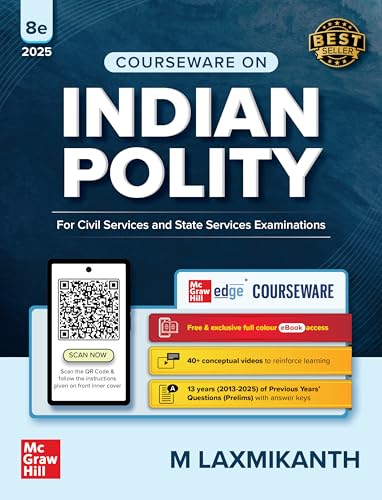
Indian Polity — M. Laxmikanth (8th Edition)
- McGraw Hill courseware edition, 856 pages
- Covers the full Prelims and Mains polity syllabus in one volume
- Solved Prelims PYQs from 2013–25 plus 12 years of Mains questions
Western Political Thought
| Book | Author | How to Use | Priority |
|---|---|---|---|
| An Introduction to Political Theory | O.P. Gauba | The foundational text for all of Western Political Thought. Read cover to cover. Covers Plato through Rawls with UPSC-relevant depth. Most aspirants need nothing else for this section. | Essential |
| Political Theory: An Introduction | Eddy Asirvatham and K.K. Misra | Supplement for topics where you want an alternative perspective. Useful for its concise treatment of individual thinkers. Read selectively, not cover to cover. | Optional |
| A History of Political Theory | George Sabine | An academic classic, but too detailed for UPSC purposes. Only consult if you are a political science graduate and want deeper engagement. | Not Recommended for Most |
Rahul Puri’s recommendation: O.P. Gauba alone covers 90 percent of what UPSC asks in Western Political Thought. Read it twice before touching any other source. Supplement with class notes for thinkers like Gramsci, Hannah Arendt, or feminist thinkers where Gauba’s coverage may be thinner.
Indian Political Thought
| Book | Author | How to Use | Priority |
|---|---|---|---|
| Foundations of Indian Political Thought | V.R. Mehta | The standard text for Indian Political Thought from Kautilya to modern thinkers. Covers Gandhian thought, Ambedkar, Nehru, and Lohia. | Essential |
| Indian Government and Politics | Bidyut Chakrabarty and Rajendra Kumar Pandey | Select chapters on Indian political thinkers. Particularly strong on Ambedkar and post-independence thought. | Recommended (selective) |
| Hind Swaraj | M.K. Gandhi | Primary source for Gandhi’s critique of modern civilisation. Short (under 100 pages) and essential for understanding Gandhian political philosophy beyond the textbook treatment. | Recommended |
| Annihilation of Caste | B.R. Ambedkar | Primary source for Ambedkar’s most powerful argument. Essential reading given the increasing frequency of Ambedkar-related PYQs. | Recommended |
Indian Government and Politics
| Book | Author | How to Use | Priority |
|---|---|---|---|
| Indian Polity | M. Laxmikanth | The undisputed foundation for Indian Government and Politics. You probably already have it from your GS preparation. For PSIR, focus on chapters covering federalism, judiciary, party system, electoral politics, and local governance. | Essential |
| Indian Government and Politics | Bidyut Chakrabarty and Rajendra Kumar Pandey | Provides the analytical depth that Laxmikanth lacks. Laxmikanth tells you what the provisions are; Chakrabarty explains why they matter politically. Use for topics like coalition politics, identity politics, and social movements. | Recommended |
| Introduction to the Constitution of India | D.D. Basu | A legal text – too detailed for most PSIR aspirants. Only useful if you struggle with specific constitutional provisions. | Optional |
Rahul Puri’s recommendation: Laxmikanth is your base. Supplement with Chakrabarty for the political analysis that UPSC expects in PSIR answers (as opposed to the factual recall that suffices for GS II). The key difference between a GS answer on federalism and a PSIR answer on federalism is analytical depth – Chakrabarty provides that depth.
Political Ideologies
| Book | Author | How to Use | Priority |
|---|---|---|---|
| Political Ideologies: An Introduction | Andrew Heywood | The single best source for political ideologies. Covers liberalism, conservatism, socialism, nationalism, fascism, feminism, ecologism, and multiculturalism. Clear, well-structured, and directly mapped to the UPSC syllabus. | Essential |
| Political Theory | Andrew Heywood | Complements the ideologies book with deeper treatment of concepts like justice, equality, liberty, and democracy. Read selectively for topics where Gauba’s treatment feels insufficient. | Optional |
Comparative Politics (Paper I Section)
| Book | Author | How to Use | Priority |
|---|---|---|---|
| Comparative Government and Politics: An Introduction | Rod Hague and Martin Harrop | Standard text for comparative politics methodology and country studies. Use for understanding the comparative method and the political systems of major democracies. | Recommended |
Paper II Booklist – Comparative Politics and International Relations
International Relations Theory
| Book | Author | How to Use | Priority |
|---|---|---|---|
| International Relations | Joshua S. Goldstein and Jon C. Pevehouse | The most accessible and UPSC-relevant IR textbook. Covers realism, liberalism, constructivism, Marxist approaches, and all major IR concepts. Read the theory chapters thoroughly and use case studies selectively. | Essential |
| International Relations | Palmer and Perkins | An older but still relevant Indian textbook. Useful for its treatment of non-alignment, India’s role in international politics, and North-South issues. Supplement with Goldstein, do not use as primary. | Optional |
| International Politics | K.K. Ghai | A concise handbook useful for quick revision. Not a substitute for Goldstein but handy in the final month. | Optional |
India’s Foreign Policy
| Book | Author | How to Use | Priority |
|---|---|---|---|
| India’s Foreign Policy | Rajesh Rajagopalan and Varun Sahni | Comprehensive treatment of India’s foreign policy from independence to the present. Covers bilateral relations, regional policy, nuclear doctrine, and multilateral engagement. | Essential |
| India’s Foreign Policy: Retrospect and Prospect | Sumit Ganguly (ed.) | A collection of essays by leading scholars. Read selectively – the chapters on India-US, India-China, and India-Pakistan relations are particularly valuable. | Recommended (selective) |
| India in a Reconnecting Eurasia | Various Authors | Useful for understanding India’s evolving relationship with Central Asia, Russia, and the broader Eurasian landmass. Read if time permits. | Optional |
International Organisations and Global Governance
| Book | Author | How to Use | Priority |
|---|---|---|---|
| International Relations (relevant chapters) | Joshua S. Goldstein | Covers the UN system, WTO, international law, and global governance. Sufficient for UPSC purposes. | Essential |
| International Organisations | Selected IGNOU material | Concise treatment of major international organisations. A useful supplement. | Optional |
Comparative Politics (Country Studies)
| Book | Author | How to Use | Priority |
|---|---|---|---|
| Comparative Government and Politics | Rod Hague and Martin Harrop | Use for UK, USA, and China political system comparisons. Focus on chapters covering these three countries specifically. | Recommended |
| Government and Politics of China | Tony Saich | For aspirants who want deeper understanding of the Chinese political system. Read selectively. | Optional |
Beyond Books – Essential Non-Book Sources
Books give you the foundation. These non-book sources give you the current affairs integration that turns a 240-mark paper into a 270-mark paper.
MEA Annual Report
Published by the Ministry of External Affairs every year, available free on the MEA website. This is the single most important non-book source for Paper II. It provides India’s official position on every bilateral relationship, India’s multilateral engagements, and strategic priorities. Read the latest edition cover to cover at least once.
Economic and Political Weekly (EPW)
Selected articles on Indian politics, social movements, federalism, caste dynamics, and electoral politics. You do not need a subscription – read 2 to 3 relevant articles per month on topics that intersect with your PSIR syllabus. Particularly valuable for Paper I (Indian Government and Politics).
PSIR Magazine by Anantam IAS
(see PSIR Magazine)
Monthly magazine specifically designed for PSIR optional aspirants. Covers current affairs with direct PSIR syllabus mapping, model answers, and topic-wise analysis. This is the most time-efficient way to keep your PSIR preparation current.
The Hindu and Indian Express Editorials
Read the international relations and political analysis editorials (not all editorials). Focus on:
- India’s foreign policy developments
- Geopolitical analysis (Indo-Pacific, West Asia, South Asia)
- Constitutional and governance issues
- Electoral politics analysis
Spend 15 to 20 minutes daily on relevant editorials. Maintain a running note of key developments organised by PSIR syllabus topic.
Rajya Sabha TV / Sansad TV Debates
Selected programmes on foreign policy, constitutional issues, and political developments. Watch 1 to 2 relevant programmes per week. Particularly useful for understanding multiple perspectives on policy issues.
IDSA / Manohar Parrikar Institute for Defence Studies and Analyses
Free online articles and issue briefs on defence, security, and foreign policy. Use selectively for Paper II topics on India’s security environment, nuclear policy, and regional security dynamics.
What NOT to Read
This section is as important as the booklist itself. The following are common wastes of time:
Do not read entire textbooks cover to cover (except Gauba and Heywood). For most books on this list, you should read selected chapters relevant to the PSIR syllabus, not every page. Goldstein has chapters on international political economy that are beyond the syllabus – skip them.
Do not add books after seeing topper booklists. Every topper interview lists books that worked for that specific individual. If a topper recommends Morgenthau’s “Politics Among Nations,” that does not mean you need to read it. Your core booklist is sufficient. Adding books mid-preparation is a sign of insecurity, not thoroughness.
Do not read academic journals unless preparing for a specific topic. Academic journals are written for scholars, not UPSC aspirants. EPW is the exception because it bridges the gap between academic analysis and accessible writing.
Do not read George Sabine’s “History of Political Theory” for UPSC. It is a brilliant academic text but far too detailed for the depth UPSC expects. Gauba covers the same thinkers in a more exam-friendly format.
Do not read multiple books on the same topic hoping for “different perspectives.” Read one book well, revise it, and supplement with class notes. Two books on the same topic create confusion, not clarity.
Do not read books on topics outside the PSIR syllabus. This sounds obvious, but aspirants often get drawn into tangential readings – books on general Indian history, economic theory, or area studies that fall outside the eight sections of PSIR. Stay within the syllabus.
Month-by-Month Preparation Strategy (12-Month Plan)
This plan assumes you are starting PSIR preparation from scratch with 12 months to Mains. Adjust timelines if you have more or less time. The plan integrates reading, revision, and answer writing into a single schedule.
Month 1-2: Paper I Foundation
Reading Focus:
- Complete O.P. Gauba (An Introduction to Political Theory) – first reading, cover to cover
- Begin M. Laxmikanth (Indian Polity) – focus on PSIR-relevant chapters (federalism, judiciary, party system, fundamental rights, DPSP, local governance)
- Read Hind Swaraj and Annihilation of Caste
Activities:
- Make topic-wise notes while reading (one page per major thinker or concept)
- Solve 2 PYQs per week without time limit
- Begin building your diagram library (one new diagram per topic)
Target: By end of Month 2, you should be able to write a basic answer on any Western or Indian Political Thought topic, even if it lacks depth.
Month 3-4: Paper I Depth + Paper II Start
Reading Focus:
- Andrew Heywood (Political Ideologies) – complete reading
- V.R. Mehta (Foundations of Indian Political Thought) – focus on post-independence thinkers
- Begin Joshua Goldstein (International Relations) – theory chapters first
- Bidyut Chakrabarty (selective chapters on Indian Government and Politics)
Activities:
- Begin answer writing: 4 answers per week (2 Paper I, 2 Paper II)
- Introduce loose time limits (25 minutes for 20-mark questions)
- Start reading PSIR Magazine monthly
- First revision of Gauba (targeted, focusing on weak areas)
Target: By end of Month 4, Paper I base should be 80 percent complete. Paper II should be 30 to 40 percent complete.
Month 5-6: Paper II Depth + First Full Revision
Reading Focus:
- Complete Goldstein (remaining chapters on international organisations, global issues)
- Rajesh Rajagopalan (India’s Foreign Policy) – complete reading
- MEA Annual Report (latest year) – complete reading
- Hague and Harrop (selected chapters on UK, USA, China)
Activities:
- Answer writing: 4 to 6 answers per week with strict time limits
- Complete first revision of all Paper I sources
- Begin integrating current affairs into Paper II answers
- Solve Paper II PYQs from 2019-2025
Target: By end of Month 6, both papers should be covered. You are now in revision and practice mode.
Month 7-8: Answer Writing Intensive
Reading Focus:
- Second revision of Gauba, Heywood, and Goldstein (targeted chapters only)
- MEA Annual Report – second reading with focus on India’s bilateral relations
- Weekly current affairs updates linked to PSIR syllabus
Activities:
- Answer writing: 6 to 8 answers per week under strict exam conditions
- Full paper simulation every 2 weeks (3 hours, complete paper)
- Analyse topper answer copies (see PSIR model answers) and compare with your answers
- Build and revise PYQ outline bank
- Practise diagrams until each takes under 2 minutes
Target: By end of Month 8, you should be able to complete a full PSIR paper within 3 hours with reasonable quality.
Month 9-10: Mock Tests + Weak Area Revision
Reading Focus:
- Targeted re-reading of sections you consistently score poorly in
- Fresh current affairs integration (last 6 months of developments)
- Class notes revision
Activities:
- Full-length mock tests: one per week (alternating Paper I and Paper II)
- Get mocks evaluated by a mentor or faculty
- Identify and address persistent weak areas
- Create a “last month revision sheet” – one page per topic summarising key points, thinkers, examples, and diagrams
Target: By end of Month 10, your mock scores should consistently be in the 120+ range per paper.
Month 11-12: Final Revision and Current Affairs Mapping
Reading Focus:
- Revision sheets only – no new books, no new sources
- Latest 3 months of current affairs mapped to PSIR syllabus sections
- Quick scan of MEA Annual Report for any updates
Activities:
- Light answer writing: 3 to 4 answers per week (focus on quality and confidence)
- Revise diagram library
- Revise PYQ outline bank
- Mental rehearsal: go through each syllabus section and confirm you can write on every major topic
- Rest adequately in the final week – diminishing returns set in rapidly
Target: Walk into the exam hall knowing you can attempt every question with confidence, complete the paper on time, and present well-structured answers with contemporary relevance.
Frequently Asked Questions
Can I prepare PSIR without coaching?
Yes, but it requires more self-discipline. The booklist on this page, combined with our PSIR Magazine and the answer writing framework, covers the same ground that coaching does. What coaching provides beyond books is structured peer discussion, regular answer evaluation, and mentorship – all of which you need to arrange independently if self-studying.
I have a political science graduation – should I skip the basics?
No. Your graduation taught you political science as an academic discipline. UPSC tests political science as an examination subject – the approach, depth, and presentation are different. Read Gauba even if you have read Sabine. Read Goldstein even if you have studied IR theory in college. The UPSC-specific framing matters.
How many books is too many?
If your active reading list has more than 6 to 7 books across both papers, it is too many. The “essential” books on this page total 5 (Gauba, Laxmikanth, Heywood, Goldstein, Rajagopalan). Everything else is supplementary and should be read selectively, not cover to cover.
Should I make my own notes or use someone else’s?
Make your own for Paper I (the act of writing crystallises understanding of political theory). For Paper II, a combination of your own notes and curated current affairs compilations is more efficient.
What to Do Next
- Acquire the essential books listed above – start with Gauba and Laxmikanth.
- Read the PSIR syllabus to understand what each section covers.
- Begin with PYQs early – see our complete PYQ analysis.
- Study the Paper I guide and Paper II guide for topic-wise breakdowns.
- Develop your answer writing using the framework in our PSIR model answers.
- Subscribe to the PSIR Magazine for monthly current affairs integration.
- Visit the PSIR Optional hub for the complete overview.
Booklist and strategy compiled by Rahul Puri, PSIR Faculty, Anantam IAS. Updated March 2026.