Aptitude Realisation: Identifying Talent, Aptitude vs Attitude vs Intelligence (UPSC GS IV)
How aptitude is realised — identification, resolve, socio-cultural support; aptitude vs intelligence vs interest; UPSC GS IV explainer with Indian case studies.
A talent that is never identified, never developed and never given an environment to bloom is, for practical purposes, indistinguishable from no talent at all. Aptitude realisation is the process by which a latent capacity becomes a demonstrated excellence — and it is one of the GS IV themes the UPSC keeps returning to, because the civil services themselves are a vast aptitude-realisation problem at the scale of a billion people.
This article works through the meaning of aptitude realisation, the conditions necessary for it, the conceptual neighbours of aptitude (intelligence, ability, skill, attitude, interest), and the implications for civil-service selection, training and policy.
What aptitude realisation means
Aptitude is an inborn or early-developed potential to learn or perform in a specific area. It is not what the person currently knows or can do — it is what the person can become good at, given the right training and environment.
Aptitude realisation is the actualisation of that potential — the journey from "she has the potential to be a great mathematician" to "she is a great mathematician." Three conditions, all necessary and individually insufficient, drive this realisation.
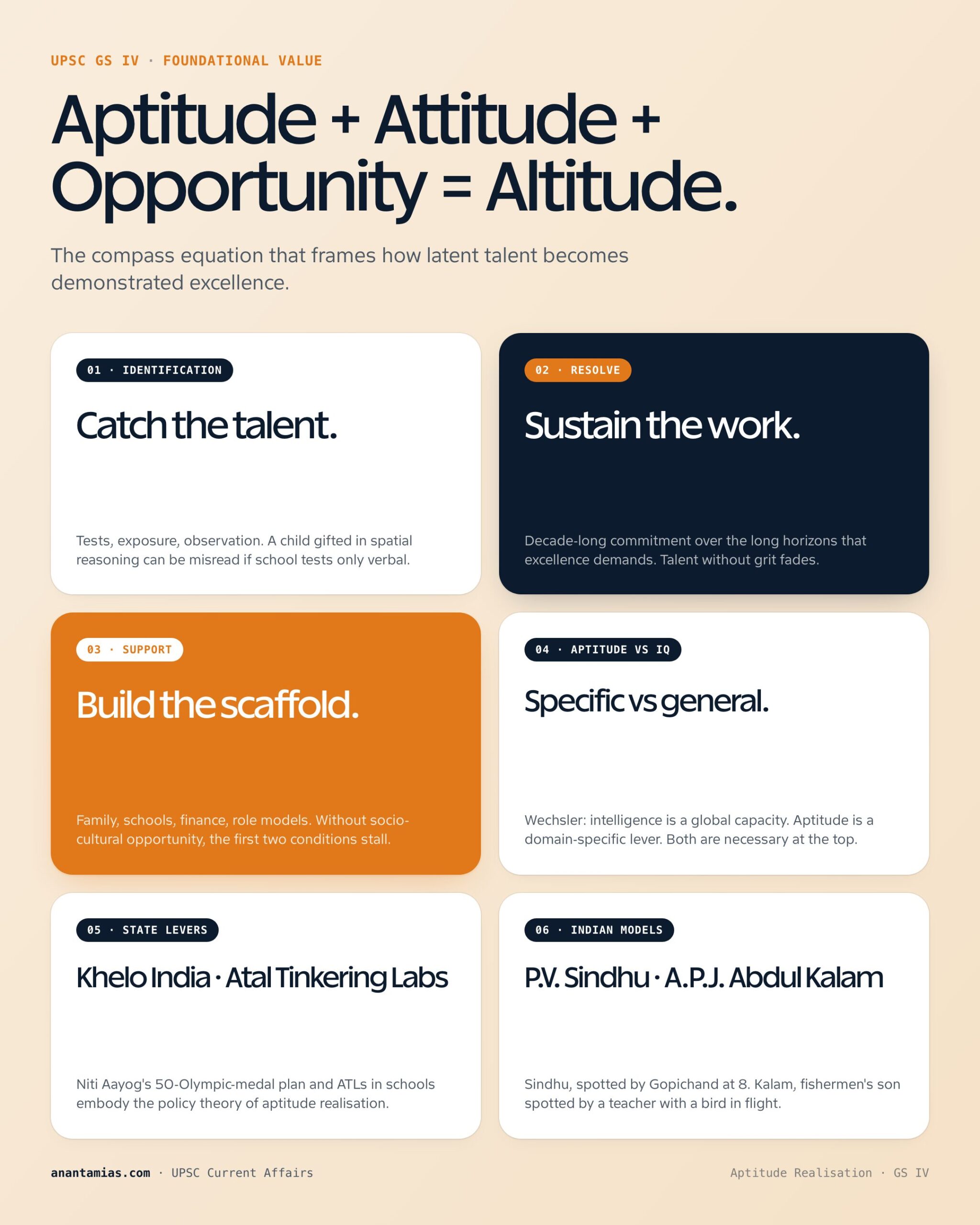
- Correct identification of aptitude — knowing which capacity the person actually has. A child gifted in spatial reasoning may be misread as poor in academics if the school tests only verbal ability.
- Resolve to pursue the aptitude — sustained personal commitment over the long horizons that excellence demands. Talent without grit fades.
- Socio-cultural and economic support — family, community, institutions, finance and time. A child from a household with no books, no electricity for evening study and no role models faces multiplicative disadvantage even when the first two conditions are met.
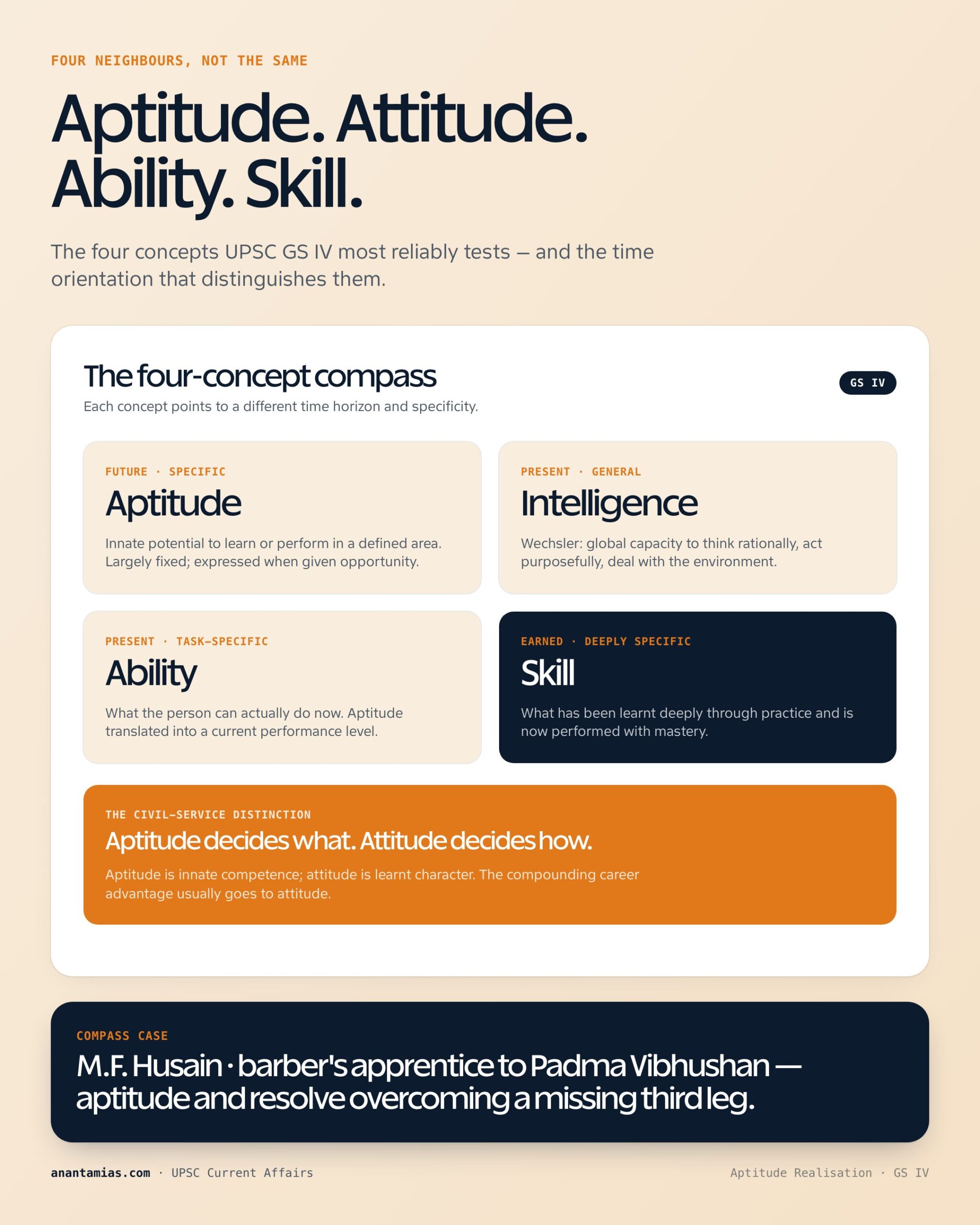
The interaction matters. Where two conditions are strong, a weakness in the third can sometimes be compensated. M.F. Husain's story — barber's apprentice, painter of cinema hoardings, eventually a Padma Vibhushan — is a textbook case of dominant aptitude and dominant resolve overcoming severe early socio-economic disadvantage. But the more common story in India is of aptitude unrealised because one of the three legs of the stool is missing.
Aptitude, intelligence, ability, skill — neighbours that are not the same
These four terms are routinely confused. The distinctions matter for both policy design and exam writing.
| Concept | Definition | Time orientation | Specificity |
|---|---|---|---|
| Intelligence | General mental capacity to think rationally, act purposefully and deal with environment | Present | General — applies across domains |
| Aptitude | Innate potential to learn a specific kind of task | Future | Domain-specific |
| Ability | What a person can do now | Present | Specific to a known task |
| Skill | What a person has learnt deeply through practice and now performs with mastery | Past, deployed in present | Highly specific |
Aptitude precedes ability, which precedes skill. A young person may have a high aptitude for music (future), translate that into ability through training (present), and over years convert it into a mature skill. Without aptitude the ceiling on ability is low; without practice the aptitude does not translate into ability.
Aptitude and intelligence
David Wechsler defined intelligence as "the global capacity of the individual to think rationally, act purposefully and deal effectively with his environment." It is more general than aptitude and substantially mental.
| Intelligence | Aptitude |
|---|---|
| Mental in nature | Both physical and mental |
| General — applicable across fields | Specific to a particular field |
| Substantially fixed in adulthood, with development possible | Largely innate, expressed when given opportunity |
| Necessary but not sufficient for high achievement | A specific lever for excellence in a chosen field |
A high-intelligence individual without specific aptitude often plateaus in any one field; a person with strong domain aptitude can outperform a generally more intelligent peer in that domain. Both are necessary at the top of any profession.
Aptitude and attitude — the most important distinction for civil services
This is the distinction the GS IV examiner most likes to test.
| Aptitude | Attitude |
|---|---|
| Innate or early-developed | Learnt through experience |
| Mental and physical | Mental — cognitive, affective, behavioural |
| Decides what one will do well in life | Decides how one will do it, and whether one will persist |
| Associated with competence | Associated with character |
| Largely stable | Modifiable through experience and reflection |
The pithy Indian formulation captures the relationship.
Aptitude + Attitude + Opportunity = Altitude.
A civil servant with great aptitude but poor attitude — say, brilliant analytical capacity paired with arrogance toward subordinates — produces office friction and policy failure. A civil servant with average aptitude but excellent attitude — patient, fair, persistent — often outperforms more "gifted" colleagues over a career. Both matter, but in service of citizens, attitude often does more daily work than raw aptitude.
Aptitude and interest
Interest is liking and the presence of positive emotion toward an activity, regardless of skill or ability. Interest pulls the person toward the activity; aptitude determines whether they will excel once there.
The three combinations matter.
- High aptitude + high interest = the strongest engine of realisation.
- High aptitude + low interest = wasted potential, the unhappy dynastic doctor.
- Low aptitude + high interest = enthusiastic mediocrity, occasionally rescued by hard work and grit.
Career counselling in Indian schools should map aptitude and interest both — but most schools test neither.
Why aptitude realisation matters at the policy level
If the state wants to maximise national capability, it must do four things.
- Identify aptitudes early. Tests, exposure to varied activities, observation by trained teachers.
- Provide pathways for resolve. Stipends, mentorship, structured competitions, role models.
- Engineer socio-cultural opportunity. Schools that reach where children are, hostels, scholarships, family counselling.
- Match aptitude to vocation. Career counselling and labour-market signals.
Niti Aayog's 50-Olympic-medal Action Plan is a concrete example. The plan rests on catching children young, mapping their aptitude through structured assessment, and providing training pipelines that culminate in international competition. Khelo India runs on this logic — identify aptitude in remote districts, fund coaching, build infrastructure.
Two Indian case studies
Case study 1 — P.V. Sindhu and Pullela Gopichand's academy
Sindhu's identification as a badminton aptitude was early — Gopichand spotted her at eight. The resolve came from a family that drove her 56 km daily for training. The socio-cultural support came from a coach who had himself won All-England, a state government that backed sports infrastructure, and corporate sponsorship that paid for international competition. Two Olympic medals later, Sindhu is the textbook case for what aptitude realisation requires.
Case study 2 — APJ Abdul Kalam
Born in a fisherman's family in Rameswaram, Kalam's aptitude for science and engineering was identified by a teacher who let him watch a bird in flight from the classroom. Resolve carried him through selling newspapers to fund his education. Socio-cultural support came from teachers, mentors at MIT (Madras Institute of Technology) and eventually the institutional structure of DRDO and ISRO. The result was India's missile programme — and a presidency.
Civil services application
Aptitude realisation has implications throughout the civil-service career.
Selection. UPSC has been criticised for testing memory more than aptitude. The CSAT paper attempts aptitude assessment but is widely felt to be inadequate. Reform of the selection examination toward better aptitude measurement — quantitative reasoning, ethical reasoning, situational judgement — is a recurring policy debate.
Training. LBSNAA's foundation course attempts to identify trainee aptitudes — for field administration, for policy work, for specialised regulatory roles — and channel postings accordingly. Imperfect but improving.
Cadre management. Posting an officer to a role mismatched with aptitude wastes both person and post. Tax-administration aptitude is not the same as district-administration aptitude; the system that ignores this loses on both ends.
Schemes for citizens. SHE-Box for women, Skill India for youth, Atal Tinkering Labs in schools — every successful scheme begins by recognising that aptitude exists everywhere in the population and the state's job is to provide the missing condition for its realisation.
UPSC past-year question references
- 2018 GS IV: "Aptitude is an important component that goes as input in human personality." — direct testing of aptitude as a personality determinant.
- 2017 GS IV: distinguishing aptitude from attitude in the context of foundational values.
- 2020 GS IV case study: a young officer whose technical aptitude is mismatched with her current posting, with ethical consequences.
Mains answer hook
Aptitude is potential; aptitude realisation is the journey from potential to demonstrated excellence. It requires three conditions in interaction — correct identification, sustained resolve, and socio-cultural opportunity. For the civil servant, aptitude realisation operates at two levels: as a personal project of self-knowledge, and as a policy task of building systems that catch talent wherever it exists. The state that fails to realise the aptitudes of its citizens is throwing away its most valuable resource.
Prelims pointers
- Aptitude is innate; attitude is learnt.
- Niti Aayog's plan for 50 Olympic medals — example of aptitude policy.
- Aptitude + Attitude + Opportunity = Altitude.
- M.F. Husain — example of dominant aptitude overcoming socio-economic adversity.
- Khelo India and Atal Tinkering Labs — institutional aptitude-realisation programmes.
FAQ
Can aptitude be acquired or only realised?
The dominant view is that aptitude is innate or early-developed and is realised rather than created. Skills and abilities can be acquired throughout life; aptitude has a strong developmental window.
Is intelligence the same as aptitude?
No. Intelligence is general mental capacity; aptitude is specific potential in a defined area. A person can have moderate intelligence and high aptitude in music, or high intelligence and low aptitude in athletics.
Which matters more — aptitude or attitude?
For civil services, both are necessary. Attitude tends to have a larger compounding effect over a career because it determines how aptitude is deployed daily.
How can the state help with aptitude realisation?
By providing early identification (psychometric and observational), pathways for sustained resolve (stipends, mentorship), and socio-cultural support (schools, hostels, infrastructure).
What happens when aptitude and interest diverge?
The dynastic doctor with high aptitude but low interest is unhappy and underperforms; the enthusiastic amateur with high interest but low aptitude rarely reaches the top. Counselling should map both.
Aptitude is the most generous fact about human beings — that potential is widely distributed. Aptitude realisation is the most demanding task for a society — to make sure that distribution is honoured. This is what a humane civil service is, in the end, for.