Article 110: Money Bill Definition, Procedure, and Supreme Court Cases
Article 110 defines what counts as a Money Bill in India. Learn its scope, Speaker's certification, Rajya Sabha role, and key judgments.
Article 110 of the Indian Constitution defines what qualifies as a Money Bill and sets out the special procedure by which such bills are enacted. Because Money Bills bypass the Rajya Sabha's full amending power and are certified solely by the Speaker of the Lok Sabha, the provision has been at the centre of high-stakes constitutional debates, including the Aadhaar Act case and the Finance Act 2017 case. For UPSC aspirants, Article 110 is a frequent Prelims and Mains topic because it sits at the intersection of legislative procedure, federalism, and the rights of the upper house.
What Article 110 Says
Article 110(1) defines a Money Bill as a Bill containing only provisions dealing with any of the following matters:
- (a) Imposition, abolition, remission, alteration, or regulation of any tax.
- (b) Regulation of borrowing by the Government of India or giving of guarantees.
- (c) Custody of the Consolidated Fund of India or Contingency Fund of India, payment into or withdrawal from these funds.
- (d) Appropriation of moneys out of the Consolidated Fund of India.
- (e) Declaring any expenditure to be charged on the Consolidated Fund of India or increasing such expenditure.
- (f) Receipt of money on account of the Consolidated Fund or public account, or custody or audit of such accounts.
- (g) Any matter incidental to the above.
A bill is not a Money Bill merely because it imposes fines, demands fees for services, or involves the imposition or abolition of a tax by a local authority.
The "Only" Rule
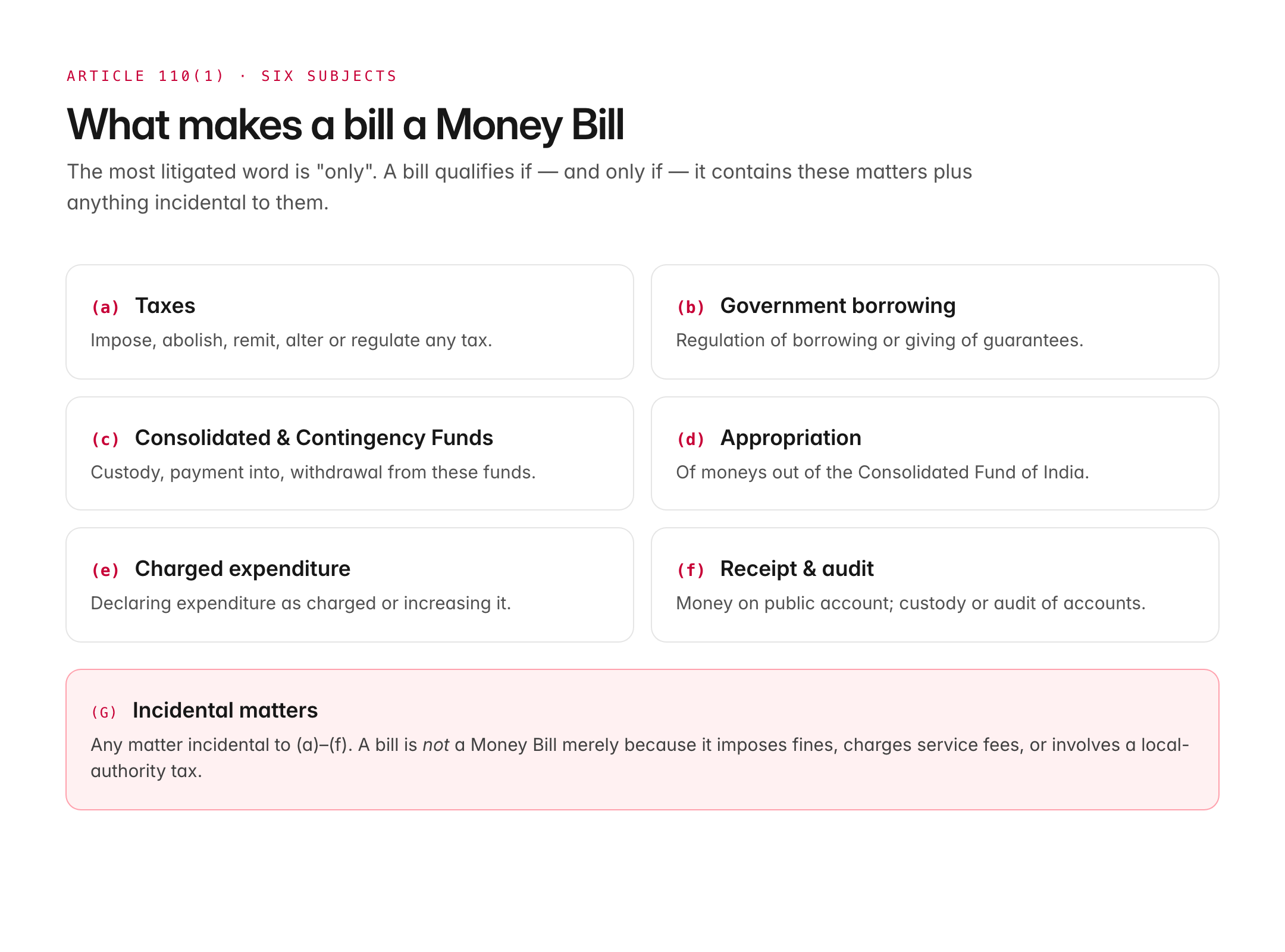
The most litigated word in Article 110 is "only". A bill qualifies as a Money Bill if it contains only the six subjects plus incidental matters. If it contains any extraneous provision, it becomes a Financial Bill under Article 117, not a Money Bill.
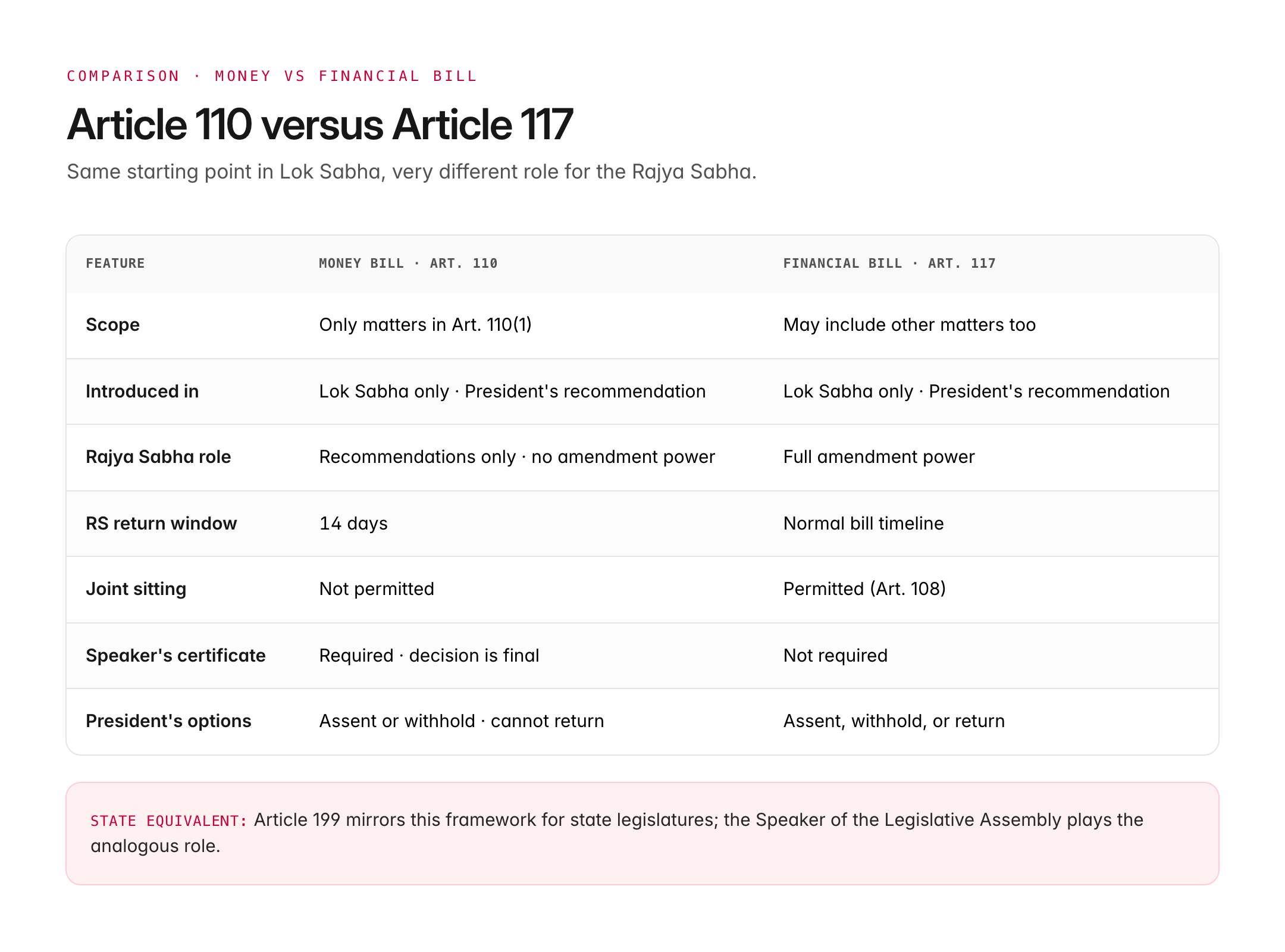
| Feature | Money Bill (Art. 110) | Financial Bill (Art. 117) |
|---|---|---|
| Scope | Only matters in Art. 110(1) | May contain other matters too |
| Where introduced | Only Lok Sabha, with President's recommendation | Only Lok Sabha, with President's recommendation |
| Rajya Sabha role | Recommendations only; no amendment power | Full amendment power |
| Joint sitting | Not permitted | Permitted (Art. 108) |
| Certification | Speaker's certificate required | Not required |
The Ordinary Bill under Article 107 does not require President's recommendation and can be introduced in either House.
Procedure for a Money Bill
The procedure is deliberately streamlined:
- Introduction only in the Lok Sabha, and only with the prior recommendation of the President.
- Passed by the Lok Sabha in the normal manner.
- Transmitted to the Rajya Sabha, which must return it within 14 days with or without recommendations.
- If the Lok Sabha accepts the recommendations, the bill stands passed with those amendments; if it rejects them, the bill is deemed passed in its original form.
- If the Rajya Sabha fails to return the bill within 14 days, it is deemed passed by both Houses at the end of that period.
- The bill then goes to the President, who must either assent or withhold assent — the President cannot return a Money Bill for reconsideration (Article 111).
This procedure reflects the principle, inherited from the British House of Commons, that financial matters should be decided by the directly elected house.
Speaker's Certification
Article 110(3) provides that if a question arises whether a Bill is a Money Bill or not, the decision of the Speaker of the Lok Sabha is final. Article 110(4) further requires the Speaker to endorse a certificate on every Money Bill when it is transmitted to the Rajya Sabha or presented to the President for assent.
This certification has been politically sensitive. Governments have been accused of classifying certain bills as Money Bills to bypass the Rajya Sabha, particularly when the ruling party lacks a majority there.
Landmark Supreme Court Cases
Several cases have tested the scope of Article 110:
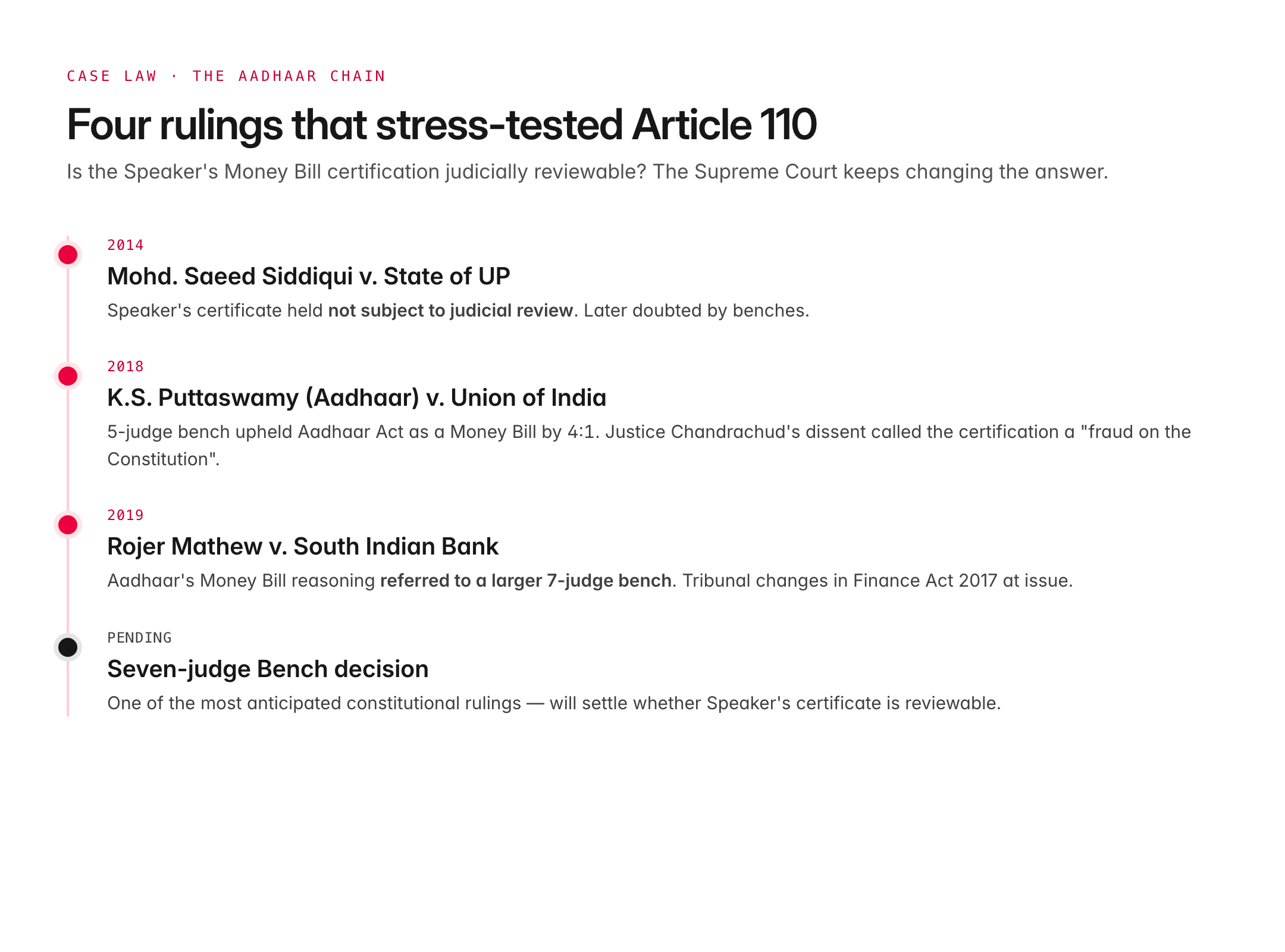
- Mohd. Saeed Siddiqui v. State of UP (2014): The Speaker's certificate was held to be not subject to judicial review. This was later doubted.
- K.S. Puttaswamy (Aadhaar) v. Union of India (2018): A five-judge bench upheld the Aadhaar Act, 2016 as a Money Bill by a 4:1 majority. Justice D.Y. Chandrachud dissented, calling the certification a "fraud on the Constitution".
- Rojer Mathew v. South Indian Bank (2019): A five-judge bench referred the correctness of the Aadhaar ruling on Money Bill classification to a larger seven-judge bench because of doubts about whether the Finance Act 2017 (which changed tribunal structures) qualified as a Money Bill.
- The seven-judge reference remains pending as of the current legal position, making this one of the most anticipated constitutional decisions.
Significance and Federal Implications
Article 110 is significant for four reasons:
- Executive control over finance. The provision ensures that only the elected lower house, where the government enjoys a majority, can impose or alter taxes.
- Limited bicameralism in fiscal matters. The Rajya Sabha's reduced role reflects the principle that state representation should not frustrate the budgetary will of the nation.
- Speaker's pivotal role. The finality of the Speaker's certificate places enormous responsibility on what is expected to be a neutral office.
- Judicial review debate. Whether the Speaker's certification can be reviewed by courts is itself a core constitutional question.
A similar provision for state legislatures exists in Article 199, which defines Money Bills at the state level with the Speaker of the Legislative Assembly playing an analogous role.
UPSC Relevance
Prelims focus: six subjects listed in Article 110(1), procedure timelines (14 days for Rajya Sabha), Speaker's certificate, President's powers regarding Money Bills, and distinction from Financial Bills under Article 117. Comparison with state equivalent Article 199.
Mains GS angle:
- GS II — Parliament and state legislatures, structure, functioning, conduct of business, powers and privileges, and issues arising out of these.
- Analytical questions on the Speaker's impartiality, judicial review of certification, and the Aadhaar and Finance Act 2017 controversies.
Sample PYQ angle: UPSC has asked about the differences between a Money Bill and a Financial Bill and the role of the Rajya Sabha in passing each. A strong answer defines Article 110, contrasts the procedure with Article 117, cites Aadhaar and Rojer Mathew, and concludes with a balanced view on strengthening parliamentary scrutiny while preserving executive accountability in fiscal matters.