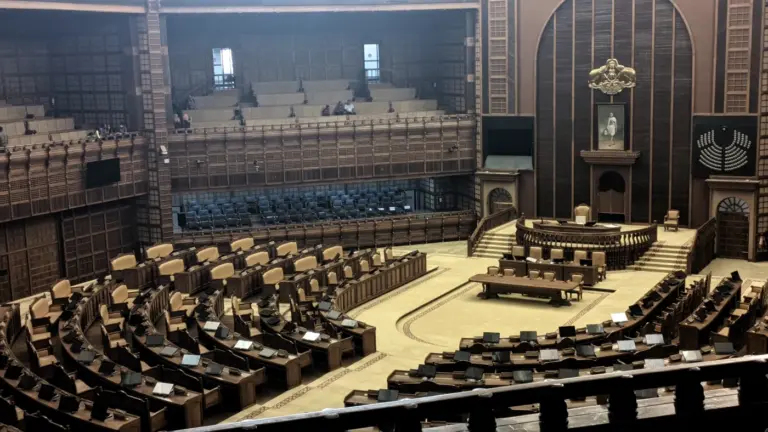
The Rajya Sabha is the Council of States, the upper chamber of the Indian Parliament. It represents the states and union territories, balances the directly elected Lok Sabha, and protects the federal structure that the Constitution sets up. Unlike the Lok Sabha, which dissolves every five years, the Rajya Sabha is a permanent body. One-third of its members retire every second year, which means the chamber never disappears and never holds a single general election of its own.
This permanent character was a deliberate design choice in the Constituent Assembly. The framers wanted a house of review that would not be swept away by a single electoral wave. They also wanted a forum where state legislatures could send representatives who would deliberate on national legislation with longer terms and more distance from the daily pressures of constituency politics.
This explainer covers the composition of the Rajya Sabha, the election method under Article 80, the chamber’s powers including the special powers under Articles 249 and 312, the comparison with the Lok Sabha on money bills, no-confidence motions, and the joint sitting under Article 108, and the prelims-mains material a UPSC aspirant needs.
Quick Facts on the Rajya Sabha
- Constitutional basis. Articles 80 and 84 of the Constitution.
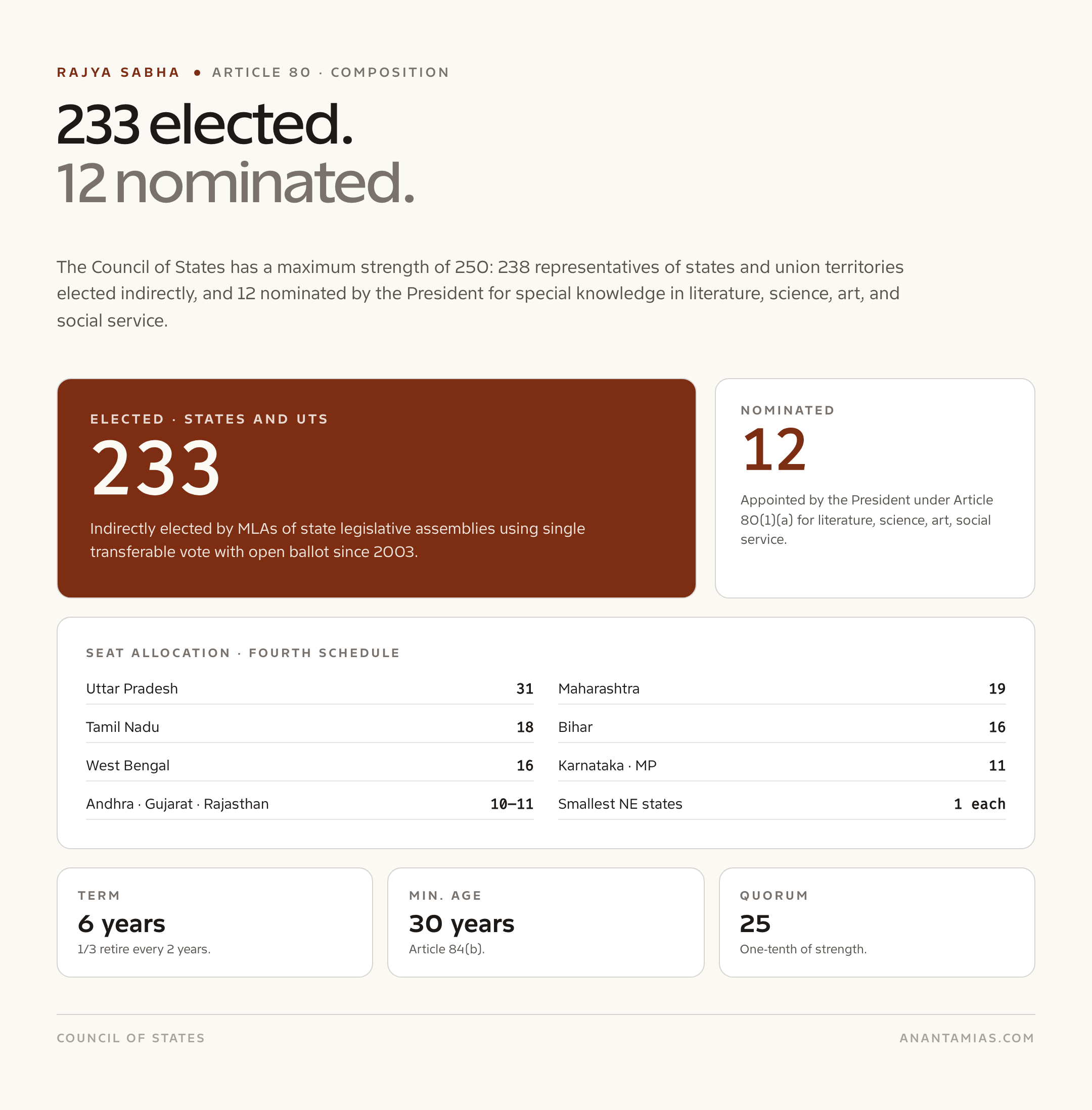
- Maximum strength. 250 members (238 elected from states and UTs plus 12 nominated by the President).
- Current strength. 245 members (233 elected plus 12 nominated).
- First sitting. 13 May 1952.
- Term. Six years for each member; one-third retire every two years.
- Permanent body. Cannot be dissolved.
- Minimum age. 30 years (Article 84).
- Presiding officer. Vice-President of India is ex-officio Chairman.
- Deputy Chairman. Elected by the members from among themselves.
- Quorum. One-tenth of total membership, that is 25 members.
Composition of the Rajya Sabha Under Article 80
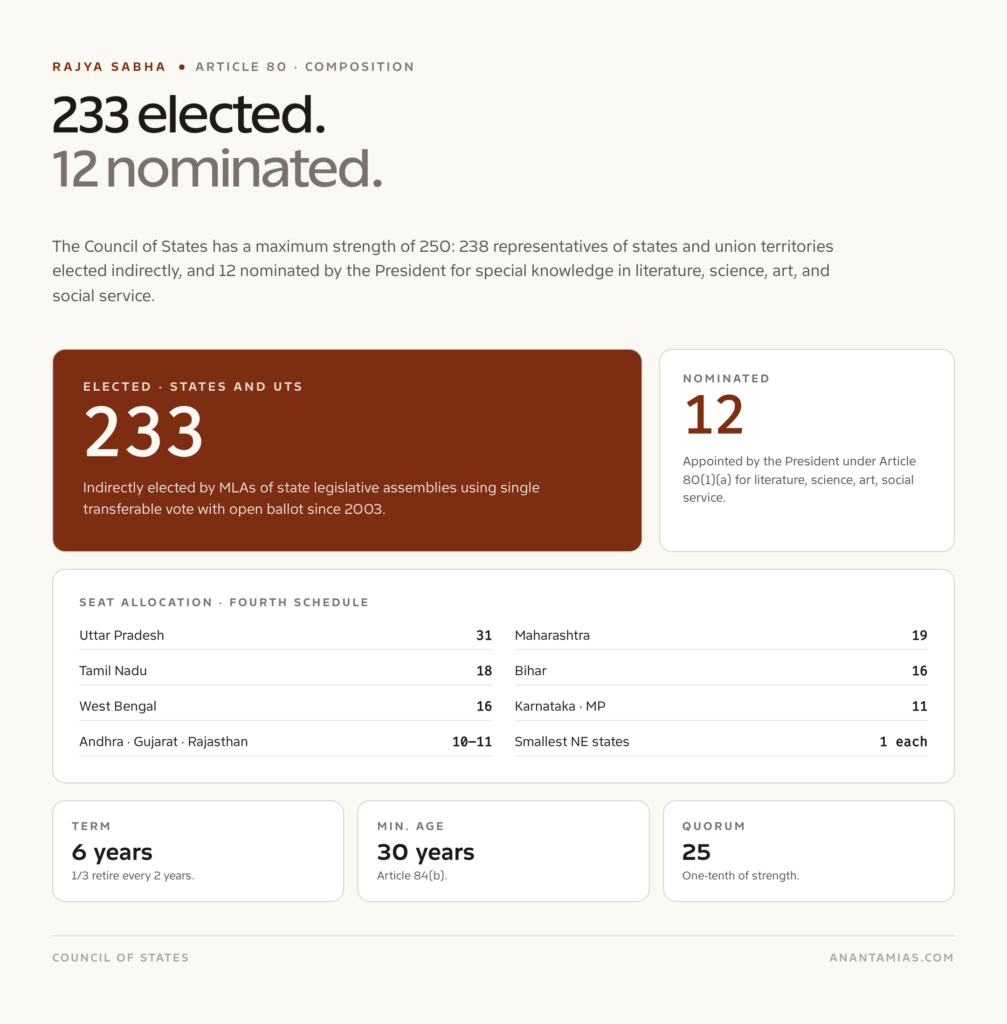
Article 80 of the Constitution lays down the composition of the Rajya Sabha. The maximum strength is 250 members. Of these, 238 are representatives of the states and union territories elected indirectly, and 12 are nominated by the President from persons having special knowledge or practical experience in literature, science, art, and social service.
The Fourth Schedule allocates seats to the states and union territories on the basis of population. Uttar Pradesh sends 31 members, Maharashtra 19, Tamil Nadu 18, Bihar 16, and West Bengal 16. The smallest states such as Nagaland, Mizoram, Manipur, Tripura, Sikkim, Meghalaya, and Arunachal Pradesh send one member each. Among the union territories only Delhi, Puducherry, and Jammu and Kashmir send members; the others have no Rajya Sabha representation.
The current effective strength of the Rajya Sabha is 245 because Jammu and Kashmir’s four seats are vacant pending the establishment of a new electoral college after the abrogation of Article 370 and the reorganisation of the former state into two union territories. The 12 nominated seats are filled by the President on the advice of the Council of Ministers.
Election to the Rajya Sabha
Rajya Sabha members from the states are elected by the elected members of the state legislative assembly using the single transferable vote system of proportional representation. Each MLA has one vote, but the vote is fractional and weighted. Voting is by open ballot since the 2003 amendment to the Representation of the People Act, a change the Supreme Court upheld in Kuldip Nayar v. Union of India (2006).
Open ballot has changed Rajya Sabha politics. Before 2003, cross-voting was a chronic feature of every biennial election. After 2003, an MLA who wants to vote against the party whip must show the ballot to the authorised agent of the party, and failure to do so renders the vote invalid. The chamber’s character as a forum of state representation has become tighter as a consequence.
Union territory representatives are elected indirectly by members of an electoral college specially constituted for the purpose. Nominated members are appointed by the President under Article 80(1)(a) and Article 80(3). The Supreme Court in R.C. Poudyal v. Union of India (1993) clarified that the President’s nomination power is a matter of executive discretion exercised on aid and advice of the Council of Ministers and is not justiciable on merit.
Permanent Body and the One-Third Retirement Rule
The Rajya Sabha is a permanent body under Article 83(1). It is not subject to dissolution. Each member serves a six-year term, and one-third of the members retire every two years. The biennial elections fill the seats vacated by retirement.
This staggered rotation has three consequences. First, the Rajya Sabha never holds a general election of its own; only the seats falling vacant in a given biennium go to the polls. Second, the chamber preserves institutional memory across election cycles. Third, government majorities in the Rajya Sabha shift slowly, which forces an incoming Lok Sabha majority to negotiate with the upper house for at least the first few years of its term.
The biennial cycle is run by the Election Commission of India under Sections 14 to 16 of the Representation of the People Act 1951.
Legislative Powers of the Rajya Sabha
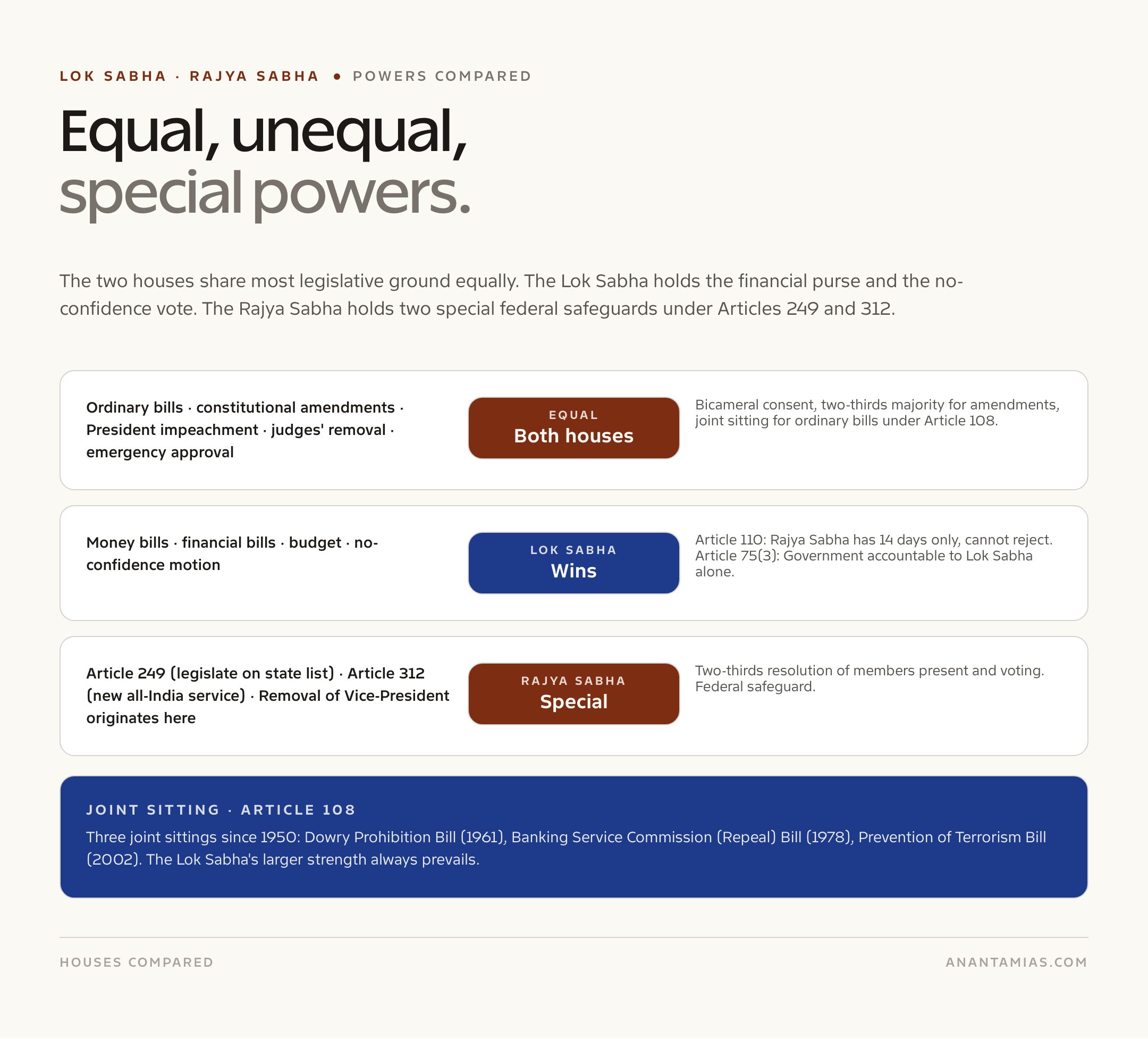
The Rajya Sabha has co-equal legislative powers with the Lok Sabha on ordinary bills. A bill must be passed by both houses in the same form before it goes to the President for assent. Either house can introduce an ordinary bill, and a disagreement between the two houses is resolved by a joint sitting summoned by the President under Article 108.
Three joint sittings have been held in independent India: in 1961 for the Dowry Prohibition Bill, in 1978 for the Banking Service Commission (Repeal) Bill, and in 2002 for the Prevention of Terrorism Bill. In each the larger Lok Sabha majority prevailed, which is why the joint sitting is sometimes called a procedural escape valve rather than a genuine instrument of bicameral compromise.
On constitutional amendment bills under Article 368, the Rajya Sabha has full equality with the Lok Sabha. The same equality applies to amendments that touch fundamental rights such as Article 20 of the Indian Constitution. A constitutional amendment bill must be passed by each house separately by a two-thirds majority of members present and voting, with the support of more than half of the total membership. There is no joint sitting on constitutional amendments.
Money Bills and the Limited Rajya Sabha Role
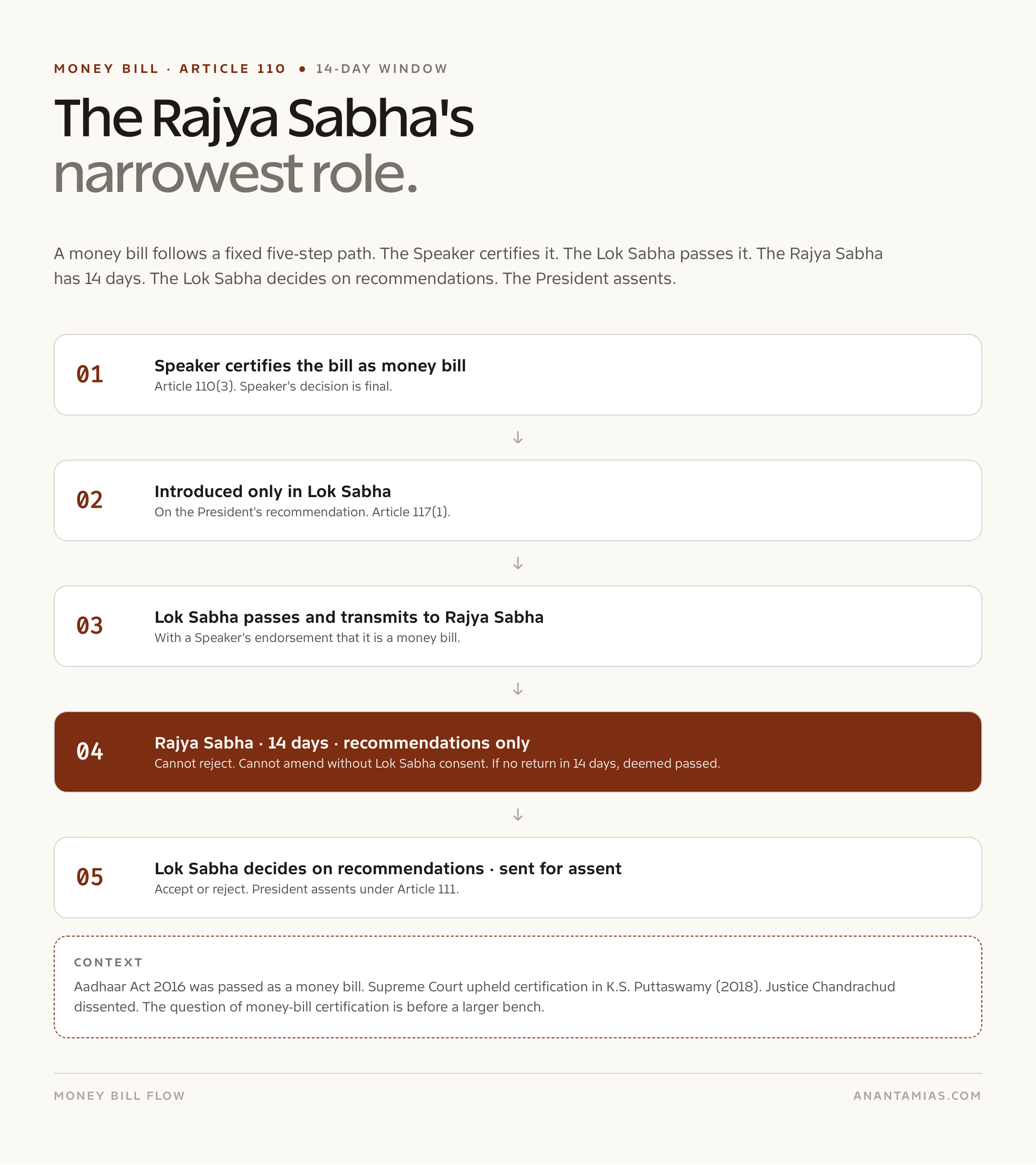
The most discussed limitation on the Rajya Sabha is its restricted role on money bills under Article 110. A money bill is defined narrowly to mean a bill that contains only provisions dealing with the imposition, abolition, or regulation of any tax, borrowing, custody of the Consolidated Fund or Contingency Fund, the appropriation of moneys, declaration of any expenditure as expenditure charged on the Consolidated Fund, the receipt of money on account of the Consolidated Fund, or any incidental matter.
The Speaker of the Lok Sabha certifies whether a bill is a money bill, and the Speaker’s decision is final. The certified money bill can be introduced only in the Lok Sabha on the President’s recommendation. Once passed by the Lok Sabha, it goes to the Rajya Sabha, which has only 14 days to return it with recommendations. The Lok Sabha may accept or reject the recommendations. If the Rajya Sabha does not return the bill within 14 days, it is deemed passed by both houses.
The Rajya Sabha cannot reject a money bill, cannot amend it without the Lok Sabha’s consent, and cannot prevent it from becoming law. The Aadhaar (Targeted Delivery of Financial and Other Subsidies) Act 2016 was passed as a money bill, and the Supreme Court in K.S. Puttaswamy v. Union of India (2018) upheld the certification, although Justice D.Y. Chandrachud dissented and called it a fraud on the Constitution. The question of the Speaker’s certification of money bills is still under review by a larger bench in subsequent litigation.
Financial bills under Article 117 are distinct from money bills and do require the Rajya Sabha’s full assent.
Special Powers of the Rajya Sabha
The Rajya Sabha has two powers that the Lok Sabha does not. These are sometimes called the federal safeguard provisions.
Article 249. The Rajya Sabha can authorise Parliament to legislate on a state list subject in the national interest by passing a resolution supported by two-thirds of members present and voting. The resolution is valid for one year and may be renewed. This provision lets the Centre temporarily legislate in a domain otherwise reserved to states.
Article 312. The Rajya Sabha can authorise Parliament to create an all-India service by a similar two-thirds resolution. The Indian Administrative Service, the Indian Police Service, and the Indian Forest Service exist because the Rajya Sabha (or its predecessor under the 1935 Act) so resolved. Any new all-India service in the future requires a Rajya Sabha resolution under Article 312.
Both Articles place the Rajya Sabha as the constitutional guardian of the federal balance, with the power to authorise central intrusions into state legislative space. Asymmetric arrangements such as the Sixth Schedule of the Indian Constitution operate in parallel to these federal safeguards.
Powers the Rajya Sabha Does Not Have
The Rajya Sabha cannot remove the Council of Ministers. Article 75(3) makes the Council of Ministers collectively responsible to the Lok Sabha alone. A no-confidence motion can be moved only in the Lok Sabha. The Prime Minister can sit in the Rajya Sabha (Indira Gandhi, H.D. Deve Gowda, Manmohan Singh, and others did), but the government’s survival depends on the Lok Sabha vote.
The Rajya Sabha cannot reject the budget. Article 113 requires that the demands for grants be voted only by the Lok Sabha. The Rajya Sabha discusses the budget but does not vote on the demands.
The Rajya Sabha has no role in the election of the Speaker of the Lok Sabha or in the conduct of the lower house’s business.
Presiding Officers and Procedure
The Vice-President of India is the ex-officio Chairman of the Rajya Sabha under Article 64. The Chairman presides over sittings, interprets the rules, and decides points of order. The Chairman is not a member of the chamber and does not vote except in a tie. The Deputy Chairman is elected by the members from among themselves and presides in the Chairman’s absence.
The Rajya Sabha follows the Rules of Procedure and Conduct of Business notified under Article 118. Question hour, zero hour, special mention, calling attention, short duration discussion, and adjournment motion are all available in the chamber, with adaptations from Lok Sabha practice.
The chamber’s quorum is 25 members, one-tenth of the total membership. The current chamber has 245 members in active service.
Rajya Sabha versus Lok Sabha: Equal, Unequal, Special
A standard UPSC comparison of the two houses divides their relationship into three buckets. Equal powers apply to ordinary bills, constitutional amendment bills, impeachment of the President under Article 61, removal of the Vice-President, removal of judges, declaration of an emergency, and approval of certain ordinances.
Unequal powers favour the Lok Sabha on money bills, financial bills, budget, no-confidence, and the joint sitting (where the larger Lok Sabha numerical strength dominates).
Special powers favour the Rajya Sabha on legislation over state-list subjects under Article 249, creation of new all-India services under Article 312, and the removal of the Vice-President under Article 67 (the resolution to remove the Vice-President originates only in the Rajya Sabha).
The two chambers together form a balanced bicameral structure that is neither purely majoritarian (which a unicameral Lok Sabha would have been) nor purely federal (which a Rajya Sabha equally weighted by state would have been).
Notable Vice-Presidents and Chairmen
Sarvepalli Radhakrishnan was the first Chairman of the Rajya Sabha from 1952 to 1962. He was succeeded by Zakir Husain, who later became President. Other notable Chairmen include V.V. Giri, B.D. Jatti, R. Venkataraman, Shankar Dayal Sharma, K.R. Narayanan, Krishan Kant, Bhairon Singh Shekhawat, Hamid Ansari, M. Venkaiah Naidu, and Jagdeep Dhankhar.
The Vice-Presidency has historically been a stepping stone to the Presidency. Seven Vice-Presidents have gone on to become President of India, which gives the chair of the Rajya Sabha a political weight beyond its formal procedural role.
UPSC Angles on the Rajya Sabha
For prelims, the Rajya Sabha is tested on the strength under Article 80, the seat allocation under the Fourth Schedule, the qualifications under Article 84, the election method, the term, the powers under Articles 249 and 312, and questions on which state (often the largest state in India by area or population) sends how many members.
For mains GS-II, the questions track the federal character of the upper house, the constitutional propriety of money-bill certification, the rationale for retaining a bicameral legislature in a parliamentary system, and the comparative position with the House of Lords, the US Senate, and the Australian Senate. A standard mains answer connects the Rajya Sabha’s permanent character to its function as a counter-majoritarian forum and uses the Aadhaar money-bill controversy as a contemporary case study, alongside the budgetary frame set by indicators such as the fiscal deficit of India.
For political-science optional, the Rajya Sabha sits inside the broader debate on bicameralism, federalism, and the design of constitutional second chambers.
Frequently Asked Questions
What is the maximum strength of the Rajya Sabha?
The maximum strength is 250 members: 238 representatives of the states and union territories elected indirectly, plus 12 members nominated by the President. The current effective strength is 245.
How are members of the Rajya Sabha elected?
Members from the states are elected by the elected members of the state legislative assembly using the single transferable vote system of proportional representation, with an open ballot since 2003. Union territory members are elected by an electoral college. Twelve members are nominated by the President.
Is the Rajya Sabha a permanent body?
Yes. Article 83(1) makes the Rajya Sabha a permanent body that cannot be dissolved. One-third of its members retire every two years, and each member serves a six-year term.
Can the Rajya Sabha reject a money bill?
No. Under Article 110 the Rajya Sabha has only 14 days to return a money bill with recommendations. The Lok Sabha may accept or reject the recommendations. If the Rajya Sabha does not return the bill in 14 days, it is deemed passed.
What are the special powers of the Rajya Sabha?
Under Article 249, the Rajya Sabha can authorise Parliament to legislate on a state list subject in the national interest. Under Article 312, it can authorise the creation of a new all-India service. Both require a two-thirds majority of members present and voting.
Who presides over the Rajya Sabha?
The Vice-President of India is the ex-officio Chairman of the Rajya Sabha under Article 64. The Deputy Chairman is elected by the members from among themselves and presides in the Chairman’s absence.
What is the minimum age to become a Rajya Sabha member?
Article 84(b) sets the minimum age at 30 years, compared to 25 years for the Lok Sabha.
Tell Google you want more of this.
Add Anantam IAS as a preferred sourceOne tap, and this site shows up more often in your own Top Stories, AI Overviews and AI Mode. Remove it any time.