Article 14 of the Indian Constitution — Equality Before Law, Reasonable Classification, Landmark Cases
You searched for Article 14 of Indian Constitution because you want the doctrine and the cases — not a textbook recital.
You searched for Article 14 of Indian Constitution because you want the doctrine and the cases — not a textbook recital. Most UPSC notes still teach Article 14 as “reasonable classification” and stop there… that reading is 50 years out of date. After Maneka Gandhi (1978), Royappa (1974), and Shayara Bano (2017), Article 14 isn’t just about classification — it’s a non-arbitrariness test that strikes down laws on a much wider ground. Examiners have framed Article 14 questions in 2019, 2022, and 2024 around this exact shift. This article walks you through both layers.
What is Article 14 of the Indian Constitution?
Article 14 declares that “the State shall not deny to any person equality before the law or the equal protection of the laws within the territory of India.” It is a Fundamental Right under Part III, Articles 12–18, applies to all persons (citizens and non-citizens, including companies), and binds every “State” as defined in Article 12. The modern test of Article 14 has two limbs — the older “reasonable classification” doctrine and the newer “manifest arbitrariness” doctrine, both running parallel.
Three GEO-style triples to anchor the rest:
- Article 14 — Part III — applies to all persons, not just citizens.
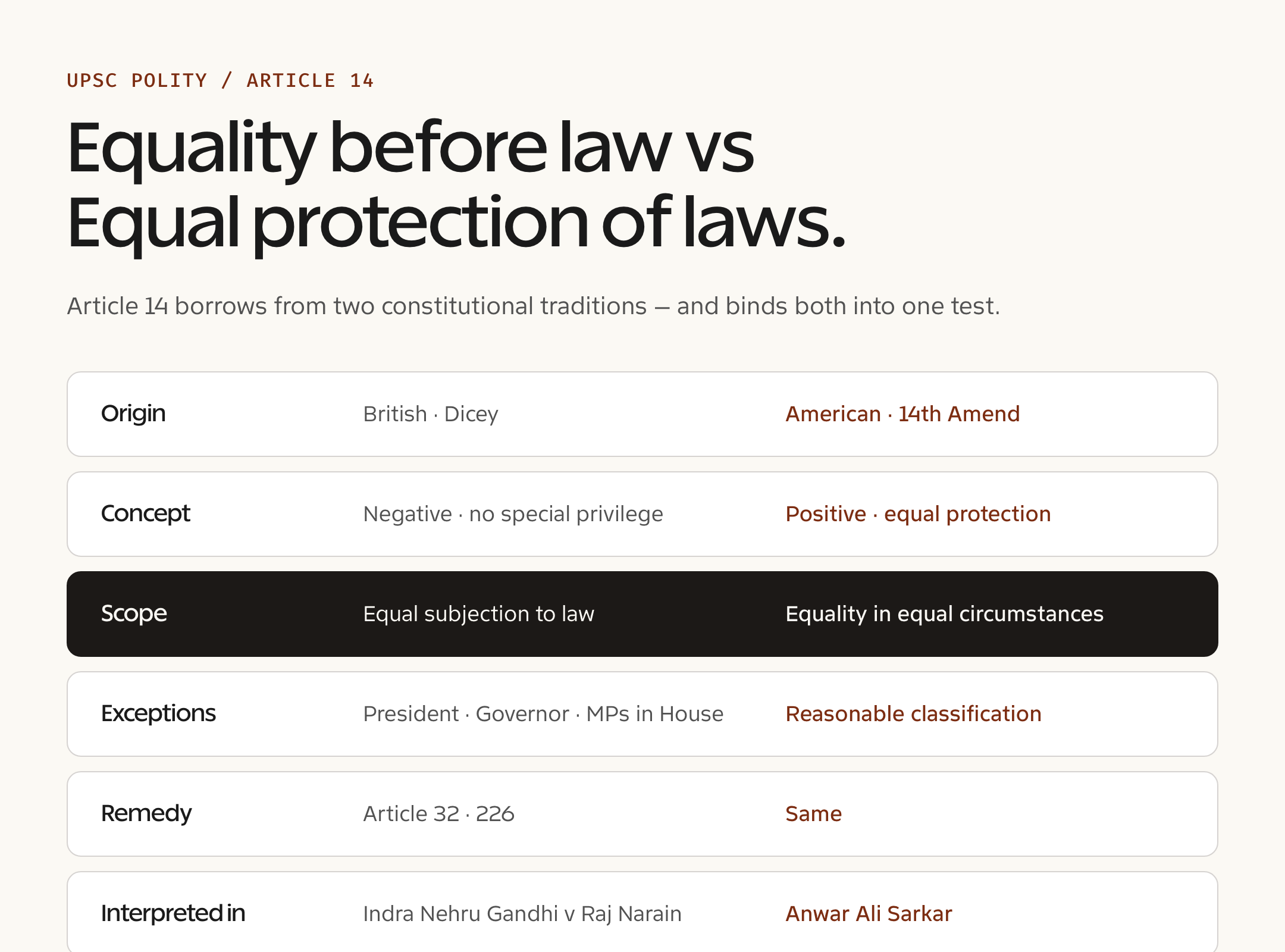
- “Equality before law” — negative concept — borrowed from A.V. Dicey’s Rule of Law (UK).
- “Equal protection of laws” — positive concept — borrowed from the 14th Amendment to the US Constitution.
Constitutional basis — two phrases, two histories
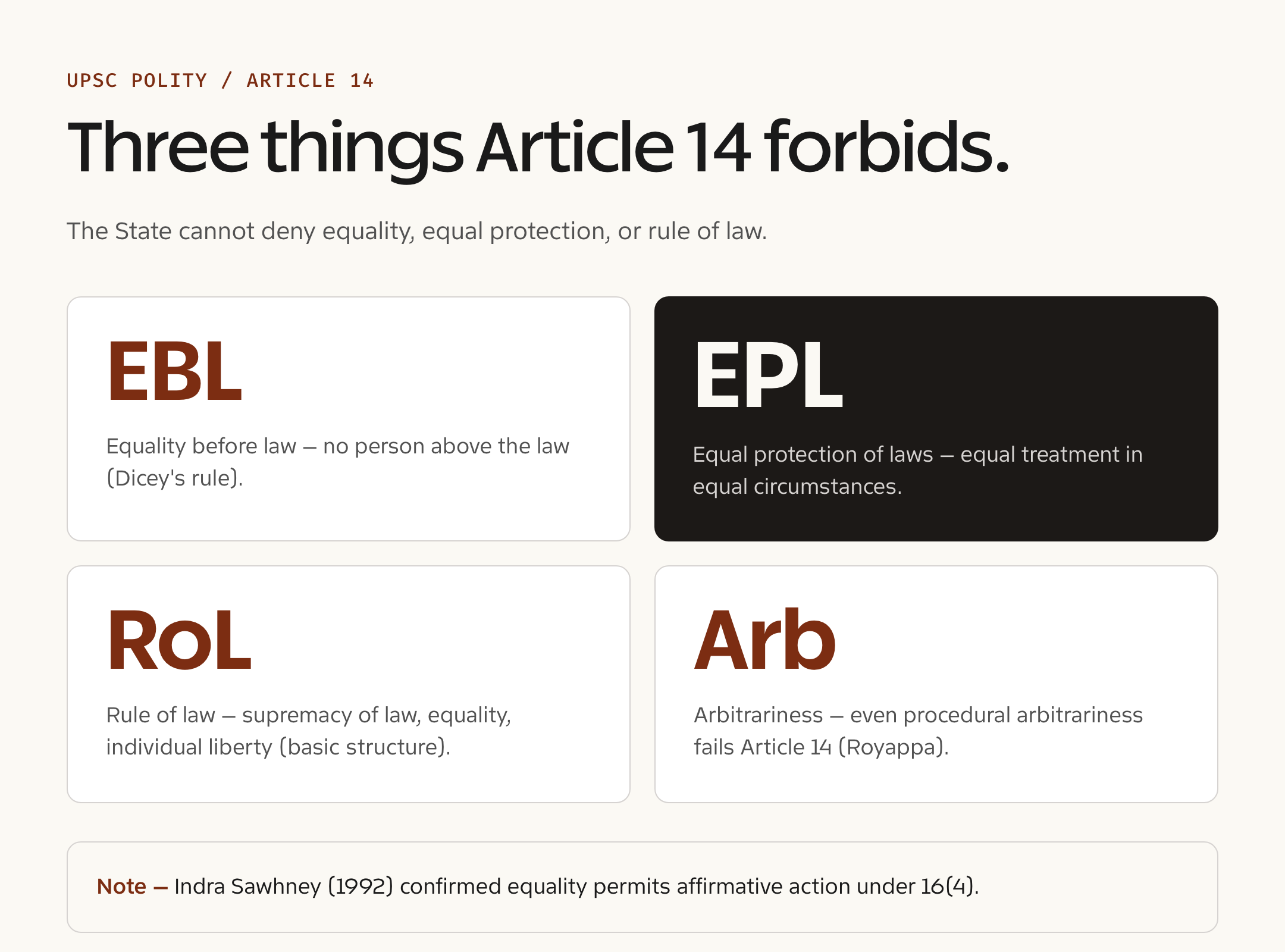
Article 14 has a peculiar twin-engine design. Read it again. “Equality before the law or the equal protection of the laws.”
The negative concept — equality before the law — comes from Dicey. It means no person is above the law. Same courts, same procedure, same liability. The State cannot grant special privileges to one citizen and not another.
The positive concept — equal protection of the laws — comes from the 14th Amendment of the US Constitution. It does not mean treating everyone the same. It means equal treatment for those similarly situated. Different classes can be treated differently — provided the classification is reasonable.
That second phrase is what made the Indian Article 14 jurisprudence so interesting… because it forced the courts to ask: when is a classification reasonable?
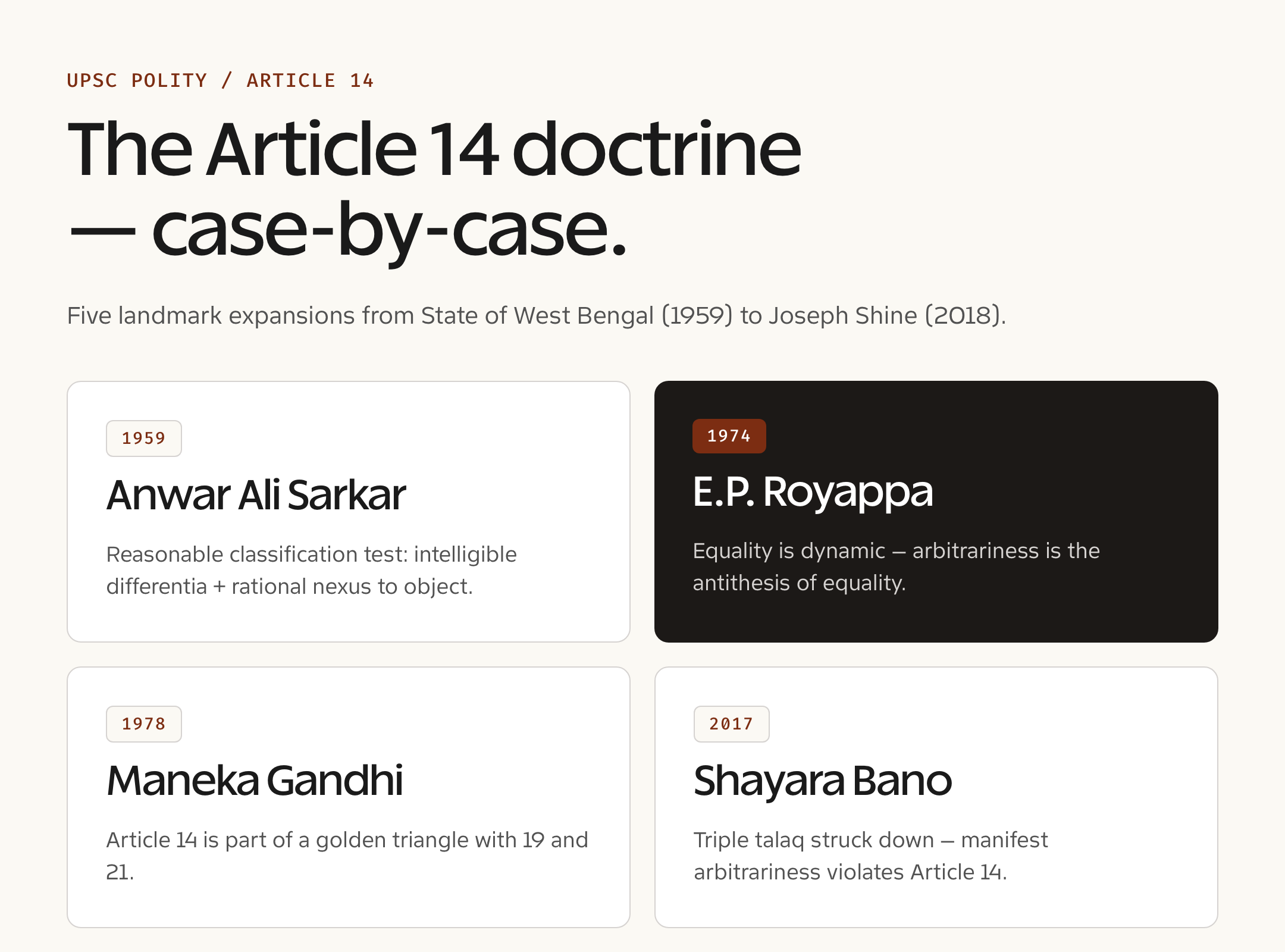
Reasonable classification — the old test (1950–1974)
For the first 25 years, Article 14 jurisprudence ran almost entirely on the reasonable classification doctrine. The leading cases:
- State of West Bengal v. Anwar Ali Sarkar (1952) — The SC struck down the West Bengal Special Courts Act for arbitrary classification of cases.
- Ram Krishna Dalmia v. Justice Tendolkar (1958) — Justice S.R. Das laid down the two-fold test that became standard: – The classification must be founded on an intelligible differentia that distinguishes persons or things grouped together from those left out. – The differentia must have a rational nexus to the object sought to be achieved by the law.
Apply both. If both pass, Article 14 is satisfied. If either fails, the law is struck down.
The model is mechanical. It works well when the State has clearly defined classes — say, treating “industrial workers” differently from “agricultural workers” for labour law purposes. It works badly when the State acts capriciously, on a whim, against a single individual… because in those cases, there’s no “class” to test at all.
That gap is what Royappa and Maneka fixed… and the fix was bigger than anyone expected.
Manifest arbitrariness — the new test (1974 onwards)
In *E.P. Royappa v. State of Tamil Nadu* (1974), Justice P.N. Bhagwati wrote one of the most-quoted lines in Indian constitutional law:
“Equality is antithetic to arbitrariness. In fact, equality and arbitrariness are sworn enemies; one belongs to the rule of law in a republic while the other, to the whim and caprice of an absolute monarch.”
That sentence opened a new doctrine. Arbitrariness — by itself — violates Article 14. You don’t need to show classification. You don’t need a similarly-situated comparator. If the State action is arbitrary, fanciful, or oppressive, it falls.
Four years later, in *Maneka Gandhi v. Union of India* (1978), a seven-judge bench cemented this. Maneka’s passport had been impounded under the Passport Act. The court held:
- Articles 14, 19, and 21 are not “watertight compartments”. They form a golden triangle.
- Any procedure under Article 21 must be “right, just and fair” — not arbitrary, fanciful, or oppressive.
- Article 14 strikes at arbitrariness in State action even where no classification is involved.
This single judgment integrated Article 14 with Article 21 of the Indian Constitution and rewired the entire fundamental rights architecture.
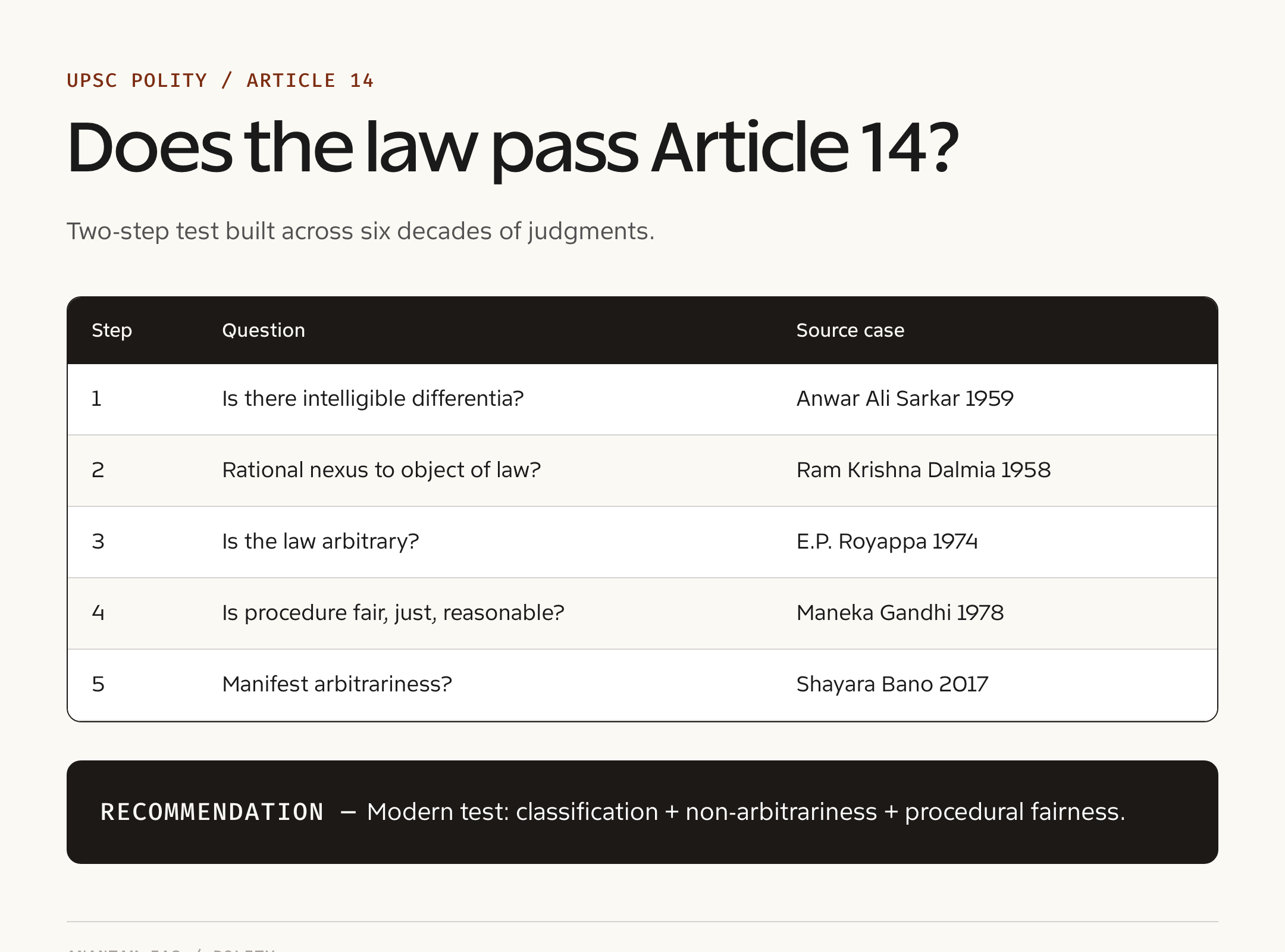
Modern arbitrariness — Shayara Bano and Joseph Shine
The Royappa-Maneka line was sometimes criticised as too vague. In Shayara Bano v. Union of India* (2017), the SC formalised “manifest arbitrariness” as a doctrinal test to strike down legislation. Triple talaq (talaq-e-biddat) was held unconstitutional partly because it was manifestly arbitrary — instant, irrevocable, capricious.
In Joseph Shine v. Union of India* (2018), Section 497 IPC (adultery) was struck down. The court found that treating women as the husband’s “property” — and exempting them from prosecution while criminalising men — was both classification-defective and manifestly arbitrary. Article 14 + Article 15 + Article 21 all came into play.
A few more landmark applications you should be able to cite:
- Indra Sawhney v. Union of India (1992) — Mandal Commission. Article 14 read with Article 16(4). 50% reservation cap.
- Air India v. Nergesh Meerza (1981) — Air hostess service rules. Termination on first pregnancy struck down as arbitrary.
- D.S. Nakara v. Union of India (1983) — Pension liberalisation cut-off date. Classifying pensioners by retirement date held arbitrary.
- Navtej Singh Johar v. Union of India (2018) — Section 377 partially struck down. Same-sex relations between consenting adults decriminalised. Article 14 + 15 + 19 + 21.
- Anuradha Bhasin v. Union of India (2020) — J&K internet shutdown. Proportionality test under Article 14 + Article 19(1)(a).
Article 14 vs the Rule of Law — exceptions
Article 14 is broad but not absolute. Six classes of exceptions you should remember:
- Article 361 — President and Governors enjoy immunity from court process during their term.
- Article 105 / 194 — Parliamentary and State Legislature privileges.
- Article 359 — Suspension during emergency (after the 44th Amendment, 1978, this cannot suspend Articles 20 and 21, but can suspend 14).
- Article 31C — Laws giving effect to certain DPSPs (Articles 39(b), 39(c)) cannot be challenged on the ground of Article 14 (post-Minerva Mills, 1980).
- Foreign sovereigns and diplomats — immune under international law.
- Reasonable classification under tax, regulatory, and welfare statutes — wider judicial deference.
Doctrine evolution timeline
Why this matters for UPSC
Article 14 is a near-guaranteed Mains question and a recurring Prelims one.
- Prelims — Direct factual MCQs on the two-fold test, Article 14 vs Article 15/16 distinctions, and exceptions like Article 361. Recent example years: 2019, 2022, 2024.
- Mains GS-II — “Discuss the evolution of equality jurisprudence under Article 14.” Standard 15-mark question. Cite Royappa, Maneka, Shayara Bano.
- Mains GS-IV (Ethics) — Equality as a moral value; classification ethics in welfare schemes.
- Essay — “Justice delayed is justice denied” or “Equality and Liberty are interdependent” — both lean on Article 14.
- Interview — Be ready for “Is reservation a violation of Article 14?” Hint: no, because of Article 16(4) read with Article 14’s classification doctrine.
Common misconceptions
- “Article 14 only applies to citizens.” Wrong. It applies to “any person” — citizens, foreigners on Indian soil, and even juristic persons (companies).
- “Equality before law and equal protection of laws mean the same thing.” They don’t. Equality before law is negative (no privilege). Equal protection is positive (equal treatment of equals).
- “Reasonable classification is the only test.” Outdated since 1974. Manifest arbitrariness is now an independent ground.
- “Article 14 forbids reservation.” Not at all. Indra Sawhney held reservation under Article 16(4) is constitutional within reasonable limits.
- “Article 14 cannot be suspended in emergency.” It can. Only Articles 20 and 21 are insulated post 44th Amendment, 1978.
How to revise this in 30 minutes
Use this stack. Skip the rest.
- Laxmikanth — Right to Equality chapter (Articles 14–18). 20 minutes. Pay extra attention to the exceptions.
- D.D. Basu — *Introduction to the Constitution of India — 5 pages on Article 14 doctrines. The phrasing is gold for Mains.
- PRS / Indian Express explainer on Joseph Shine (2018) — 5 minutes.
- Supreme Court Observer page on *Shayara Bano — for the manifest arbitrariness language.
- Vision IAS / Drishti current affairs on *Anuradha Bhasin* — for the proportionality angle.
Skip random YouTube “Article 14 in 5 minutes” videos… most still parrot only the 1958 test.
Frequently Asked Questions
Does Article 14 apply to foreigners?
Yes. The text uses u0022any personu0022, which the Supreme Court has consistently read to include non-citizens within India. Articles 15, 16, 19 are restricted to citizens; Article 14 is not.
What is the difference between equality before law and equal protection of laws?
Equality before law is a negative concept borrowed from Dicey — absence of privilege. Equal protection of laws is a positive concept borrowed from the US 14th Amendment — equal treatment of similarly situated persons.
What is the two-fold test of reasonable classification?
Laid down in Dalmia v. Tendolkar (1958) — (a) classification must be based on an intelligible differentia, and (b) the differentia must have a rational nexus to the object of the law.
What is manifest arbitrariness?
A doctrine formalised in Shayara Bano (2017) — a law can be struck down if it is excessive, disproportionate, or capricious, even without a classification challenge.
Can Article 14 be suspended during emergency?
Yes, under Article 359. After the 44th Amendment (1978), only Articles 20 and 21 are insulated from suspension; Article 14 can still be suspended.
Does Article 14 apply to private parties?
Generally no. Article 14 binds the u0022Stateu0022 as defined in Article 12. Private discrimination is governed by ordinary law (e.g., Equal Remuneration Act, Civil Rights Act).
What is the Golden Triangle in Indian constitutional law?
The interlocking triad of Articles 14, 19, and 21 — established in Maneka Gandhi (1978). Any law restricting personal liberty must satisfy all three.