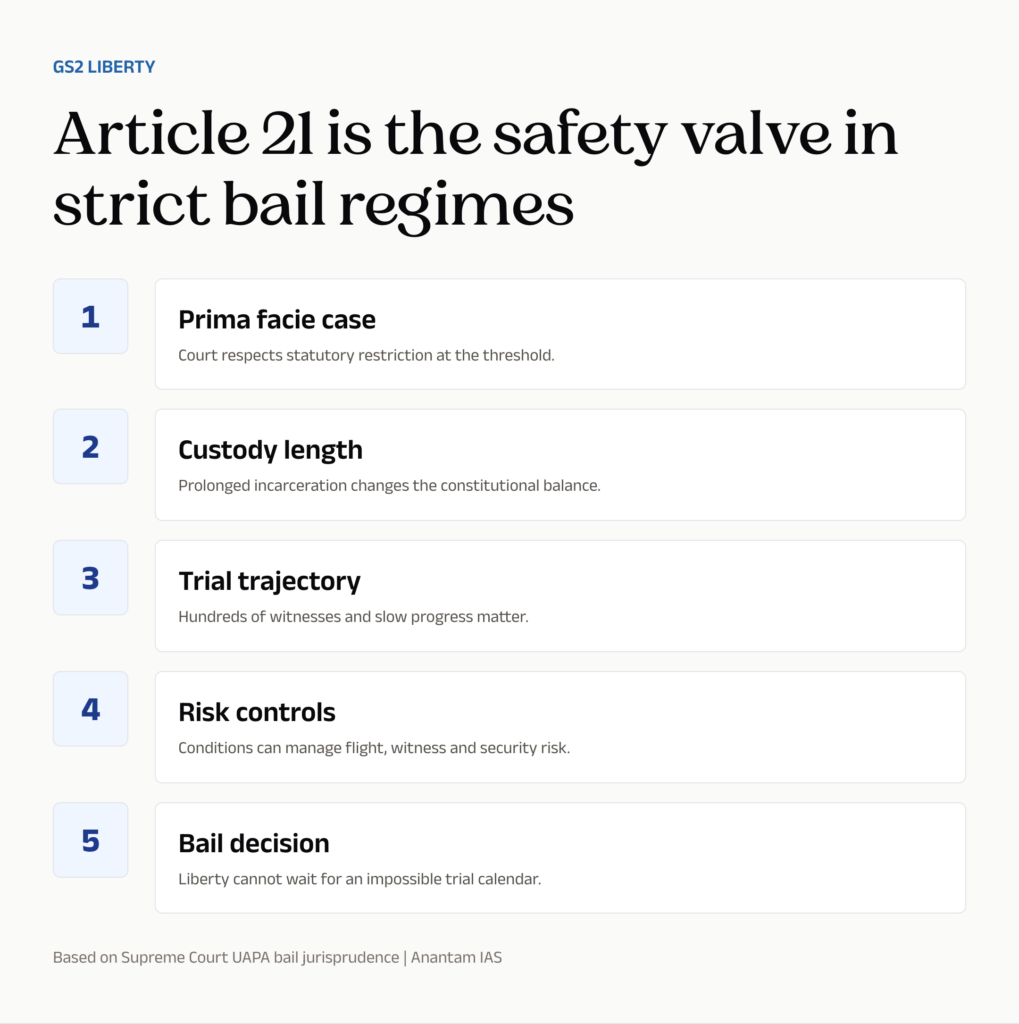
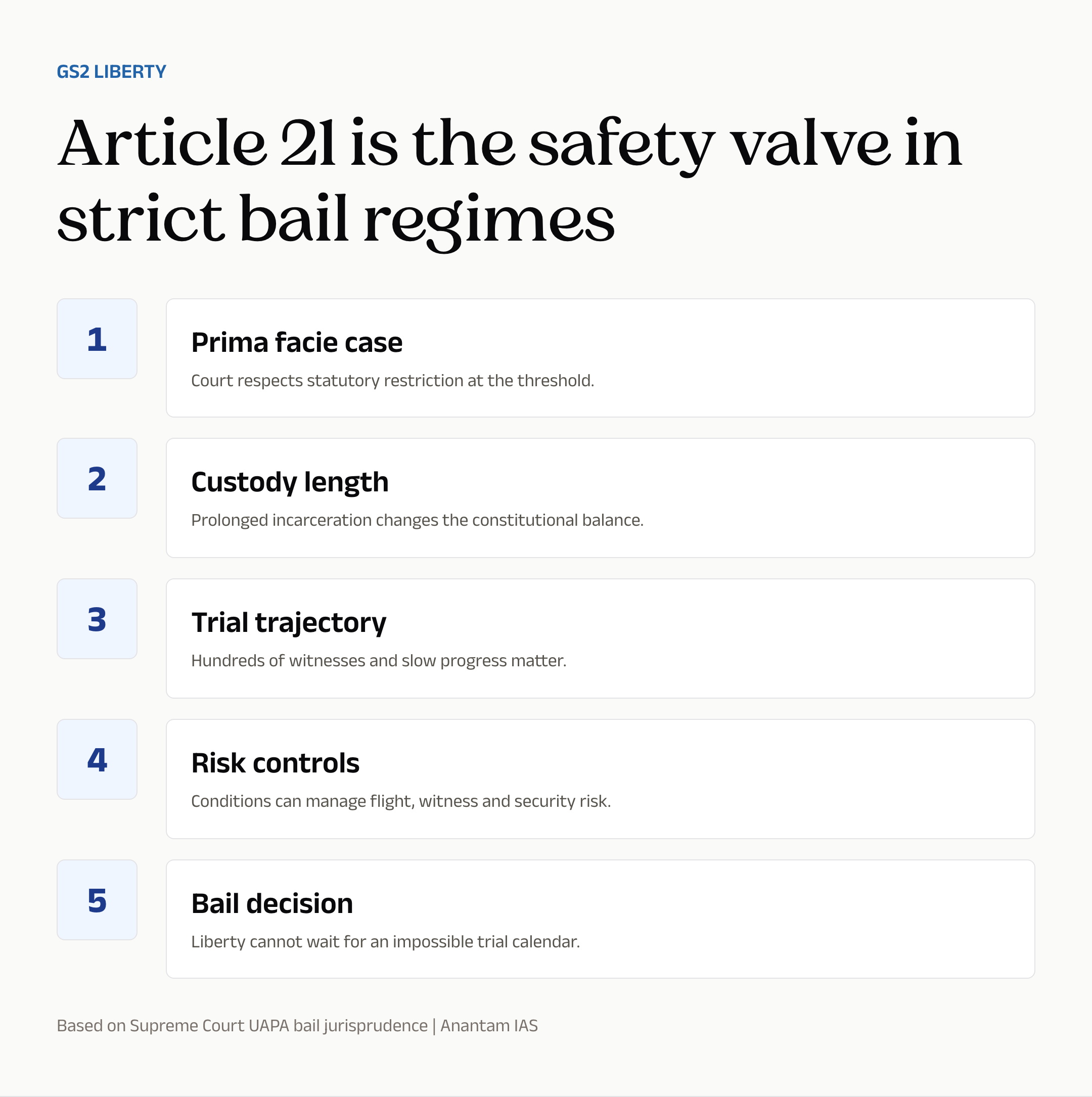
National security law can be strict. It often must be. But strict law cannot mean that an undertrial spends years in prison while the trial barely moves. UAPA bail is where the Indian Constitution asks a hard question: can the state demand patience from liberty when it cannot deliver a speedy trial?
The Issue, Framed
The issue is not whether terrorism and unlawful activities are serious. They are. The issue is whether seriousness alone can justify prolonged pre-trial incarceration when conviction has not happened and the trial has no realistic end date. That is where Article 21 enters the room.
For UPSC, this is a GS2 and GS3 bridge. It sits at the junction of personal liberty, due process, internal security, criminal justice, special laws and judicial review. A good answer must protect the state from real threats without allowing the process itself to become punishment.
My stance is direct: UAPA can have stringent bail conditions, but Article 21 must remain the constitutional safety valve. If the state wants stricter laws, it also owes faster investigation, faster trials and stronger evidence management.
What the Data Says
The Supreme Court judgment dated 18 May 2026 reiterated the K.A. Najeeb principle: statutory restrictions such as Section 43-D(5) of UAPA do not oust constitutional courts’ power to grant bail where prolonged incarceration and delayed trial violate Article 21. For the statute background, read the UAPA Act with Article 21.
The facts show why the principle matters. The appellant had been in custody since 11 June 2020, more than 5 years and 11 months. The prosecution said more than 350 witnesses were still to be examined. That is not a near-complete trial. That is a liberty problem.
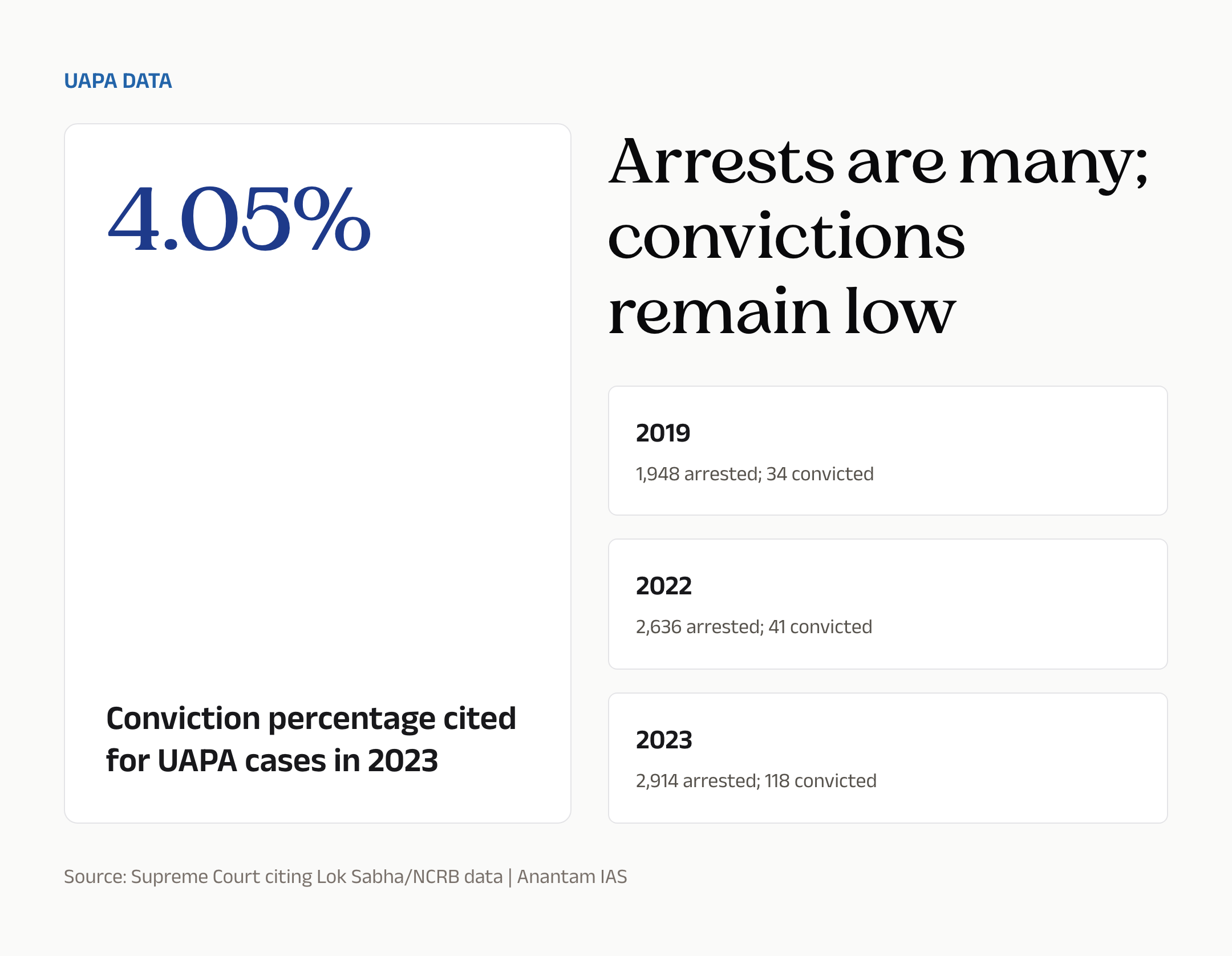
The judgment also cites Lok Sabha/NCRB data. Across India, UAPA convictions as a percentage of arrests were 1.75% in 2019, 6.06% in 2020, 3.82% in 2021, 1.56% in 2022 and 4.05% in 2023. These are not final conviction rates for every case in a strict statistical sense, but the Court used them to underline the risk of long incarceration before uncertain outcomes.
The Indian Express editorial frame is useful here: the Supreme Court must heed its own rule. If Najeeb says the rigour of special statutes can melt down before Article 21, lower courts and coordinate benches need a clear, consistent test.
The Case For
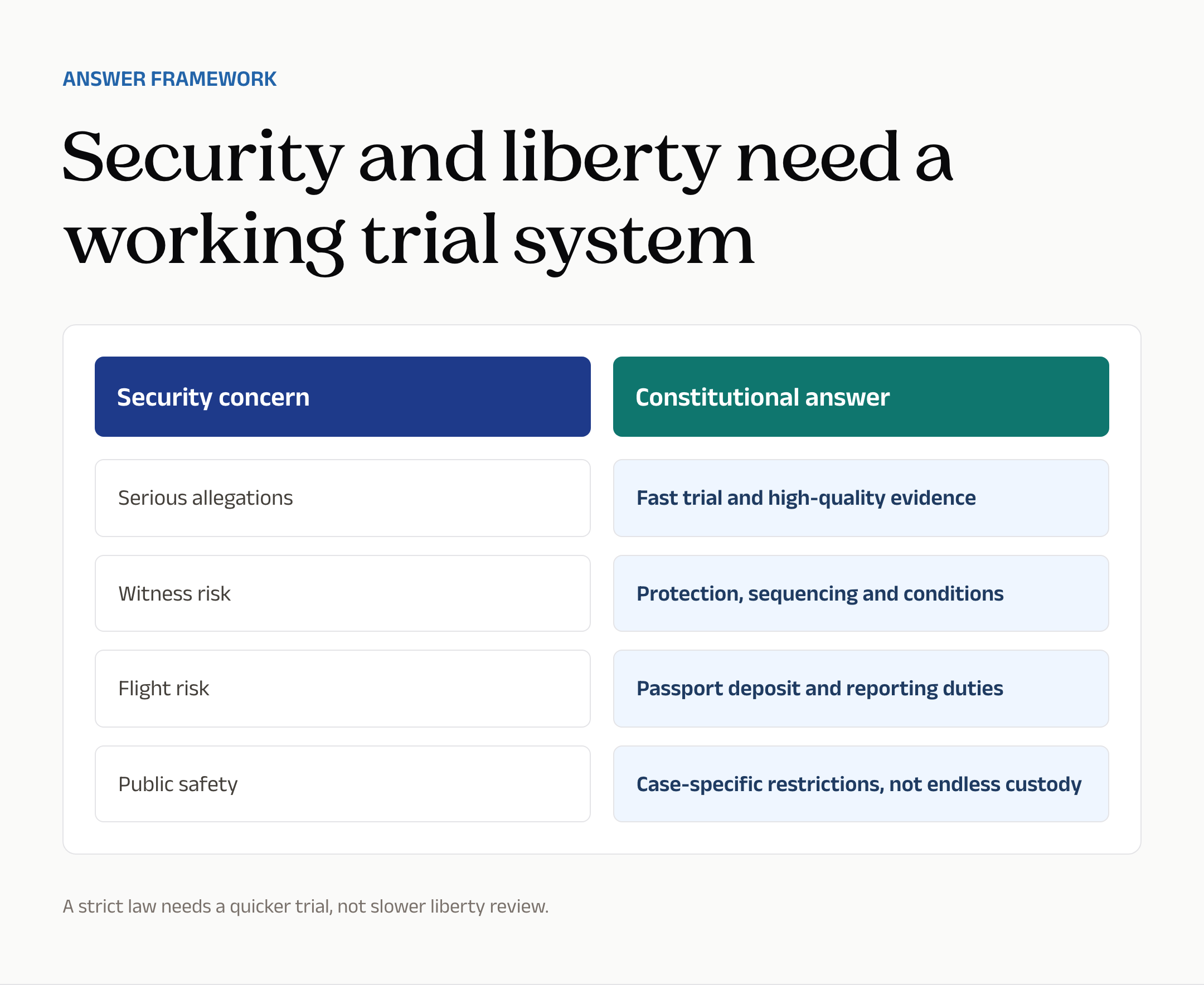
The case for strict UAPA bail is not imaginary. Terror cases may involve networks, intimidation, cross-border financing, encrypted communication and risks that are hard to reverse after release. The state has a legitimate interest in preventing accused persons from absconding, tampering with evidence or threatening witnesses.
Special laws exist because ordinary criminal law may not handle extraordinary threats. Section 43-D(5) reflects a legislative judgment that, where accusations appear prima facie true, bail should not be routine. Courts should not casually weaken that judgment.
There is also a public confidence issue. If serious terror allegations are treated like ordinary bailable matters, citizens may feel that the justice system is naive about security. A democracy has to protect liberty, but it also has to protect life.
The Case Against
The case against endless pre-trial detention is constitutional. An accused person is not a convict. If the state keeps someone in custody for five or six years while examining only a fraction of witnesses, the punishment has begun before guilt is established.
Strict bail rules can also create institutional laziness. If custody is easy to continue, the pressure to streamline charges, protect witnesses, schedule hearings and complete trial weakens. The harsher the law, the stronger the duty to make the trial swift.
The low conviction figures cited by the Court sharpen the concern. When acquittal remains a real possibility, long custody becomes especially dangerous. A person cannot be given back five years of liberty through a later acquittal.
The Deeper Structural Read
The deeper structural read is that bail debates are often used to avoid trial-system debates. We ask whether bail should be granted, but we ask less often why the trial is moving so slowly. Hundreds of witnesses, weak case management and repeated adjournments can turn even a serious case into a constitutional failure.
Article 21 does not make security law toothless. It disciplines it. It says the state may restrict liberty according to law, but the restriction cannot become arbitrary, unfair or unconscionable. That is why speedy trial is not a procedural luxury. It is the condition that makes strict pre-trial detention tolerable.
The best answer is not bail for everyone. That would be unserious. The best answer is periodic constitutional review. Courts should ask: how long has the accused been in custody, how much of the sentence equivalent has been crossed, how many witnesses remain, who caused the delay, and what release conditions can manage risk?
This approach respects both sides. It does not trivialise national security. It also refuses to let national security become a phrase that closes the Constitution.
The institutional point is equally important. If special laws create special burdens on liberty, the state must create special capacity for trial. That means trained prosecutors, protected witnesses, digital evidence management, fewer avoidable adjournments and judges who can monitor progress without turning bail hearings into mini-trials. Otherwise, strictness operates only at the front door of the case, while the back end remains ordinary and slow. A Mains answer should call this a capacity deficit, not merely a rights conflict. That framing keeps the answer practical: liberty is protected not by weakening security, but by making prosecution faster, fairer and more accountable.
What Should Be Done
First, special courts handling UAPA cases should run strict case-management calendars. The NIA Act already imagines priority and day-to-day trial. That principle must become routine, not aspirational.
Second, witness lists need discipline. If the prosecution lists hundreds of witnesses, courts should require sequencing: core witnesses first, formal witnesses through affidavits where lawful, and unnecessary duplication removed.
Third, bail review should be periodic in long custody cases. After a defined period, the burden should shift toward explaining why continued detention remains constitutionally justified despite delay.
Fourth, release conditions can be serious without being theatrical: passport deposit, location reporting, witness-contact restrictions, digital-device conditions where necessary, and quick cancellation for breach.
Finally, Parliament and the executive should treat low conviction and long trial duration as internal-security weaknesses. A strong state is not one that arrests many people. A strong state proves cases quickly, fairly and lawfully.
For Your Mains Answer
GS paper mapping: GS2: fundamental rights, judiciary, criminal justice; GS3: internal security.
Likely question frames: – Strict bail provisions under special laws must be harmonised with Article 21. Discuss with reference to UAPA jurisprudence. – Delayed trial can convert pre-trial detention into punishment. Examine in the context of national security laws. – How can India balance internal security with constitutional liberty in terror-related prosecutions?
Quotable data points: – Section 43-D(5) UAPA imposes stringent bail restrictions. – The appellant in the 18 May 2026 judgment had spent more than 5 years 11 months in custody. – More than 350 prosecution witnesses were still to be examined. – UAPA arrest/conviction data cited for 2023: 2,914 arrested, 118 convicted. – Cited conviction percentage ranged from 1.56% to 6.06% across 2019-2023. – K.A. Najeeb principle: statutory rigour can melt down before Article 21 delay.
Keywords to use: Article 21, speedy trial, pre-trial detention, constitutional safety valve, Section 43-D(5), proportionality, internal security.
Syllabus linkages: Fundamental rights, Judiciary, Internal security, Role of external state and non-state actors.
Balanced conclusion line: A democracy can be firm on terror without letting the delay of trial become the sentence.
How to Build the Answer
Start with the central tension, not a textbook definition. For this topic, the tension is: Strict bail provisions under special laws must be harmonised with Article 21. Discuss with reference to UAPA jurisprudence. That opening immediately tells the examiner that you understand both the policy problem and the value conflict. A definition can come in the second or third sentence. The first sentence should frame the debate.
Use data early, but do not dump data. A good first body paragraph can carry three numbers: Section 43-D(5) UAPA imposes stringent bail restrictions. The appellant in the 18 May 2026 judgment had spent more than 5 years 11 months in custody. More than 350 prosecution witnesses were still to be examined. Then explain what those numbers prove. UPSC rewards the move from fact to inference. The number is the anchor; the inference is the mark-scoring part.
The second body paragraph should handle the other side fairly. If your stance supports reform, first admit why the existing approach has a rationale. If your stance criticises a policy, first say what problem the policy was trying to solve. This is how an answer becomes balanced without becoming vague.
The way forward should be grouped, not scattered. Use headings such as institutional reform, fiscal design, citizen impact, federal coordination and technology. Use the topic’s own vocabulary: Article 21, speedy trial, pre-trial detention, constitutional safety valve, Section 43-D(5). These words help the answer sound like governance analysis rather than a newspaper summary.
Close by returning to the syllabus link: Fundamental rights, Judiciary, Internal security. The last line should not repeat the introduction. It should show judgment. One useful pattern is: ‘The goal is not X alone, but X with Y.’ That pattern lets you balance reform with rights, growth with equity, and security with liberty.
Common Mistakes to Avoid
- Do not write only the newspaper argument. Editorials are starting points. Mains answers need constitutional, economic, administrative or ethical structure.
- Do not overuse adjectives. Words like serious, grave, historic and transformative do not earn marks unless tied to evidence.
- Do not make the answer one-sided. Every topic in this batch has a real counter-argument. Steelman it in two or three lines before giving your final view.
- Do not end with a slogan. End with an implementable principle, a measurable reform, or a constitutional value.
- Do not forget the citizen. UPSC likes policy, but it rewards policy that names who gains, who loses and who needs protection.
A Compact Answer Spine
- Introduction: Open with the conflict in one sentence and define the key term in the next sentence.
- Evidence: Use two or three data points from the dossier and connect each to a policy implication.
- Arguments: Present the case for the current policy or trend, then the case against it. Keep both fair.
- Structural diagnosis: Explain the deeper administrative, economic, social or constitutional reason the issue persists.
- Way forward: Give four to five grouped reforms with clear actors: Union government, state government, regulator, court, market, municipality or citizen.
- Conclusion: Use the balanced conclusion line from this section and adapt it to the question wording.
Diagram or Flowchart Idea
Use one small diagram if the question is a 15-marker. Do not draw a decorative mind map. Draw a causal chain. The cleanest format is: problem trigger -> institutional gap -> citizen impact -> reform response. This works because the examiner can read the logic in five seconds.
For a 10-marker, skip the diagram unless it is genuinely simple. A table with two columns, ‘case for’ and ‘case against’, usually works better. The aim is not to show artistic effort. The aim is to make the answer easy to evaluate under time pressure.
Ethics and Governance Angle
Add one ethical line even in a GS2 or GS3 answer. Most current-affairs editorials are not only about efficiency. They also ask who bears the cost of policy failure. A migrant voter, an undertrial, an outdoor worker, a small exporter, a low-income commuter or an elderly citizen is often sitting silently inside the issue. Naming that citizen makes the answer sharper.
The governance angle should then convert empathy into design. Do not merely say ‘protect vulnerable groups’. Say how: targeted transfers, legal aid, local health surveillance, simplified compliance, public transport, transparent dashboards, or periodic judicial review. This is where many answers move from moral language to administrative maturity.
A useful sentence pattern is: ‘The policy is legitimate in aim, but its legitimacy depends on procedure, proportionality and capacity.’ This line works across many topics because it accepts the state’s objective without giving the state a blank cheque. It is especially useful for questions where the examiner expects balance.
How to Use Data Without Sounding Mechanical
Use fewer numbers than you know. Three well-explained data points beat ten scattered facts. Put the most important number near the beginning, use the second number to show contrast, and use the third number to justify the way forward. For example, one national number, one state or sector contrast, and one implementation gap is usually enough.
Never leave a statistic alone. Follow it with a sentence beginning with ‘This means…’ or ‘The policy implication is…’ That tiny move turns data into analysis. It also keeps the answer from reading like a fact sheet. In Mains, facts are raw material. Judgment is the finished answer.
End revision by asking one question: can this answer be understood by a tired examiner in one pass? If the answer needs rereading, simplify the structure. Keep the introduction short, give the data early, mark the two sides cleanly, and place the way forward in grouped points. Clarity is not a lower standard than depth. For UPSC writing, clarity is how depth becomes visible.
One final check: remove any line that sounds impressive but does no work. Replace it with a fact, a cause, a consequence or a reform. That habit is small, but it is the difference between an answer that feels informed and an answer that feels memorised.
Write for marks, not for noise. Every sentence should earn its place. Always be specific.
FAQ
Does UAPA bar bail completely?
No. UAPA has strict bail restrictions, but constitutional courts can grant bail when prolonged custody and delayed trial violate Article 21.
What is the Najeeb principle?
K.A. Najeeb holds that statutory bail rigour can melt down when there is no reasonable likelihood of trial completion and incarceration becomes constitutionally excessive.
Why does conviction data matter?
Low conviction percentages increase the moral and constitutional cost of long pre-trial detention, especially when acquittal cannot restore lost years.
What is the answer-writing balance?
Write that national security needs strict law, but strict law needs faster trial, better evidence and periodic liberty review.
Tell Google you want more of this.
Add Anantam IAS as a preferred sourceOne tap, and this site shows up more often in your own Top Stories, AI Overviews and AI Mode. Remove it any time.