Article 249: Parliament’s Power Over the State List
Article 249 lets Parliament legislate on the State List in national interest when the Rajya Sabha passes a two-thirds resolution — a federal safety valve.
Introduction
Article 249 of the Indian Constitution is one of the most important exceptions to India's ordinary federal distribution of legislative powers. It empowers Parliament to legislate on any matter in the State List in the national interest, provided the Rajya Sabha passes a resolution by a two-thirds majority of members present and voting. Sitting in Part XI of the Constitution — the chapter on Centre-State relations — Article 249 is a deliberate federal safety valve that protects the Union's ability to act on state subjects when extraordinary national circumstances demand uniform legislation. For UPSC aspirants, it is a staple polity topic tested in prelims identification questions and mains essays on Indian federalism.
Text and Core Meaning
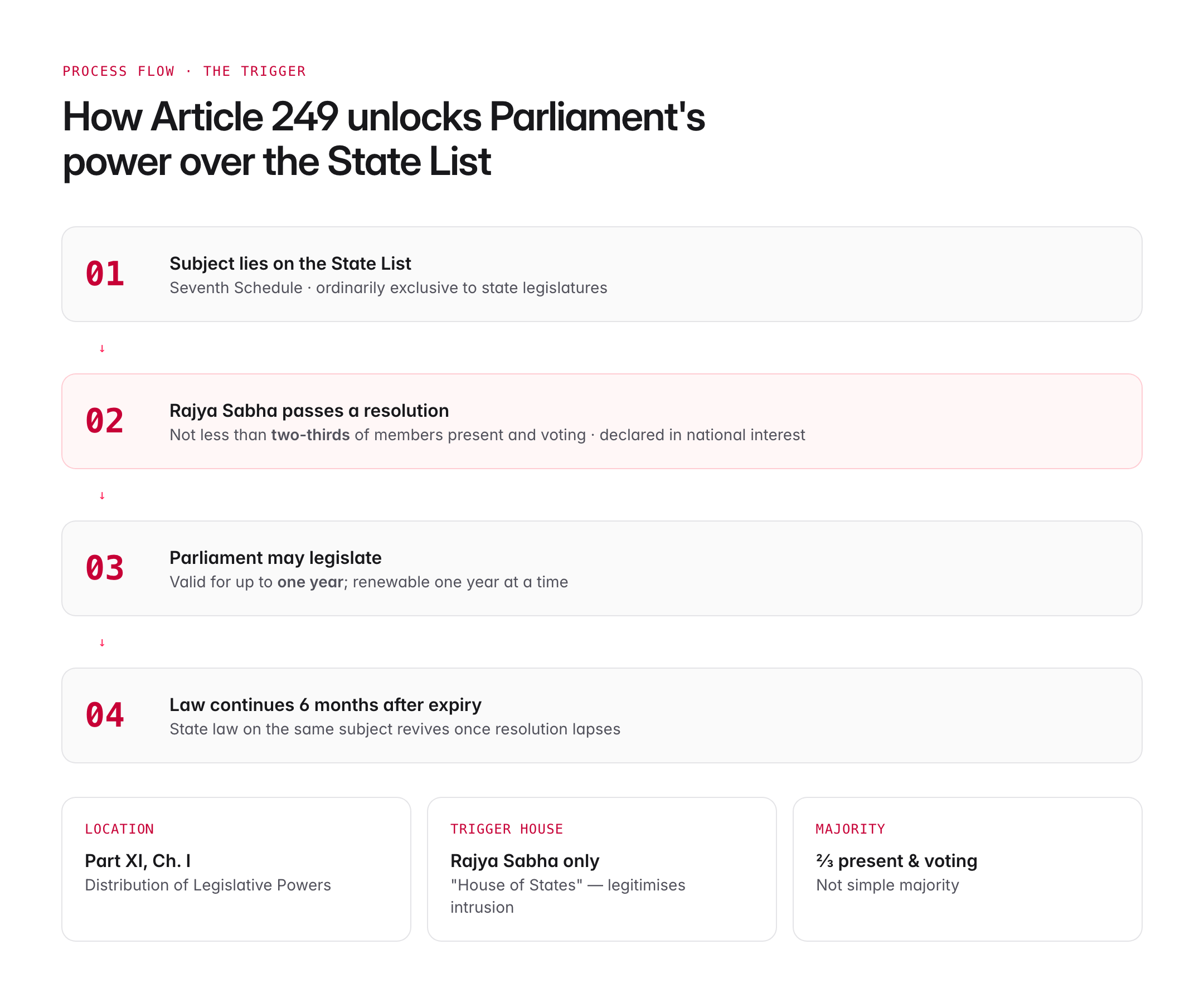
Article 249 applies when a subject lies in the State List of the Seventh Schedule but Parliament believes that legislating on it is necessary or expedient in the national interest. Without this article, Parliament would have no direct law-making power on such a subject. The article provides a channel that requires a political-legal trigger — a resolution by the Rajya Sabha — before Parliament can proceed.
The core ingredients are:
- The matter must be on the State List
- The Council of States (Rajya Sabha) must pass a resolution
- The resolution must be passed by not less than two-thirds of members present and voting
- Parliament must act in the national interest, as declared in the resolution
Why the Rajya Sabha?
The Constitution designates the Rajya Sabha as the forum for this trigger because it is the House representing the states. The logic is clear — if states themselves (through their representatives in the Upper House) agree that Parliament should legislate on a state subject for national interest, the intrusion into state autonomy acquires democratic legitimacy. This mirrors the drafting philosophy of B.R. Ambedkar, who argued that the Rajya Sabha's role should include protecting federal balance.
Duration and Renewal
A resolution under Article 249 is not indefinite. Key operational details:
| Feature | Provision |
|---|---|
| Maximum initial duration | One year |
| Renewal | By a fresh resolution each time |
| Renewal cap per resolution | Up to one year at a time |
| Effect of expiry | Law continues for six months after the resolution ceases |
| Overridden by state law? | Yes, states can later legislate once the resolution lapses |
Thus, even after Parliament has enacted a statute under Article 249, the statute's operational force over the state subject does not outlive the resolution by more than six months. State legislatures can pass laws on the matter that remain dormant during the resolution's validity but revive afterwards.
Relation to Other Articles
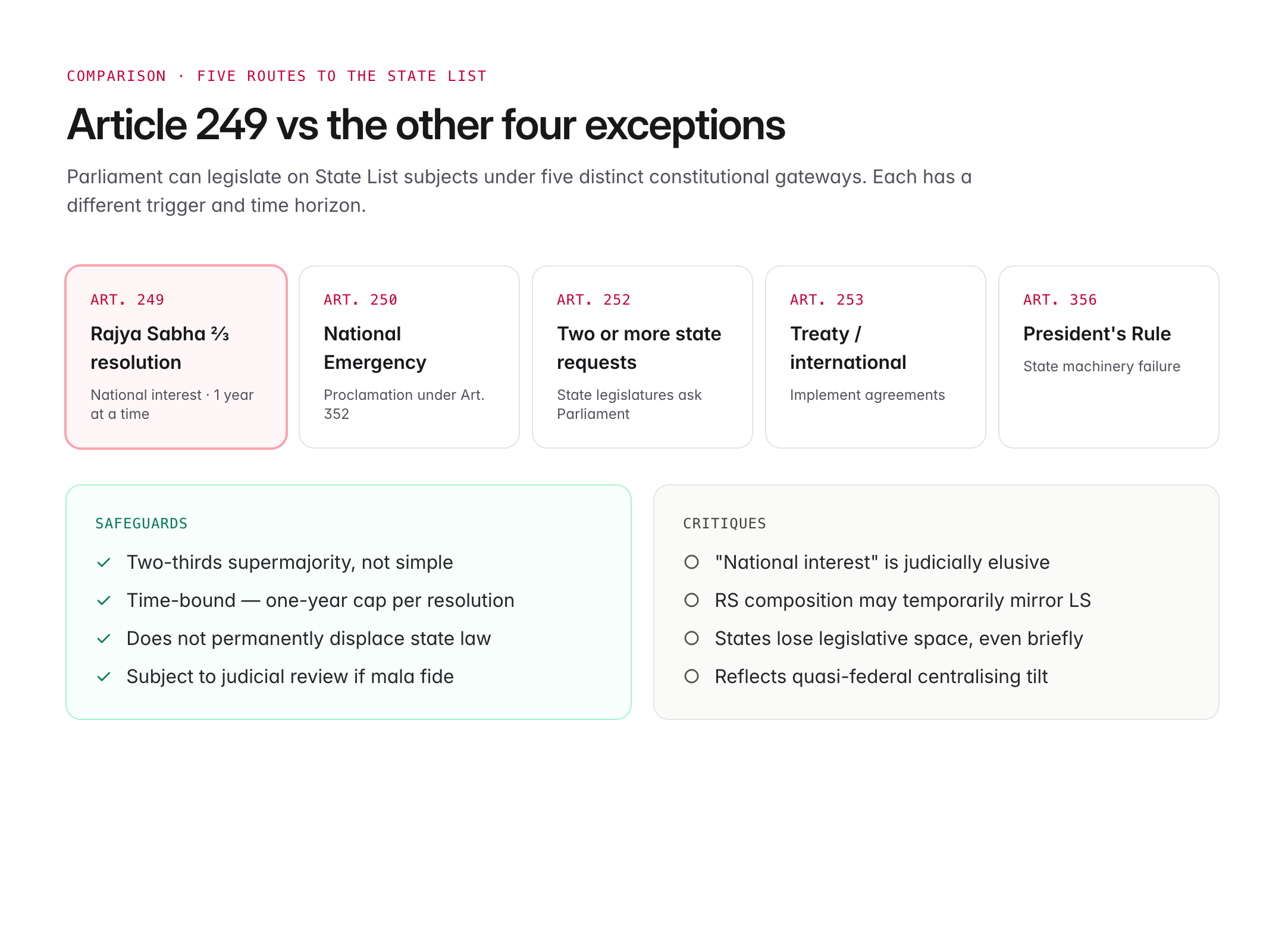
Article 249 is one of five constitutional exceptions under which Parliament can legislate on the State List:
- Article 249 — Rajya Sabha resolution (national interest)
- Article 250 — during a proclamation of National Emergency
- Article 252 — when two or more state legislatures request Parliament to legislate
- Article 253 — to implement international treaties, conventions or agreements
- Article 356 — when President's Rule is in force in a state
Among these, Article 249 is distinctive because it does not require an emergency, an external trigger (treaty), or a request from states themselves — only the considered view of the Rajya Sabha.
Use and Historical Examples
Article 249 has been invoked sparingly. It is viewed as a political tool of last resort, chiefly because ordinary legislative cooperation channels and the Concurrent List usually suffice. When invoked, the resolution tends to be politically significant and debated.
Its restrained use underlines India's commitment to cooperative federalism — the Centre has generally avoided bypassing states through Article 249 and has preferred either Concurrent List legislation, interstate councils, or negotiations in the GST Council and NITI Aayog-type forums.
Federalism, Safeguards and Critiques
Article 249 reflects the Constitution's quasi-federal character — strong at the Centre but with state safeguards. Key safeguards and critiques include:
Safeguards
- Requires a two-thirds Rajya Sabha majority, not a simple majority
- Time-bound operation
- Does not displace state law permanently
- Subject to judicial review if national interest is shown to be absent or mala fide
Critiques
- "National interest" is a broad political concept, difficult to review judicially
- The Rajya Sabha's party composition can temporarily align with the ruling Lok Sabha, reducing its independent check
- States lose legislative space on their own subjects even if briefly
Scholars often debate whether Article 249, along with Article 356, reflects the centralising tilt designed by the Constituent Assembly in response to Partition-era fears.
Key Concepts to Remember
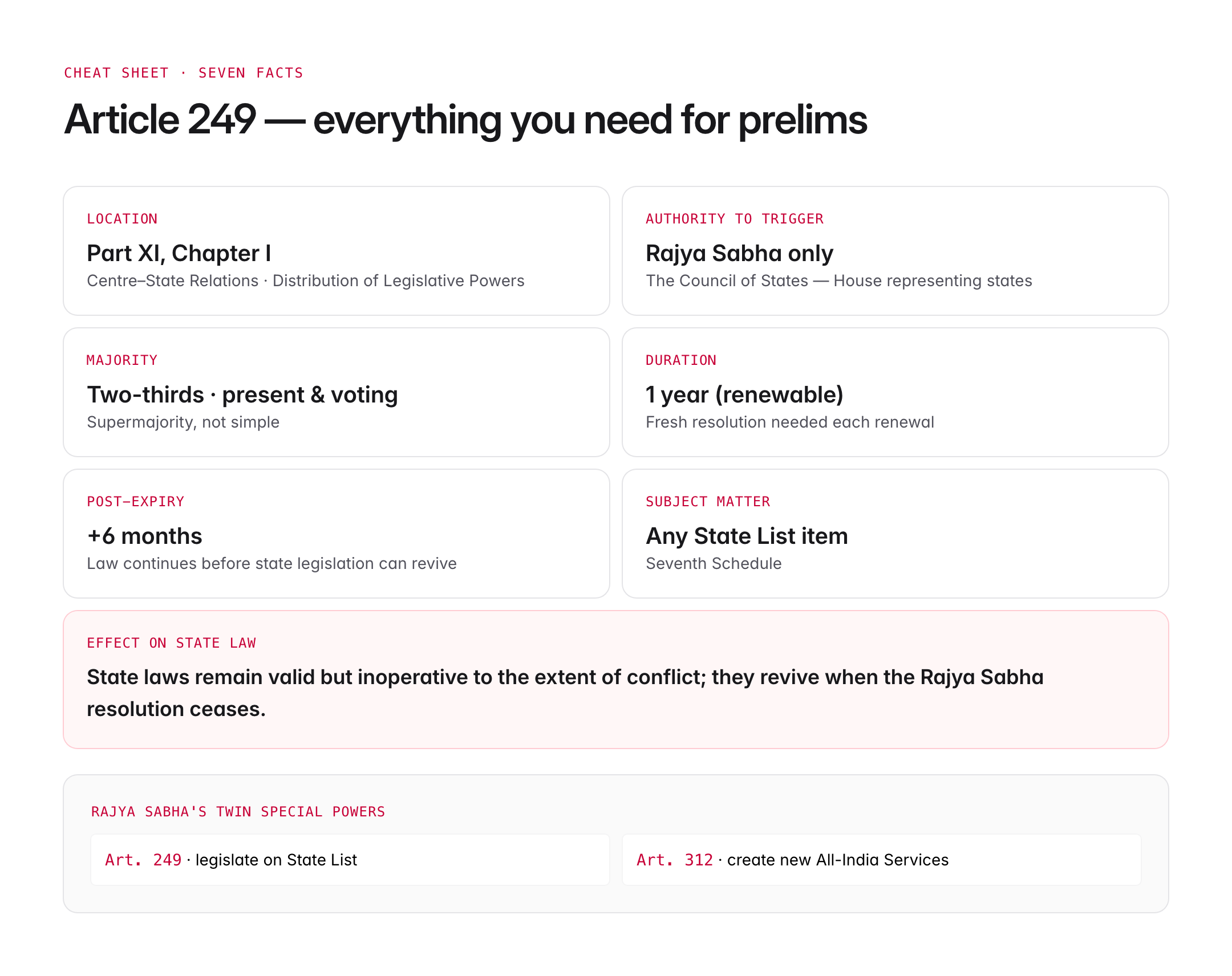
Before prelims, internalise:
- Location — Part XI, Chapter I (Distribution of Legislative Powers)
- Authority to trigger — Rajya Sabha only
- Majority — two-thirds of members present and voting
- Duration — up to one year, renewable one year at a time
- Continuation after expiry — six months post-resolution
- Subject matter — any item on the State List
- Effect on state law — state laws remain valid but inoperative to the extent of conflict
UPSC Relevance
Prelims focus: Article 249 empowers Parliament to legislate on the State List in national interest, needs a Rajya Sabha resolution passed by two-thirds of members present and voting, is valid for up to one year at a time, and laws continue for six months after the resolution expires. Remember it is different from Article 250 (emergency), 252 (state request) and 253 (treaty).
Mains GS-II angle: Use Article 249 to discuss the Indian model of federalism, the Rajya Sabha's role as the guardian of federal principles, and the Centre's legislative overreach debate. It is also useful for essays on cooperative vs competitive federalism and on the evolving meaning of "national interest".
Sample PYQ angle: UPSC has asked about mechanisms by which Parliament can legislate on state subjects, the Rajya Sabha's special powers, and federalism-related constitutional provisions. A question on the Rajya Sabha's special powers routes directly to Articles 249 and 312.