Article 44 — Uniform Civil Code and Its UPSC Significance
Complete UPSC guide to Article 44 of the Indian Constitution — Uniform Civil Code (UCC), DPSP under Part IV, SC observations, arguments for and against, and recent developments.
Article 44 of the Indian Constitution is a Directive Principle of State Policy (DPSP) under Part IV that directs the State to secure for its citizens a Uniform Civil Code (UCC) throughout the territory of India. It reads: “The State shall endeavour to secure for the citizens a uniform civil code throughout the territory of India.” Despite being part of the Constitution since 1950, Article 44 remains one of the most debated and politically sensitive provisions, touching upon the intersection of fundamental rights, religious freedom, gender justice, and secularism.
For UPSC, Article 44 is a perennial topic in Polity (GS2) and features in both Prelims and Mains across questions on DPSPs, fundamental rights, secularism, and landmark judicial pronouncements.
What Is the Uniform Civil Code?
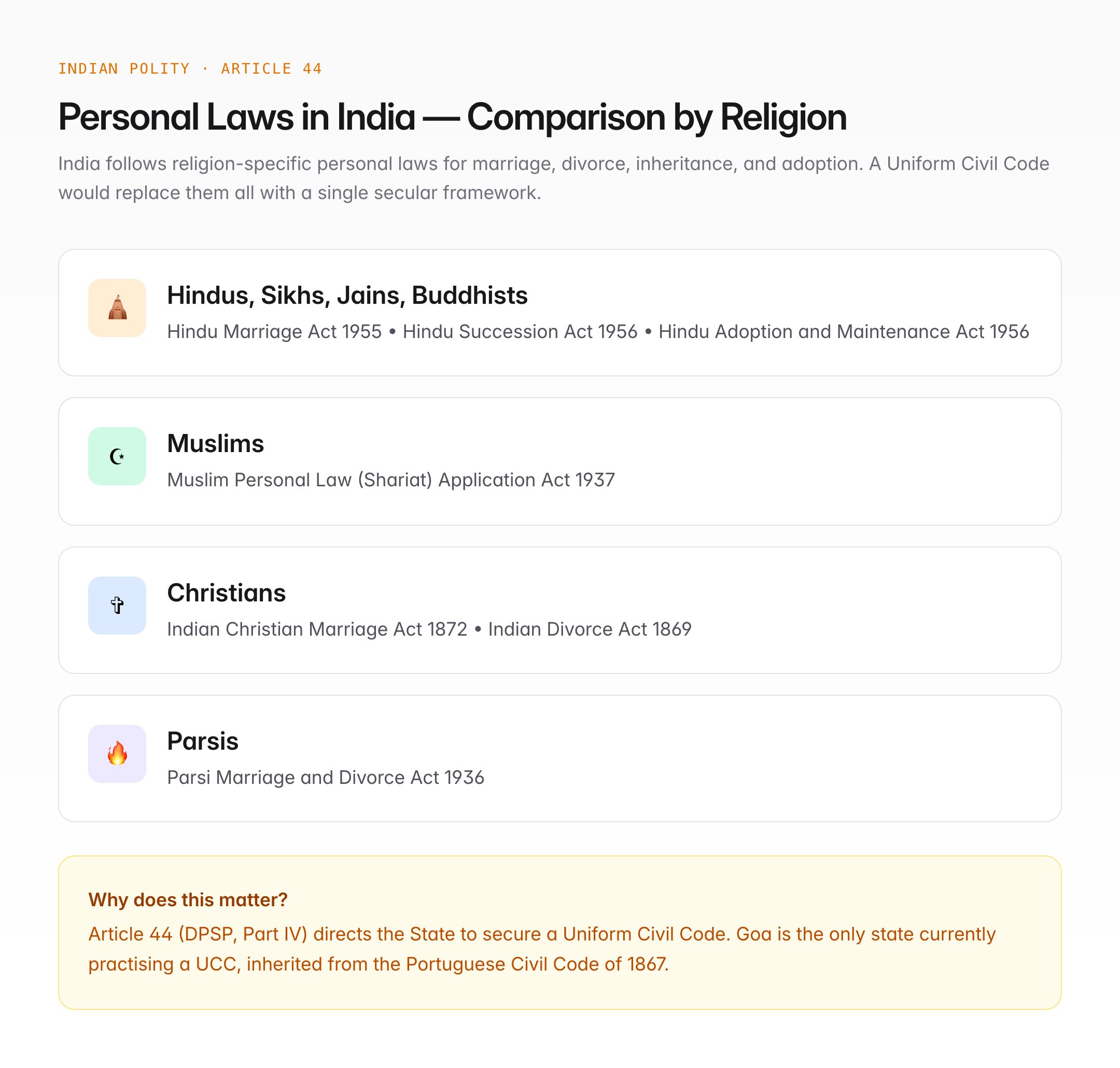
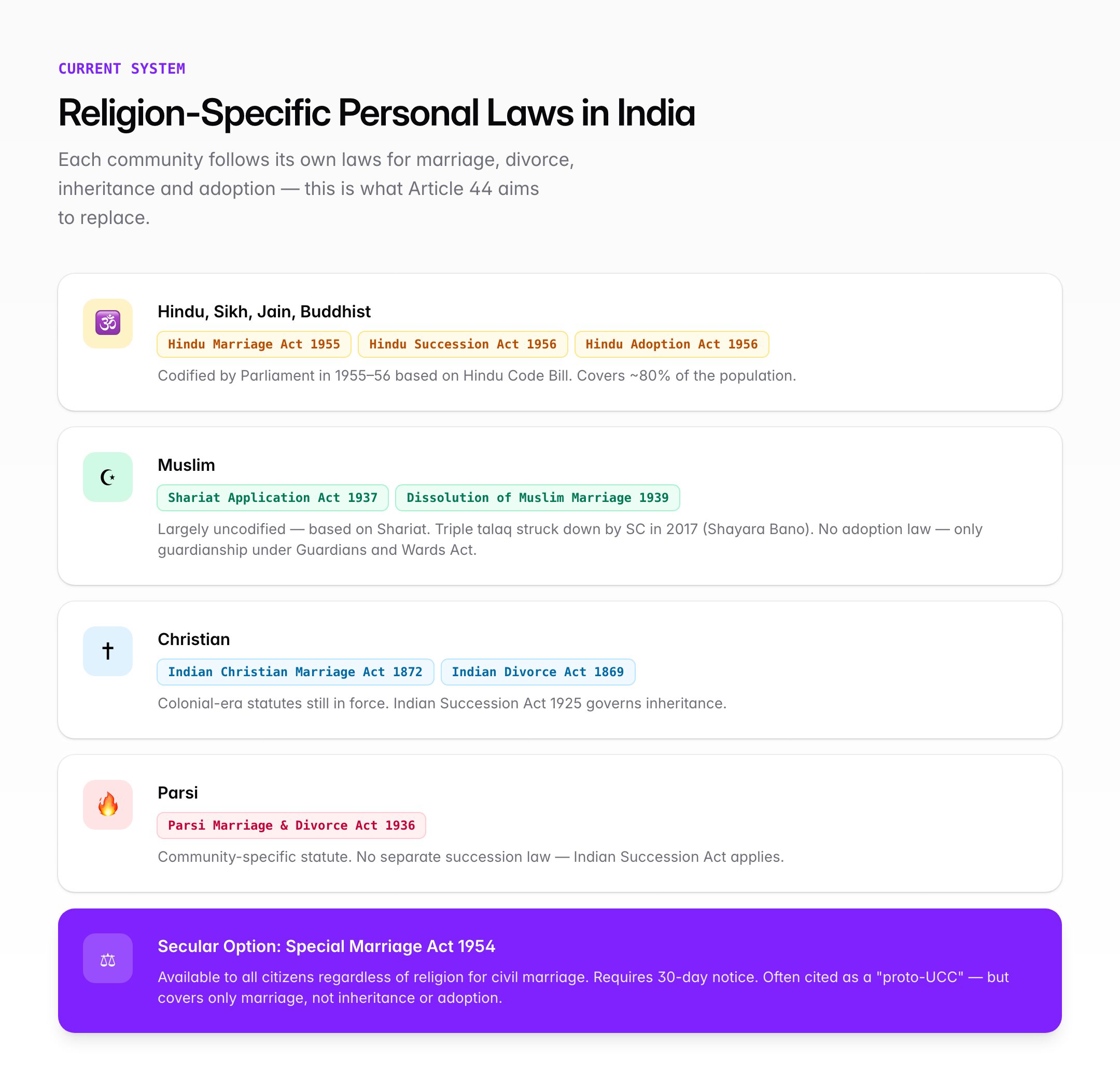
A Uniform Civil Code means a single set of secular laws governing personal matters — marriage, divorce, inheritance, adoption, and maintenance — that applies equally to all citizens regardless of their religion, caste, or community. Currently, India follows a system of religion-specific personal laws:
| Community | Governing Law |
|---|---|
| Hindus, Sikhs, Jains, Buddhists | Hindu Marriage Act 1955, Hindu Succession Act 1956, Hindu Adoption and Maintenance Act 1956 |
| Muslims | Muslim Personal Law (Shariat) Application Act 1937 |
| Christians | Indian Christian Marriage Act 1872, Indian Divorce Act 1869 |
| Parsis | Parsi Marriage and Divorce Act 1936 |
A UCC would replace this patchwork with a unified framework applicable to all citizens.
Article 44 in the Constitutional Framework
Article 44 falls under Part IV — Directive Principles of State Policy (Articles 36 to 51). Key constitutional features:
- Non-justiciable: Like other DPSPs, Article 44 cannot be enforced by courts. However, courts have repeatedly urged Parliament to implement it.
- Fundamental in governance: Article 37 states that DPSPs are "fundamental in the governance of the country" and the State has a duty to apply them in making laws.
- No conflict with Article 25: Article 25 (freedom of religion) is subject to public order, morality, health, and other provisions of Part III. Personal laws are not considered an essential part of religious practice by most constitutional experts.
Constituent Assembly Debates
During the Constituent Assembly debates, Article 44 was fiercely discussed. K.M. Munshi argued that a UCC was essential for national integration and gender justice. Alladi Krishnaswamy Ayyar stressed that personal law had nothing to do with religion in the strict sense. Opponents like Muhammad Ismail and Naziruddin Ahmad feared it would infringe upon the religious freedom of minorities. The framers placed it among DPSPs as a compromise — an aspiration rather than an immediate mandate.
Goa — India's UCC Model
Goa is the only Indian state that operates a Uniform Civil Code, inherited from the Portuguese Civil Code of 1867. Key features of the Goa Civil Code:
- Common marriage law for all communities (compulsory registration)
- Equal property rights for men and women after marriage
- Prenuptial agreements are legally recognized
- Bigamy is prohibited for all communities, including Muslims
- Equal inheritance rights irrespective of gender
The Supreme Court in John Vallamattom v. Union of India (2003) praised Goa as a "shining example" of a UCC in practice.
Landmark Supreme Court Observations
The judiciary has played a pivotal role in keeping the UCC debate alive through obiter dicta and direct recommendations:
| Case | Year | Key Observation |
|---|---|---|
| Shah Bano v. Union of India | 1985 | SC directed maintenance under Section 125 CrPC; lamented Parliament's failure to enact UCC. The government overturned the verdict through the Muslim Women (Protection of Rights on Divorce) Act 1986 |
| Sarla Mudgal v. Union of India | 1995 | SC urged the government to implement Article 44, noting that bigamy through religious conversion was unacceptable |
| John Vallamattom v. Union of India | 2003 | SC reiterated the need for UCC, pointed to Goa's example |
| Shayara Bano v. Union of India | 2017 | SC struck down triple talaq (instant divorce) as unconstitutional (5-judge bench, 3-2 verdict), strengthening the case for uniform personal laws |
| Jose Paulo Coutinho v. Maria Luiza Valentina Pereira | 2019 | SC praised Goa's common civil code and urged Parliament to act on Article 44 |
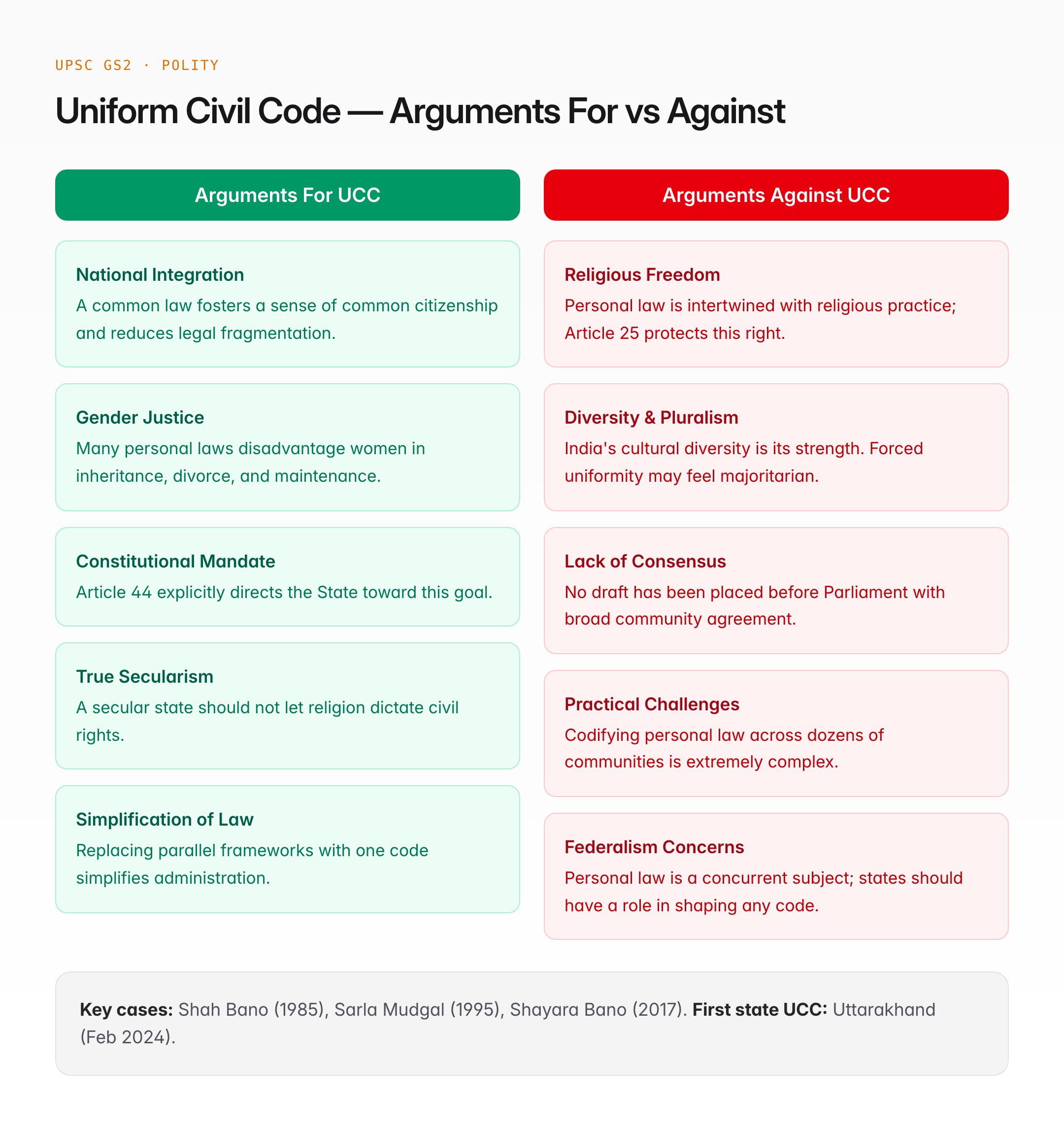
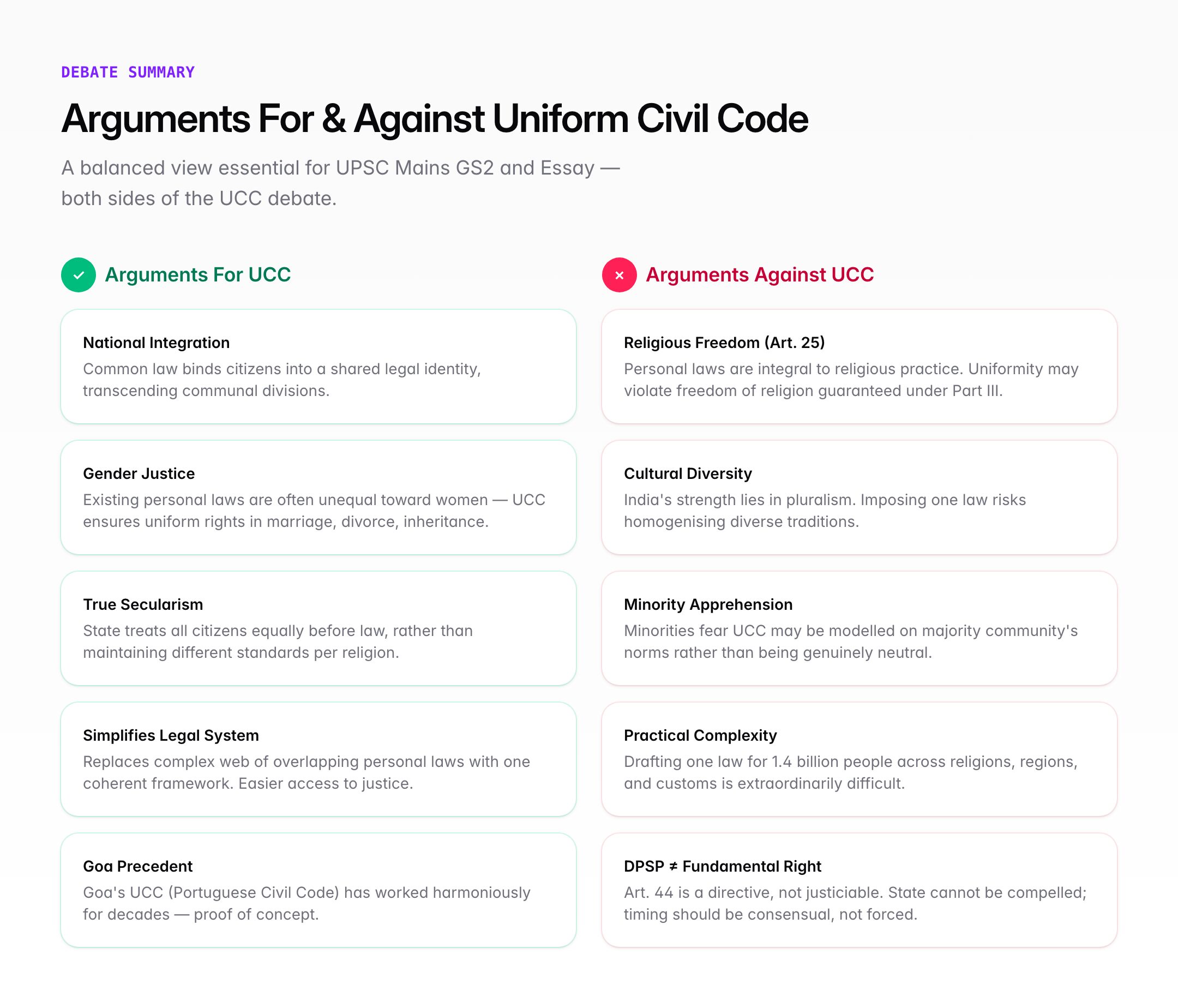
Arguments For the Uniform Civil Code
- National integration: A common law for personal matters fosters a sense of common citizenship and reduces community-based legal fragmentation.
- Gender justice: Many religion-specific personal laws disadvantage women in matters of inheritance, divorce, and maintenance. A UCC can ensure equal rights.
- Constitutional mandate: Article 44 explicitly directs the State toward this goal. Prolonged inaction undermines the spirit of the Constitution.
- Secularism: A secular State should not permit religion to dictate civil rights. Secular personal law is the norm in most modern democracies (France, Turkey, etc.).
- Simplification of law: Replacing multiple parallel legal frameworks with one unified code simplifies administration and reduces litigation.
Arguments Against the Uniform Civil Code
- Threat to religious freedom: Critics argue that personal law is intertwined with religious practice and that Article 25 protects the right to follow religious law.
- Diversity and pluralism: India's strength lies in its cultural diversity. Forced uniformity may be perceived as majoritarian imposition.
- Lack of consensus: No draft has been placed before Parliament with broad community agreement. Implementation without consultation risks social unrest.
- Practical challenges: Codifying personal law across dozens of communities with varied customs is an enormously complex legislative exercise.
- Federalism concerns: Some argue that "personal law" is a concurrent subject and that states should have a role in shaping any unified code.
Recent Developments
- Law Commission (21st) under Justice B.S. Chauhan issued a consultation paper in 2018 stating that a UCC was "neither necessary nor desirable at this stage" and recommended reforming discriminatory practices within existing personal laws instead.
- 22nd Law Commission (reconstituted in 2020) reopened the UCC debate and invited fresh public submissions in 2023.
- Uttarakhand became the first state to pass a Uniform Civil Code Act (February 2024), covering marriage, divorce, live-in relationships, and inheritance under a single law.
- The Union government has introduced UCC in legislative discourse, though no central legislation has been enacted as of 2025.
- Parliamentary Committee deliberations and political party positions keep Article 44 in the active policy domain ahead of each election cycle.
UCC vs Existing Reforms — A Comparison
| Aspect | Religion-Specific Reforms | Uniform Civil Code |
|---|---|---|
| Approach | Amend each personal law separately | Replace all with one code |
| Examples | Hindu Code Bills (1955-56), Muslim Women Act 2019 | Goa Civil Code, Uttarakhand UCC Act |
| Coverage | Addresses specific injustices within a community | Uniform rights across all communities |
| Pace | Incremental, politically easier | Comprehensive but politically challenging |
| Risk | Leaves inter-community disparities intact | May face resistance from multiple groups |
UPSC Relevance
GS Paper II: Indian Polity — DPSP vs Fundamental Rights, Article 44, secularism, judicial activism, personal law reform.
GS Paper IV: Ethics — Gender justice, equality, balancing individual rights with community identity.
Essay Paper: "Is a Uniform Civil Code necessary for true secularism?" is a classic essay prompt.
Key Points for Prelims
- Article 44 is a DPSP under Part IV, not a Fundamental Right
- It directs the State to secure a Uniform Civil Code for all citizens
- Goa is the only state currently practicing a UCC (Portuguese Civil Code origin)
- Shah Bano case (1985) is the most cited judicial reference for UCC
- Shayara Bano case (2017) struck down triple talaq (not directly a UCC ruling, but strengthened the reform argument)
- Uttarakhand passed a state-level UCC Act in 2024
- UCC is non-justiciable — courts can recommend but not compel Parliament to enact it
- Article 25 (freedom of religion) is subject to other Part III rights and public order